Report ID: 1282 |
Published Date: 01 Sep 2026 |
Report Format: |
Delivery Timeline: 48-72 Business Hours
Clean Hydrogen Market Outlook:
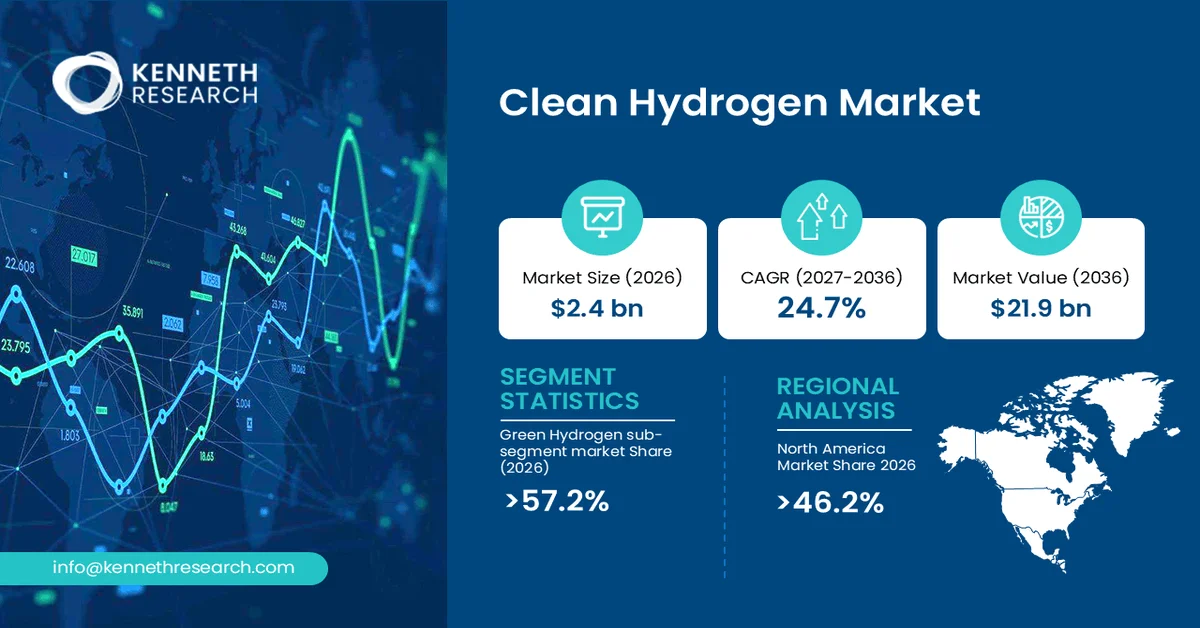
Clean Hydrogen Market size was valued at USD 2.4 billion in 2026 and is projected to reach USD 21.9 billion by the end of 2036, rising at a CAGR of 24.7% during the forecast period, i.e., 2027-2036. In 2027, the industry size of clean hydrogen is estimated at USD 3 billion.
The primary growth driver for the clean hydrogen market is accelerating industrial decarbonization, particularly in sectors where direct electrification is difficult. Government-backed hydrogen strategies increasingly prioritize clean hydrogen as a lower-carbon feedstock, reducing agent, fuel, and energy carrier across refining, chemicals, steel, transportation, power, and energy-storage applications.
The clean hydrogen market comprises technologies, equipment, infrastructure, and services involved in producing, processing, storing, transporting, and using hydrogen generated through low-carbon or near-zero-carbon production pathways. These pathways include electrolysis powered by low-carbon electricity and production from fossil or other feedstocks combined with carbon capture, utilization, and storage. The U.S. Department of Energy describes clean hydrogen in terms of low-carbon-intensity production and identifies electrolysis and carbon-managed production as key pathways.
Key characteristics include diverse production methods, electrolyzer technologies, renewable or other low-carbon energy inputs, hydrogen purification and compression systems, specialized storage and delivery infrastructure, and end-use integration. The market therefore spans both upstream production assets and downstream hydrogen applications.
Key Clean Hydrogen Market Insights Summary:
Key Takeaways: Market Trends & Insights
- Green Hydrogen held the largest share of the Production Method segment at 57.2% in 2026, supported by growing industrial decarbonization requirements
- Alkaline Electrolyzer is projected as the fastest-growing sub-segment within Electrolyzer Technology, benefiting from established technology and expanding large-scale hydrogen production projects
- North America dominated the clean hydrogen market with a 46.2% share in 2026, supported by strong hydrogen development activity across the United States and Canada
- The clean hydrogen market was valued at USD 2.4 billion in 2026
- The clean hydrogen market is projected to expand at a 24.7% CAGR from 2027 to 2036, with the United States and Canada strengthening North American market development while China and Japan support opportunities across Asia Pacific
Market Drivers
- Government-led hydrogen infrastructure and industrial deployment
- Industrial decarbonization and expansion of hard-to-abate applications
- Expansion of renewable electricity and electrolyzer deployment
- Development of hydrogen transport, storage, and distribution infrastructure
Challenges
- High production costs and financing risk
- Fragmented regulation, certification, and infrastructure
Clean Hydrogen Market Overview & Supply Chain
Global adoption of clean hydrogen is increasing as governments and industrial users seek practical decarbonization pathways for applications where direct electrification is challenging. Hydrogen is particularly relevant to refining, chemicals, steel, transport, energy storage, and integrated energy systems because it can serve as a feedstock, reducing agent, fuel, or energy carrier. The International Energy Agency reported that global hydrogen demand reached 97 Mt in 2023, demonstrating the established industrial relevance of hydrogen while highlighting the opportunity to progressively replace conventional fossil-based production with lower-emissions alternatives.
The clean hydrogen market value chain begins with input sourcing, including water, electricity from renewable or other low-carbon sources, natural gas or other feedstocks for carbon-managed pathways, and associated materials required for production systems. Manufacturing and production encompass electrolyzer systems, hydrogen-generation equipment, carbon-management technologies, purification, compression, and plant integration. Distribution then involves compression, storage, pipelines, trucking, shipping, and hydrogen-derived carriers, depending on geography and end-use requirements. End users include chemical and fertilizer producers, refineries, steel manufacturers, mobility operators, power generators, and industrial energy consumers.
Clean Hydrogen Market: Growth Drivers & Challenges
Growth Drivers
- Government-led hydrogen infrastructure and industrial deployment: Government-backed hydrogen programs are accelerating market development by reducing early-stage project risk, supporting infrastructure, and creating demand visibility for producers and technology suppliers. Public investment can improve project economics through funding for production facilities, electrolyzers, storage, transport infrastructure, and regional hydrogen hubs.
- Industrial decarbonization and expansion of hard-to-abate applications: The increasing pressure to decarbonize industrial processes is creating structural demand for clean hydrogen. Heavy industries such as steel, chemicals, refining, shipping, and long-distance transport have applications where direct electrification can be technically difficult, economically challenging, or operationally unsuitable. Clean hydrogen can replace hydrogen produced through higher-emission conventional pathways while also functioning as a reducing agent, chemical feedstock, fuel, or energy carrier. This broad functional role expands its relevance beyond the power sector and creates opportunities for producers and equipment suppliers to serve multiple industrial customer groups.
Challenges
- High production costs and financing risk: Clean hydrogen projects face a structural cost disadvantage against established hydrogen production because renewable electricity, electrolyzer systems, project infrastructure, and financing can create a higher delivered cost. The International Energy Agency identifies persistent cost pressures and financing hurdles as factors affecting project development. This challenge affects project economics, particularly where prospective industrial customers are unwilling or unable to absorb a premium for lower-emissions hydrogen. It can delay final investment decisions, restrict access to project finance, and increase dependence on government support mechanisms.
- Fragmented regulation, certification, and infrastructure: Fragmented regulatory frameworks and incomplete hydrogen infrastructure create coordination barriers across the emerging supply chain. Certification requirements can differ between jurisdictions, making it harder for producers to demonstrate the environmental attributes of hydrogen consistently across markets. At the same time, limited pipelines, storage facilities, transport networks, and suitable delivery infrastructure can prevent producers from connecting economically with prospective industrial customers. The IEA notes that differing certification methodologies can contribute to market fragmentation and that infrastructure delays can hinder the connection between supply and demand.
Clean Hydrogen Market Size and Forecast:
| Report Attribute | Details |
|---|---|
| Base Year |
2026 |
| Forecast Period |
2027-2036 |
| CAGR |
24.7% |
| Base Year Market Size (2026) |
USD 2.4 billion |
| Forecast Year Market Size (2036) |
USD 21.9 billion |
| Regional Scope |
|
Clean Hydrogen Market Segmentation Analysis:
Production Method Segment Analysis
In the production method segment, Green Hydrogen sub-segment is anticipated to capture the largest market share of 57.2% by the end of 2026.
Green hydrogen leads the production-method segment because it directly aligns hydrogen production with industrial decarbonization objectives while enabling integration with renewable power systems. Demand is supported by chemical manufacturing, refining, steelmaking, mobility, and energy-storage applications seeking lower-emission feedstocks and fuels. The production pathway also offers operational flexibility: electrolyzers can convert renewable electricity into hydrogen when power is available, creating a mechanism for linking variable renewable generation with industrial energy demand. Industry adoption is increasingly reinforced by project development, policy support, and expanding electrolyzer deployment. The International Energy Agency reports that more than 1 GW of additional water-electrolysis capacity was added globally through July 2025, demonstrating continued deployment momentum for the technology underpinning renewable hydrogen production.
Electrolyzer Technology Segment Analysis
The Alkaline Electrolyzer is projected to grow as the second-largest segment in the clean hydrogen market due to four converging demand drivers.
Alkaline electrolyzers are projected to expand as the electrolyzer technology segment develops because of their technological maturity, established industrial operating experience, and suitability for large-scale hydrogen production. Demand is supported by projects seeking proven electrolysis configurations for renewable hydrogen production, industrial feedstock applications, and integrated energy systems. The International Energy Agency identifies alkaline electrolysis as a commercially available technology with a long deployment history, while continued project development is strengthening its role in dedicated hydrogen production. On the supply side, manufacturers are expanding production capabilities and improving stack performance, efficiency, durability, dynamic operation, and system integration. These developments can improve project economics and broaden deployment opportunities.
Our in-depth analysis of the clean hydrogen market includes the following segments:
|
Segment |
Sub-segment |
|
Production Method |
|
|
Electrolyzer Technology |
|
|
Delivery From |
|
|
Application |
|
Clean Hydrogen Market Regional Insights:
North America Market Trends & Insights:
North America clean hydrogen market is projected to hold the largest revenue share of 46.2% by the end of 2026.
The United States remains the principal regional project-development center, supported by federal incentives, industrial clusters, and hydrogen hubs spanning multiple production pathways and end uses.
Canada complements this ecosystem through its established energy infrastructure, low-emissions electricity resources, provincial hydrogen strategies, and growing project pipeline. Natural Resources Canada reports 13 low-carbon hydrogen production facilities in operation across Canada, reinforcing the country’s emerging role within the regional supply chain. Together, U.S. and Canadian capabilities support North American production, technology development, industrial consumption, and cross-border clean-energy opportunities.
Asia Pacific Market Trends & Insights:
Asia Pacific is emerging as a major clean-hydrogen development region as governments pursue energy security, industrial decarbonization, and new low-carbon manufacturing opportunities. Demand is supported by established chemical, refining, steel, shipping, and heavy-transport industries, while renewable-energy expansion creates opportunities for hydrogen production and integration with power systems.
China benefits from a broad industrial base and an expanding ecosystem spanning hydrogen production, electrolyzer manufacturing, transport equipment, and industrial applications. Government initiatives increasingly focus on integrating clean hydrogen into existing industrial value chains.
Japan offers opportunities in imported hydrogen supply chains, advanced equipment, mobility, power generation, and industrial applications. Its policy emphasis on safety, commercialization, and supply-chain development supports continued private-sector participation and cross-sector deployment.
Leading Companies Operating in the Global Clean Hydrogen Market:
Here is a list of upstream, downstream, and key players operating in the Clean Hydrogen competitive ecosystem:
- Air Liquide S.A. (France)
- Company Overview
- Business Strategy
- Key Product Offerings
- Financial Performance
- Key Performance Indicators
- Risk Analysis
- Recent Development
- Regional Presence
- SWOT Analysis
- Air Products and Chemicals, Inc. (United States)
- Linde plc (United Kingdom)
- Plug Power Inc. (United States)
- Nel ASA (Norway)
- Green Hydrogen Systems (Denmark)
Recent Developments
- In March 2026, Green Hydrogen Systems faced competitive pressure as Sungrow Hydrogen shipped 160MW of alkaline electrolysis units to Oman for ACME Group's green ammonia project, along with a 3MW containerized PEM system for Italy's first MW-scale off-grid PV-to-hydrogen project and a containerized flexible system to Brazil.
- In December 2025, Nel ASA announced that its Board of Directors has taken the final investment decision to begin construction on up to 1 GW of production capacity for its Next Generation Pressurized Alkaline platform at the Herøya facility in Norway. Following a seven-year development program and successful full-scale prototype testing validating market-leading system efficiency, the platform features a fully modularized skid-based design intended to dramatically reduce system CAPEX and improve energy efficiency. The project is supported by up to EUR 135 million from the EU Innovation Fund, with commercial launch expected in the first half of 2026 and deliveries at scale anticipated in 2027.
Frequently Asked Question
In 2026, the clean hydrogen market exceeded USD 2.4 billion.
The clean hydrogen market is projected to reach USD 21.9 billion by the end of 2036, expanding at a CAGR of 24.7% over the forecast period (2027-2036).
The major players in the market are Air Liquide S.A., Air Products and Chemicals, Inc., Linde plc, Plug Power Inc., Nel ASA, Green Hydrogen Systems, and others.
In the Production Method segment, the Green Hydrogen sub-segment is anticipated to capture the largest market share of 57.2% in the future and exhibit lucrative growth opportunities during 2027-2036. This growth trajectory is largely attributed to increasing industrial decarbonization and demand for lower-emission hydrogen across hard-to-abate industries.
North America is projected to hold the largest market share of 46.2% by the end of 2026 and provide more business opportunities in the future. Continuous investments in clean hydrogen production, infrastructure, and industrial applications across the United States and Canada are fostering the region's dominance.
Why Choose Kenneth Research ?
-
Insight with Impact : We don’t just gather data — we uncover stories, trends, and opportunities that fuel business growth.
-
Experts Who Get It : Our team speaks your industry’s language and knows what really matters to your customers and market.
-
Custom-Built for You : Forget one-size-fits-all. We craft research and consulting solutions as unique as your business vision.
-
Partners, Not Just Providers : We work with you, not for you — collaborating closely to turn insights into smart, strategic moves.
-
Results That Speak : Our work powers brands, startups, and industry leaders alike — with a track record of ideas that work in the real world.
Report ID: 1282 |
Published Date: 01 Sep 2026 |
Report Format: |
Delivery Timeline: 48-72 Business Hours

Copyright © 2025 Kenneth Research. All rights reserved. Terms of Use | Privacy Policy
