Report ID: 1283 |
Published Date: 01 Sep 2026 |
Report Format: |
Delivery Timeline: 48-72 Business Hours
Circuit Breaker Monitoring Systems Market Outlook:
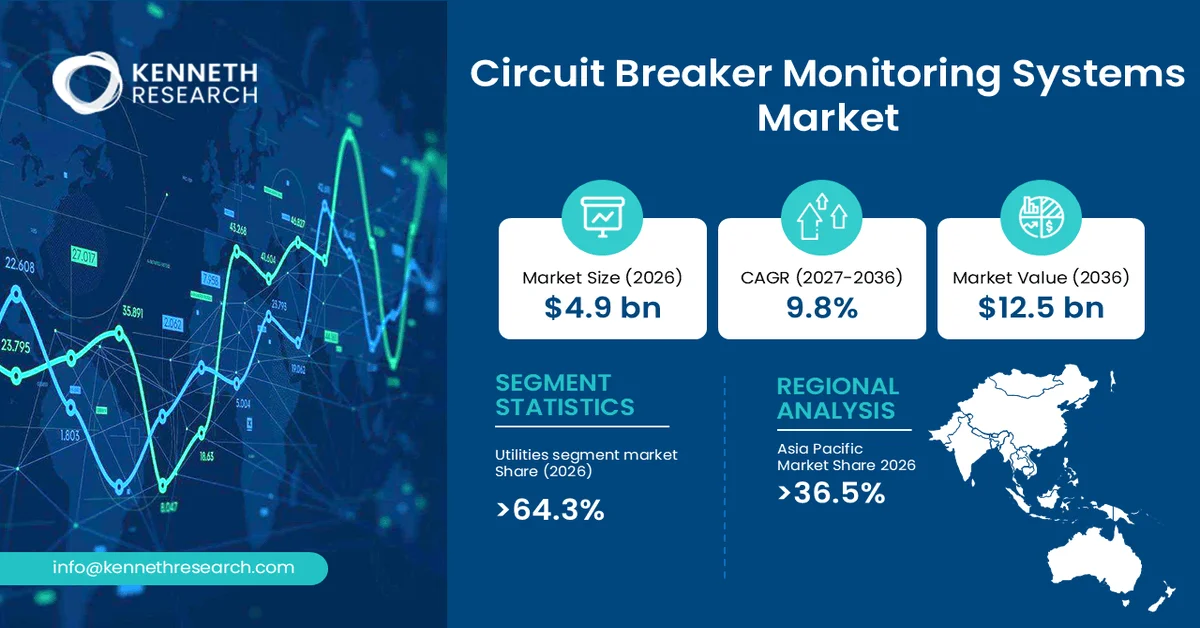
Circuit Breaker Monitoring Systems Market size was valued at USD 4.9 billion in 2026 and is projected to reach USD 12.5 billion by the end of 2036, rising at a CAGR of 9.8% during the forecast period, i.e., 2027-2036. In 2027, the industry size of the circuit breaker monitoring systems is estimated at USD 5.4 billion.
The increasing modernization of electricity grids and the shift toward real-time asset management are driving demand for circuit breaker monitoring systems. Utilities are increasingly deploying sensors, SCADA, digital substations, and predictive-maintenance technologies to improve grid visibility and equipment reliability.
The circuit breaker monitoring systems market comprises hardware, software, sensors, communication technologies, and analytical platforms used to continuously or periodically monitor the operational condition and performance of circuit breakers in electrical substations and power networks. These systems collect information on parameters such as operating time, contact condition, mechanism performance, temperature, pressure, vibration, and electrical characteristics to identify deterioration and potential failures.
Circuit breaker monitoring systems enable utilities and industrial operators to move from conventional time-based maintenance toward condition-based and predictive maintenance. Continuous monitoring can provide early indications of mechanical or electrical abnormalities, allowing operators to schedule maintenance before a failure affects grid availability.
Key Circuit Breaker Monitoring Systems Market Insights Summary:
Key Takeaways: Market Trends & Insights
- The circuit breaker monitoring systems market is projected to grow from USD 4.9 billion in 2026 to USD 12.5 billion by 2036, registering a CAGR of 9.8% during the forecast period.
- Asia-Pacific is projected to remain the leading regional market, accounting for 36.5% in 2026, supported by grid expansion, substation modernization, and digitalization across Japan and China.
- Utilities is expected to remain the leading End-user segment, accounting for 64.3% in 2026, as power companies increasingly prioritize equipment reliability, predictive maintenance, and outage reduction.
- Online (Continuous) Monitoring Systems are gaining importance as utilities seek real-time visibility into breaker condition without taking critical equipment out of service.
Market Drivers
- Increasing deployment of SCADA, substation automation, and digital-grid technologies.
- Growing utility focus on reducing unplanned outages and improving equipment availability.
- Rising adoption of IoT-enabled sensors and remote asset monitoring.
- Increasing integration of AI/ML-based analytics with electrical-equipment condition monitoring.
Challenges
- High integration and data-interpretation complexity
- High cost and reliability requirements for online monitoring
Circuit Breaker Monitoring Systems Market Overview & Supply Chain
The circuit breaker monitoring systems market is expanding as utilities modernize substations and shift toward continuous asset-health assessment. Digital substations increasingly combine sensors, intelligent electronic devices, communications networks, and supervisory control systems to capture breaker status and operating conditions. U.S. national-laboratory research identifies circuit-breaker status, operation count, interrupted-current levels, mechanical-linkage condition, and dielectric condition as important monitoring parameters.
The modernization trend is also supported by government investment in grid resilience. In December 2024, the U.S. Department of Energy announced nearly $18.4 million across grid-technology funding opportunities, including $8 million for research into lower-cost high-voltage DC circuit breakers and technologies intended to improve grid reliability and failure prevention.
The supply chain begins with sensors, current and voltage measurement devices, temperature-monitoring components, communication modules, microprocessors, control electronics, and software. Monitoring-system manufacturers integrate these components into breaker-monitoring units capable of collecting operational and diagnostic data. The systems are then integrated with substation automation platforms, SCADA, protection systems, and utility asset-management software.
Circuit Breaker Monitoring Systems Market: Growth Drivers & Challenges
Growth Drivers
- Increasing adoption of predictive maintenance in utilities: The growing transition from scheduled maintenance toward condition-based and predictive maintenance is driving demand for circuit breaker monitoring systems. Utilities increasingly use sensors and digital analytics to assess breaker operating conditions, identify degradation, and schedule maintenance before failures disrupt electricity supply. India's Ministry of Power reported that grid substations use sensors to measure parameters including circuit-breaker contact resistance, with the resulting data analyzed through computer-aided tools for predictive maintenance.
- Digitalization of electricity grid infrastructure: The modernization of transmission and distribution networks is creating a favorable environment for circuit breaker monitoring systems. Smart-grid architectures increasingly incorporate automation, communications, real-time monitoring, and digital asset management, allowing utilities to collect and analyze equipment information remotely. India's National Smart Grid Mission describes smart grids as digitally enabled systems capable of monitoring and controlling power flows in real time while improving reliability and asset management.
Challenges
- High integration and data-interpretation complexity: Circuit breaker monitoring systems collect multiple electrical and mechanical parameters but converting these measurements into reliable equipment-health assessments remains technically challenging. Differences in breaker designs, operating conditions, sensor characteristics, and degradation patterns can make it difficult to establish universal thresholds and diagnostic models. EPRI notes that limited data on breaker materials and subsystem performance complicates cost-effective condition-based maintenance and replacement programs. This challenge increases when utilities integrate monitoring systems with SCADA, protection systems, digital relays, and centralized asset-management platforms. Inconsistent data structures and communication requirements can increase integration costs and complicate deployment across heterogeneous breaker fleets.
- High cost and reliability requirements for online monitoring: The installation of Online (Continuous) Monitoring Systems can require additional sensors, communications equipment, data-processing infrastructure, and software integration. Utilities must assess whether the additional investment provides sufficient maintenance savings and reliability benefits compared with conventional inspection and offline testing. EPRI's ongoing research specifically evaluates the effectiveness of different online circuit-breaker monitoring technologies and compares monitor measurements with offline tests to determine their practical value.
Circuit Breaker Monitoring Systems Market Size and Forecast:
| Report Attribute | Details |
|---|---|
| Base Year |
2026 |
| Forecast Period |
2027-2036 |
| CAGR |
9.8% |
| Base Year Market Size (2026) |
USD 4.9 billion |
| Forecast Year Market Size (2036) |
USD 12.5 billion |
| Regional Scope |
|
Circuit Breaker Monitoring Systems Market Segmentation Analysis:
End-user Segment Analysis
In the end-user segment, utilities is anticipated to capture the largest market share of 64.3% in 2026.
Its dominance is supported by the critical role of circuit breakers in transmission and distribution networks, where equipment condition directly influences grid reliability and operational continuity. Utilities are increasingly adopting sensor-based monitoring and predictive-maintenance practices to identify deterioration before equipment failure. India's Ministry of Power has confirmed that grid substations use sensors to monitor parameters including circuit-breaker contact resistance, with computer-aided analysis supporting predictive maintenance.
The modernization of utility infrastructure is further strengthening demand for connected monitoring systems. Government initiatives increasingly emphasize real-time monitoring, automated grid operation, centralized data analysis, and improved asset management. India's modern transmission-system roadmap specifically incorporates real-time monitoring, automated operation, predictive maintenance using AI/ML, and data-driven decision-making.
Monitoring Mode Segment Analysis
In the Monitoring Mode segment, Online (Continuous) Monitoring Systems are expected to gain strong adoption as utilities shift toward real-time assessment of critical substation assets. Continuous monitoring enables operators to collect breaker condition data without taking equipment out of service, supporting earlier identification of abnormal operating conditions and more proactive maintenance decisions.
The U.S. Department of Energy highlights the growing role of monitoring and control technologies in utility infrastructure, including investments involving protective relays and breakers to improve grid reliability and reduce customer interruptions. DOE-supported initiatives are also developing systems capable of providing real-time equipment-condition information within substations, reinforcing the move toward connected monitoring architectures.
Our in-depth analysis of the global circuit breaker monitoring systems market includes the following segments:
|
Segment |
Sub-segment |
|
Monitoring Mode |
|
|
Offering |
|
|
Voltage Level |
|
|
Application |
|
|
End-User |
|
Circuit Breaker Monitoring Systems Market Regional Insights:
Asia-Pacific Market Trends & Insights:
Asia-Pacific is projected to remain the dominant region in the circuit breaker monitoring systems market, accounting for 36.5% in 2026. Regional demand is supported by extensive electricity-grid expansion, substation modernization, renewable-energy integration, and increasing adoption of digital monitoring technologies across Japan and China. Recent industry assessments also identify Asia-Pacific as the leading regional market, citing large-scale grid expansion and modernization programs across major Asian economies.
Japan benefits from an advanced electricity infrastructure and strong emphasis on grid reliability, automation, and sophisticated electrical equipment. The country’s mature utility ecosystem creates opportunities for online monitoring systems that can support predictive maintenance and improve visibility into critical substation assets.
China represents another major opportunity because of its large transmission and distribution infrastructure and continuing investment in grid modernization. The expansion of renewable generation and increasingly complex power flows further increase the need for reliable circuit-breaker condition monitoring.
North America Market Trends & Insights:
North America represents a significant secondary market for circuit breaker monitoring systems, supported by ongoing grid modernization, substation automation, and investments in electricity-system reliability. The U.S. is the primary regional market, where the Department of Energy continues to support technologies that provide real-time equipment-condition information and improve monitoring, control, and failure prevention across substations. In 2024, DOE supported development of a low-cost monitoring and data-analytics system designed to provide real-time equipment condition information at substations.
The U.S. is also investing in advanced grid technologies, including circuit breakers and digital monitoring. DOE announced nearly $18.4 million in funding opportunities in 2024 for grid technologies aimed at lowering the cost of high-voltage DC circuit breakers and improving grid reliability and failure prevention.
Canada is strengthening its smart-grid infrastructure through government-supported modernization programs. Natural Resources Canada launched a smart-grid funding call focused on technologies that improve grid reliability, resiliency, flexibility, and the scalability of advanced grid solutions.
Leading Companies Operating in the Global Circuit Breaker Monitoring Systems Market:
Here is a list of upstream, downstream, and key players operating in the global circuit breaker monitoring systems market competitive ecosystem:
- ABB Ltd. (Switzerland)
- Company Overview
- Business Strategy
- Key Product Offerings
- Financial Performance
- Key Performance Indicators
- Risk Analysis
- Recent Development
- Regional Presence
- SWOT Analysis
- Siemens Energy AG (Germany)
- Schneider Electric SE (France)
- Hitachi Energy Ltd. (Switzerland)
Recent Developments
- May 2026: ABB launched the SACE Emax 3 air circuit breaker in Romania, incorporating advanced sensing, real-time analytics, and predictive-maintenance capabilities.
- May 2026 — Hitachi Energy introduced 800 kV SF₆-free EconiQ dead-tank circuit-breaker technology for ultra-high-voltage transmission applications.
Frequently Asked Question
In 2026, the circuit breaker monitoring systems market was valued at USD 4.9 billion.
The market is projected to reach USD 12.5 billion by 2036, expanding at a CAGR of 9.8% during the forecast period (2027-2036).
Major participants include ABB Ltd., Siemens Energy AG, Schneider Electric SE, Hitachi Energy Ltd., GE Vernova, Eaton Corporation plc, Mitsubishi Electric Corporation, and Toshiba Energy Systems & Solutions Corporation.
In the End-user segment, Utilities is anticipated to remain dominant, accounting for 64.3% in 2026.
Asia-Pacific is projected to remain the leading region, accounting for 36.5% in 2026, supported by grid expansion, substation modernization, renewable-energy integration, and increasing digitalization across Japan and China.
Why Choose Kenneth Research ?
-
Insight with Impact : We don’t just gather data — we uncover stories, trends, and opportunities that fuel business growth.
-
Experts Who Get It : Our team speaks your industry’s language and knows what really matters to your customers and market.
-
Custom-Built for You : Forget one-size-fits-all. We craft research and consulting solutions as unique as your business vision.
-
Partners, Not Just Providers : We work with you, not for you — collaborating closely to turn insights into smart, strategic moves.
-
Results That Speak : Our work powers brands, startups, and industry leaders alike — with a track record of ideas that work in the real world.
Report ID: 1283 |
Published Date: 01 Sep 2026 |
Report Format: |
Delivery Timeline: 48-72 Business Hours

Copyright © 2025 Kenneth Research. All rights reserved. Terms of Use | Privacy Policy
