Report ID: 1332 |
Published Date: 09 Sep 2026 |
Report Format: |
Delivery Timeline: 48-72 Business Hours
Chemical Hydrogen Market Outlook:
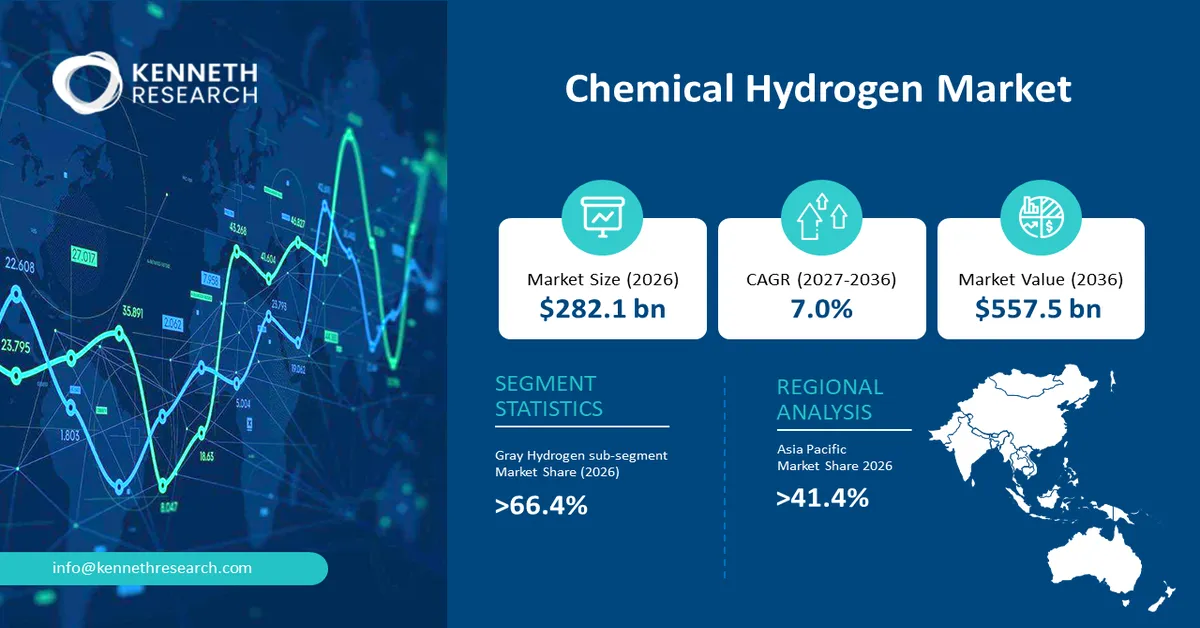
Chemical Hydrogen Market size was valued at USD 282.1 billion in 2026 and is projected to reach USD 557.5 billion by the end of 2036, rising at a CAGR of 7.0% during the forecast period, i.e., 2027-2036. In 2027, the industry size of the chemical hydrogen is estimated at USD 303.2 billion.
The primary growth driver for the chemical hydrogen market is expanding industrial demand for hydrogen as a feedstock, particularly in refining, ammonia, methanol, and other chemical processes. Government-led decarbonization policies are also encouraging industries to evaluate lower-emissions hydrogen pathways while maintaining established hydrogen-dependent production operations.
The chemical hydrogen market comprises the production, processing, supply, distribution, and industrial use of hydrogen as a chemical feedstock or process input. Hydrogen can be produced through several technological pathways, including natural-gas reforming, coal or biomass-based thermochemical processes, water electrolysis, and other emerging production methods. The U.S. Department of Energy identifies both thermochemical processes and electrolysis as established pathways for producing hydrogen from different feedstocks and energy sources.
A defining characteristic of the market is its close integration with industrial production systems. Hydrogen is not only an energy carrier but also an essential input for established chemical and refining operations. Its industrial applications include feedstock use in ammonia and methanol production, refinery processes, and emerging applications such as steel production and hydrogen-based fuels. The International Energy Agency reports that established refining and industrial applications continue to account for the overwhelming majority of global hydrogen demand, while newer applications are developing from a comparatively small base.
Key Chemical Hydrogen Market Insights Summary:
Key Takeaways: Market Trends & Insights
- Chemical hydrogen market is projected to increase from USD 282.1 billion in 2026 to USD 557.5 billion by 2036, reflecting a 7.0% CAGR during 2027-2036
- Gray Hydrogen holds the largest position within the Type segment, accounting for a 66.4% market share in 2026, supported by established industrial applications and mature production infrastructure
- Captive Hydrogen is identified as the second and fastest-growing analysis segment, supported by increasing demand for reliable onsite hydrogen supply across industrial facilities
- Asia Pacific dominates the chemical hydrogen market with a 41.4% market share in 2026, driven by strong industrial activity and hydrogen development across China and Japan
- North America represents the secondary regional market, with the United States and Canada offering opportunities through industrial decarbonization initiatives, hydrogen infrastructure development, and expanding clean-energy investment
Market Drivers
- Government-led decarbonization and hydrogen demand policies
- Expansion of hydrogen-intensive industrial applications
- Industrial decarbonization and emissions-reduction requirements
- Advances in electrolysis, carbon-management, storage, and hydrogen distribution technologies
Challenges
- High production costs and project bankability
- Inadequate transport, storage, and distribution infrastructure
Chemical Hydrogen Market Overview & Supply Chain
Global adoption of the chemical hydrogen market is increasing as hydrogen remains integral to refining and chemical manufacturing while new production technologies broaden its role in lower-emissions industrial systems. Technological progress in electrolysis, reforming, carbon-management solutions, and hydrogen infrastructure is expanding production options and supporting industrial decarbonization strategies. The International Energy Agency reported that installed water-electrolyser capacity reached 1.4 GW by the end of 2023, demonstrating continued development of hydrogen-production infrastructure.
The industry value chain begins with feedstocks and energy inputs, including natural gas, coal, water, biomass, and electricity from conventional or renewable sources. These inputs are converted into hydrogen through processes such as reforming, gasification, biomass conversion, or electrolysis, with purification and conditioning performed to meet application-specific specifications. Production facilities may be integrated directly with consuming industrial plants or connected to broader supply networks. Distribution encompasses pipelines, compression, storage, road transportation, and, increasingly, hydrogen carriers such as ammonia for longer-distance movement. End users include refineries, ammonia and methanol producers, chemical manufacturers, metals producers, and emerging energy applications.
Chemical Hydrogen Market: Growth Drivers & Challenges
Growth Drivers:
- Government-led decarbonization and hydrogen demand policies: Government policies are increasingly creating commercial conditions for hydrogen adoption by combining emissions-reduction objectives with industrial support mechanisms. Mandates, incentives, carbon-management programs, procurement measures, and hydrogen strategies can improve project economics and give producers greater visibility over future demand. This is particularly important for the chemical hydrogen market because established users such as refineries, ammonia producers, and chemical manufacturers can provide anchor demand for new supply projects.
- Expansion of hydrogen-intensive industrial applications: The chemical hydrogen market benefits from its established role in industrial processes, providing a comparatively strong foundation for continued hydrogen consumption while new applications develop. Refining, ammonia, methanol, and other chemical processes require dependable hydrogen supplies, creating opportunities for producers to expand capacity around existing industrial demand centres. At the same time, hydrogen is gaining strategic relevance in applications where direct electrification or conventional fuels may provide fewer decarbonization options.
Challenges:
- High production costs and project bankabilit: A major restraint is the cost disadvantage associated with lower-emissions hydrogen production compared with established fossil-based pathways. The root cause is the capital-intensive nature of electrolysers, renewable power integration, carbon-management systems, storage, and associated infrastructure, compounded by financing costs and uncertain utilization rates. For chemical hydrogen producers, this can make investment decisions difficult when customers remain sensitive to feedstock costs and are not yet willing to absorb substantial premiums.
- Inadequate transport, storage, and distribution infrastructure: Limited hydrogen infrastructure constrains the ability to connect production sites with geographically dispersed industrial consumers. Hydrogen has historically been produced and consumed close to the point of use, so extensive transport and storage networks have not developed at the scale required for a more distributed market. This creates a structural bottleneck for producers seeking access to new customers and for industrial users that cannot economically establish dedicated production facilities. Commercially, infrastructure gaps can increase delivered costs, restrict supplier choice, complicate supply planning, and discourage long-term offtake commitments.
Chemical Hydrogen Market Size and Forecast:
| Report Attribute | Details |
|---|---|
| Base Year |
2026 |
| Forecast Period |
2027-2036 |
| CAGR |
7.0% |
| Base Year Market Size (2026) |
USD 282.1 billion |
| Forecast Year Market Size (2036) |
USD 557.5 billion |
| Regional Scope |
|
Chemical Hydrogen Market Segmentation Analysis:
Type Segment Analysis
In the type segment, gray hydrogen sub-segment is anticipated to capture the largest market share of 66.4% by the end of 2026.
Gray hydrogen dominates the type segment because established industrial users prioritize continuous, cost-efficient hydrogen supply, while conventional production assets benefit from mature technologies, established feedstock networks, and extensive operating experience. Refining, ammonia, methanol, and other chemical processes already rely heavily on hydrogen, making gray hydrogen readily compatible with existing plant configurations and procurement systems. The International Energy Agency reported that in 2024, the vast majority of global hydrogen demand was supplied by fossil-fuel-based production without measures to capture associated emissions, confirming the continued strength of conventional hydrogen within established industrial consumption.
Supply and Distribution System Segment Analysis
The captive hydrogen is projected to grow as the second-largest segment in the chemical hydrogen market due to four converging demand drivers.
Captive hydrogen is projected to grow as industrial consumers increasingly favor production at or near the point of use to secure supply reliability, reduce dependence on external distribution networks, and align hydrogen production with specific process requirements. This model is particularly relevant to refineries, chemical plants, ammonia facilities, and other continuous-process industries where interruptions in hydrogen availability can affect production economics. The International Energy Agency reported that, based on projects that had reached final investment decision, 2.5 Mt of low-emissions hydrogen is expected to be produced and consumed in refineries and industrial facilities by 2030. This reinforces the role of onsite production in emerging industrial hydrogen deployment. Supply-side advances in electrolysis, reforming, carbon-management systems, and integrated renewable power are expanding the technological options available to captive users.
Our in-depth analysis of the chemical hydrogen market includes the following segments:
|
Segment |
Sub-segment |
|
Type |
|
|
Supply and Distribution System |
|
|
Distribution Channel |
|
|
Application |
|
Chemical Hydrogen Market Regional Insights:
Asia Pacific Market Trends & Insights:
Asia Pacific chemical hydrogen market is projected to hold the largest revenue share of 41.4% by the end of 2026.
Asia Pacific is the dominant region in the chemical hydrogen market, supported by its extensive refining and chemical-manufacturing base, established hydrogen consumption, large industrial energy systems, and expanding investment in hydrogen infrastructure. The region’s leadership is reinforced by strong production capabilities and substantial downstream demand across China and Japan.
China represents the region’s principal production and industrial-consumption hub, benefiting from extensive manufacturing capabilities, established chemical and refining industries, and growing electrolyser deployment. Its large domestic industrial base supports both conventional hydrogen consumption and emerging lower-emissions production.
Japan is pursuing a more policy-led model, emphasizing hydrogen supply-chain development, industrial utilization, and decarbonization. Japan’s Hydrogen Society Promotion Act, enacted in 2024, provides a regulatory framework intended to accelerate commercial implementation and strengthen hydrogen supply chains. Together, China’s manufacturing depth and Japan’s policy-supported commercialization create complementary growth conditions for the regional market, with future expansion increasingly shaped by infrastructure investment, industrial decarbonization, and cross-border hydrogen supply-chain development.
North America Market Trends & Insights:
North America is an important market for chemical hydrogen, supported by established refining and petrochemical activity, expanding clean-energy investment, and increasing interest in hydrogen for hard-to-abate industrial applications. In the United States, hydrogen demand is being supported through regional hub development designed to connect producers, consumers, and supporting infrastructure.
The United States represents the principal growth engine in North America because of its large industrial base, federal hydrogen programs, and development of regional hydrogen hubs. These initiatives are intended to strengthen connections between production, storage, delivery, and end users while supporting commercial deployment.
Canada complements this ecosystem through its hydrogen strategy, investment incentives, industrial capabilities, and emerging domestic and export-oriented supply chains. Canadian government priorities emphasize hubs, corridors, industrial deployment, and infrastructure development, particularly for chemical, refining, steel, and other hard-to-abate applications. Together, the two countries provide a strong platform for regional hydrogen supply-chain development, with future opportunities increasingly linked to cross-border infrastructure, industrial decarbonization, and low-carbon hydrogen trade.
Leading Companies Operating in the Global Chemical Hydrogen Market:
Here is a list of upstream, downstream, and key players operating in the chemical hydrogen market competitive ecosystem:
- Air Products and Chemicals, Inc. (United States)
- Company Overview
- Business Strategy
- Key Product Offerings
- Financial Performance
- Key Performance Indicators
- Risk Analysis
- Recent Development
- Regional Presence
- SWOT Analysis
- Linde plc (United Kingdom)
- Iwatani Corporation (Japan)
- Taiyo Nippon Sanso Corporation (Japan)
Recent Developments
- In April 2026, Taiyo Nippon Sanso Corporation commenced sales of a hydrogen purification system for ammonia cracking gas, capable of extracting hydrogen gas from ammonia cracking gas and achieving purity compliant with ISO 14687:2025 Grade D for fuel cell vehicles. The system leverages Nippon Sanso’s proprietary gas separation and purification technologies to produce high-purity hydrogen for FCVs and a wide range of other applications, contributing to Japan's carbon neutrality goals and expanding the ammonia-based hydrogen supply chain.
- In June 2026, Linde plc continued its Build-Own-Operate (BOO) model, constructing its own plants on customers' sites for on-site hydrogen supply to major industrial customers. The company has developed the DRYREF process jointly with BASF, which uses a special catalyst to optimize dry reforming of methane, significantly reducing steam requirements and enabling the use of CO₂ as a feedstock to generate operating cost savings of up to USD 20 million over the first five years of operation.
Frequently Asked Question
In 2026, the chemical hydrogen market exceeded USD 282.1 billion.
The chemical hydrogen market is projected to reach USD 557.5 billion by the end of 2036, expanding at a CAGR of 7.0% over the forecast period (2027-2036).
The major players in the market are Air Products and Chemicals, Inc., Linde plc, Iwatani Corporation, Taiyo Nippon Sanso Corporation, and others.
In the Type segment, the Gray Hydrogen sub-segment is anticipated to capture the largest market share of 66.4% in the future and exhibit lucrative growth opportunities during 2027-2036. This growth trajectory is largely attributed to established industrial demand from refining, ammonia, methanol, and other chemical processes.
Asia Pacific is projected to hold the largest market share of 41.4% by the end of 2026 and provide more business opportunities in the future. Continuous investments in hydrogen production, industrial applications, infrastructure, and policy-supported supply chains across China and Japan are fostering the region's dominance.
Why Choose Kenneth Research ?
-
Insight with Impact : We don’t just gather data — we uncover stories, trends, and opportunities that fuel business growth.
-
Experts Who Get It : Our team speaks your industry’s language and knows what really matters to your customers and market.
-
Custom-Built for You : Forget one-size-fits-all. We craft research and consulting solutions as unique as your business vision.
-
Partners, Not Just Providers : We work with you, not for you — collaborating closely to turn insights into smart, strategic moves.
-
Results That Speak : Our work powers brands, startups, and industry leaders alike — with a track record of ideas that work in the real world.
Report ID: 1332 |
Published Date: 09 Sep 2026 |
Report Format: |
Delivery Timeline: 48-72 Business Hours

Copyright © 2025 Kenneth Research. All rights reserved. Terms of Use | Privacy Policy
