Report ID: 1071 |
Published Date: 11 Aug 2026 |
Report Format: |
Delivery Timeline: 48-72 Business Hours
Ceramic Foam Market Outlook:
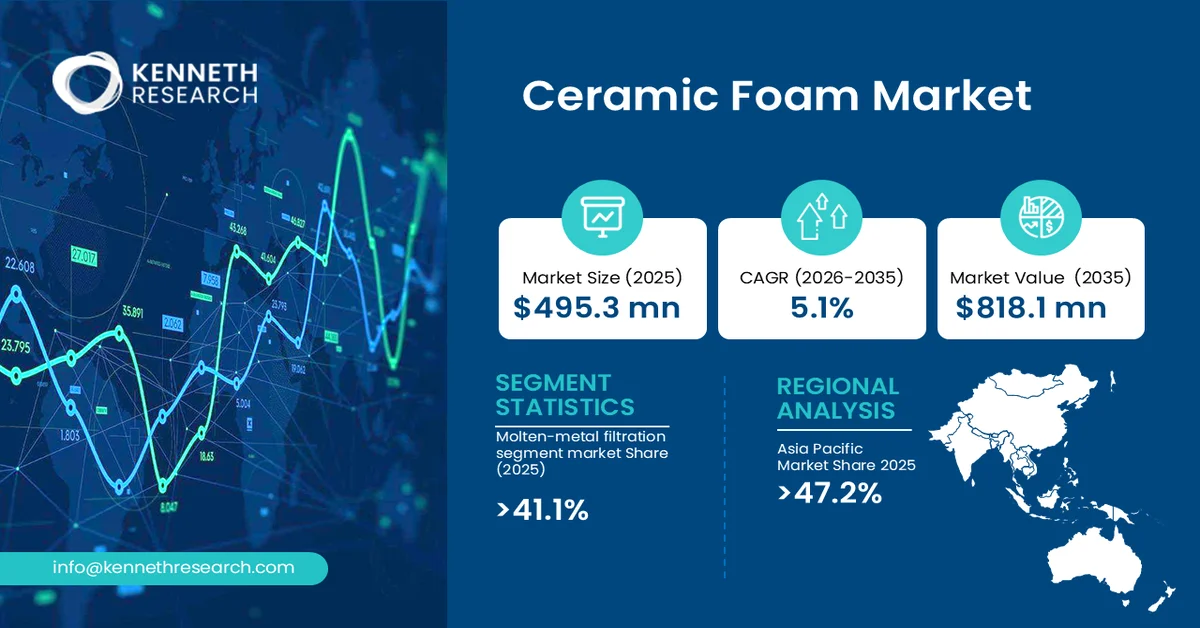
Ceramic Foam market size was valued at USD 495.3 million in 2025 and is projected to reach USD 818.1 million by the end of 2035, rising at a CAGR of 5.1% during the forecast period, i.e., 2026-2035. In 2026, the industry size of ceramic foam is estimated at USD 520.4 million.
The primary growth driver of the ceramic foam market is the increasing demand for high-quality metal castings across automotive, aerospace, and industrial manufacturing. Ceramic foam filters efficiently remove non-metallic inclusions from molten metals, improving casting quality, mechanical performance, process efficiency, and reducing defects, making them indispensable in modern foundry operations.
The ceramic foam market comprises the production, commercialization, and application of highly porous ceramic materials engineered with interconnected open-cell structures. These materials are manufactured from ceramics such as alumina, silicon carbide, zirconia, and other refractory compositions to withstand extreme temperatures, corrosive environments, and mechanical stress. Their unique porous architecture enables excellent permeability, high thermal stability, low density, and superior chemical resistance, making them suitable for demanding industrial applications.
A defining characteristic of ceramic foam is its ability to combine structural integrity with high porosity, allowing efficient filtration, catalyst support, thermal insulation, and fluid flow management. The interconnected pore network effectively captures contaminants while maintaining consistent flow characteristics, supporting reliable performance in high-temperature processing environments.
The market is industrially significant because ceramic foams play a critical role in metal casting, emission control systems, chemical processing, energy applications, and advanced manufacturing. Their use enhances product quality, improves operational efficiency, extends equipment life, and supports stringent quality and environmental requirements across multiple end-use industries.
Key Ceramic Foam Market Insights Summary:
Key Takeaways: Market Trends & Insights
- In the application segment, the molten metal filtration sub-segment is anticipated to capture the largest market share of 41.1% during 2026-2035
- The Asia Pacific market represented 47.2% of the global ceramic foam market in 2025
- Japan is expected to remain one of the key revenue-generating countries in the Asia Pacific ceramic foam market, supported by its advanced foundry, automotive, and precision manufacturing industries
- China is anticipated to maintain its position as the largest demand center within Asia Pacific, driven by its extensive steel, aluminum, and industrial manufacturing base
- North America is projected to witness sustained growth throughout the forecast period, supported by continued investments in advanced manufacturing, aerospace, metal casting, and industrial modernization
- The major players in the market are Selee Corporation, Drache Umwelttechnik GmbH, LANIK s.r.o., Pyrotek Inc., Foseco, Vesuvius plc, Capital Refractories Ltd., Ferro-Term Sp. z o.o., Galaxy Enterprise, JiangXi JinTai Special Material Co., Ltd., and others
Market Drivers
- Increasing adoption of lightweight and high-performance materials in aerospace and automotive manufacturing
- Technological advancements in porous ceramic manufacturing and precision sintering processes
- Rising investments in steel, aluminum, and non-ferrous metal production facilities.
- Growing use of ceramic foam in renewable energy systems and high-temperature thermal management applications
Challenges
- High production complexity and manufacturing costs
- Limited standardization across diverse industrial applications
Ceramic Foam Market Overview & Supply Chain
Global adoption of ceramic foam is accelerating as manufacturers prioritize cleaner production processes, higher-quality cast components, and improved thermal and chemical performance across metal processing, automotive, aerospace, chemical, and environmental applications. Ceramic foams are increasingly used in molten metal filtration, catalyst systems, and high-temperature insulation because they enhance process efficiency while minimizing contamination and material waste. Their compatibility with advanced manufacturing and industrial decarbonization initiatives further strengthens demand. This trend is reinforced by growing investments in industrial manufacturing for clean technologies. The International Energy Agency (IEA) reported in 2023 that approximately USD 640 billion in investment is required by 2030 to expand global manufacturing capacity for key clean energy technologies in line with its Net Zero Emissions Scenario, underscoring the expanding need for advanced high-temperature ceramic materials throughout industrial supply chains.
The ceramic foam industry value chain begins with the procurement of high-purity raw materials such as alumina, silicon carbide, zirconia, mullite, binders, and polymer foam templates sourced from specialty ceramic and chemical suppliers. These materials undergo formulation, impregnation, shaping, drying, and high-temperature sintering to produce porous ceramic structures with controlled pore density and mechanical strength. Manufacturers continuously optimize production parameters to achieve consistent filtration efficiency, thermal resistance, and durability for industrial applications. Finished products are distributed through direct sales channels, industrial distributors, engineering solution providers, and OEM supply networks serving regional and international markets. The primary end users include foundries, steel and aluminium producers, automotive manufacturers, aerospace companies, chemical processing facilities, environmental technology providers, and energy equipment manufacturers. Key stakeholders across the value chain include raw material suppliers, ceramic component manufacturers, equipment integrators, industrial distributors, research organizations, certification bodies, and end-use industries that incorporate ceramic foam into critical production processes.
Ceramic Foam Market: Growth Drivers & Challenges
Growth Drivers:
- Rising demand for high-quality metal castings and industrial decarbonization: The increasing emphasis on defect-free metal casting and resource-efficient manufacturing is a major growth driver for the ceramic foam market. Ceramic foam filters play a crucial role in removing non-metallic inclusions from molten metals, enabling manufacturers to produce castings with superior mechanical strength, dimensional accuracy, and surface finish. As industries such as automotive, aerospace, and heavy machinery adopt stricter quality standards, demand for advanced filtration solutions continues to grow. Simultaneously, industrial decarbonization initiatives are encouraging manufacturers to invest in technologies that reduce material waste and improve process efficiency, where ceramic foam products offer measurable operational advantages. Looking ahead, expanding investments in sustainable industrial infrastructure and advanced manufacturing are expected to strengthen adoption across foundries and metallurgical facilities. Supporting this trend, the U.S. department of energy announced USD 156 million in 2023 for applied research and development projects focused on accelerating industrial decarbonization technologies.
- Expanding applications in environmental and chemical processing: The widening use of ceramic foam in environmental protection and chemical processing is creating sustained growth opportunities for the market. Its highly porous structure and exceptional thermal and chemical stability make it an effective material for catalyst support, emission control systems, gas purification, and high-temperature reaction environments. As industries modernize production facilities and comply with increasingly stringent environmental regulations, the need for durable ceramic components capable of maintaining performance under aggressive operating conditions continues to rise. Continuous advancements in ceramic processing technologies are also improving pore uniformity, mechanical strength, and service life, making ceramic foam suitable for more specialized industrial applications. Over the long term, increasing investments in clean processing technologies, hydrogen production, waste treatment, and advanced catalytic systems are expected to broaden the material's commercial adoption and reinforce its strategic importance across multiple industrial value chains.
Challenges:
- High production complexity and manufacturing costs: The production of ceramic foam involves technically demanding manufacturing processes, including controlled slurry preparation, polymer foam impregnation, drying, burnout, and high-temperature sintering. Maintaining consistent pore structure, mechanical strength, and thermal stability requires precise process control and premium-grade ceramic raw materials, resulting in significant production costs. Small process deviations can lead to structural defects, inconsistent filtration performance, and reduced product reliability, increasing rejection rates and operational expenses. These factors create pricing challenges, particularly in cost-sensitive industries where conventional filtration alternatives remain available. Commercially, manufacturers face pressure to balance product quality with competitive pricing while investing in advanced manufacturing technologies. Looking ahead, improvements in automation, process optimization, and energy-efficient production methods may gradually reduce manufacturing costs, but the industry's capital-intensive production environment will continue to pose a barrier for new entrants and capacity expansion.
- Limited standardization across end-use applications: A significant restraint for the ceramic foam market is the lack of universal product standardization across different industrial applications. End users often require customized pore size, density, material composition, thermal resistance, and mechanical properties based on specific molten metal grades, chemical processes, or operating conditions. This high level of customization complicates production planning, inventory management, and quality assurance while extending product qualification cycles. Manufacturers must allocate considerable engineering resources to application-specific product development, increasing lead times and limiting economies of scale. Commercially, these challenges can slow customer adoption, particularly among industries seeking standardized, readily available components. As advanced manufacturing sectors continue to evolve, demand for specialized ceramic foam solutions is expected to increase, making product customization a competitive advantage but also a continuing operational challenge.
Ceramic Foam Market Size and Forecast:
| Report Attribute | Details |
|---|---|
| Base Year |
2025 |
| Forecast Year |
2026-2035 |
| CAGR |
5.1% |
| Base Year Market Size (2025) |
USD 495.3 million |
| Forecast Year Market Size (2035) |
USD 818.1 million |
| Regional Scope |
|
Ceramic Foam Market Segmentation Analysis:
Application Mode Segment Analysis
In the application mode segment, the molten-metal filtration sub-segment is anticipated to capture the largest market share of 41.1% by the end of 2025.
The Molten Metal Filtration sub-segment dominates the ceramic foam market because of its indispensable role in improving casting quality across aluminum, iron, steel, and other non-ferrous metal production. Foundries increasingly deploy ceramic foam filters to remove non-metallic inclusions, minimize turbulence during mold filling, and reduce casting defects, enabling higher mechanical performance and lower rejection rates. The segment's adoption is further supported by growing quality requirements in automotive, aerospace, heavy equipment, and precision engineering industries, where defect-free cast components are essential. On the supply side, manufacturers have expanded production of application-specific ceramic foam filters with optimized pore structures, thermal shock resistance, and chemical stability, improving reliability across diverse metallurgical processes. The U.S. Geological Survey (USGS) reported in its 2023 Mineral Commodity Summaries that transportation applications accounted for 35% of domestic aluminum consumption in 2022, highlighting the sustained demand for high-quality cast aluminum components that rely on effective molten metal filtration. Looking ahead, continued investments in lightweight materials, advanced foundry technologies, and high-performance metal processing are expected to reinforce the segment's leadership.
Catalyst Support Segment Analysis
The catalyst Support is projected to grow as the second-largest segment in the ceramic foam market due to four converging demand drivers.
The Catalyst Support sub-segment is projected to experience strong growth as industries increasingly adopt high-performance catalytic systems for emission control, chemical synthesis, petroleum refining, and clean energy applications. Ceramic foam serves as an effective catalyst support because its interconnected porous structure provides a large surface area, excellent thermal stability, and high resistance to chemical corrosion, enabling efficient catalytic reactions under demanding operating conditions. Growing investments in cleaner industrial processes, hydrogen technologies, and advanced chemical manufacturing are accelerating adoption across refineries, petrochemical plants, and environmental treatment facilities. On the supply side, manufacturers are developing ceramic foam supports with improved pore uniformity, mechanical strength, and tailored compositions to enhance catalyst efficiency and service life. Supporting this demand trend, the U.S. Energy Information Administration (EIA) reported that U.S. catalytic reforming fresh feed input averaged 2,772 thousand barrels per day in 2023, reflecting the continued importance of catalytic processing infrastructure that relies on advanced catalyst support materials. Looking ahead, expanding decarbonization initiatives and process intensification are expected to further strengthen demand for ceramic foam catalyst supports.
Our in-depth analysis of the global ceramic foam market includes the following segments:
|
Segment |
Sub-segment |
|
Type |
|
|
Manufacturing Process |
|
|
Application |
|
|
End-User Industry |
|
|
Geography |
|
Ceramic Foam Market Regional Insights:
Asia Pacific Market Trends & Insights:
Asia Pacific ceramic foam market is projected to hold the largest revenue share of 47.2% by the end of 2025.
It is the leading regional market due to its extensive metal manufacturing ecosystem, robust industrial base, and strong investments in automotive, aerospace, chemical processing, and heavy engineering. The region benefits from integrated supply chains for refractory ceramics, abundant manufacturing capacity, and sustained investments in advanced foundry technologies that require high-performance ceramic foam products. Rapid industrialization, expanding infrastructure development, and growing adoption of high-quality casting processes continue to strengthen regional demand. Supportive industrial policies, increasing automation in metal processing, and ongoing modernization of production facilities further reinforce the region's leadership. A key indicator of this industrial strength is global steel production: the world steel association reported that Asia and oceania produced 1,367.2 million tonnes of crude steel in 2023, underscoring the scale of metallurgical activity that supports demand for ceramic foam filtration and related high-temperature ceramic applications.
Within the region, Japan maintains a strong position through its advanced manufacturing capabilities, high-quality foundry operations, and emphasis on precision engineering for automotive, industrial machinery, and specialty alloy production, where ceramic foam filters are widely utilized to enhance casting quality.
China represents the largest demand center owing to its expansive steel, aluminum, and non-ferrous metal industries, supported by continuous investments in manufacturing modernization and industrial upgrading. The country's large-scale production of metal castings, chemical processing equipment, and environmental technologies creates sustained demand for ceramic foam products across filtration, catalyst support, and thermal management applications. Together, Japan's technological expertise and China's manufacturing scale provide a strong foundation for Asia Pacific's continued leadership in the ceramic foam market.
North America Market Trends & Insights:
North America represents a strategically important region for the ceramic foam market, supported by strong demand from advanced manufacturing, metal casting, aerospace, automotive, chemical processing, and energy industries. The region continues to invest in modernizing industrial facilities, improving production efficiency, and adopting advanced materials capable of withstanding harsh operating environments. Ceramic foam products are increasingly incorporated into molten metal filtration systems, catalyst support applications, and thermal management solutions to enhance process reliability and product quality. Government initiatives promoting domestic manufacturing, industrial innovation, supply chain resilience, and lower-emission production technologies are further encouraging the adoption of high-performance ceramic materials. Looking ahead, expanding investments in clean energy infrastructure, semiconductor manufacturing, advanced metallurgy, and next-generation industrial technologies are expected to create additional opportunities for ceramic foam manufacturers, particularly as industries seek materials that improve operational efficiency and support sustainability objectives.
The U.S. remains the region's primary market due to its extensive foundry network, advanced aerospace and defense manufacturing, robust chemical processing sector, and ongoing investments in industrial modernization. Demand is further supported by increasing adoption of precision casting technologies and high-performance filtration systems across critical manufacturing industries.
Canada contributes through its well-established mining, metallurgy, aluminum production, and energy sectors, where ceramic foam products are utilized to improve metal quality, optimize processing efficiency, and support high-temperature industrial operations. Continued investments in advanced manufacturing capabilities and sustainable industrial processes are expected to strengthen demand across both countries.
Leading Companies Operating in the Global Ceramic Foam Market:
Here is a list of upstream, downstream, and key players operating in the global ceramic foam market competitive ecosystem:
- SELEE Corporation (United States)
- Company Overview
- Business Strategy
- Key Product Offerings
- Financial Performance
- Key Performance Indicators
- Risk Analysis
- Recent Development
- Regional Presence
- SWOT Analysis
- American Elements (United States)
- Kyocera Corporation (Japan)
- Morgan Advanced Materials (United Kingdom)
- CeramTec GmbH (Germany)
- ERG Aerospace Corporation (United States)
Recent Developments
- In October 2025, X-MAT launched X-FOAM™, a revolutionary ceramic foam designed for extreme heat and high-performance applications in aerospace, defense, and advanced engineering industries. Derived from proprietary Silicon Oxycarbide polymer-derived ceramic resin technology, X-Foam is lightweight, machinable, and offers significant cost advantages over traditional ceramic materials while maintaining superior stiffness and temperature resistance.
- In August 2025, SELEE Corporation partnered with MAGMA to integrate an extensive, validated library of SELEE ceramic foam filters into MAGMASOFT® 6.1. The new SELEE Filter Database provides users direct access to detailed property data including pore size, flow rate, and filtration capacity, enabling automated filter selection and placement in casting simulations for improved accuracy and efficiency.
Frequently Asked Question
In 2025, the ceramic foam market exceeded USD 495.3 million.
The ceramic foam market is projected to reach USD 818.1 million by the end of 2035, expanding at a CAGR of 5.1% over the forecast period (2026-2035).
The major players in the market are Selee Corporation, Pyrotek Inc., Drache Umwelttechnik GmbH, LANIK s.r.o., Vesuvius plc, Foseco, Capital Refractories Ltd., Ferro-Term Sp. z o.o., Galaxy Enterprise, JiangXi JinTai Special Material Co., Ltd., and others.
In the application segment, the molten metal filtration sub-segment is anticipated to capture the largest market share of 41.1% in the future and exhibit lucrative growth opportunities during 2026-2035. This growth trajectory is largely attributed to the increasing demand for high-quality metal castings and advanced molten metal filtration solutions across automotive, aerospace, and industrial manufacturing.
Asia Pacific is projected to hold the largest market share of 47.2% by the end of 2025 and provide more business opportunities in the future. Continuous investments in advanced manufacturing, metal processing, and foundry modernization across China and Japan are fostering the region's dominance.
Why Choose Kenneth Research ?
-
Insight with Impact : We don’t just gather data — we uncover stories, trends, and opportunities that fuel business growth.
-
Experts Who Get It : Our team speaks your industry’s language and knows what really matters to your customers and market.
-
Custom-Built for You : Forget one-size-fits-all. We craft research and consulting solutions as unique as your business vision.
-
Partners, Not Just Providers : We work with you, not for you — collaborating closely to turn insights into smart, strategic moves.
-
Results That Speak : Our work powers brands, startups, and industry leaders alike — with a track record of ideas that work in the real world.
Report ID: 1071 |
Published Date: 11 Aug 2026 |
Report Format: |
Delivery Timeline: 48-72 Business Hours

Copyright © 2025 Kenneth Research. All rights reserved. Terms of Use | Privacy Policy
