Report ID: 1025 |
Published Date: 29 Jul 2026 |
Report Format: |
Delivery Timeline: 48-72 Business Hours
Ceramic Coating Market Outlook:
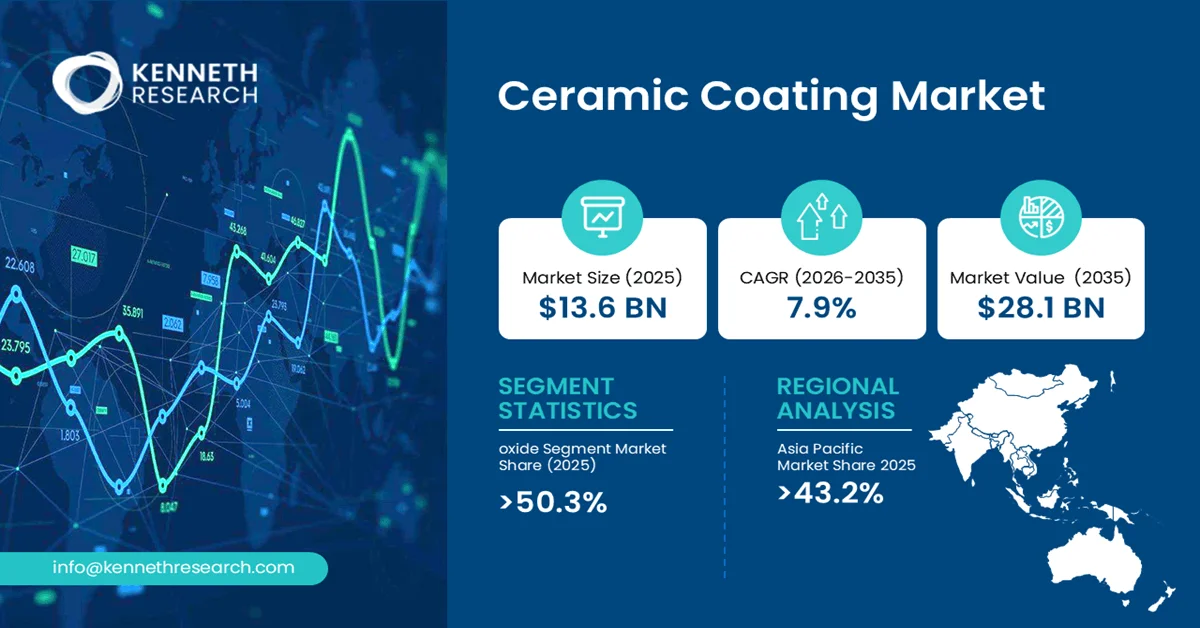
Ceramic Coating Market size was valued at USD 13.6 billion in 2025 and is projected to reach USD 28.1 billion by the end of 2035, rising at a CAGR of 7.9% during the forecast period, i.e., 2026-2035. In 2026, the industry size of ceramic coating is estimated at USD 14.6 billion.
The ceramic coating market is primarily driven by increasing demand for high-performance surface protection solutions across automotive, aerospace, energy, and industrial manufacturing. Superior resistance to wear, corrosion, oxidation, and extreme temperatures extends component lifespan and lowers maintenance costs, encouraging broader adoption in industries focused on operational efficiency, durability, and lifecycle cost optimization.
The ceramic coating market comprises advanced inorganic coating materials applied to metallic, ceramic, and composite surfaces to enhance durability and performance under demanding operating conditions. These coatings are typically deposited using techniques such as thermal spraying, physical vapor deposition (PVD), chemical vapor deposition (CVD), and sol-gel processing, creating a protective layer that shields substrates from wear, corrosion, oxidation, abrasion, and thermal degradation.
Ceramic coatings are characterized by exceptional hardness, high-temperature stability, chemical inertness, low thermal conductivity, and excellent resistance to mechanical and environmental stress. Depending on application requirements, they are formulated using oxide, carbide, nitride, or other ceramic materials to improve component longevity while maintaining dimensional stability and functional performance.
The market plays a critical role across industries including transportation and automotive, aerospace, healthcare, energy, industrial manufacturing, electronics, and marine. By extending equipment service life, improving fuel efficiency through thermal insulation, reducing maintenance frequency, and enhancing operational reliability, ceramic coatings have become an essential surface engineering solution supporting advanced manufacturing, sustainability objectives, and high-performance industrial operations.
Key Ceramic Coating Market Insights Summary:
Key Takeaways: Market Trends & Insights
- In the product segment, the oxide sub-segment accounted for the largest revenue share of 50.3% in 2025
- Asia Pacific dominated the global ceramic coating market with a 43.2% revenue share in 2025, led by China and India
- The Transportation & Automotive application segment is projected to witness strong growth during 2026-2035, driven by increasing adoption in conventional and electric vehicles
- Rising demand for high-performance, wear-resistant, and thermal barrier coatings across aerospace, automotive, energy, and industrial manufacturing is accelerating market expansion
- Continuous advancements in thermal spray and vapor deposition technologies are enhancing coating performance and supporting broader industrial adoption
Market Drivers
- Increasing use of ceramic coatings in aerospace engines and turbine components operating under extreme temperatures.
- Growing demand for corrosion-resistant coatings in marine, oil & gas, and chemical processing industries.
- Rising investments in industrial automation and high-performance manufacturing equipment.
- Expanding application of ceramic coatings in medical devices, implants, and precision healthcare equipment.
Challenges
- High application costs and complex processing requirements
- Performance limitations on complex substrates and under harsh operating conditions
Ceramic Coating Market Overview & Supply Chain
Global adoption of ceramic coatings is accelerating as manufacturers seek materials capable of withstanding extreme temperatures, corrosive environments, and mechanical wear while improving operational efficiency and extending equipment life. The technology has become increasingly important across automotive, aerospace, energy, industrial equipment, and healthcare applications, where enhanced surface performance contributes to greater reliability and lower maintenance requirements. The growing emphasis on clean energy technologies has also strengthened demand for advanced coating solutions used in high-performance components such as turbines, batteries, and heat pumps. Reflecting this trend, the International Energy Agency (IEA) reported that investment in clean technology manufacturing accounted for around 0.7% of total global investment in 2023, surpassing investment in the steel industry, highlighting the expanding industrial ecosystem that relies on advanced materials and protective coatings.
The ceramic coating market value chain begins with the sourcing of high-purity raw materials, including alumina, zirconia, titania, carbides, nitrides, and specialty chemical additives supplied by advanced materials manufacturers. These inputs undergo formulation and processing before being applied through technologies such as thermal spraying, physical vapor deposition (PVD), chemical vapor deposition (CVD), and sol-gel techniques by specialized coating providers. Quality assurance, performance testing, and certification are integral steps to ensure coatings meet industry-specific durability, thermal resistance, and corrosion protection standards. Finished coated components are distributed either directly to original equipment manufacturers (OEMs) or through industrial distributors and engineering service providers. Key end users include transportation and automotive manufacturers, aerospace companies, power generation facilities, healthcare device producers, electronics manufacturers, and heavy industrial enterprises. Major stakeholders across the value chain include raw material suppliers, equipment manufacturers, coating service providers, OEMs, research institutions, certification bodies, and industrial maintenance organizations.
Ceramic Coating Market: Growth Drivers & Challenges
Growth Drivers:
- Rising Investments in Advanced Manufacturing and Clean Energy Infrastructure: The increasing global focus on advanced manufacturing, electrification, and energy-efficient industrial systems is significantly accelerating demand for ceramic coatings. Components used in turbines, electric mobility, industrial machinery, batteries, and thermal management systems require superior resistance to heat, corrosion, and mechanical wear, making ceramic coatings an essential enabling technology. As governments continue to support domestic manufacturing capabilities and clean energy deployment, manufacturers are investing in high-performance materials that improve equipment durability while reducing maintenance costs. These developments also encourage innovation in coating formulations and application technologies, enabling broader industrial adoption. The long-term expansion of advanced manufacturing ecosystems is expected to reinforce demand for ceramic coatings across transportation, power generation, aerospace, and heavy industrial sectors. Supporting this trend, the U.S. Department of Energy announced nearly USD 85 million in 2024 to accelerate domestic manufacturing of electric heat pumps and related components across five factories, strengthening demand for advanced protective materials used in high-performance manufacturing.
- Expanding Adoption of High-Performance Surface Engineering Across Industrial Sectors: Industries are increasingly prioritizing lifecycle performance over initial equipment costs, driving wider adoption of advanced surface engineering technologies such as ceramic coatings. Manufacturers seek coatings that enhance abrasion resistance, thermal insulation, chemical stability, and oxidation protection to improve asset reliability under demanding operating conditions. The trend is particularly evident in transportation, aerospace, industrial machinery, electronics, and healthcare manufacturing, where longer service intervals translate into lower operating expenses and improved productivity. Continuous advances in coating processes, including plasma spraying and vapor deposition technologies, are enabling greater precision, adhesion, and compatibility with complex component geometries. As industrial automation and high-performance manufacturing continue to expand worldwide, ceramic coatings are expected to become an increasingly integral part of equipment design, supporting operational efficiency, sustainability objectives, and long-term infrastructure resilience.
Challenges:
- High Application Costs and Complex Processing Requirements: The widespread adoption of ceramic coatings is constrained by the significant capital investment required for specialized coating equipment, precision application technologies, and skilled technical personnel. Processes such as thermal spraying, physical vapor deposition (PVD), and chemical vapor deposition (CVD) require tightly controlled operating environments and rigorous quality assurance to achieve consistent coating performance. These technical requirements increase production costs and extend implementation timelines, particularly for small and medium-sized manufacturers. Commercially, higher application costs can discourage end users from replacing conventional surface treatment methods unless clear long-term cost savings are demonstrated. Looking ahead, continued improvements in automated coating systems, process efficiency, and scalable manufacturing techniques are expected to gradually reduce implementation costs, although affordability will remain a key consideration in price-sensitive industrial sectors.
- Performance Limitations on Complex Substrates and Harsh Operating Conditions: Despite their excellent resistance to wear, corrosion, and high temperatures, ceramic coatings can experience performance challenges when applied to substrates with incompatible thermal expansion characteristics or complex geometries. Improper surface preparation, inadequate adhesion, or repeated exposure to severe mechanical shock and cyclic thermal loading may result in cracking, delamination, or reduced coating lifespan. These risks require extensive material selection, testing, and process optimization before commercial deployment, increasing development time and engineering costs. From a business perspective, concerns regarding long-term coating reliability may delay purchasing decisions in mission-critical industries where component failure carries significant operational and financial consequences. Future advancements in nanostructured ceramic materials, hybrid coating systems, and improved deposition technologies are expected to enhance coating durability and broaden their suitability across increasingly demanding industrial applications.
Ceramic Coating Market Size and Forecast:
| Report Attribute | Details |
|---|---|
| Base Year |
2025 |
| Forecast Year |
2026-2035 |
| CAGR |
7.9% |
| Base Year Market Size (2025) |
USD 13.6 billion |
| Forecast Year Market Size (2035) |
USD 28.1 billion |
| Regional Scope |
|
Ceramic Coating Market Segmentation Analysis:
Product Segment Analysis
In the product segment, the oxide sub-segment is anticipated to capture the largest market share of 50.3% by the end of 2025.
The oxide sub-segment dominates the ceramic coating market due to its exceptional combination of thermal stability, corrosion resistance, electrical insulation, and cost-effective performance across diverse industrial applications. Oxide coatings, particularly alumina, zirconia, and titania-based formulations, are extensively adopted in transportation and automotive, aerospace, power generation, healthcare, and industrial manufacturing because they effectively protect components exposed to high temperatures, abrasion, and chemically aggressive environments. Growing industrial demand for longer-lasting equipment and improved operational efficiency continues to reinforce the segment's leadership. On the supply side, well-established global production capabilities for oxide ceramic feedstocks, mature thermal spray technologies, and continuous product innovation enable reliable commercial availability and scalable manufacturing. The segment is also benefiting from expanding investments in advanced manufacturing and energy infrastructure, where high-performance protective coatings are increasingly specified.
Application Segment Analysis
The transportation & automotive is projected to grow as the second-largest segment in the ceramic coating market due to four converging demand drivers.
The transportation & automotive sub-segment is projected to witness robust growth as vehicle manufacturers increasingly adopt ceramic coatings to enhance component durability, improve thermal management, and reduce maintenance requirements. Ceramic coatings are widely applied to engine parts, exhaust systems, brake components, transmission systems, and lightweight structural parts to provide superior resistance to wear, corrosion, oxidation, and high operating temperatures. The accelerating transition toward electric mobility is further expanding demand, as battery systems, power electronics, and thermal management components require advanced protective coatings to improve efficiency and service life. On the supply side, continuous advancements in thermal spray and vapor deposition technologies are enabling higher production efficiency and more consistent coating quality for automotive manufacturers and suppliers. Looking ahead, increasing investments in next-generation vehicles, lightweight materials, and sustainable manufacturing are expected to further strengthen adoption. Supporting this trend, the International Energy Agency (IEA) reported that global electric car sales exceeded 17 million in 2024, with more than 20% of all new cars sold worldwide being electric, reinforcing the growing need for high-performance surface engineering solutions in modern vehicles.
Our in-depth analysis of the global ceramic coating market includes the following segments:
|
Segment |
Sub-segment |
|
Product/Type |
|
|
Technology |
|
|
Application |
|
|
Substrate Compatibility |
|
|
Application Method |
|
Ceramic Coating Market Regional Insights:
Asia Pacific Market Trends & Insights:
Asia Pacific ceramic coating market is projected to hold the largest revenue share of 43.2% by the end of 2025.
The region’s leadership is supported by its extensive manufacturing base, strong automotive production ecosystem, expanding aerospace activities, growing power generation infrastructure, and increasing investments in advanced materials. Countries across the region continue to prioritize industrial modernization, export-oriented manufacturing, and technology-intensive production, all of which create sustained demand for high-performance protective coatings. In addition, the presence of large-scale raw material processing capabilities and coating application service providers strengthens regional supply chains and enhances commercial availability. Government support for industrial upgrading, energy efficiency, and advanced manufacturing further reinforces the adoption of ceramic coatings across transportation, industrial equipment, electronics, and energy applications.
China serves as the primary growth engine within the region due to its large-scale manufacturing capacity, advanced industrial infrastructure, and significant investments in automotive, aerospace, electronics, and energy-related production. The country's focus on high-value manufacturing continues to support demand for ceramic-coated components used in demanding operating environments.
India is emerging as a key market driven by expanding industrial production, rising vehicle manufacturing, infrastructure development, and increasing adoption of advanced materials across engineering industries. Ongoing investments in domestic manufacturing capabilities and modernization initiatives are expected to further strengthen the utilization of ceramic coatings across multiple end-use sectors in the coming years.
North America Market Trends & Insights:
North America represents a strategically important market for ceramic coatings due to its strong presence in aerospace, automotive, energy, healthcare, and advanced manufacturing industries. Demand is driven by the need for high-performance materials that enhance equipment durability, improve thermal efficiency, and reduce lifecycle maintenance costs. The region continues to invest in next-generation manufacturing technologies, industrial automation, and clean energy infrastructure, creating favorable conditions for the adoption of advanced surface engineering solutions. Government policies supporting domestic manufacturing, critical materials development, and low-carbon industrial technologies are encouraging companies to expand production capabilities and adopt innovative coating processes. Additionally, increasing research and development activities, coupled with collaboration between industry, academia, and technology providers, are accelerating the commercialization of advanced ceramic coating materials. These trends position North America as a significant contributor to future technological advancements and industrial applications across multiple end-use sectors.
The United States leads the regional market owing to its well-established aerospace and defense industries, extensive automotive manufacturing base, and strong focus on advanced materials research. Continuous investments in industrial modernization, energy technologies, and precision manufacturing are supporting wider adoption of ceramic coatings across high-value applications.
Canada is strengthening its position through expanding aerospace manufacturing, mining and energy operations, and industrial equipment production. The country's emphasis on sustainable manufacturing practices, innovation-driven industrial development, and advanced engineering capabilities is creating additional opportunities for ceramic coating suppliers, particularly in applications requiring superior wear resistance, corrosion protection, and high-temperature performance
Leading Companies Operating in the Global Ceramic Coating Market:
Here is a list of upstream suppliers, coating service providers, material manufacturers, and key players operating in the global ceramic coating market competitive ecosystem:
- OC Oerlikon (Switzerland)
- Company Overview
- Business Strategy
- Key Product Offerings
- Financial Performance
- Key Performance Indicators
- Risk Analysis
- Recent Development
- Saint-Gobain (France)
- Bodycote plc (United Kingdom)
- APS Materials, Inc. (United States)
- A&A Coatings (United States)
- Flame Spray Technologies (Netherlands)
- Morgan Advanced Materials (United Kingdom)
- CeramTec GmbH (Germany)
Frequently Asked Question
In 2025, the ceramic coating market exceeded USD 13.6 billion.
The ceramic coating market is projected to reach USD 28.1 billion by the end of 2035, expanding at a CAGR of 7.9% over the forecast period (2026-2035).
The major players in the market are OC Oerlikon, Saint-Gobain, Bodycote plc, Kyocera Corporation, APS Materials, A&A Coatings, Linde Advanced Material Technologies, Thermion Inc., Flame Spray Technologies, Plasma Coatings, CeramTec GmbH, CoorsTek Inc., Zircotec Ltd., ASB Industries, Morgan Advanced Materials, Fujimi Incorporated, TST Coatings Inc., Integrated Global Services (IGS), H.C. Starck Solutions, and others.
In the Product segment, the Oxide sub-segment is anticipated to capture the largest market share of 50.3% in the future and exhibit lucrative growth opportunities during 2026-2035. This growth trajectory is largely attributed to its superior thermal stability, corrosion resistance, wear protection, and widespread adoption across automotive, aerospace, energy, and industrial manufacturing applications.
Asia Pacific is projected to hold the largest market share of 43.2% by the end of 2035 and provide more business opportunities in the future. Continuous investments in advanced manufacturing, automotive production, and industrial infrastructure across China and India are fostering the region's dominance.
Why Choose Kenneth Research ?
-
Insight with Impact : We don’t just gather data — we uncover stories, trends, and opportunities that fuel business growth.
-
Experts Who Get It : Our team speaks your industry’s language and knows what really matters to your customers and market.
-
Custom-Built for You : Forget one-size-fits-all. We craft research and consulting solutions as unique as your business vision.
-
Partners, Not Just Providers : We work with you, not for you — collaborating closely to turn insights into smart, strategic moves.
-
Results That Speak : Our work powers brands, startups, and industry leaders alike — with a track record of ideas that work in the real world.
Report ID: 1025 |
Published Date: 29 Jul 2026 |
Report Format: |
Delivery Timeline: 48-72 Business Hours

Copyright © 2025 Kenneth Research. All rights reserved. Terms of Use | Privacy Policy
