Report ID: 1024 |
Published Date: 29 Jul 2026 |
Report Format: |
Delivery Timeline: 48-72 Business Hours
Ceramic Adhesives Market Outlook:
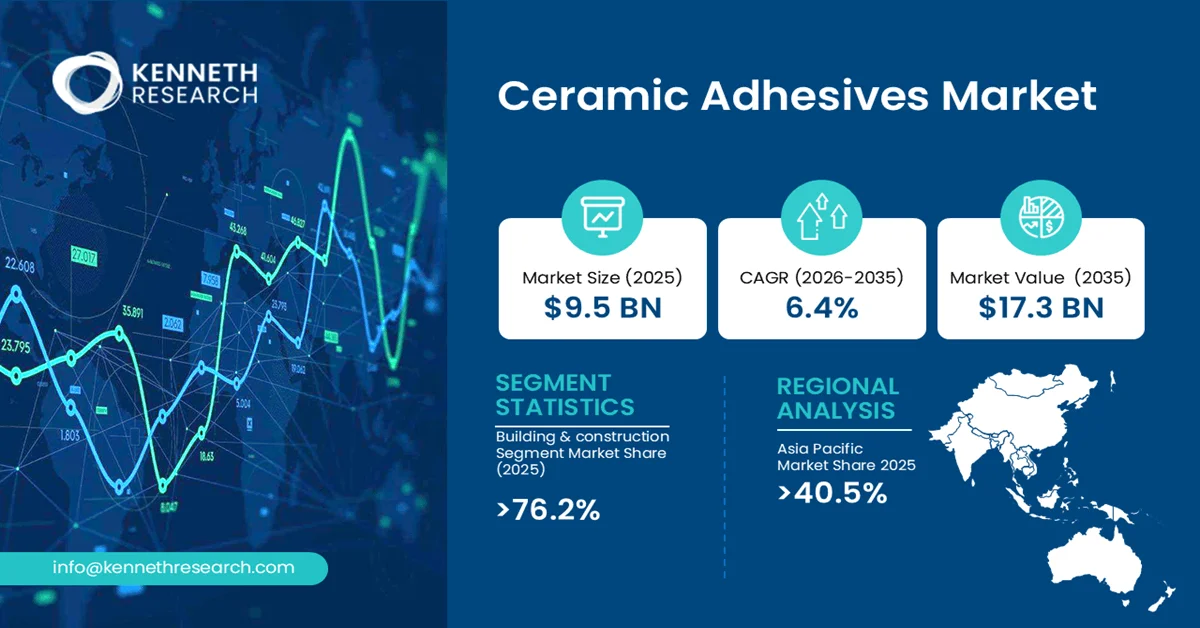
Ceramic Adhesives Market size was valued at USD 9.5 billion in 2025 and is projected to reach USD 17.3 billion by the end of 2035, rising at a CAGR of 6.4% during the forecast period, i.e., 2026-2035. In 2026, the industry size of the ceramic adhesives is estimated at USD 10.1 billion.
Rising investments in residential, commercial, and public infrastructure construction are the primary growth driver of the ceramic adhesives market. Increasing adoption of ceramic tiles for durable, aesthetically appealing, and low-maintenance surfaces is accelerating demand for advanced adhesive formulations that provide stronger bonding, improved flexibility, moisture resistance, and faster installation across modern construction projects.
The ceramic adhesives market comprises specialized bonding materials formulated to securely fix ceramic tiles, porcelain tiles, natural stone, and related ceramic products onto floors, walls, ceilings, and other substrates across residential, commercial, industrial, and institutional environments. These adhesives are available in multiple chemistries, including cement-based, epoxy, acrylic, silicone, and other performance-oriented formulations, each designed to meet specific installation requirements and substrate conditions.
Ceramic adhesives are characterized by high bond strength, excellent durability, resistance to moisture, thermal variations, abrasion, and chemicals, as well as compatibility with diverse construction materials such as concrete, cement screeds, gypsum boards, and masonry. Compared with conventional mortar, they offer enhanced workability, improved adhesion, reduced material wastage, and longer service life, making them suitable for modern construction practices.
Industrially, ceramic adhesives are an essential component of the construction chemicals value chain, supporting efficient tile installation in new construction and renovation projects while also serving specialized applications such as dental restorations and selected high-performance industrial assemblies. Their role in improving installation quality, structural reliability, and lifecycle performance makes them an indispensable material in contemporary building systems.
Key Ceramic Adhesives Market Insights Summary:
Key Takeaways: Market Trends & Insights
- The ceramic adhesives market was valued at USD 9.5 billion in 2025 and is projected to reach USD 17.3 billion by 2035, registering a 6.4% CAGR during 2026–2035
- Building & Construction accounted for 75.2% of the market in 2025, making it the leading application segment driven by strong construction and renovation activities
- Cement-Based Adhesives remain the dominant chemistry type due to their excellent bonding performance, cost-effectiveness, and compatibility with diverse substrates
- Asia Pacific held the largest regional share of 40.5% in 2025, supported by extensive construction activities and manufacturing strength across China and Japan
- Increasing investments in infrastructure development, urbanization, and sustainable construction practices are expected to drive long-term growth and innovation across the ceramic adhesives market
Market Drivers
- Expansion of residential and commercial infrastructure development
- Increasing renovation and remodeling activities in existing buildings
- Expansion of sustainable and energy-efficient building construction
- Increasing adoption of large-format tiles and advanced installation technologies
Challenges
- Raw material availability and procurement cost volatility
- Performance variability across diverse installation conditions
Ceramic Adhesives Market Overview & Supply Chain
Global adoption of ceramic adhesives is increasing as rapid urbanization, infrastructure modernization, and renovation activities drive demand for durable, high-performance tile installation solutions. Modern ceramic adhesives offer superior bonding strength, flexibility, moisture resistance, and compatibility with large-format tiles, making them essential for contemporary construction practices. Increasing emphasis on sustainable and energy-efficient buildings has also encouraged the use of advanced construction materials that improve installation quality and reduce maintenance requirements. Government-led investments in resilient infrastructure and stricter building performance standards continue to reinforce demand across residential, commercial, and institutional projects. The construction sector's strategic importance further supports ceramic adhesive consumption; according to the International Energy Agency (IEA), buildings accounted for 34% of global energy demand and 37% of energy- and process-related CO₂ emissions in 2022, highlighting the sector's significance and the growing focus on efficient building materials and construction practices.
The ceramic adhesives industry value chain begins with the procurement of raw materials such as cement, silica sand, graded fillers, polymers, redispersible polymer powders, cellulose ethers, resins, plasticizers, and specialty chemical additives sourced from mining companies and chemical manufacturers. These materials undergo formulation, blending, quality testing, and packaging at manufacturing facilities to produce adhesive grades tailored for different substrates, tile types, and environmental conditions. Products are then distributed through construction material wholesalers, building product distributors, retail chains, specialized tile suppliers, and increasingly through digital procurement platforms serving contractors and institutional buyers. The principal end users include residential and commercial builders, infrastructure developers, renovation contractors, industrial facility owners, architects, interior designers, and tile installation professionals. Key stakeholders across the ecosystem include raw material suppliers, adhesive manufacturers, logistics providers, certification bodies, distributors, construction companies, engineering consultants, and project owners, all contributing to product innovation, regulatory compliance, and efficient project execution.
Ceramic Adhesives Market: Growth Drivers & Challenges
Growth Drivers:
- Expansion of Sustainable and Energy-Efficient Building Construction: The growing emphasis on sustainable construction practices and energy-efficient buildings is a key driver for the ceramic adhesives market. Governments, developers, and construction companies are increasingly adopting advanced building materials that improve structural durability, reduce maintenance requirements, and support environmentally responsible construction. Ceramic adhesives contribute by providing enhanced bond strength, compatibility with modern tile materials, and reduced installation waste compared to conventional methods. The International Energy Agency (IEA) highlights that improving the energy performance of buildings remains a critical priority for reducing emissions and supporting sustainable development, reinforcing the importance of high-performance construction materials across the building sector. As green building standards continue to evolve, manufacturers are expected to focus on low-emission, high-performance adhesive formulations that align with changing construction requirements and long-term sustainability objectives.
- Increasing Adoption of Large-Format Tiles and Advanced Installation Technologies: The increasing preference for large-format ceramic and porcelain tiles is driving demand for specialized ceramic adhesives that provide superior bonding performance and long-term durability. Unlike conventional installation materials, advanced ceramic adhesives accommodate heavier tiles, minimize slippage, and withstand thermal movement and moisture exposure, making them suitable for complex construction environments. Simultaneously, the construction industry is embracing improved installation techniques to enhance project efficiency, reduce rework, and achieve consistent quality. These trends are encouraging manufacturers to develop innovative adhesive formulations with improved flexibility, faster curing characteristics, and compatibility with a wider range of substrates. As architectural designs become more sophisticated and construction quality standards continue to rise, the adoption of advanced ceramic adhesives is expected to increase across residential, commercial, and infrastructure projects.
Challenges:
- Volatility in Raw Material Availability and Procurement Costs: The ceramic adhesives market is significantly influenced by fluctuations in the availability and pricing of essential raw materials, including cement, polymer binders, specialty additives, fillers, and chemical modifiers. Supply chain disruptions, geopolitical uncertainties, environmental regulations affecting mining and chemical production, and transportation constraints can create inconsistent raw material supplies and procurement challenges for manufacturers. These factors complicate production planning, increase manufacturing costs, and make long-term pricing agreements more difficult to maintain. As a result, manufacturers may experience pressure on profit margins while distributors and contractors face higher procurement costs and longer lead times. Going forward, companies are expected to strengthen supplier diversification, establish regional sourcing strategies, and optimize inventory management to improve supply chain resilience and reduce exposure to procurement-related risks.
- Performance Variability Across Diverse Installation Conditions: Ceramic adhesives must perform consistently across a wide range of substrates, tile types, climatic conditions, and installation environments. Variations in substrate preparation, moisture levels, temperature, installer expertise, and project-specific requirements can affect bonding performance and long-term durability. This creates challenges for manufacturers in developing universally compatible formulations while maintaining compliance with evolving construction standards. Inconsistent installation outcomes can lead to project delays, warranty claims, additional maintenance costs, and reputational risks for both manufacturers and contractors. Commercially, suppliers must invest in product testing, technical support, installer training, and application-specific solutions to ensure reliable performance. As construction projects become more technically demanding, continuous formulation innovation and enhanced field support will remain essential to overcoming these performance-related challenges.
Ceramic Adhesives Market Size and Forecast:
| Report Attribute | Details |
|---|---|
| Base Year |
2025 |
| Forecast Year |
2026-2035 |
| CAGR |
6.4% |
| Base Year Market Size (2025) |
USD 9.5 billion |
| Forecast Year Market Size (2035) |
USD 17.3 billion |
| Regional Scope |
|
Ceramic Adhesives Market Segmentation Analysis:
Application Segment Analysis
In the application segment, the building & construction sub-segment is anticipated to capture the largest market share of 76.2% by the end of 2025.
The Building & Construction segment dominates the ceramic adhesives market due to the extensive use of ceramic and porcelain tiles in residential, commercial, institutional, and infrastructure projects. Growing demand for aesthetically appealing, durable, and low-maintenance flooring and wall solutions has increased the adoption of high-performance ceramic adhesives capable of providing superior bond strength, moisture resistance, and long-term durability. The segment also benefits from the widespread transition toward large-format tiles and modern installation techniques that require specialized adhesive formulations rather than conventional cement mortars. On the supply side, manufacturers continue to expand product portfolios with application-specific, low-emission, and high-flexibility adhesives that comply with evolving building standards and sustainability requirements. According to the UK Office for National Statistics (ONS), the value of new construction work in Great Britain reached a record high in 2023, reflecting sustained construction activity that supports demand for tile installation materials and associated adhesive products. Looking ahead, continued investments in urban development, commercial buildings, infrastructure modernization, and renovation projects are expected to reinforce the segment's leadership while encouraging further innovation in ceramic adhesive technologies.
Chemistry-Type Segment Analysis
The Cement-Based adhesives is projected to grow as the second-largest segment in the ceramic adhesive market due to four converging demand drivers.
The Cement-Based Adhesives segment is projected to witness sustained growth owing to its widespread suitability for residential, commercial, and infrastructure tile installation applications. These adhesives are preferred for their strong bonding performance, ease of application, compatibility with concrete and masonry substrates, and cost-effectiveness compared with alternative chemistries. Demand is further supported by increasing adoption of vitrified and large-format tiles, which require reliable adhesive systems that deliver long-term durability and moisture resistance. On the supply side, manufacturers continue to improve cement-based formulations through polymer modification, enhanced workability, and compliance with modern construction standards, enabling their use across a broader range of applications. Government specifications also reinforce the use of cement-based tile adhesives in contemporary construction. For example, the Government of India Specifications for Civil Works (2023) recommend polymer-modified quick-set tile adhesives conforming to IS 15477 for tile flooring applications and classify adhesive types according to substrate and application requirements, reflecting the growing standardization of cement-based adhesive solutions. Looking ahead, continued infrastructure development, housing construction, and product innovation are expected to strengthen the segment's growth trajectory.
Our in-depth analysis of the global ceramic adhesives market includes the following segments:
|
Segment |
Sub-segment |
|
Chemistry-Type |
|
|
Application |
|
Ceramic Adhesives Market Regional Insights:
Asia Pacific Market Trends & Insights:
Asia Pacific ceramic adhesives market is projected to hold the largest revenue share of 40.5% by the end of 2025.
The region's dominance is supported by extensive residential and commercial construction activity, continuous urban expansion, and strong investments in transportation, industrial, and public infrastructure. Rapid adoption of ceramic and porcelain tiles across new construction and renovation projects has sustained demand for advanced adhesive solutions that offer durability, moisture resistance, and efficient installation. The presence of large-scale tile manufacturers, well-established construction chemical producers, and integrated raw material supply networks further strengthens regional production capabilities. In addition, supportive building regulations, increasing adoption of modern construction practices, and growing investments in sustainable infrastructure continue to encourage the use of high-performance ceramic adhesives across diverse end-use sectors.
China serves as the primary growth engine of the region due to its vast construction sector, integrated manufacturing ecosystem, and continuous infrastructure development.
Japan complements regional demand through its emphasis on high-quality construction practices, advanced building technologies, and renovation of aging residential and commercial buildings. According to the National Bureau of Statistics of China (NBS), the value added of China's construction industry reached 100 million yuan in 2024, representing a 3.8% year-on-year increase at constant prices, highlighting the continued expansion of construction activities that support demand for ceramic adhesives. Looking ahead, ongoing urban development, infrastructure investments, and technological advancements in construction materials are expected to reinforce Asia Pacific's leadership in the ceramic adhesives market.
North America Market Trends & Insights:
North America represents a significant market for ceramic adhesives, supported by sustained demand from residential construction, commercial real estate, institutional projects, and renovation activities. The region has witnessed increasing adoption of advanced tile installation systems as builders prioritize durable, moisture-resistant, and high-performance construction materials. Growing investments in infrastructure modernization, healthcare facilities, hospitality developments, and multifamily housing continue to create favorable conditions for ceramic adhesive consumption. Government initiatives focused on improving transportation infrastructure, enhancing energy-efficient buildings, and upgrading public facilities are further encouraging the use of modern construction materials. In addition, stringent building standards and the increasing preference for environmentally responsible products are prompting manufacturers to introduce low-emission, high-performance adhesive formulations. Looking ahead, continued urban redevelopment, technological advancements in construction chemicals, and increasing renovation of aging buildings are expected to create substantial opportunities for ceramic adhesive manufacturers across the region.
The United States accounts for the largest share of regional demand owing to its extensive residential and commercial construction sector, robust renovation market, and strong presence of construction chemical manufacturers. The country's emphasis on infrastructure renewal, sustainable building practices, and advanced construction technologies continues to support the adoption of high-performance ceramic adhesives.
Canada complements regional growth through ongoing investments in residential housing, public infrastructure, healthcare, and institutional construction. Rising demand for durable building materials, combined with increasing renovation and energy-efficiency initiatives, is expected to strengthen ceramic adhesive adoption across Canadian construction projects. Together, these countries are expected to sustain North America's position as a key regional market for ceramic adhesives throughout the forecast period.
Leading Companies Operating in the Global Ceramic Adhesives Market:
Here is a list of upstream, downstream, and key players operating in the global ceramic adhesives market competitive ecosystem:
- H.B. Fuller (United States)
- Company Overview
- Business Strategy
- Key Product Offerings
- Financial Performance
- Key Performance Indicators
- Risk Analysis
- Recent Development
- Dow (United States)
- BASF Construction Solutions (Germany)
- MYK LATICRETE (India)
- Pidilite Industries (India)
- Henkel (Germany)
Recent Developments
- In March 2025, Sika announced the full acquisition of HPS North America, strengthening its building finishing portfolio. The acquisition expands Sika's flooring, tile installation, and surface preparation solutions, reinforcing its position in the ceramic adhesives and construction chemicals industry.
- In February 2025, Sika launched SikaBond®-5900 and SikaBond®-5800 resilient flooring adhesives. The new products are designed to provide enhanced installation performance for residential and commercial flooring applications while expanding Sika's adhesive portfolio.
Frequently Asked Question
In 2025, the ceramic adhesives market exceeded USD 9.5 billion.
The ceramic adhesives market is projected to reach USD 17.3 billion by the end of 2035, expanding at a CAGR of 6.4% over the forecast period (2026-2035).
The major players in the market are Sika AG, MAPEI S.p.A., Ardex Group, Saint-Gobain Weber, Bostik, Henkel, LATICRETE International, Fosroc, Pidilite Industries, MYK LATICRETE, Kerakoll Group, Master Builders Solutions, Dow, H.B. Fuller, Murexin, Terraco Group, Cemix, UltraTech Building Solutions, Parex Group, Huntsman Corporation, and others.
In the Application segment, the Building & Construction sub-segment is anticipated to capture the largest market share of 75.2% in the future and exhibit lucrative growth opportunities during 2026-2035. This growth trajectory is largely attributed to increasing residential and commercial construction activities, rising adoption of ceramic and porcelain tiles, and growing demand for high-performance tile installation materials.
Asia Pacific is projected to hold the largest market share of 40.5% by the end of 2035 and provide more business opportunities in the future. Continuous investments in construction, infrastructure modernization, and urban development across China and Japan are fostering the region's dominance.
Why Choose Kenneth Research ?
-
Insight with Impact : We don’t just gather data — we uncover stories, trends, and opportunities that fuel business growth.
-
Experts Who Get It : Our team speaks your industry’s language and knows what really matters to your customers and market.
-
Custom-Built for You : Forget one-size-fits-all. We craft research and consulting solutions as unique as your business vision.
-
Partners, Not Just Providers : We work with you, not for you — collaborating closely to turn insights into smart, strategic moves.
-
Results That Speak : Our work powers brands, startups, and industry leaders alike — with a track record of ideas that work in the real world.
Report ID: 1024 |
Published Date: 29 Jul 2026 |
Report Format: |
Delivery Timeline: 48-72 Business Hours

Copyright © 2025 Kenneth Research. All rights reserved. Terms of Use | Privacy Policy
