Report ID: 1070 |
Published Date: 11 Aug 2026 |
Report Format: |
Delivery Timeline: 48-72 Business Hours
CBCT Dental Imaging Market Outlook:
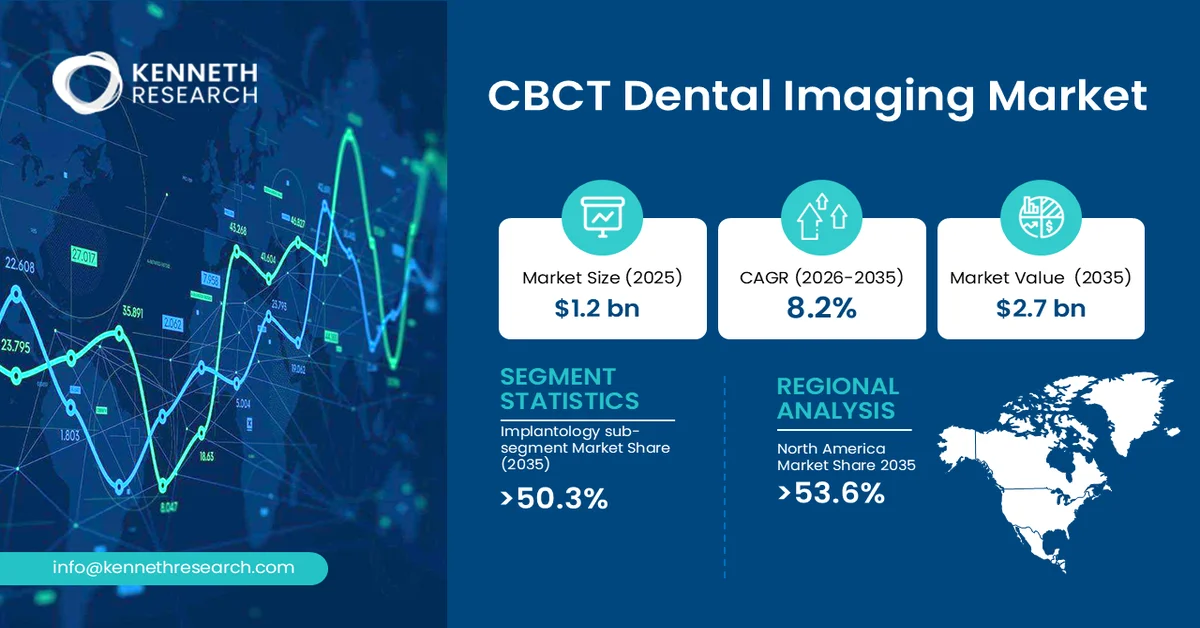
CBCT Dental Imaging Market size was valued at USD 1.2 billion in 2025 and is projected to reach USD 2.7 billion by the end of 2035, rising at a CAGR of 8.2% during the forecast period, i.e., 2026-2035. In 2026, the industry size of the CBCT dental imaging is estimated at USD 1.3 billion.
The primary growth driver for the CBCT dental imaging market is the increasing adoption of precision dentistry and implant procedures requiring high-resolution three-dimensional imaging. Advances in cone beam computed tomography technology, digital workflows, and treatment planning software are enhancing diagnostic accuracy, clinical efficiency, and patient outcomes, driving widespread utilization across dental practices.
The CBCT dental imaging market comprises cone beam computed tomography systems and associated software used to generate high-resolution three-dimensional images of the teeth, jaw, facial bones, and surrounding oral structures. These imaging systems support comprehensive diagnosis, treatment planning, and post-procedure evaluation across multiple dental specialties, including implantology, orthodontics, endodontics, oral surgery, and periodontics. The industrial relevance of the CBCT dental imaging market continues to expand with increasing demand for minimally invasive procedures, digital treatment planning, and precision-guided dental interventions.
Key CBCT Dental Imaging Market Insights Summary:
Key Takeaways: Market Trends & Insights
- In the application segment, the implantology sub-segment is anticipated to capture the revenue share of 50.3% during 2026-2035
- North America CBCT dental imaging market is projected to hold the largest revenue share of 53.6% by the end of 2035
- Europe CBCT dental imaging market is estimated to hold the second-largest revenue share of 34.3% during the forecast period.
Market Drivers
- Growing adoption of digital implant dentistry and guided surgical workflows.
- Increasing integration of artificial intelligence and advanced imaging software.
- Rising demand for minimally invasive and precision-guided dental procedures.
- Continuous technological advancements in CBCT systems with enhanced image quality and lower radiation exposure.
Challenges
- High capital investment and lifecycle ownership costs.
- Regulatory compliance requirements and shortage of skilled imaging professionals.
CBCT Dental Imaging Market Overview & Supply Chain
Global adoption of CBCT dental imaging is increasing due to the growing demand for precise three-dimensional diagnostics, digital treatment planning, and minimally invasive dental procedures. Dental professionals are increasingly integrating CBCT systems into implantology, orthodontics, endodontics, and oral surgery to improve diagnostic accuracy and clinical outcomes. Technological advancements in detector technology, artificial intelligence-assisted image interpretation, cloud-enabled imaging platforms, and integration with CAD/CAM workflows are strengthening the role of CBCT in modern dentistry. The World Health Organization (WHO) reports that oral diseases affect nearly 3.7 billion people worldwide, demonstrating the substantial need for advanced diagnostic technologies capable of improving oral healthcare delivery and treatment planning.
The CBCT dental imaging market value chain begins with the procurement of high-precision components, including X-ray tubes, flat-panel detectors, semiconductor electronics, imaging sensors, software platforms, and medical-grade mechanical assemblies. Equipment manufacturers integrate these components through advanced engineering, system calibration, software development, and rigorous quality assurance to produce CBCT imaging systems that comply with international medical device standards. Distribution is carried out through direct sales teams, authorized distributors, and specialized medical equipment providers serving dental clinics, hospitals, imaging centers, and academic institutions.
CBCT Dental Imaging Market: Growth Drivers & Challenges
Growth Drivers:
- Growing adoption of digital implant dentistry and guided surgical workflows: The growing transition toward digital implant dentistry is a major driver for the CBCT dental imaging market. Cone beam computed tomography enables highly accurate three-dimensional visualization of bone structures, anatomical landmarks, and implant sites, significantly improving treatment planning and surgical precision. Integration with CAD/CAM systems, intraoral scanners, and digital surgical guides has streamlined clinical workflows while reducing procedural risks and improving patient outcomes. Manufacturers continue to introduce advanced imaging platforms with AI-assisted diagnostics and enhanced software capabilities, further accelerating adoption across dental practices and specialty clinics.
- Increasing integration of artificial intelligence and advanced imaging software: Artificial intelligence is transforming CBCT dental imaging by improving diagnostic consistency, automating anatomical identification, and supporting more efficient treatment planning. AI-powered software assists clinicians in detecting pathological conditions, evaluating bone quality, and generating standardized reports while reducing interpretation time. The integration of cloud connectivity, image management platforms, and digital workflows further enhances collaboration among dental specialists and improves patient care continuity. Manufacturers are investing in intelligent imaging ecosystems that combine CBCT scanners with advanced software solutions, enabling predictive diagnostics and workflow optimization. As digital dentistry continues to evolve, AI-enabled imaging platforms are expected to become a standard component of modern dental practices, supporting broader adoption across implantology, orthodontics, oral surgery, and multidisciplinary dental care.
Challenges:
- High capital investment and lifecycle ownership costs: The adoption of CBCT dental imaging systems is constrained by the substantial capital investment required for equipment acquisition, installation, facility modifications, software licensing, and ongoing maintenance. Smaller dental clinics and independent practices often face budget limitations that delay technology upgrades despite growing demand for advanced diagnostic capabilities. In addition to the initial purchase cost, recurring expenses related to software updates, calibration, regulatory compliance, cybersecurity, and staff training increase the total cost of ownership. These financial barriers can slow equipment replacement cycles and reduce penetration in cost-sensitive markets. Although technological advancements and financing programs are expected to improve affordability over time, manufacturers will need to develop scalable, cost-efficient solutions and flexible commercial models to expand adoption among smaller healthcare providers.
- Regulatory compliance requirements and shortage of skilled imaging professionals: CBCT systems operate within a highly regulated healthcare environment that requires compliance with radiation safety standards, medical device regulations, data privacy requirements, and clinical quality guidelines. Manufacturers must continuously update hardware and software to satisfy evolving regulatory expectations across different jurisdictions, increasing product development complexity and time-to-market. Healthcare providers also face challenges in recruiting and training professionals capable of accurately acquiring, interpreting, and integrating three-dimensional CBCT data into clinical decision-making. Inconsistent expertise may affect diagnostic quality and limit the full utilization of advanced imaging capabilities. Looking ahead, standardized training programs, AI-assisted image interpretation, and harmonized regulatory frameworks are expected to reduce these barriers, but workforce development and compliance costs will remain important considerations for sustained market expansion.
CBCT Dental Imaging Market Size and Forecast:
| Report Attribute | Details |
|---|---|
| Base Year |
2025 |
| Forecast Year |
2026-2035 |
| CAGR |
8.2% |
| Base Year Market Size (2025) |
USD 1.2 billion |
| Forecast Year Market Size (2035) |
USD 2.7 billion |
| Regional Scope |
|
CBCT Dental Imaging Market Segmentation Analysis:
Application Segment Analysis
Implantology sub-segment is estimated to dominate the global market with largest share of 50.3% during the forecast period.
The implantology segment dominates the CBCT dental imaging market due to the increasing requirement for accurate three-dimensional visualization during dental implant planning and placement procedures. CBCT systems provide detailed assessments of bone volume, density, and anatomical structures, enabling clinicians to improve implant positioning and reduce procedural complications. Growing adoption of guided implant surgery, digital workflows, and integration with CAD/CAM technologies is further strengthening demand among dental specialists. On the supply side, manufacturers are developing advanced CBCT platforms with improved image resolution, reduced radiation exposure, and software compatibility for implant planning applications. The rising emphasis on precision dentistry and personalized treatment approaches is expected to support continued implantology adoption.
Technology Segment Analysis
The cone beam computed technology sub-segment is projected to hold second-largest share in the global market by the end of 2035.
The cone beam computed technology segment is projected to grow due to increasing demand for high-resolution, three-dimensional dental imaging solutions that support accurate diagnosis and treatment planning. Dental professionals are increasingly adopting CBCT technology because it provides detailed visualization of maxillofacial structures while supporting applications such as implant placement, orthodontic assessment, endodontic evaluation, and oral surgery planning. Industry adoption is being strengthened by continuous improvements in detector performance, software integration, artificial intelligence capabilities, and workflow automation. Manufacturers are focusing on developing compact, user-friendly CBCT systems with enhanced image quality and optimized radiation management to address the needs of modern dental practices.
Our in-depth analysis of the global CBCT dental imaging market includes the following segments:
|
Segment |
Sub-segment |
|---|---|
|
Application |
|
|
Technology |
|
|
Product Type |
|
|
Patient Type |
|
|
End Use |
|
CBCT Dental Imaging Market Regional Insights:
North America Trends & Insights:
North America is projected to maintain its leadership position in the CBCT dental imaging market, accounting for 53.6% of the market share in 2035. The region’s dominance is supported by advanced dental healthcare infrastructure, strong adoption of digital dentistry technologies, and significant investment in next-generation diagnostic equipment. North America has a well-established ecosystem of dental device manufacturers, research institutions, specialized clinics, and technology providers that accelerate innovation in CBCT imaging solutions. Regulatory frameworks supporting medical device quality, radiation safety, and healthcare technology advancement further encourage the adoption of advanced imaging platforms. The region also benefits from increasing demand for implantology, orthodontic procedures, and precision-guided dental treatments.
The United States represents the largest contributor within North America due to its extensive network of dental practices, high adoption of digital dental workflows, and strong presence of leading dental imaging manufacturers. Continuous investment in AI-enabled imaging, cloud-based dental platforms, and advanced diagnostic systems supports market development.
Canada contributes through its growing dental care infrastructure, increasing integration of digital healthcare technologies, and expanding demand for modern diagnostic solutions across dental clinics and specialty centers. The National Institute of Dental and Craniofacial Research (NIDCR) reported that about 90% of adults aged 20 to 64 in the United States had dental caries in permanent teeth, reflecting substantial ongoing requirements for advanced dental diagnostic and treatment-support technologies.
Europe Trends & Insights:
Europe represents a significant market for CBCT dental imaging due to increasing demand for advanced dental diagnostics, digital treatment planning, and precision-based oral healthcare procedures. The region has witnessed growing adoption of three-dimensional imaging technologies across implantology, orthodontics, endodontics, and oral surgery applications. Strong industrial activity from dental technology manufacturers, research institutions, and healthcare technology providers supports continuous innovation in CBCT systems, imaging software, and integrated digital dentistry platforms. Government initiatives focused on healthcare modernization, medical device quality standards, and digital transformation are encouraging the adoption of advanced diagnostic technologies.
Germany is a key contributor to Europe’s CBCT dental imaging ecosystem, supported by its strong medical technology industry, advanced healthcare infrastructure, and established dental equipment manufacturing capabilities. The country’s focus on engineering excellence and innovation supports the development and adoption of sophisticated dental imaging solutions.
The United Kingdom contributes through its expanding digital dentistry adoption, increasing use of advanced diagnostic technologies in dental practices, and emphasis on improving healthcare service efficiency. The country’s growing integration of technology-enabled dental workflows creates opportunities for CBCT manufacturers and service providers.
Leading Companies Operating in the Global CBCT Dental Imaging Market:
- Dentsply Sirona (United States)
- Company Overview
- Business Strategy
- Key Product Offerings
- Financial Performance
- Key Performance Indicators
- Risk Analysis
- Recent Development
- Regional Presence
- SWOT Analysis
- Planmeca (Finland)
- Vatech (South Korea)
- Carestream Dental (United States)
- NewTom (Italy)
Recent Developments
- In September 2025, Planmeca introduced the Planmeca Viso G1 CBCT imaging system, expanding its Viso family with a system designed for general dentistry, endodontics, and implantology applications. The product strengthens Planmeca’s CBCT portfolio by targeting wider clinical adoption and supporting dental practices seeking integrated three-dimensional imaging capabilities.
- In June 2025, Planmeca launched Romexis 7, an updated dental imaging software platform featuring AI-powered functions, including automated anatomical recognition and CBCT image analysis capabilities. The software advancement highlights the growing importance of AI integration in CBCT workflows and enhances the value of imaging systems through automated analysis and improved diagnostic support.
- In March 2025, Dentsply Sirona showcased new connected dentistry capabilities at IDS 2025, including DS Core Diagnose features and AI-supported tools for digital dental imaging workflows. The development supports the shift toward cloud-connected dental ecosystems by improving image accessibility, diagnostic flexibility, and integration between CBCT systems and digital treatment planning platforms.
Frequently Asked Question
In 2025, the CBCT dental imaging market exceeded USD 1.2 billion.
The CBCT dental imaging market is projected to reach USD 2.7 billion by the end of 2035, expanding at a CAGR of 8.2% over the forecast period (2026-2035).
The major players in the market are Dentsply Sirona, Planmeca, Vatech, Carestream Dental, NewTom, and others.
In the application segment, the implantology sub-segment is anticipated to capture the largest market share of 50.3% in the future and exhibit lucrative growth opportunities during 2026-2035. This growth trajectory is largely attributed to increasing adoption of precision implant procedures, digital treatment planning, and three-dimensional imaging technologies.
North America is projected to hold the largest market share of 53.6% by the end of 2035 and provide more business opportunities in the future. Strong adoption of digital dentistry technologies, advanced dental healthcare infrastructure, and continuous investments in AI-enabled imaging solutions across the U.S. and Canada are fostering the region's dominance.
Why Choose Kenneth Research ?
-
Insight with Impact : We don’t just gather data — we uncover stories, trends, and opportunities that fuel business growth.
-
Experts Who Get It : Our team speaks your industry’s language and knows what really matters to your customers and market.
-
Custom-Built for You : Forget one-size-fits-all. We craft research and consulting solutions as unique as your business vision.
-
Partners, Not Just Providers : We work with you, not for you — collaborating closely to turn insights into smart, strategic moves.
-
Results That Speak : Our work powers brands, startups, and industry leaders alike — with a track record of ideas that work in the real world.
Report ID: 1070 |
Published Date: 11 Aug 2026 |
Report Format: |
Delivery Timeline: 48-72 Business Hours

Copyright © 2025 Kenneth Research. All rights reserved. Terms of Use | Privacy Policy
