Report ID: 1338 |
Published Date: 10 Sep 2026 |
Report Format: |
Delivery Timeline: 48-72 Business Hours
Carbonization Furnace Market Outlook:
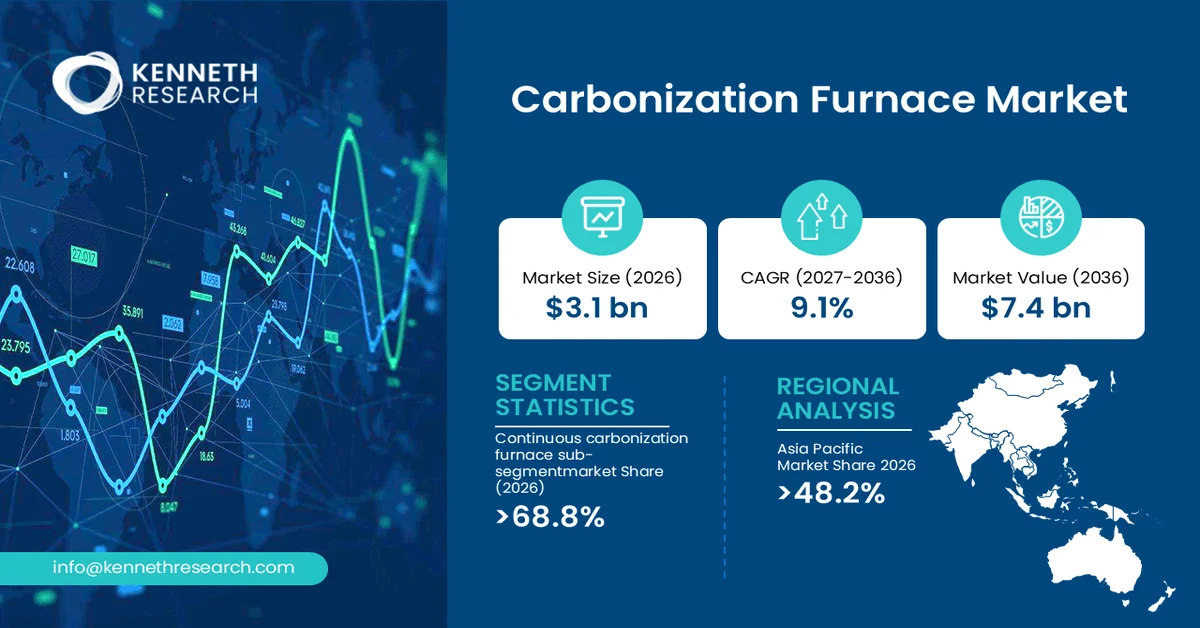
Carbonization Furnace Market size was valued at USD 3.1 billion in 2026 and is projected to reach USD 7.4 billion by the end of 2036, rising at a CAGR of 9.1% during the forecast period, i.e., 2027-2036. In 2027, the industry size of the carbonization furnace is estimated at USD 3.4 billion.
The increasing need to convert biomass, coal, and other carbonaceous feedstocks into higher-value carbon products is driving investment in carbonization furnaces.
The carbonization furnace market comprises industrial thermal-processing equipment designed to convert carbonaceous feedstocks into carbon-rich solid products through controlled heating in an oxygen-limited environment. Depending on the feedstock and intended output, furnaces can process biomass, wood residues, agricultural waste, coal, coke-related materials, and other organic carbonaceous inputs.
Key characteristics include furnace configuration, operating temperature, residence time, heating method, atmosphere control, feedstock-handling capability, thermal efficiency, emission management, automation, and continuous or batch operation.
Key Carbonization Furnace Market Insights Summary:
Key Takeaways: Market Trends & Insights
- Carbonization Furnace Market is projected to grow from USD 3.1 billion in 2026 to USD 7.4 billion by 2036, expanding at a CAGR of 9.1% during the forecast period.
- Asia-Pacific accounted for the largest regional share at 48.2% in 2026, supported by strong biomass availability, industrial manufacturing capabilities, and expanding carbonization activity across Japan and China.
- Continuous Carbonization Furnace remained the leading furnace type with a 68.8% share in 2026, supported by higher process continuity, automated feed handling, consistent thermal conditions, and suitability for commercial-scale carbonization operations.
- Medium-scale Furnaces are positioned for continued growth because they offer a balance between processing capacity, capital requirements, operational flexibility, and suitability for decentralized biomass and carbon-product processing facilities.
Market Drivers
- Growing industrial interest in biomass carbonization
- Increasing emphasis on thermal-process efficiency and automation
- Rising utilization of carbon-rich products across industrial applications
- Development of scalable continuous thermal-processing technologies
Challenges
- Feedstock variability and process-control requirements
- High capital and supply-chain complexity
Carbonization Furnace Market Overview & Supply Chain
Global adoption of carbonization furnaces is increasing as industries seek controlled thermal-conversion technologies for biomass residues, carbon products, and other carbonaceous feedstocks. The technology is gaining relevance in biochar production, resource recovery, metallurgical applications, and emerging carbon-material pathways because controlled carbonization can convert low-value feedstocks into useful carbon-rich products.
The value chain begins with biomass producers, forestry operations, agricultural processors, waste-management companies, and other suppliers providing carbonaceous feedstocks. Feedstocks are collected, sorted, dried, sized, and prepared according to furnace requirements before entering the carbonization system. Furnace manufacturers supply thermal-processing chambers, heating systems, feeding mechanisms, gas-handling equipment, temperature controls, emission-management systems, and automation. Engineering and equipment-integration companies may subsequently install and commission complete systems at industrial facilities.
Carbonization Furnace Market: Growth Drivers & Challenges
Growth Drivers:
- Growing industrial interest in biomass carbonization: Increasing interest in biomass-derived carbon products is supporting demand for carbonization furnaces capable of converting agricultural residues, forestry materials, and other organic feedstocks into stable carbon-rich products. Controlled carbonization enables industrial operators to manage feedstock conversion, improve product consistency, and integrate thermal processing with downstream applications such as biochar, renewable fuels, and carbon-material production.
- Increasing emphasis on thermal-process efficiency and automation: Industrial users are increasingly seeking carbonization equipment that can provide consistent product quality while reducing energy consumption, operating complexity, and process variability. Modern furnace systems can integrate automated feed handling, temperature monitoring, gas circulation, combustion controls, and emissions-management technologies to maintain stable carbonization conditions. Continuous operation can further improve equipment utilization by enabling uninterrupted feedstock processing and more predictable production.
Challenges
- Feedstock variability and process-control requirements: Carbonization performance can vary substantially according to feedstock moisture, particle size, density, composition, and thermal characteristics. These variations can affect heat transfer, residence time, conversion efficiency, and the quality of the resulting carbonized product. The U.S. Department of Energy's Feedstock-Conversion Interface Consortium specifically identifies feedstock variability as a factor affecting process reliability and product quality and supports research into predictive control of thermochemical conversion processes.
- High capital and supply-chain complexity: Carbonization projects can require significant investment in thermal-processing equipment, feedstock preparation, gas handling, emissions control, product processing, and supporting infrastructure. The complexity increases when projects are designed for integrated carbon-management or resource-recovery applications. The U.S. Department of Energy identifies high capital costs and supply-chain complexity as important challenges for thermochemical biomass-conversion pathways, noting that variable biomass composition and transportation requirements can add to project complexity.
Carbonization Furnace Market Size and Forecast:
| Report Attribute | Details |
|---|---|
| Base Year |
2026 |
| Forecast Period |
2027-2036 |
| CAGR |
9.1% |
| Base Year Market Size (2026) |
USD 3.1 billion |
| Forecast Year Market Size (2036) |
USD 7.4 billion |
| Regional Scope |
|
Carbonization Furnace Market Segmentation Analysis:
Furnace Type Segment Analysis
In the furnace type segment, the continuous carbonization furnace sub-segment is anticipated to capture the largest market share of 68.8% in 2026.
Its dominance is supported by the ability to maintain uninterrupted feedstock processing, stable thermal conditions, consistent residence time, and more predictable carbon-product quality. Continuous systems are particularly attractive for industrial operators seeking higher operational efficiency and reduced manual handling compared with batch-oriented configurations.
The U.S. Forest Service has demonstrated continuous biochar production using a mobile pyrolysis unit designed to process residual woody biomass, showing the practical application of continuous thermal-conversion equipment for converting forest residues into carbon-rich products.
Capacity Segment Analysis
In the capacity segment, the medium-scale furnace sub-segment is anticipated to witness strong growth because these systems provide a practical balance between production capability, investment requirements, operational flexibility, and feedstock-handling needs. Medium-scale configurations are particularly suitable for commercial operators and regional processing facilities that require more consistent output than small batch systems without the infrastructure burden associated with very large industrial installations.
Demand is also supported by the increasing availability of biomass feedstocks and the development of decentralized carbonization applications. India's Ministry of New and Renewable Energy reported that the country generates approximately 750 million tonnes of biomass annually, including substantial agricultural and forestry residues, supporting the availability of feedstocks for distributed thermal-conversion projects.
Our in-depth analysis of the global carbonization furnace market includes the following segments:
|
Segment |
Sub-segment |
|
Furnace Type |
|
|
By Capacity |
|
|
By End User Industry |
|
|
By Feedstock |
|
Carbonization Furnace Market Regional Insights:
Asia-Pacific Market Trends & Insights:
Asia-Pacific holds the dominant regional position, accounting for 48.2% in 2026 according to the provided market input. Regional leadership is supported by extensive biomass resources, established thermal-processing capabilities, industrial manufacturing infrastructure, and government initiatives promoting biomass utilization and resource recovery.
Japan has a mature industrial base for thermal-processing technologies and is advancing biomass utilization through government-supported programs. Japan's Ministry of the Environment also recognizes carbonization technologies for resource recovery, including systems that convert sewage sludge into activated carbon under controlled low-oxygen conditions.
China represents a major regional manufacturing and industrial-processing center. Government policy is increasingly supporting biomass utilization and low-carbon industrial technologies, including the integration of biomass into existing energy systems.
North America Market Trends & Insights:
North America represents an important market for carbonization furnaces, supported by growing interest in biomass utilization, carbon removal, biochar production, and waste-to-value technologies. The region benefits from established industrial infrastructure, technology development capabilities, and increasing efforts to convert agricultural and forestry residues into higher-value carbon products.
U.S. is the primary contributor, supported by its large agricultural and forestry resource base, expanding biochar activity, and investment in carbon-management technologies. The country's established industrial ecosystem also supports development and deployment of automated carbonization equipment.
Canada offers opportunities through its substantial forestry resources and growing focus on biomass utilization and carbon removal. Availability of wood residues provides a favorable feedstock base for carbonization applications, while clean-technology initiatives can encourage investment in efficient thermal-conversion systems.
Leading Companies Operating in the Global Carbonization Furnace Market:
Here is a list of upstream, downstream, and key players operating in the global carbonization furnace market competitive ecosystem:
- Zhengzhou Yirui Carbonization Equipment (China)
- Company Overview
- Business Strategy
- Key Product Offerings
- Financial Performance
- Key Performance Indicators
- Risk Analysis
- Recent Development
- Regional Presence
- SWOT Analysis
- Henan Olten Environmental Sci-Tech (China)
- GBL Group (China)
Recent Developments
- January 2025: Henan Olten Environmental Sci-Tech published an updated technical development covering the carbonization process and the operating stages of carbonization equipment, including drying, pyrolysis, and final carbonization.
- May 2025: Henan Olten Environmental Sci-Tech published a technical development covering traditional, continuous industrial, and emerging biomass-carbonization technologies.
Frequently Asked Question
In 2026, the carbonization furnace market exceeded USD 3.1 billion.
The carbonization furnace market is projected to reach USD 7.4 billion by the end of 2036, expanding at a CAGR of 9.1% over the forecast period (2027-2036).
The major players in the market are LEEMAY Machinery, Zhengzhou Yirui Carbonization Equipment, Henan Olten Environmental Sci-Tech, GBL Group, and others.
In the furnace type segment, the continuous carbonization furnace sub-segment is anticipated to capture the largest market share of 68.8% in the future and exhibit lucrative growth opportunities during 2027-2036.
Asia-Pacific is projected to hold the largest market share of 48.2% by the end of 2026 and provide more business opportunities in the future.
Why Choose Kenneth Research ?
-
Insight with Impact : We don’t just gather data — we uncover stories, trends, and opportunities that fuel business growth.
-
Experts Who Get It : Our team speaks your industry’s language and knows what really matters to your customers and market.
-
Custom-Built for You : Forget one-size-fits-all. We craft research and consulting solutions as unique as your business vision.
-
Partners, Not Just Providers : We work with you, not for you — collaborating closely to turn insights into smart, strategic moves.
-
Results That Speak : Our work powers brands, startups, and industry leaders alike — with a track record of ideas that work in the real world.
Report ID: 1338 |
Published Date: 10 Sep 2026 |
Report Format: |
Delivery Timeline: 48-72 Business Hours

Copyright © 2025 Kenneth Research. All rights reserved. Terms of Use | Privacy Policy
