Report ID: 1118 |
Published Date: 20 Aug 2026 |
Report Format: |
Delivery Timeline: 48-72 Business Hours
Carbon Nanomaterials Market Outlook:
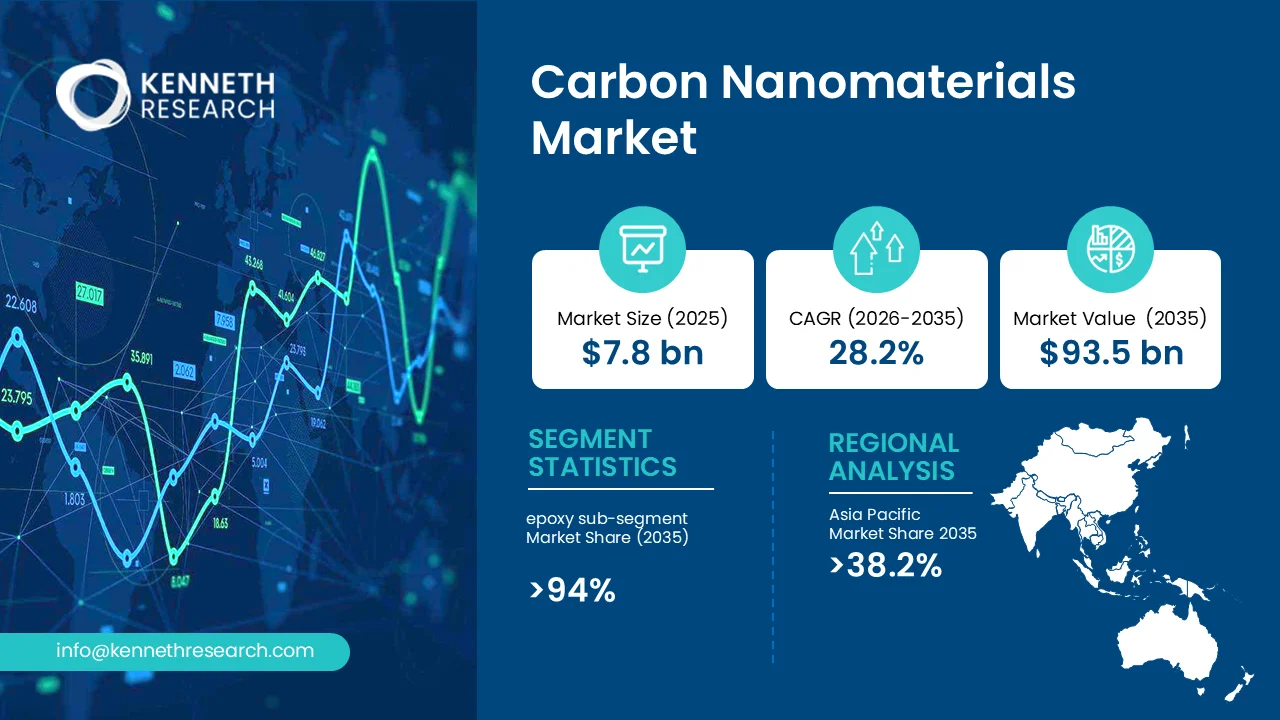
Carbon Nanomaterials Market size was valued at USD 7.8 billion in 2025 and is projected to reach USD 93.5 billion by the end of 2035, rising at a CAGR of 28.2% during the forecast period, i.e., 2026-2035. In 2026, the industry size of the carbon nanomaterials is estimated at USD 10 billion.
The primary growth driver for the carbon nanomaterials market is the accelerating integration of advanced nanomaterials into high-performance industrial applications. Demand for lightweight, conductive, and mechanically robust materials across electronics, energy storage, healthcare, aerospace, and advanced manufacturing continues to increase as industries prioritize innovation, efficiency, product durability, and next-generation material performance.
The carbon nanomaterials market comprises the global production, development, commercialization, and application of engineered carbon-based nanostructures, including fullerenes, carbon nanotubes, graphene derivatives, carbon nanofibers, and related nanoscale materials. These materials are characterized by exceptionally high surface area, superior electrical and thermal conductivity, outstanding mechanical strength, chemical stability, and unique optical properties resulting from their nanoscale structure. Their tunable characteristics enable manufacturers to optimize performance for highly specialized industrial and scientific applications.
Carbon nanomaterials have become strategically important across multiple industries because they enhance product functionality while supporting lightweight design, improved energy efficiency, and superior durability. They are increasingly incorporated into advanced composites, batteries, supercapacitors, semiconductor components, medical devices, drug delivery systems, coatings, sensors, filtration technologies, and environmental remediation solutions. Continuous advances in nanotechnology research, scalable manufacturing techniques, and material engineering have broadened commercial adoption across both established and emerging sectors. As industries increasingly focus on high-performance materials capable of supporting next-generation technologies, carbon nanomaterials continue to play a pivotal role in enabling innovation, improving operational efficiency, and expanding the capabilities of modern industrial manufacturing and advanced product development.
Key Carbon Nanomaterials Market Insights Summary:
Key Takeaways: Market Trends & Insights
- Carbon nanomaterials Market is projected to grow from USD 7.8 billion in 2025 to USD 93.5 billion by 2035 at a 28.2% CAGR.
- Asia Pacific is projected to lead the global market with a 38.2% share by 2035, supported by strong nanotechnology research, advanced manufacturing capabilities, and expanding electronics and energy storage industries across Japan and China.
- Fullerenes are expected to remain the leading type segment with a 94% market share, driven by their broad commercial adoption in electronics, healthcare, energy storage, coatings, and advanced industrial applications.
- The Medical & Healthcare end-user segment is anticipated to witness robust growth as carbon nanomaterials gain wider adoption in biosensors, targeted drug delivery, regenerative medicine, medical imaging, implantable devices, and precision diagnostics.
- The market continues to benefit from increasing investment in advanced battery technologies, high-performance electronics, sustainable manufacturing, and next-generation nanotechnology innovation, accelerating the commercialization of carbon nanomaterial-based solutions across multiple industries.
Market Drivers
- Growing adoption of lightweight conductive composites in aerospace and automotive manufacturing.
- Increasing commercialization of nanomaterial-enabled environmental remediation, water treatment, and advanced filtration technologies.
- Expanding investment in advanced battery and energy storage technologies.
- Increasing integration into high-performance electronics and medical technologies.
Challenges
- Limited manufacturing standardization and quality consistency.
- Complex regulatory compliance and commercial adoption barriers.
Carbon Nanomaterials Market Overview & Supply Chain
Growing global adoption of carbon nanomaterials is being driven by the need for advanced materials capable of delivering superior electrical conductivity, mechanical strength, thermal stability, and lightweight performance across high-value industries. Their expanding use in energy storage systems, semiconductor manufacturing, biomedical technologies, aerospace components, and environmental applications aligns with increasing public and private investment in advanced materials innovation. Regulatory agencies and international organizations are also strengthening frameworks for the responsible development and commercialization of nanotechnology, supporting wider industrial confidence. Reflecting this momentum, the Organisation for Economic Co-operation and Development (OECD) maintains internationally comparable indicators for public-sector nanotechnology R&D expenditures covering government and higher education sectors through 2023, highlighting sustained governmental investment in nanotechnology research and innovation.
The carbon nanomaterials industry value chain begins with the sourcing of high-purity carbon feedstocks, hydrocarbon gases, graphite, catalysts, specialty chemicals, and process gases used for synthesizing nanoscale carbon structures. Material manufacturers employ production technologies such as chemical vapor deposition, arc discharge, laser ablation, and advanced purification techniques to achieve consistent material quality and application-specific properties. Following production, materials undergo characterization, functionalization, quality assurance, and packaging before being supplied through specialty chemical distributors, advanced material suppliers, and direct industrial procurement channels. Downstream participants integrate carbon nanomaterials into composites, electronic components, batteries, coatings, filtration systems, sensors, medical products, and research applications. Major stakeholders include raw material suppliers, nanomaterial manufacturers, equipment providers, research institutions, technology developers, contract manufacturers, regulatory authorities, industrial OEMs, healthcare companies, electronics producers, energy solution providers, and academic laboratories collaborating to accelerate commercialization and application development across multiple end-use industries.
Carbon Nanomaterials Market: Growth Drivers & Challenges
Growth Drivers:
- Expanding investment in advanced battery and energy storage technologies: The transition toward electrification and renewable energy systems is significantly increasing demand for advanced materials that improve battery efficiency, conductivity, thermal management, and operational life. Carbon nanomaterials are increasingly incorporated into lithium-ion batteries, next-generation solid-state batteries, supercapacitors, and conductive additives because they enhance charge transport and structural stability. Their ability to improve energy density while reducing material weight makes them valuable across electric mobility and stationary energy storage applications. Continued investment in battery innovation is expected to accelerate commercialization of high-performance carbon nanomaterials and stimulate collaboration between material developers, battery manufacturers, and research institutions. This trend is likely to strengthen production capabilities, encourage process innovation, and expand application opportunities across global energy infrastructure. Supporting this direction, the International Energy Agency (IEA) reported that global electric car sales exceeded 17 million in 2024, reflecting the rapidly growing ecosystem supporting advanced battery technologies.
- Increasing integration into high-performance electronics and medical technologies: Carbon nanomaterials are becoming increasingly important in advanced electronics and healthcare because they combine exceptional electrical performance with mechanical flexibility and chemical stability. Semiconductor manufacturers, sensor developers, medical device companies, and diagnostic technology providers are investing in materials capable of supporting miniaturization and higher device performance. Functionalized carbon nanomaterials enable improved biosensing, conductive coatings, flexible electronics, implantable devices, and precision diagnostic platforms while also supporting next-generation wearable technologies. As manufacturing processes become more scalable and quality standards continue to mature, industrial adoption is expected to broaden beyond research-oriented applications into mainstream commercial production. Future innovation in printable electronics, smart medical devices, personalized healthcare technologies, and multifunctional materials is expected to further strengthen long-term demand for engineered carbon nanomaterials across multiple technology-intensive industries.
Challenges:
- Limited manufacturing standardization and quality consistency: One of the most significant restraints affecting the carbon nanomaterials market is the difficulty of achieving consistent material quality at commercial production scale. Variations in particle size, purity, morphology, structural defects, and surface functionalization can influence the performance of carbon nanomaterials across end-use applications. These inconsistencies complicate product qualification, increase validation requirements, and make it difficult for manufacturers to guarantee uniform performance across production batches. As a result, downstream industries such as electronics, healthcare, aerospace, and energy often require extensive testing before integrating these materials into commercial products. The additional quality assurance burden increases production costs, extends commercialization timelines, and creates procurement uncertainty. Future market expansion will depend on broader adoption of standardized manufacturing processes, internationally accepted characterization methods, and robust quality management systems that improve reproducibility across the global supply chain.
- Complex regulatory compliance and commercial adoption barriers: Commercial adoption of carbon nanomaterials remains constrained by evolving regulatory frameworks governing nanomaterial safety, environmental management, workplace exposure, and product approval. Manufacturers operating across multiple jurisdictions must navigate differing regulatory definitions, documentation requirements, testing protocols, and compliance expectations, increasing both administrative complexity and development costs. These obligations are particularly challenging for smaller producers seeking international market access, as they require substantial investment in toxicological evaluation, product stewardship, and regulatory documentation. Customers in highly regulated industries also tend to adopt new nanomaterial technologies cautiously, resulting in extended qualification cycles and slower purchasing decisions. Over the longer term, greater international regulatory harmonization, clearer technical guidance, and improved safety assessment methodologies are expected to reduce uncertainty, support wider commercialization, and facilitate broader industrial acceptance of carbon nanomaterial-based products.
Carbon Nanomaterials Market Size and Forecast:
| Report Attribute | Details |
|---|---|
| Base Year |
2025 |
| Forecast Year |
2026-2035 |
| CAGR |
28.2% |
| Base Year Market Size (2025) |
USD 7.8 billion |
| Forecast Year Market Size (2035) |
USD 93.5 billion |
| Regional Scope |
|
Carbon Nanomaterials Market Segmentation Analysis:
Type Segment Analysis
In the type segment, the fullerenes sub-segment is anticipated to capture the largest market share of 94% by the end of 2035.
The fullerenes sub-segment dominates the carbon nanomaterials market owing to its well-established commercial availability, exceptional electron-accepting capability, molecular stability, and broad applicability across pharmaceuticals, electronics, energy storage, coatings, lubricants, and advanced research. Compared with several emerging carbon nanomaterials, fullerenes benefit from a longer commercialization history, enabling manufacturers to develop mature production processes, dependable quality control, and established customer relationships. Demand is further supported by their compatibility with organic photovoltaic devices, conductive materials, catalysts, antioxidant formulations, and biomedical research, where their unique molecular structure delivers specialized functional properties. On the supply side, continued improvements in purification technologies, scalable synthesis methods, and specialized processing have strengthened production reliability while supporting industrial adoption across high-value applications. The Japan Science and Technology Agency (JST) identifies "nanoscale high-functional materials" as one of Japan's priority research and development areas in its 2023. Looking ahead, fullerenes are expected to maintain their leadership as manufacturers continue expanding applications in precision healthcare, next-generation electronics, energy technologies, and multifunctional advanced materials, supported by ongoing investments in nanotechnology innovation and industrial-scale production capabilities.
End User Segment Analysis
The medical & healthcare end-user segment is projected to witness robust growth as carbon nanomaterials continue to enable next-generation medical technologies requiring high precision, biocompatibility, and multifunctional performance. Their unique electrical, mechanical, and surface characteristics support applications in biosensors, targeted drug delivery, tissue engineering, medical imaging, implant coatings, regenerative medicine, and advanced diagnostic devices. Healthcare manufacturers are increasingly collaborating with nanotechnology developers to improve device sensitivity, therapeutic efficiency, and patient outcomes while supporting the development of personalized medicine. On the supply side, advances in material purification, functionalization techniques, and scalable manufacturing processes are improving the consistency required for regulated medical applications. Demand is also supported by sustained investment in pharmaceutical innovation and medical technologies. According to the OECD, retail pharmaceuticals accounted for around one-sixth of total health spending across OECD countries in 2023, underscoring the continued expansion of advanced healthcare technologies that increasingly incorporate high-performance materials.
Our in-depth analysis of the global carbon nanomaterials market includes the following segments:
|
Segment |
Sub-segment |
|
Type |
|
|
Method of Production |
|
|
Application |
|
|
End User |
|
|
Distribution Channel |
|
Carbon Nanomaterials Market Regional Insights:
Asia Pacific Market Trends & Insights:
Asia Pacific is projected to account for 38.2% of the carbon nanomaterials market by 2035, making it the leading regional market throughout the forecast period.
The region's leadership is supported by its well-established advanced materials manufacturing ecosystem, strong semiconductor and electronics industries, expanding battery value chain, and sustained investments in nanotechnology research and commercialization. Governments across the region continue to promote advanced manufacturing, high-value chemicals, clean energy technologies, and research commercialization through long-term innovation initiatives. The presence of integrated supply chains, specialized production facilities, research institutes, and major end-use manufacturers further strengthens regional competitiveness. Increasing adoption of carbon nanomaterials across electronics, healthcare, automotive, aerospace, and energy applications continues to reinforce Asia Pacific's position as the principal production and consumption hub for advanced carbon-based nanomaterials. Japan and China remain central contributors to regional leadership.
Japan benefits from internationally recognized expertise in precision materials engineering, nanotechnology research, and high-value manufacturing, enabling continued innovation in specialty carbon nanomaterials for electronics, healthcare, and energy applications.
China complements this strength through large-scale manufacturing capabilities, extensive industrial infrastructure, and growing commercialization of advanced materials across strategic industries. Supporting the region's technological leadership, the World Intellectual Property Organization (WIPO) reported that China remained the world's largest filer of Patent Cooperation Treaty (PCT) applications in 2024, highlighting the country's sustained innovation activity in advanced technologies, including materials science. Together, Japan's technology-driven innovation and China's manufacturing scale create a highly competitive regional ecosystem that is expected to sustain Asia Pacific's leadership in the development, production, and commercialization of carbon nanomaterials across diverse industrial sectors.
North America Market Trends & Insights:
North America represents a strategically important market for carbon nanomaterials, supported by strong demand from advanced manufacturing, aerospace, defense, healthcare, electronics, and clean energy industries. The region benefits from a mature innovation ecosystem that connects research institutions, technology developers, material manufacturers, and industrial end users, enabling the rapid commercialization of advanced nanomaterial technologies. Government-backed research programs, public-private partnerships, and continued investment in semiconductor manufacturing, energy storage, and sustainable industrial technologies are encouraging wider adoption of high-performance carbon nanomaterials. Increasing emphasis on domestic supply chain resilience, advanced material innovation, and next-generation manufacturing is expected to create new commercial opportunities for producers. As industrial users seek materials offering enhanced conductivity, strength, and multifunctionality, carbon nanomaterials are anticipated to become increasingly integrated into high-value applications across multiple sectors.
The United States serves as the regional innovation hub, driven by extensive research capabilities, established advanced manufacturing infrastructure, and strong collaboration between national laboratories, universities, and private industry. The country continues to accelerate the commercialization of nanotechnology-enabled solutions in medical devices, aerospace systems, energy storage, electronics, and defense applications.
Canada complements this ecosystem through its strengths in advanced materials research, clean technology development, and university-led innovation, while supporting commercialization through collaborative research initiatives and industrial partnerships. Growing investments in sustainable manufacturing, battery technologies, and high-value materials are expected to strengthen Canada's role in the regional value chain. Together, the United States and Canada provide a robust foundation for continued technological advancement, supply chain development, and broader industrial adoption of carbon nanomaterials across North America.
Leading Companies Operating in the Global Carbon Nanomaterials Market:
Here is a list of upstream, downstream, and key players operating in the global carbon nanomaterials market competitive ecosystem:
- Nano-C Inc.(United States)
- Company Overview
- Business Strategy
- Key Product Offerings
- Financial Performance
- Key Performance Indicators
- Risk Analysis
- Recent Development
- Regional Presence
- SWOT Analysis
- OCSiAl(Luxembourg)
- Arkema S.A.(France)
- Nanocyl S.A.(Belgium)
- Resonac Corporation(Japan)
Recent Developments
- November 2025: OCSiAl announced the development of the world's largest graphene nanotube manufacturing hub in Differdange, Luxembourg, supported by a long-term land lease with the Government of Luxembourg and recent investment funding.
- February 2025: Arkema showcased new specialty material innovations, including composite and battery technologies, at JEC World 2025.
- April 2026: OCSiAl introduced new TUBALL™ single-wall carbon nanotube solutions for advanced battery electrode applications.
Frequently Asked Question
In 2025, the carbon nanomaterials market exceeded USD 7.8 billion.
The carbon nanomaterials market is projected to reach USD 93.5 billion by the end of 2035, expanding at a CAGR of 28.2% over the forecast period (2026-2035).
The major players in the market are Nano-C Inc., OCSiAl, Arkema S.A., Nanocyl S.A., Resonac Corporation, and others.
In the type segment, the fullerenes sub-segment is anticipated to capture the largest market share of 94% in the future and exhibit lucrative growth opportunities during 2026-2035. This growth trajectory is largely attributed to increasing adoption in advanced electronics, energy storage, healthcare, and high-performance industrial applications due to its exceptional electrical and molecular properties.
Asia Pacific is projected to hold the largest market share of 38.2% by the end of 2035 and provide more business opportunities in the future. Continuous investments in advanced materials manufacturing, nanotechnology innovation, and electronics and energy storage industries across Japan and China are fostering the region's dominance.
Why Choose Kenneth Research ?
-
Insight with Impact : We don’t just gather data — we uncover stories, trends, and opportunities that fuel business growth.
-
Experts Who Get It : Our team speaks your industry’s language and knows what really matters to your customers and market.
-
Custom-Built for You : Forget one-size-fits-all. We craft research and consulting solutions as unique as your business vision.
-
Partners, Not Just Providers : We work with you, not for you — collaborating closely to turn insights into smart, strategic moves.
-
Results That Speak : Our work powers brands, startups, and industry leaders alike — with a track record of ideas that work in the real world.
Report ID: 1118 |
Published Date: 20 Aug 2026 |
Report Format: |
Delivery Timeline: 48-72 Business Hours

Copyright © 2025 Kenneth Research. All rights reserved. Terms of Use | Privacy Policy
