Report ID: 1105 |
Published Date: 18 Aug 2026 |
Report Format: |
Delivery Timeline: 48-72 Business Hours
Carbon Fiber Composites Market Outlook:
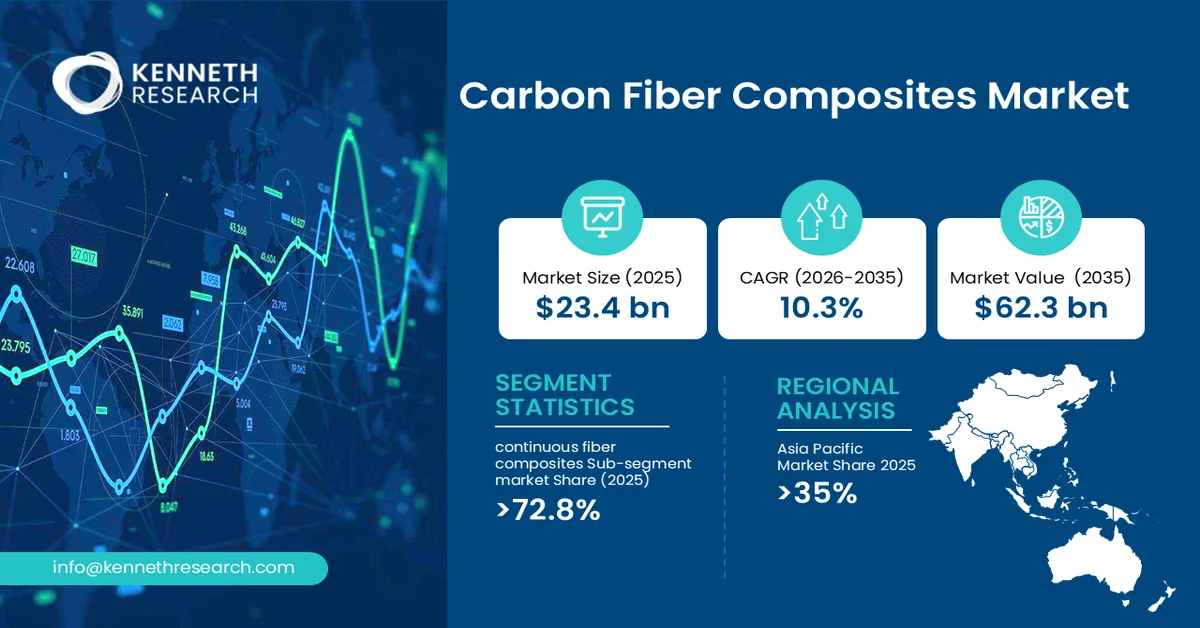
Carbon Fiber Composites Market size was valued at USD 23.4 billion in 2025 and is projected to reach USD 62.3 billion by the end of 2035, rising at a CAGR of 10.3% during the forecast period, i.e., 2026-2035. In 2026, the industry size of the carbon fiber composites is estimated at USD 25.8 billion.
Growing demand for lightweight, high-strength materials across aerospace, automotive, wind energy, and infrastructure is the primary growth driver of the carbon fiber composites market. Government-backed decarbonization initiatives and fuel-efficiency regulations are accelerating the adoption of advanced composite materials that improve structural performance while reducing weight, emissions, and lifecycle operating costs.
The carbon fiber composites market comprises engineered materials produced by combining carbon fibers with polymer, metal, or ceramic matrices to create lightweight structures with exceptional mechanical performance. These composites provide superior strength-to-weight ratio, stiffness, fatigue resistance, corrosion resistance, and dimensional stability compared with conventional metallic materials, making them suitable for demanding structural and semi-structural applications.
Carbon fiber composites are manufactured in multiple forms, including continuous and discontinuous fiber reinforcements, and are processed through technologies such as prepreg layup, resin transfer molding, filament winding, pultrusion, and compression molding. Their ability to withstand harsh operating environments while minimizing component weight enables manufacturers to improve energy efficiency, extend service life, and reduce maintenance requirements.
Key Carbon Fiber Composites Market Insights Summary:
Key Takeaways: Market Trends & Insights
- Carbon Fiber Composites Market projected to grow from USD 23.4 billion in 2025 to USD 62.3 billion by 2035 at a 10.3% CAGR.
- Asia Pacific accounted for the largest regional share at 35% in 2025, supported by strong manufacturing capabilities, expanding aerospace production, renewable energy investments, and advanced materials development across Japan and China.
- Continuous Fiber Composites are expected to remain the leading Fiber Form segment with a 72.8% market share, driven by increasing demand for high-strength, lightweight materials in aerospace, automotive, wind energy, and industrial applications.
- PAN-based Carbon Fiber Composites are projected to witness robust growth owing to their superior mechanical properties, broad industrial adoption, and expanding use in hydrogen storage systems, advanced mobility, and renewable energy infrastructure.
- The market is benefiting from increasing adoption of lightweight engineering materials, continuous advancements in composite manufacturing technologies, growing investments in sustainable transportation and clean energy, and expanding utilization across high-performance structural applications.
Market Drivers
- Growing adoption of electric vehicles requiring lightweight structural materials.
- Increasing investments in automated composite manufacturing technologies.
- Rising demand for high-pressure hydrogen storage vessels for the clean energy economy.
- Expanding defense modernization programs utilizing advanced composite structures.
Challenges
- High production costs and limited cost competitiveness.
- Recycling complexity and end-of-life material management.
Carbon Fiber Composites Market Overview & Supply Chain
Global adoption of carbon fiber composites is accelerating as industries prioritize lightweight, high-performance materials to improve energy efficiency, durability, and lifecycle performance. Aerospace manufacturers use advanced composites to reduce aircraft weight and fuel consumption, while automotive producers integrate them to support vehicle electrification and stricter emissions requirements. Demand is also expanding across wind energy, pressure vessels, industrial machinery, and infrastructure, where superior mechanical strength and corrosion resistance deliver long-term operational benefits. Government-led investments in clean energy infrastructure further reinforce the strategic importance of advanced composite materials. According to the International Energy Agency, wind-generated electricity supplied 10.1% of the European Union's electricity demand in 2024, highlighting the continued expansion of wind energy installations that increasingly utilize carbon fiber composite components for larger, more efficient turbine blades
The carbon fiber composites value chain begins with precursor materials such as polyacrylonitrile (PAN), pitch, or rayon, together with matrix materials including epoxy, polyester, thermoplastic, ceramic, or metal resins sourced from specialty chemical manufacturers. Carbon fiber producers convert these precursors into high-strength fibers through stabilization, carbonization, surface treatment, and sizing processes before supplying them to composite manufacturers. Fabricators then combine fibers with selected matrices using manufacturing techniques such as prepreg processing, resin transfer molding, filament winding, pultrusion, compression molding, or automated fiber placement to produce finished components. Distribution occurs through direct supply agreements, industrial distributors, engineering contractors, and original equipment manufacturers serving specialized applications. End users include aerospace, automotive, wind energy, construction, marine, defense, pressure vessel, and industrial equipment sectors. Key stakeholders comprise precursor suppliers, carbon fiber manufacturers, resin producers, composite fabricators, OEMs, engineering firms, certification agencies, and maintenance service providers.
Carbon Fiber Composites Market: Growth Drivers & Challenges
Growth Drivers:
- Expanding aerospace programs and aircraft lightweighting initiatives: The aerospace industry's continued emphasis on reducing aircraft weight while improving structural performance is a major catalyst for the carbon fiber composites market. Carbon fiber composites enable manufacturers to produce lighter airframes, wings, fuselage sections, and interior components without compromising strength or durability, improving fuel efficiency and operational economics. As commercial aviation recovers and next-generation aircraft platforms incorporate a greater proportion of advanced composites, demand continues to strengthen across the supply chain. Government agencies are simultaneously supporting sustainable aviation technologies and advanced manufacturing, encouraging broader adoption of high-performance composite materials. The resulting investments in aircraft modernization, certification of composite-intensive designs, and manufacturing automation are expected to expand long-term opportunities for material suppliers, component manufacturers, and aerospace OEMs while accelerating innovation in composite processing technologies. In September 2023, the U.S. Federal Aviation Administration (FAA) announced nearly $300 million to support sustainable aviation fuel infrastructure and low-emission aviation technologies, reinforcing government investment in next-generation aviation technologies that increasingly rely on advanced composite materials.
- Rising adoption across wind energy and industrial infrastructure: The increasing deployment of renewable energy infrastructure is creating sustained demand for carbon fiber composites, particularly in large wind turbine blades where high stiffness, fatigue resistance, and low weight are essential for improving energy generation efficiency. Beyond renewable energy, industries including pressure vessels, marine, construction, and industrial equipment are replacing conventional materials with advanced composites to improve durability, corrosion resistance, and lifecycle performance. Manufacturers are also investing in automated production technologies that enhance consistency while reducing manufacturing costs and material waste. As governments and industries pursue decarbonization, electrification, and infrastructure modernization, the use of high-performance composite materials is expected to expand into additional structural applications. This diversification of end-use industries reduces dependence on any single sector and strengthens the long-term growth outlook for composite manufacturers and technology developers.
Challenges:
- High production costs and limited cost competitiveness: The production of carbon fiber composites involves energy-intensive precursor conversion, specialized manufacturing equipment, strict process controls, and extensive quality assurance, resulting in significantly higher production costs than conventional engineering materials. Complex fabrication methods, including autoclave curing and precision layup, further increase capital expenditure and manufacturing lead times. These cost barriers restrict adoption in price-sensitive industries where performance advantages alone may not justify premium material expenses. Commercially, manufacturers must balance investments in advanced production technologies with customer expectations for competitive pricing, placing pressure on operating margins. Looking ahead, wider commercialization will depend on manufacturing automation, process optimization, recyclable composite technologies, and economies of scale that can reduce overall production costs while maintaining consistent product quality and structural reliability.
- Recycling complexity and end-of-life material management: Carbon fiber composites present significant end-of-life management challenges because the strong bond between reinforcing fibers and matrix materials makes separation and material recovery technically demanding. Existing recycling technologies often recover fibers with reduced mechanical performance, limiting their suitability for high-value structural applications. In addition, the absence of standardized recycling infrastructure and varying regulatory approaches across regions complicate circular economy implementation. These limitations create commercial uncertainty for manufacturers seeking to meet sustainability objectives while controlling disposal and compliance costs. As environmental regulations become more stringent, companies are expected to increase investment in recyclable resin systems, advanced fiber recovery methods, closed-loop manufacturing processes, and product designs that improve material recoverability without compromising performance.
Carbon Fiber Composites Market Size and Forecast:
| Report Attribute | Details |
|---|---|
| Base Year |
2025 |
| Forecast Year |
2026-2035 |
| CAGR |
10.3% |
| Base Year Market Size (2025) |
USD 23.4 billion |
| Forecast Year Market Size (2035) |
USD 62.3 billion |
| Regional Scope |
|
Carbon Fiber Composites Market Segmentation Analysis:
Fiber Form Segment Analysis
In the fiber form segment, the continuous fiber composites sub-segment is anticipated to capture the largest market share of 72.8% by the end of 2025.
Continuous fiber composites dominate the carbon fiber composites market because they provide the highest levels of tensile strength, stiffness, fatigue resistance, and structural integrity required for mission-critical applications. Their superior load-bearing capability makes them the preferred material for aerospace structures, wind turbine blades, automotive body components, pressure vessels, and industrial equipment where long service life and weight reduction are essential. Demand continues to increase as manufacturers pursue lightweight designs that improve energy efficiency and operational performance without compromising safety. On the supply side, established production capabilities, continuous advancements in automated fiber placement, prepreg manufacturing, and resin infusion technologies have strengthened commercial availability and product consistency. The segment also benefits from long-term qualification programs and engineering standards that encourage adoption in highly regulated industries. Looking ahead, increasing investments in advanced mobility, renewable energy infrastructure, and automated composite manufacturing are expected to reinforce the leadership of continuous fiber composites across high-performance structural applications. According to the U.S. Department of Energy, replacing conventional steel components with carbon fiber composites can reduce vehicle body and chassis weight by 50–70%, demonstrating the material's strategic importance for lightweight transportation applications and supporting sustained demand for continuous fiber composites.
Precursor Type Segment Analysis
PAN-based carbon fiber composites are projected to experience strong growth because they deliver an optimal combination of high tensile strength, stiffness, fatigue resistance, and processing consistency required for demanding structural applications. These characteristics have established PAN-derived fibers as the preferred reinforcement material across aerospace, automotive, wind energy, hydrogen storage vessels, and industrial equipment. Growing emphasis on lightweight engineering, electrification, and low-emission transportation is encouraging manufacturers to increase the use of PAN-based composites in critical components where mechanical reliability is essential. On the supply side, continuous investment in precursor innovation, manufacturing efficiency, and automated production technologies is improving scalability while supporting cost reduction initiatives. Research organizations and industrial manufacturers are also developing next-generation PAN precursor technologies to enhance production efficiency and sustainability. Looking ahead, expanding deployment in hydrogen infrastructure, advanced mobility, and renewable energy systems is expected to reinforce the long-term growth of PAN-based carbon fiber composites as industries demand higher-performance structural materials. The U.S. Department of Energy is supporting a project to develop melt-spun polyacrylonitrile (PAN) precursor technology for high-strength carbon fibers used in hydrogen storage vessels, with the project running from October 15, 2021, through September 30, 2026, demonstrating continued government investment in advancing PAN-based carbon fiber manufacturing for clean energy applications.
Our in-depth analysis of the global carbon fiber composites market includes the following segments:
|
Segment |
Sub-segment |
|
Fiber Form |
|
|
Precursor Type |
|
|
Matrix Type |
|
|
Manufacturing Process |
|
|
Application |
|
|
End User |
|
Carbon Fiber Composites Market Regional Insights:
Asia Pacific Market Trends & Insights:
Asia Pacific accounted for 35% of the carbon fiber composites market in 2025, making it the leading regional market.
The region's dominance is driven by its well-established manufacturing ecosystem, strong aerospace and automotive supply chains, expanding wind energy capacity, and continuous investment in advanced materials production. Governments across the region are promoting industrial modernization, clean energy deployment, and high-value manufacturing, creating favorable conditions for the adoption of carbon fiber composites. The presence of integrated carbon fiber manufacturers, resin suppliers, composite fabricators, and global OEMs further strengthens regional competitiveness by enabling efficient production and localized supply chains. Rising investments in electric mobility, hydrogen infrastructure, and advanced transportation systems are also accelerating the use of lightweight composite materials across multiple industries. These factors collectively position Asia Pacific as the principal production and consumption hub for high-performance carbon fiber composite applications.
Japan remains a global technology leader owing to its advanced carbon fiber manufacturing capabilities, strong aerospace supply chain, and continuous innovation in high-performance materials. Japanese manufacturers have developed sophisticated production technologies that support demanding applications in aviation, automotive, and industrial equipment.
China continues to expand its position through significant investments in domestic aerospace, renewable energy, electric vehicles, and advanced manufacturing, supported by increasing localization of composite production capabilities. The country's expanding industrial base and infrastructure projects are creating sustained demand for structural composite materials. Together, Japan's technological leadership and China's manufacturing scale reinforce Asia Pacific's position as the world's leading regional market for carbon fiber composites. According to Japan's Ministry of Economy, Trade and Industry (METI), the country's 2025 Current Survey of Production continues to monitor output across transport machinery, chemicals, plastics, and other manufacturing industries, reflecting the strength of Japan's advanced manufacturing base that underpins carbon fiber composite production and downstream industrial applications.
North America Market Trends & Insights:
North America represents a strategically important region for the carbon fiber composites market, supported by strong demand from aerospace, defense, automotive, renewable energy, industrial equipment, and clean energy infrastructure. The region benefits from a mature advanced manufacturing ecosystem, extensive research and development capabilities, and close collaboration among material suppliers, technology developers, universities, and original equipment manufacturers. Government initiatives promoting domestic manufacturing, sustainable transportation, advanced aviation technologies, hydrogen infrastructure, and energy transition continue to encourage the adoption of high-performance composite materials. In addition, increasing investments in manufacturing automation, digital production technologies, and next-generation material development are improving production efficiency and expanding commercial opportunities. The region is also witnessing growing interest in recyclable composite systems and circular manufacturing practices, creating opportunities for innovation throughout the value chain. These factors position North America as a key center for technological advancement and high-value applications of carbon fiber composites.
The United States leads regional demand through its well-established aerospace, defense, automotive, and industrial manufacturing sectors. Continuous investment in advanced materials research, commercial aviation, space exploration, and clean energy technologies supports sustained adoption of carbon fiber composites across critical structural applications. The country also benefits from a comprehensive network of composite manufacturers, engineering firms, research institutions, and OEMs that accelerate commercialization of new technologies.
Canada is strengthening its position through a growing aerospace manufacturing industry, expanding clean energy initiatives, and increasing adoption of advanced composites in transportation, marine, and industrial applications. Collaborative research programs, skilled manufacturing capabilities, and investments in sustainable industrial development are expected to support continued growth in the Canadian carbon fiber composites ecosystem.
Leading Companies Operating in the Global Carbon Fiber Composites Market:
Here is a list of upstream, downstream, and key players operating in the global carbon fiber composites market competitive ecosystem:
- Toray Industries, Inc.(Japan)
- Company Overview
- Business Strategy
- Key Product Offerings
- Financial Performance
- Key Performance Indicators
- Risk Analysis
- Recent Development
- Regional Presence
- SWOT Analysis
- Hexcel Corporation(United States)
- Teijin Limited(Japan)
- Mitsubishi Chemical Carbon Fiber and Composites(United States)
Recent Developments
- December 2025: Mitsubishi Chemical Group announced expansion of carbon fiber manufacturing capacity in Japan and the U.S. for high-end aerospace, sports, and industrial applications.
- September 2025: Hexcel Corporation & HyPerComp Engineering Introduced a Type IV carbon overwrap pressure vessel (COPV) manufactured using HexTow® IM11-R/12K carbon fiber at CAMX 2025.
Frequently Asked Question
In 2025, the carbon fiber composites market exceeded USD 23.4 billion.
The Carbon Fiber Composites Market is projected to reach USD 62.3 billion by the end of 2035, expanding at a CAGR of 10.3% over the forecast period (2026-2035).
The major players in the market are Toray Industries, Inc., Hexcel Corporation, Teijin Limited, Mitsubishi Chemical Carbon Fiber and Composites, SGL Carbon SE, and others.
In the fiber form segment, the continuous fiber composites sub-segment is anticipated to capture the largest market share of 72.8% in the future and exhibit lucrative growth opportunities during 2026-2035. This growth trajectory is largely attributed to increasing adoption of lightweight, high-strength materials across aerospace, automotive, wind energy, and industrial applications.
Asia Pacific is projected to hold the largest market share of 35% by the end of 2025 and provide more business opportunities in the future. Continuous investments in advanced manufacturing, aerospace, electric mobility, and renewable energy across Japan and China are fostering the region's dominance.
Why Choose Kenneth Research ?
-
Insight with Impact : We don’t just gather data — we uncover stories, trends, and opportunities that fuel business growth.
-
Experts Who Get It : Our team speaks your industry’s language and knows what really matters to your customers and market.
-
Custom-Built for You : Forget one-size-fits-all. We craft research and consulting solutions as unique as your business vision.
-
Partners, Not Just Providers : We work with you, not for you — collaborating closely to turn insights into smart, strategic moves.
-
Results That Speak : Our work powers brands, startups, and industry leaders alike — with a track record of ideas that work in the real world.
Report ID: 1105 |
Published Date: 18 Aug 2026 |
Report Format: |
Delivery Timeline: 48-72 Business Hours

Copyright © 2025 Kenneth Research. All rights reserved. Terms of Use | Privacy Policy
