Report ID: 1388 |
Published Date: 25 Sep 2026 |
Report Format: |
Delivery Timeline: 48-72 Business Hours
Capillary Blood Collection Devices Market Outlook:
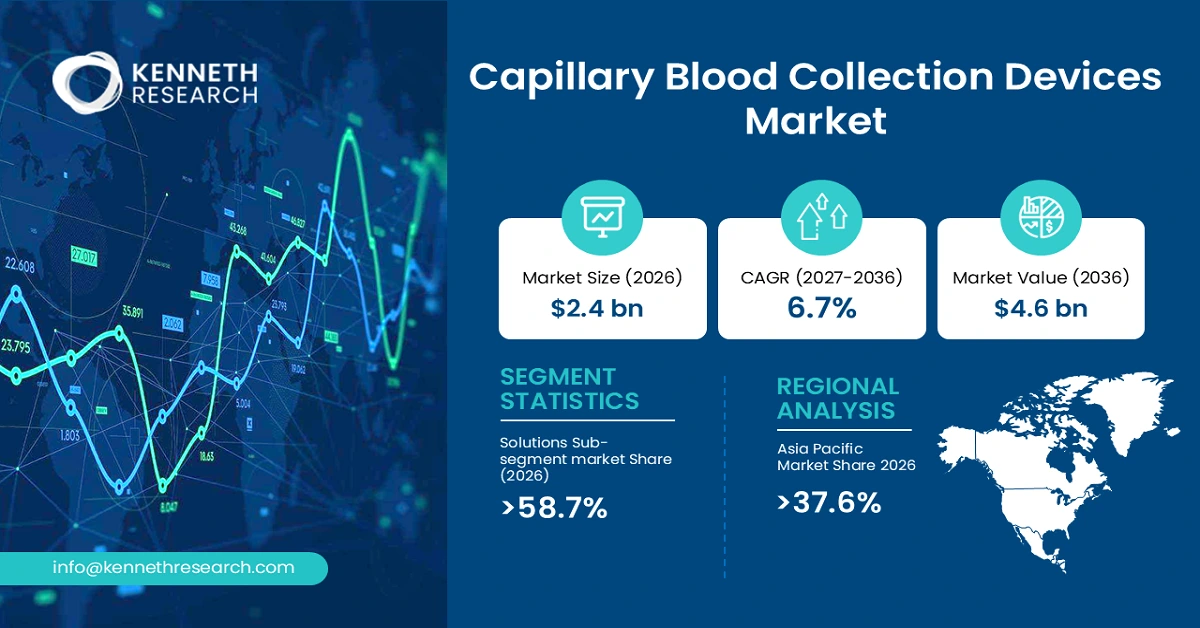
Capillary Blood Collection Devices Market size was valued at USD 2.4 billion in 2026 and is projected to reach USD 4.6 billion by the end of 2036, expanding at a CAGR of 6.7% during the forecast period, i.e., 2027–2036. In 2027, the industry size of the capillary blood collection devices is estimated at USD 2.6 billion.
The rising burden of diabetes is a primary growth driver because routine glucose monitoring requires convenient access to capillary blood. CDC data show that total diabetes prevalence among U.S. adults was 15.8% during August 2021–August 2023, reinforcing demand for practical blood-sampling devices across home monitoring and healthcare settings.
Capillary blood collection devices are medical devices designed to obtain small-volume blood specimens from capillaries near the skin surface for diagnostic or monitoring purposes. The category includes devices such as lancets, capillary collection tubes, micro-collection systems, and related sampling components used to collect, contain, or transport capillary whole blood. The U.S. Food and Drug Administration defines a capillary blood collection device as a blood collection device intended to collect or transport capillary whole-blood specimens for testing clinical analytes.
These devices are characterized by minimally invasive sampling, controlled blood acquisition, compatibility with diagnostic workflows, and designs intended to support safe and efficient specimen handling. Depending on the application, devices may incorporate micro-needles, skin-puncture mechanisms, collection chambers, anticoagulants, or preservatives.
Key Capillary Blood Collection Devices Market Insights Summary:
Key Takeaways: Market Trends & Insights
- The capillary blood collection devices market was valued at USD 2.4 billion in 2026 and is projected to reach USD 4.6 billion by 2036, expanding at a CAGR of 6.7% during 2027–2036
- The plastic segment dominated the material category with a 58.7% market share in 2026, supported by disposability, lightweight construction, and suitability for high-volume medical applications
- Lancets represent the fastest-growing product sub-segment, driven by recurring requirements for finger-stick sampling across diabetes monitoring, point-of-care testing, and home healthcare
- North America led the market with a 37.6% share in 2026, supported by established healthcare infrastructure, diagnostic networks, regulatory maturity, and demand across the United States and Canada.
Market Drivers
- Rising prevalence of diabetes and routine blood-glucose monitoring
- Expansion of decentralized and point-of-care testing
- Increasing adoption of home-based healthcare and self-testing
- Technological advances in minimally invasive capillary sampling devices
Challenges
- Risk of needlestick injuries and increasing user-safety requirements
- Specimen-quality and collection-consistency constraints
Capillary Blood Collection Devices Market Overview & Supply Chain
Adoption of capillary blood collection devices is increasing globally as healthcare systems expand decentralized testing, self-monitoring, and point-of-care diagnostics. These devices enable small-volume specimen collection with limited patient burden and are particularly relevant where rapid testing or conventional venous sampling is less practical. Their importance is reinforced by the growing emphasis on accessible diabetes monitoring and diagnostic capacity.
The value chain begins with sourcing raw materials and specialized inputs, including medical-grade plastics, metals, elastomers, adhesives, coatings, packaging materials, and components used in skin-puncture and micro-collection mechanisms. Manufacturers convert these inputs through molding, forming, machining, assembly, sterilization, packaging, and quality-control processes. Production activities must maintain consistency in dimensions, sterility, puncture performance, specimen containment, and compatibility with diagnostic systems. Finished devices move through distributors, medical-supply companies, laboratory procurement channels, pharmacies, and healthcare networks before reaching end users. Key end users include hospitals, clinics, diagnostic laboratories, physician offices, home-care settings, and individual patients conducting self-testing.
Capillary Blood Collection Devices Market: Growth Drivers & Challenges
Growth Drivers
- Rising Prevalence of Diabetes and Routine Blood-Glucose Monitoring: The increasing prevalence of diabetes is strengthening recurring demand for capillary blood collection devices because glucose monitoring commonly relies on finger-stick blood sampling. The recurring nature of diabetes management also supports repeat consumption of disposable collection devices rather than one-time procurement. Over the coming years, greater emphasis on early detection, disease management, and regular glucose assessment should reinforce demand for reliable, easy-to-use capillary sampling solutions across professional and home-based healthcare environments.
- Expansion of Decentralized and Point-of-Care Testing: The shift toward decentralized diagnostic testing is creating additional demand for capillary blood collection devices because many point-of-care workflows require simple, rapid, and minimally invasive specimen acquisition. Capillary sampling can support testing in physician offices, outpatient centers, pharmacies, community healthcare settings, and home-care environments where conventional venous collection may be less practical.
Challenges
- Risk of Needlestick Injuries and User-Safety Requirements: The risk of accidental needlestick injuries remains a significant restraint because capillary blood collection frequently involves sharp lancing components that must be handled and discarded after use. The root cause is the inherent exposure to needles during skin puncture, device activation, disposal, and, in some settings, specimen handling. This creates operational concerns for healthcare providers and increases the importance of safety-engineered products, controlled activation, and secure post-use disposal.
- Specimen-Quality and Collection-Consistency Constraints: Variability in capillary specimen collection can restrain adoption when inadequate blood volume, excessive squeezing, contamination, or inconsistent puncture technique affects specimen quality. The root cause is that capillary sampling is influenced by collection technique, anatomical conditions, device characteristics, and user experience, creating potential variability compared with standardized professional venous collection. Such inconsistencies can complicate diagnostic workflows, generate repeat sampling requirements, and increase consumable usage.
Capillary Blood Collection Devices Market Size and Forecast:
| Report Attribute | Details |
|---|---|
| Base Year |
2026 |
| Forecast Year |
2027-2036 |
| CAGR |
6.7% |
| Base Year Market Size (2026) |
USD 2.4 Billion |
| Forecast Year Market Size (2037) |
USD 4.6 Billion |
| Regional Scope |
|
Capillary Blood Collection Devices Market Segmentation Analysis:
Material Segment Analysis
In the material segment, plastic sub-segment is anticipated to capture the largest market share of 58.7% by the end of 2026.
The plastic segment dominates the material category because plastic-based capillary collection components combine low weight, manufacturability, transparency, chemical compatibility, and suitability for disposable medical workflows. Demand is supported by the increasing use of micro-collection systems in laboratory and decentralized testing, where containers must safely retain small-volume specimens while enabling visual inspection and straightforward handling. The U.S. CDC’s National Health and Nutrition Examination Survey laboratory protocol for August 2021–August 2023 specifically identifies polypropylene as an acceptable material for blood-collection containers and recommends lot-screened micro-collection containers for capillary blood specimens, demonstrating ongoing use of plastic collection formats in federally conducted laboratory workflows.
Product Segment Analysis
The lancets is projected to grow as the second-largest segment in the capillary blood collection devices market due to four converging demand drivers.
Lancets are projected to grow rapidly within the product category because they are fundamental to finger-stick capillary blood sampling and are consumed repeatedly across diabetes monitoring and point-of-care testing workflows. Demand is supported by the expanding population requiring routine glucose assessment and by greater use of decentralized testing. The U.K. government’s diabetes profile reports that 7.0% of adults aged 17 and over in England had GP-recorded type 2 diabetes at March 2024, demonstrating a substantial patient base requiring ongoing diabetes-management services. Industry adoption is also moving toward safer, more ergonomic lancing systems that improve puncture control and user convenience. Manufacturers can differentiate through controlled penetration, reduced discomfort, safety mechanisms, and compatibility with glucose-monitoring systems.
Our in-depth analysis of the Capillary Blood Collection Devices market includes the following segments:
|
Segment |
Sub-segment |
|
Product |
|
|
Material |
|
|
Application |
|
|
End-User |
|
Capillary Blood Collection Devices Market Regional Insights:
North America Market Trends & Insights:
North America capillary blood collection devices market is projected to hold the largest revenue share of 37.6% by the end of 2026.
It is supported by mature healthcare infrastructure, established diagnostic networks, high adoption of home-based monitoring, and strong demand for disposable sampling products. The region benefits from sophisticated medical-device manufacturing capabilities, established procurement systems, and continued investment in decentralized diagnostics.
Within the region, the United States represents the principal demand center, supported by extensive healthcare infrastructure, diabetes-management programs, diagnostic laboratories, and established medical-device commercialization channels.
Canada provides a complementary market supported by public healthcare delivery, chronic-disease management initiatives, and growing emphasis on accessible monitoring. Collectively, North America's regulatory maturity, healthcare expenditure, established distribution networks, and technological capabilities should sustain its leadership and encourage continued investment in safer, more convenient, and digitally compatible capillary collection technologies.
Asia Pacific Market Trends & Insights:
Asia Pacific presents strong demand potential for capillary blood collection devices as healthcare systems expand decentralized diagnostics, chronic-disease screening, primary-care capacity, and home-based monitoring. Industrial activity is supported by expanding medical-device manufacturing ecosystems, improving diagnostic infrastructure, and greater integration of digital health technologies.
Within China, government emphasis on community screening, primary-level diabetes management, digital health, and diagnostic capability enhancement should support broader adoption of convenient blood-sampling technologies. The country also offers a substantial manufacturing base and expanding domestic medical-device ecosystem.
Japan represents a technologically mature market characterized by sophisticated healthcare delivery, established medical-device capabilities, and strong demand for products supporting chronic-disease management and aging-related healthcare needs. Together, China and Japan provide complementary opportunities: China through healthcare-system expansion and manufacturing scale, and Japan through technology-intensive applications, quality-focused procurement, and advanced diagnostic workflows.
Leading Companies Operating in the Capillary Blood Collection Devices Market:
Here is a list of upstream, downstream, and key players operating in capillary blood collection devices market competitive ecosystem:
- Nova Biomedical (United States)
- Company Overview
- Business Strategy
- Key Product Offerings
- Financial Performance
- Key Performance Indicators
- Risk Analysis
- Recent Development
- Regional Presence
- SWOT Analysis
- Terumo Corporation (Japan)
- SARSTEDT AG & Co. KG (Germany)
- Cardinal Health, Inc. (United States)
- B. Braun Melsungen AG (Germany)
- Kabe Labortechnik GmbH (Germany)
Recent Developments
- In January 2026, Terumo Corporation launched the Venoject II Vacuum Blood Collection Tube RAPClot™ in Japan. It is the world's first vacuum tube to use a snake-venom-derived clotting accelerator, achieving blood coagulation in about 5 minutes, even for heparinized blood, compared to the typical 30 minutes required by conventional tubes.
Frequently Asked Question
In 2026, the capillary blood collection devices market was valued at USD 2.4 Billion.
The capillary blood collection devices market is projected to reach USD 4.6 Billion by the end of 2036, expanding at a CAGR of 6.7% over the forecast period (2027-2036).
The major players in the market are Nova Biomedical (United States), Terumo Corporation (Japan), SARSTEDT AG & Co. KG (Germany), Cardinal Health, Inc. (United States), B. Braun Melsungen AG (Germany), Kabe Labortechnik GmbH (Germany), and others.
In the Material segment, the Plastic sub-segment is anticipated to capture the largest market share of 58.7% in the future and exhibit lucrative growth opportunities during 2027-2036. This growth trajectory is largely attributed to the increasing use of disposable sampling products across decentralized and point-of-care diagnostic workflows.
North America is projected to hold the largest market share of 37.6% by the end of 2026 and provide more business opportunities in the future. Established healthcare infrastructure, strong diagnostic networks, and demand across the United States and Canada are fostering the region's dominance.
Why Choose Kenneth Research ?
-
Insight with Impact : We don’t just gather data — we uncover stories, trends, and opportunities that fuel business growth.
-
Experts Who Get It : Our team speaks your industry’s language and knows what really matters to your customers and market.
-
Custom-Built for You : Forget one-size-fits-all. We craft research and consulting solutions as unique as your business vision.
-
Partners, Not Just Providers : We work with you, not for you — collaborating closely to turn insights into smart, strategic moves.
-
Results That Speak : Our work powers brands, startups, and industry leaders alike — with a track record of ideas that work in the real world.
Report ID: 1388 |
Published Date: 25 Sep 2026 |
Report Format: |
Delivery Timeline: 48-72 Business Hours

Copyright © 2025 Kenneth Research. All rights reserved. Terms of Use | Privacy Policy
