Report ID: 1069 |
Published Date: 18 Aug 2026 |
Report Format: |
Delivery Timeline: 48-72 Business Hours
Cancer Stem Cells Market Outlook:
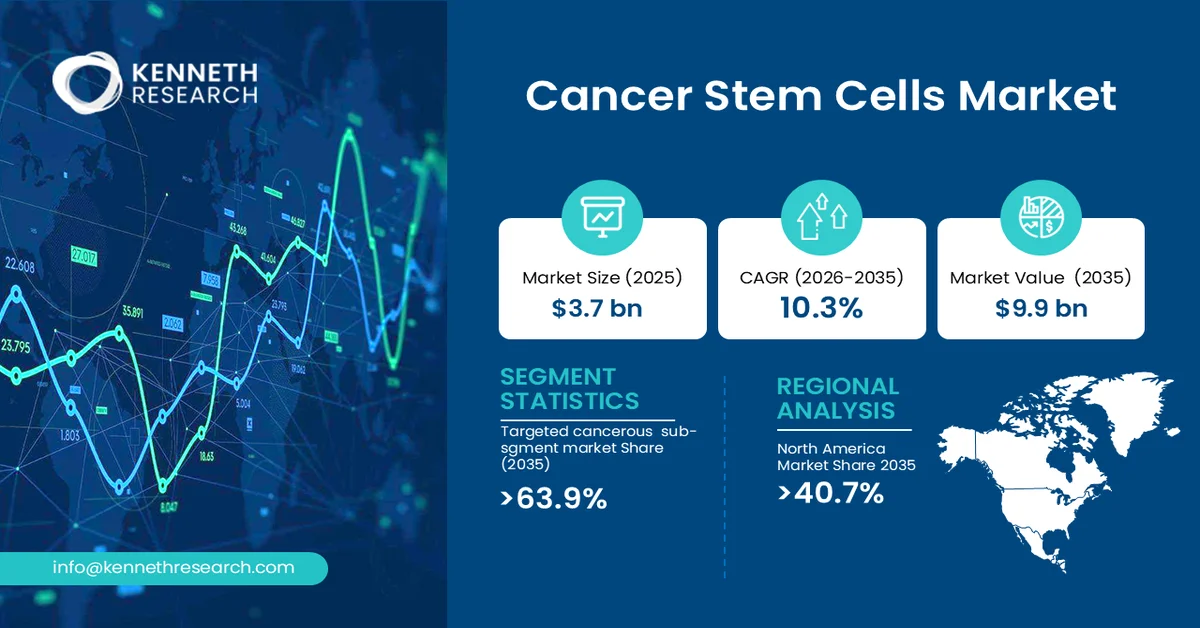
Cancer Stem Cells Market size was valued at USD 3.7 billion in 2025 and is projected to reach USD 9.9 billion by the end of 2035, rising at a CAGR of 10.3% during the forecast period, i.e., 2026-2035. In 2026, the industry size of the cancer stem cells is estimated at USD 4.1 billion.
The rising global burden of cancer, which is accelerating demand for therapies capable of targeting tumor initiation, recurrence, metastasis, and treatment resistance, is the primary growth driver for the cancer stem cells market.
The cancer stem cells market comprises products, technologies, and research platforms focused on identifying, isolating, characterizing, and therapeutically targeting cancer stem cells—a subpopulation of tumor cells with the ability to self-renew, differentiate, and sustain tumor growth. These cells are widely recognized for their role in cancer initiation, disease progression, metastatic spread, therapeutic resistance, and tumor relapse, making them an important focus of modern oncology research and drug development. Cancer stem cell-based approaches support the development of precision oncology by enabling treatments that selectively eliminate tumor-initiating cells while complementing conventional chemotherapy, immunotherapy, radiation therapy, and targeted therapies.
Key Cancer Stem Cells Market Insights Summary:
Key Takeaways: Market Trends & Insights
- In the mode of action segment, the targeted cancerous stem cells sub-segment is anticipated to capture the revenue share of 63.9% during 2026-2035
- North America cancer stem cells market is projected to hold the largest revenue share of 40.7% by the end of 2035
- The U.S. region alone accounts for over 72.5% of the North America market in 2026.
- The major players in the market are STEMCELL Technologies, Miltenyi Biotec, Creative Bioarray, Stemline Therapeutics, Inc., PromoCell GmbH, and Propanc Biopharma.
Market Drivers
- Rising public investment in oncology research and translational medicine
- Increasing adoption of precision oncology and targeted therapeutics
- Growing investment in three-dimensional tumor models and advanced cell culture technologies
- Increasing strategic collaborations among biotechnology companies, pharmaceutical firms, and academic research institutions
Challenges
- Scientific complexity and lack of standardized cancer stem cell identification
- High development costs and complex clinical translation
Cancer Stem Cells Market Overview & Supply Chain
The adoption of cancer stem cell technologies is increasing globally as healthcare systems prioritize precision oncology, biomarker-driven treatment strategies, and therapies that address tumor recurrence and treatment resistance. Advances in single-cell sequencing, gene editing, organoid models, and molecular profiling have strengthened the ability to identify and target cancer stem cells with greater specificity. According to the World Health Organization, cancer accounted for nearly 10 million deaths worldwide in 2024, underscoring the substantial demand for more effective treatment modalities that can improve long-term patient outcomes and reduce disease recurrence.
The procurement of specialized biological inputs, including cell culture media, reagents, antibodies, growth factors, laboratory consumables, and advanced analytical instruments sourced from life science suppliers. Products are subsequently distributed through direct commercial channels, specialized laboratory distributors, contract research organizations, and clinical supply networks serving global healthcare markets. Major stakeholders across the value chain include raw material suppliers, technology developers, regulatory authorities, healthcare providers, research institutions, investors, and commercial partners collaborating to accelerate innovation and clinical translation in cancer stem cell applications.
Cancer Stem Cells Market: Growth Drivers & Challenges
Growth Drivers:
- Rising public investment in oncology research and translational medicine: Growing public investment in oncology research is accelerating innovation across the cancer stem cell ecosystem. National research agencies and public-private initiatives are funding projects focused on tumor biology, biomarker discovery, precision medicine, and next-generation targeted therapies, creating favorable conditions for cancer stem cell research. Enhanced funding also supports the development of advanced laboratory models, cell characterization technologies, and companion diagnostics that improve the identification and therapeutic targeting of cancer stem cells. In the long term, sustained government-backed research programs are expected to accelerate novel product development, strengthen industry-academia collaboration, and improve the availability of innovative oncology solutions. The National Cancer Institute reports that Cancer Moonshot funding totaled USD 1.8 billion across fiscal years 2017–2023, supporting research that accelerates cancer prevention, diagnosis, treatment, and care.
- Increasing adoption of precision oncology and targeted therapeutics: The transition from conventional cancer treatments toward precision oncology is creating significant opportunities for the cancer stem cells market. Healthcare providers increasingly recognize that eliminating cancer stem cells may help address tumor recurrence, metastasis, and therapeutic resistance, complementing existing chemotherapy, immunotherapy, and targeted treatment regimens. Advances in genomic profiling, single-cell analysis, molecular diagnostics, and artificial intelligence are enabling more accurate identification of tumor-initiating cell populations, supporting the development of personalized treatment strategies. Pharmaceutical and biotechnology companies are integrating cancer stem cell biology into drug discovery pipelines to improve therapeutic efficacy and optimize patient stratification during clinical development.
Challenges:
- Scientific complexity and lack of standardized cancer stem cell identification: One of the most significant restraints in the cancer stem cells market is the scientific complexity associated with accurately identifying and characterizing cancer stem cells across different tumor types. Cancer stem cell populations exhibit considerable heterogeneity, and commonly used biomarkers may vary depending on cancer origin, disease stage, and patient-specific biological characteristics. This lack of universally accepted identification standards creates inconsistencies in research findings, limits reproducibility across laboratories, and complicates the translation of preclinical discoveries into clinical applications. Continued advances in multi-omics technologies, standardized research protocols, and collaborative validation initiatives are expected to gradually improve consistency, although scientific standardization will remain a long-term industry challenge.
- High development costs and complex clinical translation: The commercialization of cancer stem cell-based therapeutics and associated research technologies requires substantial investment throughout discovery, preclinical validation, manufacturing, and clinical development. Specialized laboratory infrastructure, advanced analytical technologies, highly skilled scientific personnel, and stringent quality control requirements contribute to elevated operational costs. Furthermore, demonstrating long-term safety, efficacy, and clinical benefit for therapies targeting cancer stem cells remains challenging because treatment outcomes often require extended evaluation periods.
Cancer Stem Cells Market Size and Forecast:
| Report Attribute | Details |
|---|---|
| Base Year |
2025 |
| Forecast Year |
2026-2035 |
| CAGR |
10.3% |
| Base Year Market Size (2025) |
USD 3.7 billion |
| Forecast Year Market Size (2035) |
USD 9.9 billion |
| Regional Scope |
|
Cancer Stem Cells Market Segmentation Analysis:
Mode of Action Segment Analysis
In the mode of action segment, the targeted cancerous sub-segment is anticipated to capture the largest market share of 63.9% by the end of 2035.
Targeted cancerous stem cells represent the leading sub-segment because of their ability to address one of the most persistent challenges in oncology—tumor recurrence driven by treatment-resistant cell populations. Unlike conventional therapies that primarily eliminate rapidly dividing cancer cells, targeted cancer stem cell approaches are designed to inhibit signalling pathways responsible for self-renewal, proliferation, and metastatic progression. This has encouraged widespread adoption in oncology research, particularly among pharmaceutical companies and biotechnology firms developing precision therapeutics and biomarker-guided treatment strategies. On the supply side, advancements in molecular diagnostics, gene sequencing, monoclonal antibody engineering, and cell characterization technologies have improved the discovery and development of targeted therapies, enabling a stronger commercial pipeline. The National Cancer Institute notes that the U.S. Food and Drug Administration has approved targeted therapy drugs for numerous cancer types, with regularly updated indications spanning hematologic and solid tumors, reflecting sustained clinical adoption of targeted oncology approaches.
Cancer Forms Segment Analysis
The breast segment is projected to grow as the second-largest revenue segment in the cancer stem cells market.
The breast sub-segment is projected to experience robust growth due to sustained research activity in targeted oncology and the increasing emphasis on therapies that address tumor recurrence and treatment resistance. Breast cancer has been extensively studied for the role of cancer stem cells in disease progression, metastasis, and resistance to conventional treatments, making it a key focus area for translational research and precision medicine initiatives. On the supply side, improvements in molecular diagnostics, next-generation sequencing, cell isolation technologies, and advanced laboratory models have strengthened the development of breast cancer-specific targeted therapies. The U.S. Centers for Disease Control and Prevention (CDC) reported that 288,494 new breast cancer cases were diagnosed among females in the United States in 2023, highlighting the continued need for innovative therapeutic approaches and advanced oncology research.
Our in-depth analysis of the global cancer stem cells market includes the following segments:
|
Segment |
Sub-segment |
|---|---|
|
Mode of Action |
|
|
Cancer Forms |
|
Cancer Stem Cells Market Regional Insights:
North America Market Trends & Insights:
North America is projected to account for 40.7% of the cancer stem cells market in 2035, maintaining its leadership through a combination of advanced oncology research infrastructure, robust biotechnology innovation, and strong public investment in cancer research. The region benefits from an established ecosystem comprising pharmaceutical companies, biotechnology firms, academic medical centers, and contract research organizations actively engaged in cancer stem cell therapeutics and biomarker development. Favorable regulatory pathways for oncology products, widespread adoption of precision medicine, and continued investment in translational research further reinforce regional competitiveness. North America also demonstrates high utilization of advanced molecular diagnostics, genomic technologies, and cell-based research platforms, enabling rapid integration of cancer stem cell discoveries into clinical development. These factors collectively strengthen product innovation, commercialization, and collaboration across the regional oncology ecosystem.
The United States serves as the principal growth engine due to its extensive cancer research network, significant biotechnology investment, and leadership in oncology clinical trials. Canada complements regional growth through expanding translational research capabilities, collaborative academic programs, and supportive public funding for biomedical innovation. Together, both countries foster strong partnerships between research institutions and industry participants, accelerating the development of cancer stem cell-based therapeutics and diagnostics. The U.S. National Cancer Institute (NCI) states that there are 74 NCI-Designated Cancer Centers located across 37 states and the District of Columbia, providing a highly specialized infrastructure for cutting-edge cancer research, clinical studies, and translational medicine that underpins continued regional innovation.
Asia Pacific Market Trends & Insights:
Asia Pacific is the fastest-growing region for the cancer stem cells market, driven by rising oncology research activity and expanding healthcare infrastructure. The rising demand for advanced cancer treatment solutions. The region is witnessing greater adoption of precision medicine, molecular diagnostics, and biotechnology-based research platforms as healthcare providers and research institutions seek improved approaches for managing complex cancers. Industrial activity is strengthening through collaborations between pharmaceutical companies, biotechnology firms, academic institutions, and clinical research organizations focused on developing innovative cancer therapeutics and diagnostic technologies. Government initiatives aimed at strengthening biomedical research, improving cancer care accessibility, and encouraging biotechnology innovation are further supporting regional development.
China represents a major contributor to regional growth due to its expanding biotechnology sector, increasing oncology research capacity, and rising focus on innovative cancer therapies. The country’s large patient population and improving clinical research ecosystem provide significant opportunities for cancer stem cell research and therapeutic development.
Japan contributes through its advanced healthcare infrastructure, strong biomedical research capabilities, and established pharmaceutical industry. The country’s focus on regenerative medicine, precision healthcare, and advanced therapeutic development supports continued opportunities for cancer stem cell applications. Together, China and Japan strengthen Asia Pacific’s position as an important hub for oncology innovation and commercialization.
Leading Companies Operating in the Global Cancer Stem Cells Market:
Here is a list of upstream, downstream, and key players operating in the global cancer stem cells market competitive ecosystem:
- STEMCELL Technologies (Canada)
- Company Overview
- Business Strategy
- Key Product Offerings
- Financial Performance
- Key Performance Indicators
- Risk Analysis
- Recent Development
- Regional Presence
- SWOT Analysis
- Miltenyi Biotec (Germany)
- Creative Bioarray (United States)
- Stemline Therapeutics, Inc. (United States)
- PromoCell GmbH (Germany)
- Propanc Biopharma (Australia)
Recent Developments
- In June 2025, STEMCELL Technologies commercially launched the STEMprep™ Tissue Dissociator System, an automated instrument designed to standardize tissue dissociation and generate single-cell suspensions for research applications, including cancer research. The launch strengthens STEMCELL Technologies’ position in advanced cell research workflows by improving reproducibility and efficiency in sample preparation.
- In February 2025, Bio-Techne announced the release of the GMP TcBuster™ Non-Viral Genome Engineering System, a technology designed to support development and manufacturing of cell-based therapies through genetic engineering workflows. The product expands Bio-Techne’s capabilities in advanced cell therapy development and supports researchers working on engineered cellular platforms relevant to next-generation oncology applications.
- In September 2025, Takara Bio announced completion of the regulatory notification process in Japan for the confirmatory study pathway of its NY-ESO-1・siTCR™ gene therapy program and continued regulatory advancement under Japan’s regenerative medicine framework. The regulatory progress highlights continued industry movement toward engineered cell-based oncology solutions and strengthens Takara Bio’s capabilities in developing advanced cancer-related cellular therapies.
Frequently Asked Question
In 2025, the cancer stem cells market exceeded USD 3.7 billion.
The cancer stem cells market is projected to reach USD 9.9 billion by the end of 2035, expanding at a CAGR of 10.3% over the forecast period (2026-2035).
The major players in the market are STEMCELL Technologies (Canada),Miltenyi Biotec (Germany),Creative Bioarray (United States),Stemline Therapeutics, Inc. (United States),PromoCell GmbH (Germany),Propanc Biopharma (Australia), and others.
In the mode of action segment, the targeted cancerous stem cells sub-segment is anticipated to capture the largest market share of 63.9% in the future and exhibit lucrative growth opportunities during 2026-2035. This growth trajectory is largely attributed to increasing adoption of precision oncology approaches targeting treatment-resistant cancer cell populations.
North America is projected to hold the largest market share of 40.7% by the end of 2035 and provide more business opportunities in the future. Continuous investments in oncology research, biotechnology innovation, and advanced healthcare infrastructure in the U.S. and Canada are fostering the region's dominance.
Why Choose Kenneth Research ?
-
Insight with Impact : We don’t just gather data — we uncover stories, trends, and opportunities that fuel business growth.
-
Experts Who Get It : Our team speaks your industry’s language and knows what really matters to your customers and market.
-
Custom-Built for You : Forget one-size-fits-all. We craft research and consulting solutions as unique as your business vision.
-
Partners, Not Just Providers : We work with you, not for you — collaborating closely to turn insights into smart, strategic moves.
-
Results That Speak : Our work powers brands, startups, and industry leaders alike — with a track record of ideas that work in the real world.
Report ID: 1069 |
Published Date: 18 Aug 2026 |
Report Format: |
Delivery Timeline: 48-72 Business Hours

Copyright © 2025 Kenneth Research. All rights reserved. Terms of Use | Privacy Policy
