Report ID: 1029 |
Published Date: 28 Jul 2026 |
Report Format: |
Delivery Timeline: 48-72 Business Hours
Cancer API Market Outlook:
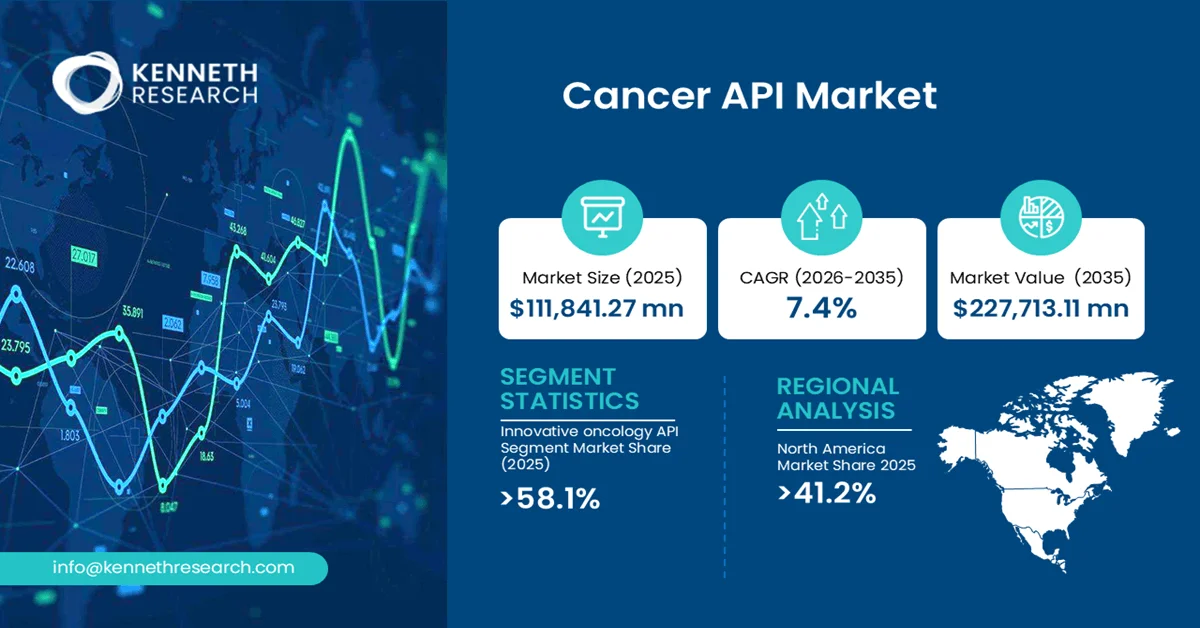
Cancer API Market size was valued at USD 111,841.27 million in 2025 and is projected to reach USD 227,713.11 million by the end of 2035, rising at a CAGR of 7.4% during the forecast period, i.e., 2026-2035. In 2026, the industry size of the cancer API is estimated at USD 120,090.11 million.
The primary growth driver for the cancer API market is the increasing global cancer burden, which is accelerating demand for active pharmaceutical ingredients used in targeted therapies, immunotherapies, and precision medicines. In 2022, an estimated 20 million new cancer cases were reported worldwide, reinforcing the need for expanded oncology drug manufacturing capacity.
The cancer API (Active Pharmaceutical Ingredient) market comprises the production, development, and commercial supply of pharmaceutical substances that deliver the therapeutic effect in oncology medications. These APIs are used in a broad spectrum of cancer treatments, including cytotoxic drugs, targeted therapies, hormone therapies, immunotherapies, antibody-drug conjugates, and other advanced oncology formulations. Manufacturers supply these ingredients to pharmaceutical and biotechnology companies for use in branded and generic cancer medicines across multiple dosage forms.
Cancer APIs are characterized by stringent quality requirements, complex synthesis processes, high-potency manufacturing capabilities, and compliance with international Good Manufacturing Practice (GMP) standards. The market includes both innovative and generic APIs, supported by specialized containment technologies, advanced process chemistry, and regulatory oversight to ensure product safety, consistency, and efficacy.
Key Cancer API Market Insights Summary:
Key Takeaways: Market Trends & Insights
- Cancer API market projected to grow from USD 120,090.11 million in 2026 to USD 227,713.11 million by 2035 at a 7.4% CAGR
- Innovative Oncology API led the Type segment with a 58.1% share in 2025, driven by increasing adoption of targeted therapies and precision oncology
- North America accounted for the largest regional share at 41.2% in 2025, supported by advanced pharmaceutical manufacturing, strong oncology R&D, and favorable regulatory frameworks
- Lung Cancer remains a high-growth application segment due to expanding molecular diagnostics, increasing use of targeted therapies, and continuous innovation in personalized cancer treatment
- Asia Pacific is strengthening its position through expanding API manufacturing capabilities, government support for pharmaceutical production, and increasing contributions from China and India to the global oncology supply chain
Market Drivers
- Expansion of oncology research funding and precision medicine programs
- Increasing adoption of high-potency and targeted oncology APIs
- Growing outsourcing of oncology API manufacturing to specialized CDMOs
- Advancements in continuous manufacturing and high-containment production technologies
Challenges
- Stringent manufacturing compliance and high-containment infrastructure requirements
- Complex supply chain dependencies for specialized raw materials
Cancer API Market Overview & Supply Chain
Global adoption of cancer active pharmaceutical ingredients (APIs) is increasing as healthcare systems expand access to precision oncology, biologics, antibody-drug conjugates, and immunotherapies that require highly specialized API manufacturing. Advances in high-potency synthesis, continuous manufacturing, and regulatory harmonization are enabling pharmaceutical companies to accelerate oncology drug development while maintaining stringent quality and safety standards. Governments and regulatory agencies are also supporting innovation through streamlined approval pathways for novel cancer therapies. According to the OECD, the European Medicines Agency granted centralized marketing authorization to 17 new cancer medicines in 2021 and 15 in 2022, with targeted therapies accounting for the majority of recent approvals, underscoring the growing demand for advanced oncology APIs across the pharmaceutical manufacturing ecosystem.
The cancer API market value chain begins with the procurement of specialized chemical intermediates, biologically derived materials, catalysts, solvents, reagents, and advanced raw materials sourced from fine chemical manufacturers and biotechnology suppliers. API manufacturers then undertake complex synthesis, fermentation, purification, containment, and quality testing processes within facilities operating under stringent Good Manufacturing Practice (GMP) standards. Following production, oncology APIs undergo regulatory documentation, batch release, packaging, and secure logistics before being supplied to pharmaceutical companies and contract development and manufacturing organizations (CDMOs) for formulation into finished cancer therapeutics. Distribution requires temperature-controlled handling and comprehensive quality assurance to preserve product integrity throughout transit. End users include branded pharmaceutical manufacturers, generic drug producers, biotechnology companies, research organizations, hospitals, and specialty oncology treatment providers. Major stakeholders comprise raw material suppliers, API manufacturers, CDMOs, regulatory authorities, logistics providers, pharmaceutical companies, healthcare institutions, and research organizations collaborating across the oncology drug development ecosystem.
Cancer API Market: Growth Drivers & Challenges
Growth Drivers:
- Expansion of Oncology Research Funding and Precision Medicine Programs: Growing public investment in oncology research and precision medicine is accelerating demand for high-quality cancer active pharmaceutical ingredients (APIs). Government-backed research initiatives are fostering the discovery of novel therapeutic targets, biomarker-driven treatments, cell and gene therapies, and next-generation biologics, all of which require sophisticated API development and manufacturing capabilities. Increased funding also strengthens clinical trial pipelines, encourages collaboration between research institutions and pharmaceutical companies, and promotes technology transfer into commercial production. As more investigational therapies advance through development, manufacturers are expanding high-potency API facilities, improving process scalability, and investing in advanced synthesis technologies. Over the long term, sustained public-sector support for oncology innovation is expected to broaden the portfolio of cancer therapeutics, increase manufacturing specialization, and reinforce resilient pharmaceutical supply chains.
- Increasing Adoption of High-Potency and Targeted Oncology APIs: The pharmaceutical industry's transition toward targeted oncology therapies is creating sustained demand for highly specialized cancer APIs with improved efficacy and safety profiles. Compared with conventional chemotherapeutics, targeted therapies and biologics require advanced synthesis techniques, stringent containment systems, and robust quality assurance throughout manufacturing. Pharmaceutical companies are investing in dedicated high-potency API production facilities to support increasingly complex oncology pipelines while complying with evolving global regulatory standards. The growing prevalence of personalized medicine is also driving the development of APIs tailored to specific molecular targets and genetic biomarkers. Looking ahead, continued innovation in antibody-drug conjugates, peptide therapeutics, radiopharmaceuticals, and combination therapies will increase manufacturing complexity and strengthen the strategic importance of specialized API producers capable of delivering consistent quality, regulatory compliance, and scalable commercial production.
Challenges:
- Stringent Manufacturing Compliance and High-Containment Infrastructure Requirements: The production of cancer active pharmaceutical ingredients involves handling highly potent compounds that require sophisticated containment technologies, specialized facilities, and rigorous compliance with international Good Manufacturing Practice (GMP) standards. Establishing and maintaining such infrastructure demands substantial capital investment, continuous process validation, and highly trained personnel. Regulatory inspections have become increasingly comprehensive, requiring manufacturers to demonstrate consistent product quality, contamination control, and data integrity throughout production. These requirements lengthen facility qualification timelines, increase operational complexity, and elevate manufacturing costs. Commercially, smaller API producers may struggle to compete due to the financial burden associated with upgrading facilities and maintaining compliance across multiple regulatory jurisdictions. Looking ahead, stricter quality expectations and evolving regulatory frameworks are expected to intensify compliance obligations, making operational excellence and advanced manufacturing capabilities essential competitive differentiators.
- Complex Supply Chain Dependencies for Specialized Raw Materials: Cancer API manufacturing depends on a network of specialized suppliers providing advanced intermediates, reagents, catalysts, solvents, and biologically derived materials that often have limited qualified sources. Any disruption in the availability of these critical inputs can affect production schedules, regulatory commitments, and commercial supply continuity. Supplier qualification processes are lengthy because alternative materials frequently require regulatory documentation, process validation, and quality reassessment before implementation. From a commercial perspective, prolonged procurement cycles and limited sourcing flexibility increase inventory management challenges and expose manufacturers to procurement risks during periods of geopolitical uncertainty or transportation disruptions. As oncology therapies become more sophisticated, supply chains are expected to require greater diversification, regional sourcing strategies, and stronger collaboration between manufacturers and suppliers to improve long-term resilience.
Cancer API Market Size and Forecast:
| Report Attribute | Details |
|---|---|
| Base Year |
2025 |
| Forecast Year |
2026-2035 |
| CAGR |
7.4% |
| Base Year Market Size (2025) |
USD 111,841.27 million |
| Forecast Year Market Size (2035) |
USD 227,713.11 million |
| Regional Scope |
|
Cancer API Market Segmentation Analysis:
Type Segment Analysis
In the type segment, the Innovative Oncology API sub-segment is anticipated to capture the largest market share of 58.1% by the end of 2025.
The innovative oncology API segment dominates the cancer API market because pharmaceutical innovation has shifted toward targeted therapies, immunotherapies, antibody-drug conjugates, and other precision oncology treatments that require complex, high-value active pharmaceutical ingredients. Demand is being driven by the expanding pipeline of novel cancer therapeutics, increasing biomarker-guided treatment approaches, and the growing emphasis on medicines with improved efficacy and safety profiles. Unlike conventional APIs, innovative oncology APIs involve advanced synthesis, high-potency manufacturing, and stringent quality controls, creating significant barriers to entry and reinforcing the market position of specialized manufacturers. On the supply side, pharmaceutical companies and contract development and manufacturing organizations (CDMOs) continue investing in dedicated high-containment facilities and advanced process technologies to support commercial-scale production of next-generation oncology drugs. This trend is expected to strengthen as personalized medicine gains wider adoption globally. Supporting this momentum, the U.S. FDA's Office of Oncologic Diseases approved 13 novel oncology drugs and completed 67 additional approval decisions for expanded indications or patient populations during 2023, demonstrating sustained innovation and demand for advanced oncology APIs.
Application Segment Analysis
The lung cancer sub-segment is projected to grow as the second-largest segment in the cancer API market due to four converging demand drivers.
The lung cancer application segment is projected to experience strong growth as healthcare systems prioritize early diagnosis, precision treatment, and expanded access to targeted oncology therapies. Rising adoption of molecular diagnostics has increased the use of biomarker-driven medicines, requiring advanced active pharmaceutical ingredients (APIs) for therapies directed at specific genetic mutations and immunological pathways. Pharmaceutical companies are continuously expanding development pipelines for next-generation kinase inhibitors, antibody-drug conjugates, and combination therapies, strengthening demand for specialized oncology APIs. On the supply side, manufacturers are investing in high-potency production capabilities, process optimization, and regulatory-compliant manufacturing to support commercial-scale supply of increasingly complex lung cancer therapeutics. Future growth will also be supported by broader implementation of lung cancer screening programs and continued innovation in personalized medicine. According to the World Health Organization, lung cancer was the leading cancer globally in 2022, with an estimated 2.5 million new cases, reinforcing the sustained need for innovative oncology treatments and corresponding API production.
Our in-depth analysis of the global Cancer API market includes the following segments:
|
Segment |
Sub-segment |
|
Type |
|
|
Application |
|
Cancer API Market Regional Insights:
North America Market Trends & Insights:
North America cancer API market is projected to hold the largest revenue share of 41.2% by the end of 2025.
The region benefits from significant investments in innovative drug development, high adoption of targeted therapies, and the presence of global pharmaceutical companies with dedicated high-potency API manufacturing capabilities. Robust intellectual property protection, established Good Manufacturing Practice (GMP) standards, and extensive collaboration between biotechnology firms, contract development and manufacturing organizations (CDMOs), and academic research institutions further reinforce regional leadership. Regulatory initiatives that accelerate oncology drug development and commercialization continue to stimulate demand for specialized cancer APIs across both innovative and complex generic therapeutics. Supporting this leadership, the U.S. FDA Oncology Center of Excellence facilitated 89 oncology drug and biologic product approvals in 2024, including new medical entities, biologics, new indications, and biosimilars, demonstrating the region's sustained innovation in oncology therapeutics.
The United States serves as the principal growth engine within North America, supported by a comprehensive pharmaceutical R&D ecosystem, large-scale commercial API manufacturing facilities, and continuous investment in precision oncology, biologics, and advanced therapeutic platforms. The country's extensive clinical research network and strong regulatory framework enable rapid translation of scientific innovation into commercial oncology products.
Canada complements regional leadership through its expanding life sciences sector, government-supported biomedical research initiatives, and growing capabilities in pharmaceutical manufacturing and clinical development. Collaborative research programs, increasing investments in advanced therapeutics, and cross-border partnerships with global pharmaceutical companies continue to strengthen Canada's contribution to the regional oncology API supply chain. Together, both countries provide an integrated innovation and manufacturing environment that supports sustained growth in cancer API development and commercialization.
Asia Pacific Market Trends & Insights:
Asia Pacific is emerging as a strategically important region for the cancer API market, supported by expanding pharmaceutical manufacturing capacity, rising oncology treatment demand, and sustained investments in healthcare infrastructure. Increasing cancer incidence, improving access to advanced therapeutics, and the growing adoption of precision medicine are encouraging pharmaceutical companies to strengthen regional API production capabilities. Governments across the region are promoting domestic pharmaceutical manufacturing through supportive industrial policies, research funding, and initiatives that enhance drug innovation and supply chain resilience. The region also benefits from a strong network of contract development and manufacturing organizations (CDMOs), competitive production costs, and an expanding skilled workforce specializing in complex pharmaceutical manufacturing. As global companies seek to diversify manufacturing footprints and reduce supply chain risks, Asia Pacific is expected to attract additional investment in high-potency API facilities, process development, and advanced manufacturing technologies, creating long-term opportunities for both domestic and multinational manufacturers.
China remains a major contributor to regional growth through its extensive pharmaceutical manufacturing infrastructure, strong chemical synthesis capabilities, and continued investment in innovative drug development. Ongoing modernization of production facilities and increasing emphasis on regulatory compliance have strengthened the country's position as a key supplier of oncology APIs to global pharmaceutical companies.
India continues to expand its role through its well-established generic pharmaceutical industry, growing expertise in complex active pharmaceutical ingredient manufacturing, and increasing investment in high-value oncology APIs. Supportive government initiatives, an experienced scientific workforce, and expanding contract manufacturing capabilities are enhancing India's competitiveness in both domestic and international oncology pharmaceutical supply chains. Together, China and India are reinforcing Asia Pacific's position as a critical manufacturing and innovation hub for cancer APIs.
Leading Companies Operating in the Global Cancer API Market:
Here is a list of upstream, downstream, and key players operating in the global cancer API market competitive ecosystem:
- Biocon Limited (India)
- Company Overview
- Business Strategy
- Key Product Offerings
- Financial Performance
- Key Performance Indicators
- Risk Analysis
- Recent Development
- Eisai Pharmaceuticals (Japan)
- Aspen API (South Africa)
- Concord Biotech Limited (India)
- Shivalik Rasayan Limited (India)
- Bachem Holding AG (Switzerland)
- PolyPeptide Group (Switzerland)
Recent Developments
- In September 2025, the University of Missouri broke ground on two new additions to its Research Reactor (MURR) facility, totaling more than 29,000 square feet. The expansion includes three production lines for FDA-approved no-carrier-added lutetium-177, a critical active pharmaceutical ingredient used in cancer-fighting drugs, and will greatly increase the number of cancer-fighting drug doses available for patient care.
- In November 2025, Lupin Manufacturing Solutions commissioned a dedicated Oncology Block at its Vizag facility in India, significantly expanding its contract development and manufacturing capabilities for High Potent Active Pharmaceutical Ingredients (HPAPIs). The 4,270 sq. meter facility features 20 reactors, over 20 isolators, and advanced containment systems ensuring exposure levels of ≤0.05 µg/m³, supporting clients from preclinical research to commercial manufacturing.
Frequently Asked Question
In 2025, the cancer API market exceeded USD 111,841.27 million.
The cancer API market is projected to reach USD 227,713.11 million by the end of 2035, expanding at a CAGR of 7.4% over the forecast period (2026-2035).
The major players in the market are Biocon Limited (India), Eisai Pharmaceuticals (Japan), Aspen API (South Africa), Concord Biotech Limited (India), Shivalik Rasayan Limited (India), Bachem Holding AG (Switzerland), PolyPeptide Group (Switzerland), and others.
In the Type segment, the Innovative Oncology API sub-segment is anticipated to capture the largest market share of 58.1% in the future and exhibit lucrative growth opportunities during 2026–2035. This growth trajectory is largely attributed to the increasing adoption of targeted therapies, immunotherapies, and precision oncology medicines requiring advanced active pharmaceutical ingredients.
North America is projected to hold the largest market share of 41.2% by the end of 2035 and provide more business opportunities in the future. Continuous investments in oncology drug development, advanced pharmaceutical manufacturing, and innovation across the United States and Canada are fostering the region's dominance.
Why Choose Kenneth Research ?
-
Insight with Impact : We don’t just gather data — we uncover stories, trends, and opportunities that fuel business growth.
-
Experts Who Get It : Our team speaks your industry’s language and knows what really matters to your customers and market.
-
Custom-Built for You : Forget one-size-fits-all. We craft research and consulting solutions as unique as your business vision.
-
Partners, Not Just Providers : We work with you, not for you — collaborating closely to turn insights into smart, strategic moves.
-
Results That Speak : Our work powers brands, startups, and industry leaders alike — with a track record of ideas that work in the real world.
Report ID: 1029 |
Published Date: 28 Jul 2026 |
Report Format: |
Delivery Timeline: 48-72 Business Hours

Copyright © 2025 Kenneth Research. All rights reserved. Terms of Use | Privacy Policy
