Report ID: 1281 |
Published Date: 14 Sep 2026 |
Report Format: |
Delivery Timeline: 48-72 Business Hours
Camera Lens Market Outlook:
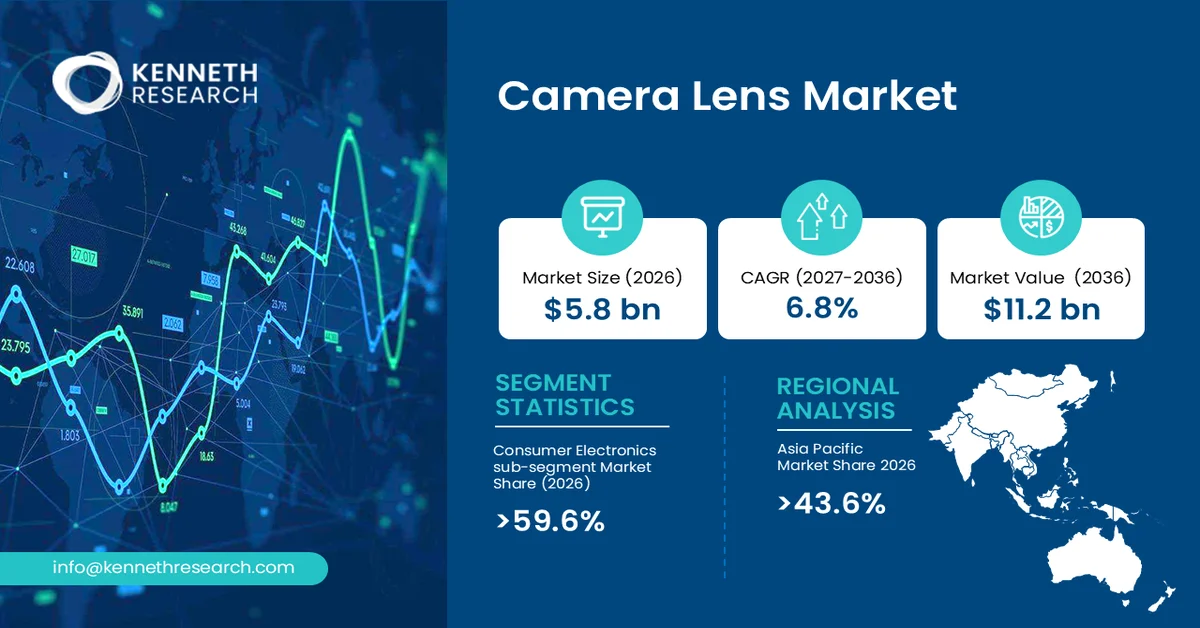
Camera Lens Market size was valued at USD 5.8 billion in 2026 and is projected to reach USD 11.2 billion by the end of 2036, rising at a CAGR of 6.8% during the forecast period, i.e., 2027–2036. In 2027, the industry size of the camera lens is estimated at USD 6.2 billion.
The rapid expansion of camera-enabled consumer electronics is driving demand for advanced camera lenses. The camera lens market comprises optical lens systems and assemblies designed to collect and focus light onto an image sensor or other image-recording medium to produce photographic or digital images. Camera lenses may consist of multiple optical elements engineered to control focal length, aperture, field of view, focus, and optical aberrations. They can be permanently integrated into camera systems or manufactured as interchangeable units offering different focal lengths and optical characteristics. The U.S. National Institute of Standards and Technology identifies the lens as the camera-system component responsible for implementing the focus function and notes that lenses may be fixed or interchangeable.
Key characteristics include optical clarity, focal-length range, aperture capability, autofocus performance, compactness, image stabilization compatibility, and correction of optical distortion. The market serves consumer electronics, photography, automotive imaging, surveillance, industrial inspection, and other imaging applications. Its industrial relevance is increasing as manufacturers integrate higher-resolution imaging into compact devices while demanding improved low-light performance, wider fields of view, and precise optical control.
Key Camera Lens Market Insights Summary:
Key Takeaways: Market Trends & Insights
- Camera lens market is projected to grow from USD 5.8 billion in 2026 to USD 11.2 billion by 2036, registering a CAGR of 6.8% during the forecast period.
- Asia-Pacific is projected to remain the leading regional market, accounting for 43.6% in 2026, supported by established optical manufacturing and strong consumer-electronics production in Japan and China.
- Consumer Electronics is expected to remain the leading Application segment with a 59.6% share in 2026, driven by increasing integration of advanced camera systems into smartphones, tablets, laptops, and other connected devices.
- Interchangeable lenses are expected to maintain strong demand as mirrorless cameras and professional imaging applications increase requirements for specialized focal lengths, autofocus, optical stabilization, and high-performance optics.
Market Drivers
- Increasing adoption of multi-camera systems in smartphones and other connected devices.
- Rising demand for compact lenses with improved optical zoom and low-light performance.
- Expansion of domestic camera-module and electronics-component manufacturing.
- Growing integration of AI-enabled imaging and computational photography into consumer devices.
Challenges
- High Precision Requirements in Lens Manufacturing
- Miniaturization and Optical Performance Trade-Offs
Camera Lens Market: Market Overview & Supply Chain
The camera lens market is expanding alongside the broader growth of camera-enabled consumer electronics, particularly smartphones, tablets, digital cameras, laptops, and connected devices. Demand is shifting toward compact optical systems that deliver higher image quality, improved low-light performance, autofocus capability, and greater imaging flexibility within increasingly space-constrained product designs. Government initiatives are also strengthening the electronics manufacturing ecosystem. India’s Electronics Component Manufacturing Scheme (ECMS) specifically covers camera module sub-assemblies and aims to build domestic component manufacturing capabilities and integrate manufacturers into global value chains.
The camera lens supply chain begins with optical glass, optical-grade plastics, coatings, precision-machined components, lens barrels, actuators, and other specialized materials. Lens manufacturers use these inputs for grinding, molding, polishing, coating, assembly, alignment, and optical testing. Finished lenses are then integrated into camera modules or supplied as interchangeable photographic lenses for end users. Camera-module manufacturers combine optical assemblies with image sensors, autofocus mechanisms, image stabilization systems, and electronic components before supplying completed modules to device manufacturers. The downstream chain includes consumer-electronics OEMs, camera manufacturers, automotive and industrial imaging companies, distributors, and specialized optical-equipment suppliers.
Camera Lens Market: Growth Drivers & Challenges
Growth Drivers
- Expansion of Camera-Enabled Consumer Electronics: The increasing integration of advanced imaging capabilities into smartphones, tablets, laptops, and other connected devices is driving demand for high-performance camera lenses. Manufacturers are incorporating multiple cameras, improved optical zoom, autofocus, and higher-resolution imaging into compact consumer devices, increasing requirements for precision optical components. Government-backed electronics manufacturing initiatives are also strengthening the supporting ecosystem. India's Electronics Component Manufacturing Scheme specifically includes camera-module sub-assemblies among targeted components, supporting greater domestic production and integration into global electronics value chains.
- Increasing Localization of Electronics and Camera-Module Manufacturing: The expansion of electronics manufacturing capacity is creating additional opportunities for camera-lens suppliers by strengthening regional component ecosystems. Governments are increasingly encouraging domestic production of camera modules and associated optical components to reduce supply-chain dependence and increase value addition. India's government reported that its Electronics Component Manufacturing Scheme covers camera modules and other high-value components, with approved projects supporting expanded domestic manufacturing capabilities.
Challenges
- High Precision Requirements in Lens Manufacturing: Camera lens manufacturing requires extremely tight control over optical geometry, surface quality, alignment, and dimensional tolerances. Small deviations during molding, grinding, polishing, or assembly can affect image sharpness, distortion, focus accuracy, and overall optical performance. This challenge becomes more significant as consumer devices demand smaller lens assemblies while simultaneously pursuing higher image quality. Research on precision optical manufacturing highlights the need for tightly controlled processing parameters and high-precision tooling to achieve the required surface contours and optical quality.
- Miniaturization and Optical Performance Trade-Offs: The continued miniaturization of camera modules creates a difficult balance between compact form factors and optical performance. Smaller lenses must deliver high resolution, adequate light capture, accurate focusing, and limited distortion despite reduced physical dimensions. U.S. technical documentation on miniature digital camera modules highlights the challenges created by shrinking pixel sizes, shorter track lengths, and manufacturing tolerances, which can constrain achievable image quality. Manufacturers must consequently optimize optical designs while accounting for tolerance sensitivity, material properties, actuator integration, and assembly precision.
Camera Lens Market Size and Forecast:
| Report Attribute | Details |
|---|---|
| Base Year |
2026 |
| Forecast Year |
2027-2036 |
| CAGR |
6.8% |
| Base Year Market Size (2026) |
USD 5.8 billion |
| Forecast Year Market Size (2036) |
USD 11.2 billion |
| Regional Scope |
|
Camera Lens Market: Segment Analysis
Application Segment Analysis
In the Application segment, the Consumer Electronics sub-segment is anticipated to capture the largest market share of 59.6% in 2026. Its dominance is supported by the widespread integration of camera systems into smartphones, tablets, laptops, and other connected consumer devices, where manufacturers increasingly prioritize image quality, compact optical designs, autofocus, and improved light capture. The U.S. National Institute of Standards and Technology notes that camera imaging quality is closely influenced by optical characteristics, with lens and focal-plane design affecting image precision and overall performance.
The continued evolution of multi-camera architectures is encouraging lens manufacturers to develop compact wide-angle, telephoto, macro, and specialized optical systems suited to different imaging functions. At the same time, increasing device miniaturization is raising requirements for precision molding, optical alignment, advanced coatings, and automated inspection. Consumer electronics manufacturers are also integrating computational photography and AI-enabled imaging, increasing the need for lenses capable of delivering consistent optical inputs to advanced image-processing systems.
Lens Type Segment Analysis
In the Lens Type segment, the Interchangeable Lens sub-segment is expected to maintain strong demand as professional photographers, content creators, and advanced imaging users increasingly seek flexibility across different focal lengths and shooting conditions. Interchangeable lenses allow users to select specialized optical configurations, including wide-angle, telephoto, macro, and zoom lenses, according to specific imaging requirements. Major camera manufacturers continue to maintain extensive interchangeable-lens portfolios. Canon lists dedicated RF and EF lens ranges across multiple focal-length categories, while Nikon's NIKKOR portfolio includes a broad selection of Z-mount lenses.
The segment is also benefiting from the continued development of mirrorless camera systems, which are encouraging manufacturers to expand lens ecosystems and introduce compact, high-performance optical designs. Sony similarly maintains a dedicated interchangeable-lens camera portfolio supporting its E-mount ecosystem.
Our in-depth analysis of the global camera lens market includes the following segments:
|
Segment |
Sub-segment |
|
Type |
|
|
Lens Type |
|
|
Distribution Channel |
|
|
Application |
|
Camera Lens Market – Regional Analysis
Asia-Pacific Market Trends & Insights:
Asia-Pacific is projected to remain the dominant region in the camera lens market, accounting for 43.6% in 2026. Regional leadership is supported by established camera and optical manufacturing capabilities, strong consumer-electronics production, and the presence of major imaging companies across Japan and China. Japan is particularly important because of its deep optical-manufacturing ecosystem. Canon identifies its Utsunomiya facility as its main lens manufacturing site, producing interchangeable camera lenses and other optical products, while Nikon manufactures NIKKOR lenses in Japan and maintains extensive interchangeable-lens production capabilities.
Japan benefits from established precision-optics expertise and strong demand for professional and consumer imaging equipment. Nikon's official portfolio includes extensive NIKKOR interchangeable lenses, while Sony maintains a broad E-mount lens portfolio spanning wide-angle, standard, telephoto, and prime configurations.
China further strengthens the regional market through its large consumer-electronics manufacturing base and expanding imaging-device ecosystem. The combination of optical expertise, electronics manufacturing, established camera brands, and growing demand for advanced imaging products should sustain Asia-Pacific's leading position in the global market.
North America Market Trends & Insights:
North America represents an important secondary market for camera lenses, supported by strong demand for professional imaging equipment, consumer electronics, automotive cameras, and advanced optical technologies.
The U.S. remains the primary market in the region, benefiting from a large consumer-electronics ecosystem and continued adoption of imaging technologies across consumer and industrial applications.
Canada provides additional opportunities through its growing technology and advanced-manufacturing ecosystem, particularly in applications requiring imaging and optical components. Across the region, demand is shifting toward higher-performance lenses with improved autofocus, optical stabilization, compact designs, and enhanced low-light capabilities.
Camera Lens Market – Competitive Landscape
Here is a list of upstream, downstream, and key players operating in the global camera lens competitive ecosystem:
- Canon Inc. (Japan)
- Company Overview
- Business Strategy
- Key Product Offerings
- Financial Performance
- Key Performance Indicators
- Risk Analysis
- Recent Development
- Regional Presence
- SWOT Analysis
- Sony Corporation (Japan)
- Nikon Corporation (Japan)
- Tamron Co., Ltd. (Japan)
Recent Developments
- October 2025: Canon announced that its cumulative production of RF and EF interchangeable lenses exceeded 170 million units, extending its record in interchangeable camera-lens production.
- August 2025: Nikon released the NIKKOR Z 24-70mm f/2.8 S II, a full-frame mirrorless standard zoom lens featuring an internal zoom mechanism, advanced autofocus, and improved portability.
Frequently Asked Question
In 2026, the camera lens market was valued at USD 5.8 billion.
The camera lens market is projected to reach USD 11.2 billion by the end of 2036, expanding at a CAGR of 6.8% during the forecast period (2027–2036).
The major players include Canon Inc., Sony Corporation, Nikon Corporation, Tamron Co., Ltd., Sigma Corporation, and others.
In the Application segment, Consumer Electronics is anticipated to remain the leading sub-segment, accounting for 59.6% in 2026. Its strong position is supported by widespread camera integration in smartphones, tablets, laptops, and other consumer devices.
Asia-Pacific is projected to remain the leading regional market, accounting for 43.6% in 2026.
Why Choose Kenneth Research ?
-
Insight with Impact : We don’t just gather data — we uncover stories, trends, and opportunities that fuel business growth.
-
Experts Who Get It : Our team speaks your industry’s language and knows what really matters to your customers and market.
-
Custom-Built for You : Forget one-size-fits-all. We craft research and consulting solutions as unique as your business vision.
-
Partners, Not Just Providers : We work with you, not for you — collaborating closely to turn insights into smart, strategic moves.
-
Results That Speak : Our work powers brands, startups, and industry leaders alike — with a track record of ideas that work in the real world.
Report ID: 1281 |
Published Date: 14 Sep 2026 |
Report Format: |
Delivery Timeline: 48-72 Business Hours

Copyright © 2025 Kenneth Research. All rights reserved. Terms of Use | Privacy Policy
