Report ID: 1094 |
Published Date: 17 Aug 2026 |
Report Format: |
Delivery Timeline: 48-72 Business Hours
Breast Cancer Liquid Biopsy Market Outlook:
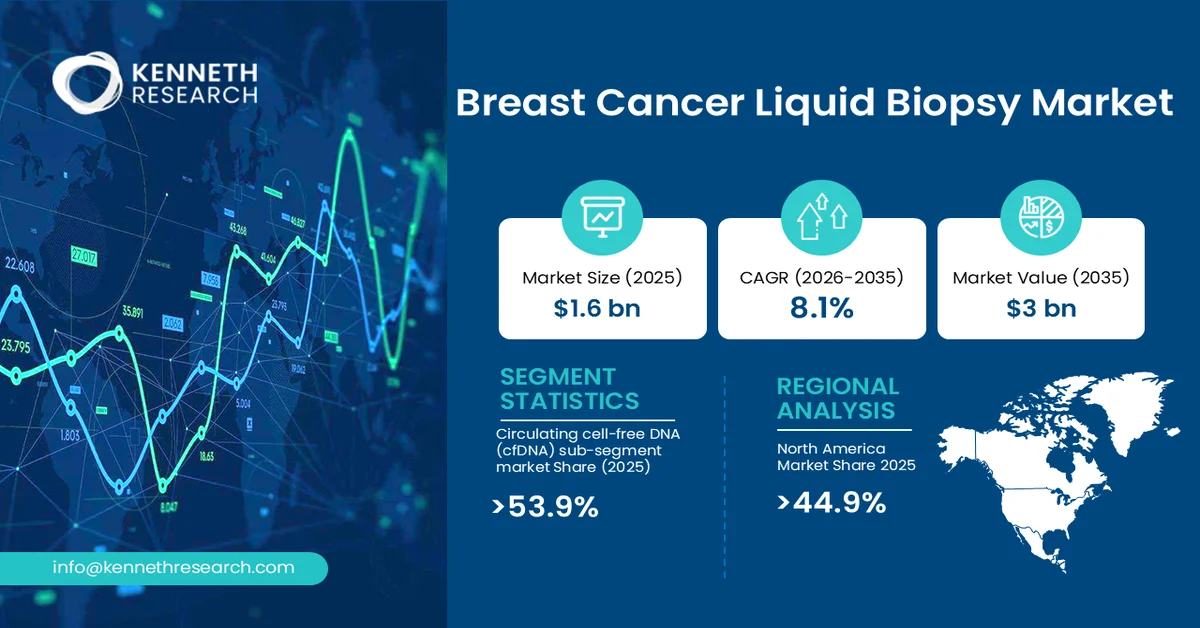
Breast Cancer Liquid Biopsy Market size was valued at USD 1.6 billion in 2025 and is projected to reach USD 3 billion by the end of 2035, rising at a CAGR of 8.1% during the forecast period, i.e., 2026-2035. In 2026, the industry size of the breast cancer liquid biopsy is estimated at USD 1.8 billion.
The primary growth driver for the breast cancer liquid biopsy market is the increasing emphasis on early cancer detection and precision oncology. Rising breast cancer incidence, expanding adoption of minimally invasive molecular diagnostics, and growing integration of biomarker-guided treatment decisions across oncology care are accelerating demand for liquid biopsy technologies worldwide.
The breast cancer liquid biopsy market comprises diagnostic products, assays, instruments, and associated services that detect and analyze tumor-derived biomarkers in blood or other body fluids to support breast cancer diagnosis, treatment selection, disease monitoring, recurrence detection, and therapeutic response assessment. Unlike conventional tissue biopsies, liquid biopsy provides a minimally invasive approach by evaluating circulating biomarkers such as circulating cell-free DNA (cfDNA), circulating tumor DNA (ctDNA), circulating tumor cells (CTCs), exosomes, and other molecular analytes. These technologies enable repeated sampling throughout the patient journey, facilitating longitudinal monitoring of tumor evolution and genomic alterations.
The market plays a critical role in modern precision oncology by supporting personalized treatment strategies, identifying actionable mutations, monitoring minimal residual disease, and detecting emerging treatment resistance with reduced patient burden. Continuous advances in molecular diagnostics, next-generation sequencing, and highly sensitive biomarker detection platforms are expanding clinical utility across breast cancer management. Industrially, the market is strategically important to diagnostic manufacturers, biotechnology companies, clinical laboratories, healthcare providers, and pharmaceutical developers seeking to improve therapeutic decision-making, clinical trial efficiency, and patient outcomes through precision medicine approaches
Key Breast Cancer Liquid Biopsy Market Insights Summary:
Key Takeaways: Market Trends & Insights
- Breast Cancer Liquid Biopsy Market valued at USD 1.6 billion in 2025 and projected to reach USD 3 billion by 2035 at a CAGR of 8.1%
- Circulating Cell-free DNA (cfDNA) led the circulating biomarkers segment with a 53.9% share in 2025 driven by its widespread use in minimally invasive genomic profiling
- Treatment Selection is expected to emerge as one of the fastest-growing application segments supported by expanding adoption of precision oncology and companion diagnostics
- North America accounted for the largest regional share of 44.9% in 2025 led by strong healthcare infrastructure, molecular diagnostics capabilities, and precision medicine investments
- The market is being shaped by increasing integration of liquid biopsy technologies into personalized breast cancer management, longitudinal disease monitoring, and targeted therapy decision-making across clinical settings
Market Drivers
- Increasing investment in molecular diagnostic research and development
- Growing collaboration between diagnostic developers and pharmaceutical companies
- Rising adoption of next-generation sequencing in oncology diagnostics
- Expanding use of minimally invasive testing in cancer clinical trials
Challenges
- Limited clinical standardization and validation across testing platforms
- High development costs and complex reimbursement environment
Breast Cancer Liquid Biopsy Market Overview & Supply Chain
Global adoption of breast cancer liquid biopsy is increasing as healthcare systems prioritize earlier diagnosis, precision oncology, and minimally invasive disease monitoring. Advances in next-generation sequencing, digital PCR, and multiplex biomarker analysis have improved the analytical performance of liquid biopsy platforms, enabling clinicians to evaluate tumor evolution without repeated tissue sampling. Regulatory support for precision medicine and expanding integration of molecular diagnostics into oncology care pathways are further strengthening clinical acceptance. The growing burden of breast cancer also reinforces the need for scalable diagnostic solutions.
The value chain of the breast cancer liquid biopsy market begins with suppliers of specialized reagents, assay chemicals, blood collection tubes, antibodies, sequencing consumables, microfluidic components, and laboratory instrumentation used for biomarker isolation and molecular analysis. Diagnostic manufacturers and biotechnology companies integrate these inputs to develop liquid biopsy kits, sequencing platforms, PCR-based assays, and software for genomic data interpretation while ensuring compliance with quality and regulatory standards. Production is supported by contract manufacturers, component suppliers, and analytical service providers that contribute to assay validation and scale-up. Distribution occurs through direct sales channels, laboratory networks, medical distributors, and strategic partnerships with hospitals and cancer centers. Clinical laboratories perform sample processing and genomic analysis before delivering actionable reports to oncologists. End users include hospitals, specialty cancer centers, diagnostic laboratories, research institutes, pharmaceutical companies, and clinical trial organizations. Major stakeholders across the ecosystem include biomarker developers, instrument manufacturers, healthcare providers, regulatory authorities, reimbursement agencies, and precision medicine collaborators working to advance personalized breast cancer management.
Biopsy Punch Market: Growth Drivers & Challenges
Growth Drivers:
- Expansion of precision oncology and companion diagnostics: The increasing adoption of precision oncology is a major growth driver for the breast cancer liquid biopsy market. As breast cancer treatment shifts toward biomarker-guided therapeutic strategies, liquid biopsy has become an important tool for identifying actionable genomic alterations, monitoring treatment response, and detecting resistance mutations through minimally invasive testing. Its ability to provide real-time molecular insights supports personalized treatment selection while reducing the need for repeated tissue biopsies. Pharmaceutical companies are also integrating liquid biopsy into targeted therapy development and clinical trials, strengthening the commercial ecosystem surrounding companion diagnostics. Continued regulatory recognition of molecular diagnostics is expected to accelerate clinical adoption, encourage innovation in highly sensitive assays, and expand reimbursement opportunities. In January 2023, the U.S. Food and Drug Administration (FDA) expanded the indication for Guardant360 CDx to detect ESR1 mutations in patients with breast cancer, reinforcing the growing role of liquid biopsy in precision oncology and targeted treatment selection.
- Increasing integration of liquid biopsy into longitudinal cancer management: Healthcare providers are increasingly incorporating liquid biopsy into longitudinal breast cancer management because it enables repeated molecular assessment throughout the patient journey without invasive procedures. Continuous monitoring helps clinicians evaluate treatment effectiveness, identify emerging resistance mechanisms, and detect disease recurrence earlier than conventional approaches in suitable clinical settings. This capability aligns with evolving oncology care models that emphasize individualized treatment optimization and evidence-based therapeutic adjustments. Simultaneously, advances in sequencing technologies, bioinformatics, and automated laboratory workflows are improving test reproducibility and operational efficiency, making liquid biopsy more practical for routine clinical use. As clinical evidence continues to expand and healthcare systems prioritize personalized cancer management, liquid biopsy is expected to become more deeply integrated into treatment pathways, supporting broader adoption across hospitals, specialized cancer centers, diagnostic laboratories, and pharmaceutical research programs.
Challenges:
- Limited clinical standardization and validation across testing platforms: A major restraint for the breast cancer liquid biopsy market is the lack of uniform clinical standardization across different testing platforms and analytical methodologies. Variations in sample collection protocols, biomarker isolation techniques, sequencing workflows, and data interpretation criteria can produce inconsistent results between laboratories. This creates uncertainty for clinicians when comparing findings across diagnostic providers and complicates the broader integration of liquid biopsy into standardized treatment pathways. For manufacturers, the need to generate extensive analytical and clinical validation data increases development timelines and regulatory complexity. Commercially, inconsistent testing standards may delay purchasing decisions by hospitals and diagnostic laboratories that seek validated, interoperable solutions. Looking ahead, broader adoption will depend on harmonized clinical guidelines, standardized quality assurance frameworks, and greater collaboration among regulators, diagnostic developers, and clinical organizations to improve confidence in test reproducibility and clinical utility.
- High development costs and complex reimbursement environment: The commercialization of advanced liquid biopsy technologies requires substantial investment in assay development, molecular validation, regulatory compliance, laboratory infrastructure, and specialized bioinformatics capabilities. These costs create barriers for emerging diagnostic companies and can limit the pace of product commercialization. At the healthcare provider level, uncertain reimbursement policies and differences in coverage across healthcare systems may restrict routine clinical utilization, particularly for newly introduced applications with evolving evidence. Commercially, manufacturers often face extended market access timelines while demonstrating clinical utility and economic value to payers. This environment can slow procurement decisions and reduce adoption despite technological advances. In the long term, expanded clinical evidence, clearer reimbursement frameworks, and value-based healthcare models are expected to improve commercial viability, but reimbursement consistency will remain a key determinant of market expansion.
Breast Cancer Liquid Biopsy Market Size and Forecast:
| Report Attribute | Details |
|---|---|
| Base Year |
2025 |
| Forecast Year |
2026-2035 |
| CAGR |
8.1% |
| Base Year Market Size (2025) |
USD 1.6 billion |
| Forecast Year Market Size (2035) |
USD 3 billion |
| Regional Scope |
|
Breast Cancer Liquid Biopsy Market - Segment Analysis
Circulating Biomarkers Segment Analysis
In the circulating biomarkers segment, the circulating cell-free dna (cfDNA) sub-segment is anticipated to capture the largest market share of 53.9% by the end of 2025.
The circulating cell-free DNA (cfDNA) sub-segment dominates the breast cancer liquid biopsy market because it offers a highly practical and scalable approach for detecting tumor-associated genetic alterations through minimally invasive blood sampling. Demand is being driven by the growing clinical preference for precision oncology, where genomic profiling supports individualized treatment selection and disease monitoring throughout the patient journey. Compared with several other circulating biomarkers, cfDNA benefits from established analytical workflows, compatibility with next-generation sequencing and PCR-based technologies, and increasing integration into routine molecular diagnostic laboratories. On the supply side, diagnostic manufacturers continue to enhance assay sensitivity, automation, and bioinformatics capabilities, enabling broader clinical implementation while improving laboratory efficiency. Future growth is expected to be supported by expanding clinical validation, greater incorporation into oncology care pathways, and continued advances in genomic analysis technologies. Supporting demand for advanced molecular diagnostics, the CDC reported that 80.0% of U.S. women aged 50–74 years were up to date with breast cancer screening in 2023, reflecting sustained engagement with breast cancer diagnostic services and opportunities for complementary precision diagnostic tools such as cfDNA-based liquid biopsy.
Application Segment Analysis
The treatment selection is projected to grow as the second-largest segment in the breast cancer liquid biopsy market due to four converging demand drivers.
The treatment selection sub-segment is projected to witness strong growth as precision oncology becomes increasingly central to breast cancer management. Liquid biopsy enables clinicians to identify actionable molecular alterations, monitor evolving tumor biology, and support personalized therapeutic decisions without relying solely on repeat tissue biopsies. This capability is particularly valuable when selecting targeted therapies, evaluating treatment resistance, and optimizing patient-specific care throughout the disease continuum. Adoption is expanding across hospitals, oncology centers, and molecular diagnostic laboratories as multidisciplinary cancer care increasingly incorporates genomic information into clinical decision-making. On the supply side, diagnostic developers are introducing more comprehensive biomarker panels, enhanced sequencing platforms, and integrated bioinformatics solutions that improve the clinical utility of liquid biopsy for treatment planning. Looking ahead, broader clinical validation, increasing availability of companion diagnostics, and stronger integration with precision medicine programs are expected to reinforce demand for treatment-selection applications. Supporting this trend, the U.S. National Cancer Institute (NCI) states that targeted therapy is used to treat certain types of breast cancer and forms part of modern systemic treatment approaches, underscoring the growing need for molecular diagnostic tools that guide therapy selection.
Our in-depth analysis of the global breast cancer liquid biopsy market includes the following segments:
|
Segment |
Sub-segment |
|
Circulating Biomarkers |
|
|
Application |
|
Biopsy Punch Market Regional Insights:
North America Market Trends & Insights:
North America breast cancer liquid biopsy market is projected to hold the largest revenue share of 44.9% by the end of 2025.
The region benefits from close collaboration among biotechnology companies, diagnostic manufacturers, pharmaceutical developers, academic research institutions, and healthcare providers, accelerating the translation of molecular research into clinical practice. High adoption of personalized oncology, favorable reimbursement for selected molecular tests, and continuous investment in translational cancer research further reinforce regional leadership. In addition, robust laboratory infrastructure and increasing integration of genomic testing into oncology care pathways continue to strengthen demand for liquid biopsy technologies across the region.
The United States represents the largest contributor to regional revenue owing to its advanced oncology care infrastructure, extensive clinical research activities, and early adoption of precision diagnostics. Continuous product innovation, regulatory approvals, and collaborations between diagnostic companies and healthcare providers support sustained market development. According to the CDC, the National Breast and Cervical Cancer Early Detection Program provided breast cancer screening and diagnostic services to 305,992 women in 2024, reflecting the scale of breast cancer diagnostic infrastructure that supports adoption of advanced molecular testing technologies.
Canada complements regional growth through expanding precision medicine initiatives, publicly funded healthcare programs, ongoing updates to national breast cancer screening policies, and increasing investment in oncology research, creating favorable conditions for broader clinical integration of liquid biopsy solutions.
Europe Market Trends & Insights:
Europe represents a strategically important region in the breast cancer liquid biopsy market, supported by growing demand for precision oncology, expanding molecular diagnostics capabilities, and strong collaboration between healthcare providers, research institutions, and biotechnology companies. Increasing emphasis on personalized cancer care has encouraged the integration of liquid biopsy into clinical workflows for treatment selection, disease monitoring, and recurrence assessment. The region's advanced laboratory infrastructure and well-established regulatory framework support the development and commercialization of innovative diagnostic technologies while maintaining high standards for analytical and clinical validation. Government-backed cancer control initiatives and investments in genomic medicine continue to strengthen the adoption of molecular testing across healthcare systems. Looking ahead, opportunities are expected to arise from broader implementation of national precision medicine strategies, continued advances in sequencing technologies, increasing collaboration between pharmaceutical and diagnostic companies, and expanding use of liquid biopsy in clinical research and companion diagnostic applications.
Germany serves as a leading market within Europe due to its strong biotechnology sector, advanced healthcare infrastructure, and extensive network of academic medical centers engaged in oncology research. The country continues to promote the adoption of precision diagnostics through investments in genomic medicine, clinical innovation, and collaborations between healthcare providers and diagnostic developers.
The United Kingdom is also a significant contributor, supported by an established life sciences ecosystem, expanding use of molecular diagnostics within cancer care pathways, and sustained investment in translational research. Ongoing partnerships among public healthcare organizations, universities, biotechnology firms, and pharmaceutical companies are accelerating clinical validation and facilitating broader integration of liquid biopsy technologies into routine oncology practice across the country.
Leading Companies Operating in the Global Biopsy Punch Market:
Here is a list of upstream, downstream, and key players operating in the global breast cancer liquid biopsy market competitive ecosystem:
- F. Hoffmann-La Roche Ltd (Switzerland)
- Company Overview
- Business Strategy
- Key Product Offerings
- Financial Performance
- Key Performance Indicators
- Risk Analysis
- Recent Development
- Regional Presence
- SWOT Analysis
- Guardant Health Inc. (United States)
- QIAGEN N.V. (Netherlands)
- Myriad Genetics Inc. (United States)
- NeoGenomics Laboratories Inc. (United States)
- Exact Sciences Corporation (United States)
Recent Developments
- October 2024: Foundation Medicine announced that the U.S. FDA approved FoundationOne® Liquid CDx as a companion diagnostic for Itovebi® (inavolisib) to identify patients with HR-positive, HER2-negative, PIK3CA-mutated advanced breast cancer. The approval expanded the use of liquid biopsy for therapy selection in breast cancer.
- December 2024: Guardant Health announced new research to be presented at the 2024 San Antonio Breast Cancer Symposium (SABCS) demonstrating how Guardant360® liquid biopsy, real-world data, and AI analytics can help tailor treatment strategies for patients with metastatic and early-stage breast cancer.
Frequently Asked Question
In 2025, the breast cancer liquid biopsy market exceeded USD 1.6 billion.
The breast cancer liquid biopsy market is projected to reach USD 3 billion by the end of 2035, expanding at a CAGR of 8.1% over the forecast period (2026-2035).
The major players in the market are F. Hoffmann-La Roche Ltd (Switzerland), Guardant Health Inc. (United States), QIAGEN N.V. (Netherlands), Myriad Genetics Inc. (United States), NeoGenomics Laboratories Inc. (United States), Exact Sciences Corporation (United States), and others.
In the circulating biomarkers segment, the circulating cell-free dna (cfDNA) sub-segment is anticipated to capture the largest market share of 53.9% in the future and exhibit lucrative growth opportunities during 2026-2035. This growth trajectory is largely attributed to increasing adoption of precision oncology and biomarker-guided treatment selection supported by advances in molecular diagnostics.
North America is projected to hold the largest market share of 44.9% by the end of 2035 and provide more business opportunities in the future. Continuous investments in precision oncology, advanced molecular diagnostics, and innovation across the United States and Canada are fostering the region's dominance.
Why Choose Kenneth Research ?
-
Insight with Impact : We don’t just gather data — we uncover stories, trends, and opportunities that fuel business growth.
-
Experts Who Get It : Our team speaks your industry’s language and knows what really matters to your customers and market.
-
Custom-Built for You : Forget one-size-fits-all. We craft research and consulting solutions as unique as your business vision.
-
Partners, Not Just Providers : We work with you, not for you — collaborating closely to turn insights into smart, strategic moves.
-
Results That Speak : Our work powers brands, startups, and industry leaders alike — with a track record of ideas that work in the real world.
Report ID: 1094 |
Published Date: 17 Aug 2026 |
Report Format: |
Delivery Timeline: 48-72 Business Hours

Copyright © 2025 Kenneth Research. All rights reserved. Terms of Use | Privacy Policy
