Report ID: 1042 |
Published Date: 28 Jul 2026 |
Report Format: |
Delivery Timeline: 48-72 Business Hours
Brain Cancer Diagnostics Market Outlook:
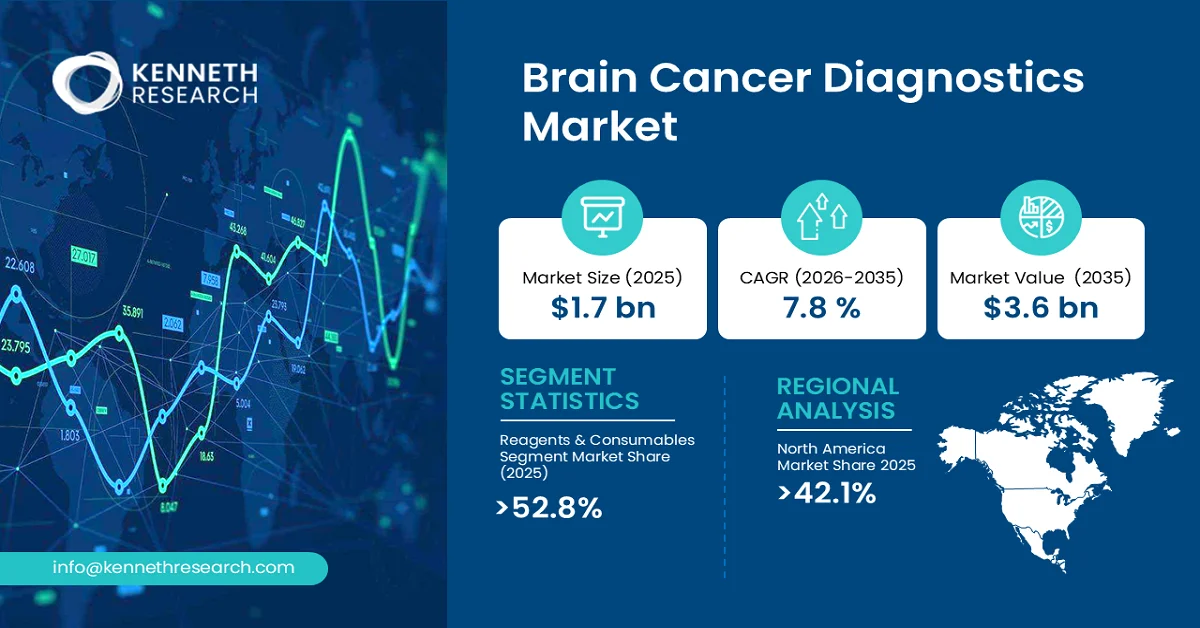
Brain Cancer Diagnostics Market size was valued at USD 1.7 billion in 2025 and is projected to reach USD 3.6 billion by the end of 2035, rising at a CAGR of 7.8% during the forecast period, i.e., 2026–2035. In 2026, the industry size of the brain cancer diagnostics is estimated at USD 1.9 billion.
The primary growth driver for the brain cancer diagnostics market is the increasing adoption of advanced molecular diagnostics and high-resolution neuroimaging to improve diagnostic accuracy, tumor classification, and treatment planning. The evolving molecular classification of central nervous system tumors is accelerating demand for integrated diagnostic workflows across hospitals, pathology laboratories, and cancer centers.
The brain cancer diagnostics market comprises diagnostic products, technologies, and services used to detect, characterize, classify, and monitor primary and metastatic brain tumors. The market encompasses imaging modalities such as magnetic resonance imaging (MRI), computed tomography (CT), and positron emission tomography (PET), alongside biopsy procedures, histopathology, molecular diagnostics, immunohistochemistry, genomic profiling, and laboratory reagents and consumables. These diagnostic solutions support the identification of tumor type, grade, molecular alterations, and disease progression, enabling clinicians to establish accurate diagnoses and develop personalized treatment strategies.
A defining characteristic of the market is its increasing reliance on integrated diagnostic approaches that combine radiological findings with molecular and genetic profiling in accordance with modern neuro-oncology practices. This multidisciplinary framework enhances diagnostic precision, supports risk stratification, and improves therapeutic decision-making. The market holds significant industrial relevance as healthcare systems continue to invest in precision oncology, digital pathology, and advanced laboratory infrastructure. Diagnostic manufacturers, biotechnology companies, clinical laboratories, hospitals, and academic research institutions collectively contribute to innovation in brain cancer diagnostics, supporting earlier detection, standardized classification, and improved clinical management of patients with central nervous system malignancies.
Key Brain Cancer Diagnostics Market Insights Summary:
Key Takeaways: Market Trends & Insights
- Brain cancer diagnostics market is projected to grow from USD 1.7 billion in 2025 to USD 3.6 billion by 2035, registering a CAGR of 7.8% during the forecast period (2026–2035)
- The reagents & consumables segment accounted for the largest share of 52.8% in 2025, driven by recurring demand for molecular diagnostics, immunohistochemistry, and genomic testing workflows
- North America held the leading regional share of 42.1% in 2025, supported by advanced healthcare infrastructure, widespread adoption of precision oncology, and strong research capabilities in the United States and Canada
- The increasing integration of AI-enabled imaging, molecular diagnostics, and genomic profiling is enhancing diagnostic accuracy and accelerating the adoption of precision brain cancer diagnostic solutions worldwide
- Growing investments in advanced neuroimaging, digital pathology, and integrated diagnostic platforms are expected to create long-term growth opportunities as healthcare systems continue to modernize cancer diagnosis and patient management
Market Drivers
- Rising investments in precision oncology research and neuro-oncology infrastructure
- Increasing utilization of liquid biopsy technologies for non-invasive brain tumor assessment
- Expansion of digital pathology and cloud-based diagnostic workflow integration
- Growing collaboration between diagnostic manufacturers, research institutions, and healthcare providers
Challenges
- High cost and limited accessibility of advanced diagnostic technologies
- Complexity of standardizing integrated diagnostic workflows
Brain Cancer Diagnostics Market Overview & Supply Chain
The global adoption of brain cancer diagnostics is accelerating as healthcare providers increasingly integrate advanced neuroimaging, molecular pathology, genomic profiling, and artificial intelligence into routine clinical workflows. The 2021 WHO classification of central nervous system tumors has further strengthened the role of molecular diagnostics alongside conventional histopathology, driving demand for more comprehensive diagnostic solutions. Healthcare systems are also investing in precision oncology to enable earlier diagnosis, accurate tumor classification, and personalized treatment selection. According to the U.S. National Cancer Institute (NCI), the Surveillance, Epidemiology, and End Results (SEER) Program reported a combined incidence of brain and other central nervous system tumors of 6.2 cases per 100,000 people per year for 2017–2021, highlighting the sustained clinical burden that continues to support investments in advanced diagnostic technologies.
The brain cancer diagnostics market operates through a specialized healthcare value chain that begins with the procurement of biological reagents, antibodies, molecular assay components, imaging contrast agents, laboratory chemicals, semiconductor components, precision optics, and medical-grade electronic assemblies sourced from biotechnology, chemical, and medical device suppliers. These inputs are integrated by manufacturers producing diagnostic imaging systems, molecular diagnostic platforms, pathology instruments, biopsy devices, and associated reagents and consumables under stringent quality and regulatory standards. Distribution occurs through direct sales organizations, authorized medical equipment distributors, laboratory supply networks, and healthcare procurement channels that serve hospitals, cancer centers, academic medical institutions, and independent diagnostic laboratories. End users include neurology departments, neurosurgical centers, pathology laboratories, oncology clinics, and research organizations that rely on integrated diagnostic workflows. Key stakeholders across the value chain include raw material suppliers, diagnostic manufacturers, biotechnology companies, healthcare providers, contract manufacturers, regulatory agencies, distributors, research institutions, and reimbursement organizations that collectively support innovation, commercialization, and clinical adoption.
Brain Cancer Diagnostics Market: Growth Drivers & Challenges
Growth Drivers:
- Expansion of AI-Enabled Neuroimaging and Advanced Diagnostic Platforms: The growing integration of artificial intelligence with neuroimaging and molecular diagnostics is significantly enhancing the efficiency and accuracy of brain cancer diagnosis. AI-assisted MRI analysis, automated lesion segmentation, image quantification, and clinical decision-support tools are reducing interpretation variability while enabling earlier identification of suspicious lesions. These technologies complement molecular profiling and digital pathology, allowing clinicians to establish more precise diagnoses and personalized treatment strategies. Regulatory clearances for AI-enabled radiology software are also encouraging healthcare providers to modernize diagnostic workflows and invest in advanced imaging infrastructure. In October 2023, the U.S. Food and Drug Administration (FDA) granted 510(k) clearance to Siemens Healthineers' AI-Rad Companion Brain MR (K232305), an automated radiological image processing software for brain MRI, demonstrating continued regulatory support for AI-assisted neuroimaging solutions. Such advancements are expected to accelerate clinical adoption, improve workflow efficiency, and stimulate continued innovation across the brain cancer diagnostics ecosystem.
- Growing Adoption of Integrated Molecular Diagnostics in Neuro-Oncology: The increasing adoption of integrated molecular diagnostics is transforming the diagnosis and classification of brain tumors. Modern neuro-oncology increasingly combines histopathology with genomic profiling, immunohistochemistry, and biomarker analysis to improve diagnostic precision and support personalized therapeutic decisions. This integrated approach enables clinicians to distinguish between tumor subtypes that exhibit similar histological characteristics but different molecular signatures and clinical outcomes. As precision medicine continues to evolve, hospitals and reference laboratories are expanding their molecular testing capabilities while investing in advanced laboratory automation and next-generation sequencing platforms. The shift toward molecularly informed clinical decision-making is also encouraging collaboration between diagnostic manufacturers, biotechnology companies, and healthcare providers to develop comprehensive diagnostic solutions. Over the coming years, broader adoption of integrated molecular diagnostics is expected to improve patient stratification, facilitate targeted therapy selection, and strengthen the overall clinical value of brain cancer diagnostic technologies.
Challenges:
- High Cost and Limited Accessibility of Advanced Diagnostic Technologies: The widespread adoption of advanced brain cancer diagnostic technologies is constrained by the high cost of sophisticated imaging systems, molecular diagnostic platforms, genomic sequencing equipment, and specialized laboratory infrastructure. Healthcare providers must also invest in skilled personnel, software integration, quality assurance programs, and ongoing maintenance to support these technologies. These financial requirements create barriers for smaller hospitals and healthcare facilities, particularly in resource-constrained regions where capital expenditure and reimbursement remain limited. As a result, disparities in diagnostic capabilities persist across healthcare systems, affecting the timely adoption of comprehensive diagnostic workflows. Commercially, manufacturers often experience longer sales cycles and slower market penetration in developing economies. Going forward, improvements in reimbursement frameworks, cost-efficient diagnostic platforms, and scalable laboratory solutions are expected to gradually reduce accessibility barriers and support broader adoption.
- Complexity of Standardizing Integrated Diagnostic Workflows: Brain cancer diagnosis increasingly depends on combining neuroimaging, histopathology, molecular profiling, and genomic analysis into a unified diagnostic framework. However, variations in laboratory capabilities, testing protocols, reporting standards, and multidisciplinary expertise make it challenging to achieve consistent implementation across healthcare institutions. The integration of multiple diagnostic modalities also requires seamless interoperability between imaging systems, laboratory information systems, and clinical decision-support platforms. These complexities increase operational demands and may delay workflow optimization, particularly in institutions transitioning toward precision oncology practices. From a commercial perspective, diagnostic manufacturers must develop interoperable solutions that comply with diverse regulatory and clinical requirements across different markets. As international clinical guidelines continue to evolve and digital health infrastructure matures, greater standardization and automation are expected to improve diagnostic consistency while reducing implementation challenges.
Brain Cancer Diagnostics Market Size and Forecast:
| Report Attribute | Details |
|---|---|
| Base Year |
2025 |
| Forecast Year |
2026-2035 |
| CAGR |
7.8% |
| Base Year Market Size (2025) |
USD 1.7 billion |
| Forecast Year Market Size (2035) |
USD 3.6 billion |
| Regional Scope |
|
Brain Cancer Diagnostics Market Segmentation Analysis:
Product Segment Analysis
In the product segment, the reagents & consumables sub-segment is anticipated to capture the largest market share of 52.8% by the end of 2025.
The Reagents & Consumables segment dominates the brain cancer diagnostics market because these products are indispensable across every stage of the diagnostic workflow, from tissue preparation and biomarker detection to molecular profiling, immunohistochemistry, and genomic analysis. Unlike capital equipment, reagents and consumables require continuous replenishment, creating recurring demand from hospitals, pathology laboratories, academic research centers, and reference diagnostic laboratories. The increasing adoption of precision oncology and molecular classification of brain tumors has further accelerated the use of specialized assay kits, antibodies, staining reagents, sequencing reagents, and quality-control materials. On the supply side, manufacturers continue to expand product portfolios with standardized, regulatory-compliant consumables that ensure reproducibility and compatibility with automated laboratory platforms. Supporting this trend, the U.S. Food and Drug Administration (FDA) states that in vitro diagnostic (IVD) products include reagents, instruments, and systems used to diagnose disease and support precision medicine, including next-generation sequencing tests for detecting genomic variations, reflecting the central role of reagents in modern diagnostic practice. Looking ahead, expanding molecular testing, laboratory automation, and precision medicine initiatives are expected to sustain long-term demand for this segment.
Technique Segment Analysis
The Imaging is projected to grow as the second-largest segment in the brain cancer diagnostics market due to four converging demand drivers.
The Imaging segment is projected to witness significant growth as it remains the primary modality for detecting, localizing, and characterizing brain tumors throughout the patient care pathway. Advances in magnetic resonance imaging (MRI), computed tomography (CT), positron emission tomography (PET), and hybrid imaging technologies are improving diagnostic precision by enabling earlier lesion detection, treatment planning, surgical navigation, and post-treatment monitoring. The growing adoption of artificial intelligence-based image analysis and advanced functional imaging techniques is further enhancing clinical confidence while reducing interpretation variability. On the supply side, manufacturers continue to introduce higher-resolution imaging systems, software upgrades, and workflow automation solutions to meet the increasing demand for precision diagnostics. According to the Organisation for Economic Co-operation and Development (OECD), the availability of CT scanners, MRI units, and PET scanners has increased rapidly across most OECD countries over the past decades, with diagnostic examinations in 2021 generally exceeding pre-pandemic (2019) levels, reflecting sustained investment in diagnostic imaging infrastructure. Looking ahead, continued modernization of radiology departments and wider integration of AI-enabled imaging solutions are expected to reinforce the long-term growth of this segment.
Our in-depth analysis of the global brain cancer diagnostics market includes the following segments:
|
Segment |
Sub-segment |
|
Technique |
|
|
Product |
|
|
Cancer Type |
|
|
End Use |
|
Brain Cancer Diagnostics Market Regional Insights:
North America Market Trends & Insights:
North America brain cancer diagnostics market is projected to hold the largest revenue share of 42.1% by the end of 2025.
The region's leadership is supported by its well-established healthcare infrastructure, widespread availability of advanced neuroimaging systems, strong adoption of molecular diagnostics, and continued investments in precision oncology. The presence of leading diagnostic manufacturers, specialized cancer centers, and research institutions further accelerates innovation and commercialization of brain cancer diagnostic technologies. In addition, supportive regulatory pathways for in vitro diagnostics and medical imaging devices encourage the rapid introduction of new diagnostic solutions. According to the Central Brain Tumor Registry of the United States (CBTRUS), developed in collaboration with the Centers for Disease Control and Prevention (CDC) and the National Cancer Institute (NCI), the average annual age-adjusted incidence rate of all primary malignant and non-malignant brain and other central nervous system tumors in the United States was 25.34 per 100,000 population during 2017–2021, demonstrating the sustained clinical burden that supports continued demand for advanced diagnostic technologies across the region.
The United States represents the largest contributor to the regional market owing to its extensive network of tertiary care hospitals, comprehensive cancer centers, advanced diagnostic laboratories, and significant investments in neuro-oncology research. The country also benefits from the early adoption of artificial intelligence-enabled imaging, molecular pathology, and genomic testing within routine clinical practice.
Canada complements regional growth through its publicly funded healthcare system, expanding investments in diagnostic imaging infrastructure, and increasing emphasis on precision medicine initiatives. Collaborative research programs, academic partnerships, and ongoing modernization of pathology and radiology services across both countries continue to strengthen North America's leadership in the brain cancer diagnostics market.
Asia Pacific Market Trends & Insights:
Asia Pacific is expected to emerge as one of the fastest-growing regions in the brain cancer diagnostics market due to expanding healthcare infrastructure, increasing adoption of advanced diagnostic technologies, and growing investments in precision medicine. Rising awareness of neurological disorders, improvements in access to specialized oncology care, and the modernization of pathology and radiology services are encouraging healthcare providers to adopt integrated diagnostic approaches for brain tumors. Governments across the region are strengthening national cancer control programs, supporting digital health initiatives, and investing in advanced medical equipment to improve diagnostic capacity. At the same time, expanding biotechnology industries, increasing clinical research activities, and greater collaboration between healthcare institutions and diagnostic manufacturers are fostering innovation in molecular diagnostics and neuroimaging. These developments are expected to create substantial opportunities for suppliers of imaging systems, diagnostic reagents, genomic testing platforms, and digital pathology solutions over the forecast period.
China is leading regional growth through significant investments in healthcare modernization, expansion of tertiary hospitals, and increasing adoption of advanced imaging and molecular diagnostic technologies. The country's growing biotechnology ecosystem and focus on precision medicine continue to strengthen demand for sophisticated brain cancer diagnostic solutions.
Japan contributes through its highly developed healthcare system, strong expertise in medical imaging, and continuous technological innovation in diagnostic equipment. The country's emphasis on early disease detection, research in neuro-oncology, and integration of advanced laboratory technologies supports the broader adoption of comprehensive brain cancer diagnostic workflows across clinical and research settings.
Leading Companies Operating in the Global Brain Cancer Diagnostics Market:
Here is a list of upstream, downstream, and key players operating in the global brain cancer diagnostics market competitive ecosystem:
- F. Hoffmann-La Roche Ltd. (Switzerland)
- Company Overview
- Business Strategy
- Key Product Offerings
- Financial Performance
- Key Performance Indicators
- Risk Analysis
- Recent Development
- Hologic, Inc. (United States)
- ZEISS Medical Technology (Germany)
- Leica Biosystems (Germany)
- Merck KGaA (Germany)
- QIAGEN N.V. (Netherlands)
Recent Developments
- Roche, in January 2024, announced the expansion of its Digital Pathology Open Environment by integrating more than 20 artificial intelligence algorithms from eight collaborators, strengthening AI-enabled cancer diagnostics and supporting improved pathology workflows for oncology applications, including brain tumor diagnostics.
- Illumina, in November 2024, announced the expansion of its TruSight™ Oncology portfolio, introducing new capabilities to broaden access to comprehensive genomic profiling and support precision oncology testing for solid tumors, including brain cancer applications.
Frequently Asked Question
In 2025, the brain cancer diagnostics market exceeded USD 1.7 billion.
The brain cancer diagnostics market is projected to reach USD 3.6 billion by the end of 2035, expanding at a CAGR of 7.8% over the forecast period (2026–2035).
The major players in the market are F. Hoffmann-La Roche Ltd., Thermo Fisher Scientific Inc., Danaher Corporation, Siemens Healthineers AG, GE HealthCare Technologies Inc., Canon Medical Systems Corporation, Fujifilm Holdings Corporation, Koninklijke Philips N.V., Agilent Technologies, Inc., Bio-Rad Laboratories, Inc., Illumina, Inc., QIAGEN N.V., Abbott Laboratories, Bio-Techne Corporation, Revvity, Inc., Merck KGaA, Leica Biosystems, ZEISS Medical Technology, Hologic, Inc., Sysmex Corporation, and others.
In the Product segment, the reagents & consumables sub-segment is anticipated to capture the largest market share of 52.8% in the future and exhibit lucrative growth opportunities during 2026–2035. This growth trajectory is largely attributed to the increasing adoption of molecular diagnostics and precision oncology, resulting in sustained demand for diagnostic reagents and consumables.
North America is projected to hold the largest market share of 42.1% by the end of 2035 and provide more business opportunities in the future. Continuous investments in advanced neuroimaging technologies, molecular diagnostics, and precision oncology across the United States and Canada are fostering the region's dominance.
Why Choose Kenneth Research ?
-
Insight with Impact : We don’t just gather data — we uncover stories, trends, and opportunities that fuel business growth.
-
Experts Who Get It : Our team speaks your industry’s language and knows what really matters to your customers and market.
-
Custom-Built for You : Forget one-size-fits-all. We craft research and consulting solutions as unique as your business vision.
-
Partners, Not Just Providers : We work with you, not for you — collaborating closely to turn insights into smart, strategic moves.
-
Results That Speak : Our work powers brands, startups, and industry leaders alike — with a track record of ideas that work in the real world.
Report ID: 1042 |
Published Date: 28 Jul 2026 |
Report Format: |
Delivery Timeline: 48-72 Business Hours

Copyright © 2025 Kenneth Research. All rights reserved. Terms of Use | Privacy Policy
