Report ID: 1117 |
Published Date: 20 Aug 2026 |
Report Format: |
Delivery Timeline: 48-72 Business Hours
BPA Free Epoxy Resin Market Outlook:
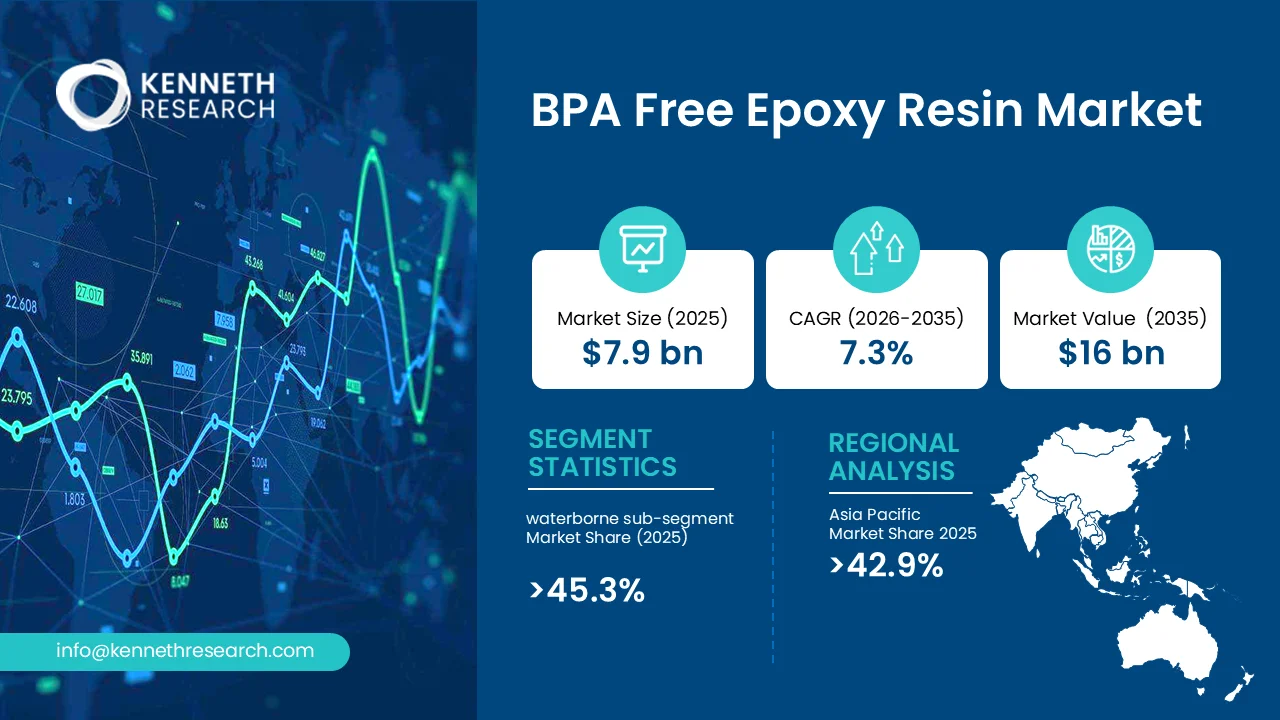
BPA Free Epoxy Resin Market size was valued at USD 7.9 billion in 2025 and is projected to reach USD 16 billion by the end of 2035, rising at a CAGR of 7.3% during the forecast period, i.e., 2026-2035. In 2026, the industry size of BPA free epoxy resin is estimated at USD 8.5 billion.
The primary growth driver for the BPA free epoxy resin market is the accelerating shift toward safer, lower-toxicity material systems driven by evolving chemical safety regulations and sustainability goals. Industrial manufacturers are increasingly adopting BPA-free epoxy formulations for coatings, adhesives, composites, and electrical applications while maintaining high mechanical strength, corrosion resistance, and durability.
The BPA free epoxy resin market comprises the production, commercialization, and application of epoxy resin systems formulated without bisphenol A (BPA) as a primary raw material. These resins are developed using alternative chemistries to deliver comparable performance while addressing growing regulatory, environmental, and occupational health considerations associated with BPA-containing materials. BPA-free epoxy resins are thermosetting polymers that exhibit excellent adhesion, chemical resistance, corrosion protection, electrical insulation, and mechanical strength after curing, making them suitable for demanding industrial environments. They are available in multiple formulations, including waterborne, solvent-free, and specialty systems designed for specific processing and performance requirements.
The market serves a broad industrial base including protective coatings, construction materials, transportation, electronics, marine, wind energy, industrial flooring, and composite manufacturing. BPA-free epoxy technologies enable manufacturers to meet increasingly stringent product stewardship requirements without compromising functional performance. Their adoption supports compliance initiatives, improves workplace and environmental safety profiles, and aligns with long-term sustainability objectives, making these materials an important component of advanced industrial coatings, adhesives, electrical encapsulation, and high-performance composite applications.
Key BPA Free Epoxy Resin Market Insights Summary:
Key Takeaways: Market Trends & Insights
- The BPA Free Epoxy Resin Market is expected to grow from USD 8.5 billion in 2026 to USD 16 billion by 2035, registering a 7.3% CAGR during the forecast period
- Waterborne remained the leading product type segment with a 45.3% market share in 2025, supported by increasing demand for low-emission and environmentally compliant epoxy resin formulations
- Asia Pacific accounted for the largest regional share of 42.9% in 2025, led by strong manufacturing capabilities, expanding industrial infrastructure, and growing demand from China and Japan
- The coatings application segment is projected to witness robust growth owing to rising adoption of durable, corrosion-resistant, and sustainable protective coating solutions across multiple industrial sectors
- Growing regulatory emphasis on safer chemical formulations and expanding investments in advanced manufacturing, renewable energy, infrastructure, and industrial coatings continue to accelerate the adoption of BPA-free epoxy resin technologies across global end-use industries
Market Drivers
- Digitalization of resin formulation and advanced material engineering
- Increasing adoption of BPA-free composites in renewable energy infrastructure
- Growing demand for environmentally compliant adhesives and sealants
- Expansion of sustainable construction and industrial infrastructure investments
Challenges
- High production costs and limited economies of scale
- Performance qualification across diverse end-use applications
BPA Free Epoxy Resin Market Overview & Supply Chain
Growing adoption of BPA-free epoxy resins is being driven by the convergence of stricter chemical safety expectations, sustainability initiatives, and demand for high-performance materials across construction, transportation, electronics, renewable energy, and industrial infrastructure. Manufacturers are increasingly replacing conventional resin chemistries with BPA-free alternatives to improve product stewardship while maintaining corrosion resistance, adhesion, electrical insulation, and mechanical durability. The transition is further supported by investments in advanced manufacturing and clean-energy supply chains that require reliable coating and composite materials. According to the International Energy Agency, announced manufacturing capacity for key clean energy technologies—including solar PV, wind, batteries, electrolysers, and heat pumps—is expanding rapidly to support global energy transition objectives, reinforcing demand for advanced industrial materials used throughout these value chains.
The BPA free epoxy resin market value chain begins with the procurement of specialty feedstocks, alternative epoxy monomers, curing agents, reactive diluents, additives, pigments, fillers, and performance modifiers sourced from global chemical manufacturers. Resin producers formulate these raw materials into BPA-free epoxy systems through controlled synthesis, blending, quality testing, and application-specific customization to achieve targeted mechanical, thermal, and chemical performance. Formulated resins are then supplied through chemical distributors, direct industrial sales channels, and regional logistics partners to ensure efficient delivery across manufacturing hubs. Downstream processing involves incorporation into coatings, adhesives, composites, electrical encapsulants, flooring systems, and protective materials by industrial formulators and component manufacturers. End users span construction, automotive, marine, aerospace, electronics, renewable energy, and heavy industrial sectors. Major stakeholders include raw material suppliers, specialty chemical companies, contract manufacturers, coating formulators, OEMs, regulatory authorities, certification organizations, distributors, and industrial procurement teams collaborating to maintain product quality, regulatory compliance, and supply chain resilience.
BPA Free Epoxy Resin Market: Growth Drivers & Challenges
Growth Drivers:
- Tightening chemical safety regulations accelerating BPA-free material adoption: Increasingly stringent chemical safety frameworks are encouraging manufacturers to transition from conventional BPA-based epoxy systems to BPA-free alternatives across industrial applications. Regulatory emphasis on reducing exposure to substances of concern has accelerated investment in alternative resin chemistries that maintain high mechanical strength, corrosion resistance, and electrical insulation while improving product stewardship. This shift is influencing product development, procurement strategies, and supply chain qualification across coatings, adhesives, electronics, and composite manufacturing. As downstream industries seek long-term regulatory compliance, BPA-free epoxy resin suppliers are expanding application-specific formulations to meet evolving customer requirements. Future growth is expected to be supported by continued innovation in high-performance resin technologies and wider acceptance of safer chemical formulations across global manufacturing sectors.
- Expanding demand for high-performance sustainable industrial coatings: Industrial asset owners are increasingly adopting BPA-free epoxy resin systems as sustainability objectives become integrated with long-term infrastructure protection strategies. Advanced BPA-free formulations provide excellent adhesion, chemical resistance, weatherability, and durability while enabling manufacturers to satisfy stricter environmental and occupational health expectations. Demand is rising across transportation, construction, renewable energy, marine, and industrial equipment applications where coating performance directly influences operational reliability and maintenance costs. Material developers are also introducing improved waterborne and low-emission formulations that enhance processing efficiency without compromising protective performance. As industrial customers prioritize lifecycle value and environmental compliance simultaneously, BPA-free epoxy technologies are expected to become an increasingly important component of next-generation protective coating systems, supporting broader adoption across infrastructure modernization and advanced manufacturing projects.
Challenges:
- Higher production costs and limited economies of scale: The development of BPA-free epoxy resins relies on alternative monomers, specialty curing agents, and advanced formulation technologies that are often more expensive than conventional BPA-based chemistries. Manufacturers must also invest in research, validation, regulatory testing, and process optimization to ensure equivalent mechanical and chemical performance across diverse industrial applications. These additional costs can reduce price competitiveness, particularly in cost-sensitive sectors where purchasing decisions remain heavily influenced by material economics. Smaller manufacturers may encounter barriers to commercializing new formulations due to limited technical resources and production scale. As production volumes increase and manufacturing processes mature, greater economies of scale are expected to improve cost efficiency, although pricing pressure is likely to remain an important competitive consideration over the medium term.
- Performance qualification across diverse end-use applications: Although BPA-free epoxy technologies continue to advance, achieving equivalent long-term performance across every industrial application remains technically demanding. End users frequently require extensive qualification testing covering corrosion resistance, thermal stability, chemical durability, electrical insulation, and long-term environmental exposure before approving alternative resin systems. These validation processes can extend product development timelines and delay commercial adoption, particularly in highly regulated industries such as aerospace, electronics, marine, and critical infrastructure. Differences in curing behavior, formulation compatibility, and application methods may also require production adjustments for downstream manufacturers. Continued investment in application-specific product development and collaborative qualification programs is expected to reduce these barriers, but extensive performance verification will remain a key commercial challenge for suppliers introducing new BPA-free resin technologies.
BPA Free Epoxy Resin Market Size and Forecast:
| Report Attribute | Details |
|---|---|
| Base Year |
2025 |
| Forecast Year |
2026-2035 |
| CAGR |
7.3% |
| Base Year Market Size (2025) |
USD 7.9 billion |
| Forecast Year Market Size (2035) |
USD 16 billion |
| Regional Scope |
|
BPA Free Epoxy Resin Market Segmentation Analysis:
Product Type Segment Analysis
In the product type segment, the waterborne sub-segment is anticipated to capture the largest market share of 45.3% by the end of 2025.
The waterborne segment dominates the BPA free epoxy resin market because it effectively combines high-performance material characteristics with evolving environmental and workplace safety requirements. Growing industrial demand for coatings with lower volatile organic compound (VOC) emissions has accelerated the adoption of waterborne BPA-free epoxy systems across construction, automotive, electronics, infrastructure, and general manufacturing. These formulations deliver strong adhesion, corrosion resistance, chemical durability, and mechanical performance while enabling manufacturers to comply with increasingly stringent environmental regulations. On the supply side, resin producers have expanded investments in advanced waterborne technologies, improving formulation stability, curing efficiency, and compatibility with diverse substrates. The availability of specialized additives, curing agents, and application-specific formulations has further strengthened commercial adoption across industrial sectors. Regulatory support for low-emission coating technologies continues to reinforce long-term demand.
Application Segment Analysis
The coatings are projected to grow as the second-largest segment in the BPA free epoxy resin market due to four converging demand drivers.
The coatings segment is projected to experience strong growth as industries increasingly prioritize durable surface protection, corrosion resistance, and environmentally responsible coating technologies. BPA-free epoxy coatings are gaining traction across infrastructure, transportation, industrial equipment, marine assets, and manufacturing facilities because they provide excellent adhesion, chemical resistance, and long service life while supporting evolving chemical safety requirements. On the supply side, resin producers are expanding portfolios with advanced BPA-free coating formulations that offer faster curing, improved substrate compatibility, and enhanced lifecycle performance. Continuous investments in infrastructure modernization and energy-efficient buildings are expected to sustain long-term demand for high-performance protective coatings. According to the International Energy Agency (IEA), 80% of the growth in global building floor area through 2030 is expected to occur in emerging and developing economies, creating sustained demand for advanced construction materials and protective coating systems used throughout new infrastructure development.
Our in-depth analysis of the global BPA free epoxy resin market includes the following segments:
|
Segment |
Sub-segment |
|
Product Type |
|
|
Application |
|
|
End-User Industry |
|
BPA Free Epoxy Resin Market Regional Insights:
Asia Pacific Market Trends & Insights:
Asia Pacific BPA free epoxy resin market is projected to hold the largest revenue share of 42.9% by the end of 2025.
The region's dominance is supported by its extensive manufacturing ecosystem, rapid industrialization, expanding infrastructure development, and strong presence of downstream industries such as automotive, electronics, construction, marine, and renewable energy. Governments across the region continue to promote advanced manufacturing, cleaner industrial production, and sustainable materials through supportive industrial policies and environmental regulations, encouraging greater adoption of BPA-free epoxy technologies. The concentration of specialty chemical manufacturers, integrated supply chains, and abundant raw material processing capabilities further strengthens regional production capacity.
China serves as the principal growth engine within the regional market due to its large-scale specialty chemical manufacturing base, expanding industrial infrastructure, and continued investment in renewable energy, electronics, transportation, and industrial coatings. Domestic producers benefit from integrated supply chains and significant manufacturing scale, enabling broad commercialization of BPA-free epoxy resin technologies.
Japan complements this position through its expertise in advanced materials, precision chemical engineering, and high-value manufacturing. The country's focus on high-performance industrial coatings, electronic components, automotive technologies, and environmentally responsible materials continues to stimulate demand for premium BPA-free epoxy formulations. Together, China and Japan reinforce Asia Pacific's competitive advantage through technological innovation, production efficiency, and strong industrial demand.
North America Market Trends & Insights:
North America represents a strategically important market for BPA-free epoxy resins, supported by strong demand from industrial coatings, transportation, construction, electronics, aerospace, renewable energy, and infrastructure maintenance applications. Manufacturers across the region are increasingly integrating BPA-free resin technologies into product portfolios to address evolving environmental expectations, corporate sustainability commitments, and stringent product stewardship requirements. Continuous investment in advanced manufacturing, high-performance materials, and resilient supply chains has strengthened regional demand for specialty epoxy systems capable of delivering durability, corrosion protection, and long-term reliability. Government initiatives promoting domestic manufacturing, infrastructure modernization, clean energy deployment, and industrial innovation are creating favorable conditions for wider adoption of BPA-free epoxy formulations. Future opportunities are expected to emerge from the expansion of electric vehicle production, renewable energy installations, modern industrial facilities, and sustainable construction practices, all of which require advanced protective coatings, adhesives, and composite materials.
The United States leads the regional market owing to its extensive specialty chemical industry, advanced research capabilities, and large base of end-use industries including aerospace, automotive, electronics, industrial equipment, and construction. Strong emphasis on sustainable material innovation and regulatory compliance continues to accelerate the commercialization of BPA-free epoxy technologies.
Canada complements regional growth through investments in clean manufacturing, infrastructure development, energy projects, and advanced industrial materials. Growing adoption of environmentally responsible coatings, combined with increasing industrial modernization and cross-border supply chain integration, is expected to strengthen Canada's role in supporting long-term demand for BPA-free epoxy resin applications across multiple industrial sectors.
Leading Companies Operating in the Global BPA Free Epoxy Resin Market:
Here is a list of upstream, downstream, and key players operating in the global BPA free epoxy resin market competitive ecosystem:
- BASF SE (Germany)
- Company Overview
- Business Strategy
- Key Product Offerings
- Financial Performance
- Key Performance Indicators
- Risk Analysis
- Recent Development
- Regional Presence
- SWOT Analysis
- DuPont (United States)
- Allnex Group (Belgium)
- Cardolite Corporation (United States)
Recent Developments
- In May 2026, researchers at EPFL demonstrated that diols derived from xylose (a sugar) can act as effective drop-in replacements for BPA in epoxy resins. The xylose-based diglycidyl ether exhibited nearly identical curing kinetics and comparable thermomechanical properties to conventional systems, while achieving up to 80% xylose recovery through simple acid treatment—enabling circular material management.
- In July 2026, researchers at Beijing Forestry University developed a rigid-flexible bio-based epoxy thermoset by coupling epoxidized soybean oil, lignin, and malic acid. The material achieved 22.08 MPa shear strength as a structural adhesive and approximately 250% increase in flexural strain relative to BPA epoxy, maintaining robust performance from -196°C to 200°C.
Frequently Asked Question
In 2025, the BPA free epoxy resin market exceeded USD 7.9 billion.
The BPA free epoxy resin market is projected to reach USD 16 billion by the end of 2035, expanding at a CAGR of 7.3% over the forecast period (2026-2035).
The major players in the market are BASF SE (Germany), DuPont (United States), Allnex Group (Belgium), Cardolite Corporation (United States), and others.
In the product type segment, the waterborne sub-segment is anticipated to capture the largest market share of 45.3% in the future and exhibit lucrative growth opportunities during 2026-2035. This growth trajectory is largely attributed to increasing demand for low-emission, environmentally compliant, and high-performance coating technologies across multiple industrial sectors.
Asia Pacific is projected to hold the largest market share of 42.9% by the end of 2025 and provide more business opportunities in the future. Continuous investments in advanced manufacturing, renewable energy, and industrial infrastructure across China and Japan are fostering the region's dominance.
Why Choose Kenneth Research ?
-
Insight with Impact : We don’t just gather data — we uncover stories, trends, and opportunities that fuel business growth.
-
Experts Who Get It : Our team speaks your industry’s language and knows what really matters to your customers and market.
-
Custom-Built for You : Forget one-size-fits-all. We craft research and consulting solutions as unique as your business vision.
-
Partners, Not Just Providers : We work with you, not for you — collaborating closely to turn insights into smart, strategic moves.
-
Results That Speak : Our work powers brands, startups, and industry leaders alike — with a track record of ideas that work in the real world.
Report ID: 1117 |
Published Date: 20 Aug 2026 |
Report Format: |
Delivery Timeline: 48-72 Business Hours

Copyright © 2025 Kenneth Research. All rights reserved. Terms of Use | Privacy Policy
