Report ID: 1425 |
Published Date: 25 Sep 2026 |
Report Format: |
Delivery Timeline: 48-72 Business Hours
Bone Densitometer Devices Market Outlook:
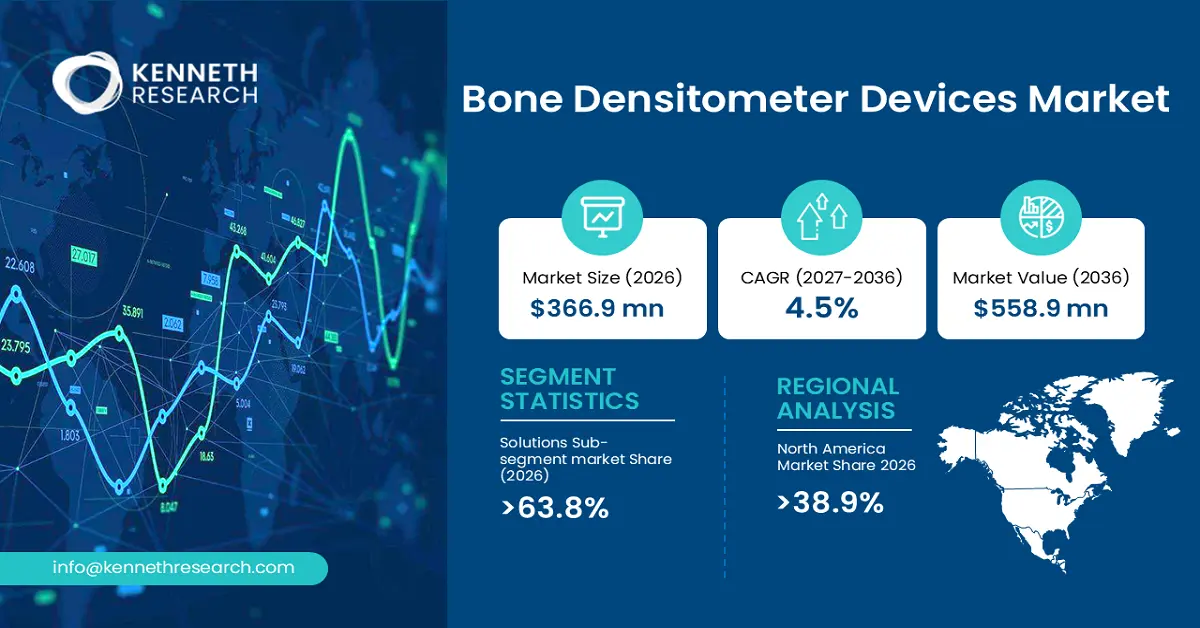
Bone Densitometer Devices Market size was valued at USD 366.9 million in 2026 and is projected to reach USD 558.9 million by the end of 2036, expanding at a CAGR of 4.5% during the forecast period, i.e., 2027–2036. In 2027, the industry size of the global bone densitometer devices market is estimated at USD 382.6 million.
The primary growth driver is the rising need for osteoporosis detection and fracture-risk assessment, particularly among aging populations. The CDC reports that nearly 1 in 5 women and 1 in 20 men over age 50 are affected by osteoporosis, strengthening demand for bone-density screening and monitoring technologies.
The bone densitometer devices market comprises medical imaging equipment used to measure bone mineral density (BMD) and assess bone strength, primarily for the detection, diagnosis, risk assessment, and management of osteoporosis and other conditions associated with reduced bone mass. These devices quantify mineral content within targeted skeletal areas and generate measurements that healthcare professionals can use to evaluate bone health.
A key characteristic of the market is its reliance on noninvasive technologies, including dual-energy X-ray absorptiometry (DXA), which is widely used for assessing BMD at clinically important skeletal sites such as the hip and spine. Devices may be configured for central or peripheral examinations, depending on clinical requirements and the intended application.
Key Bone Densitometer Devices Market Insights Summary:
Key Takeaways: Market Trends & Insights
- The bone densitometer devices market is valued at USD 366.9 million in 2026 and is projected to reach USD 558.9 million by 2036
- The market is expected to expand at a CAGR of 4.5% during 2027-2036
- Axial Bone Densitometer leads the Product Type segment with a 63.8% market share in 2026
- North America dominates the regional landscape with a 38.9% market share in 2026
- Dual Energy X-Ray Absorptiometry (DXA) represents the second and fastest analysis segment under the Technology category
Market Drivers
- Rising emphasis on osteoporosis screening and fracture prevention
- Technological advancement and integration of advanced diagnostic workflows
- Expansion of specialized osteoporosis and musculoskeletal care services
- Increasing adoption of preventive and longitudinal bone-health monitoring
Challenges
- High Equipment Cost and Budget Constraints
- Limited Access to Specialized Expertise and Diagnostic Infrastructure
Bone Densitometer Devices Market Overview & Supply Chain
Adoption of bone densitometry is increasing globally as healthcare systems place greater emphasis on early identification of osteoporosis, fracture-risk assessment, and preventive management of bone health. The technology is particularly relevant to aging populations because bone loss is closely associated with advancing age and can progress without obvious symptoms until a fracture occurs. Technological advances in DXA systems, improved imaging workflows, automated analysis, and integration with digital clinical records are supporting broader diagnostic deployment. From a healthcare-system perspective, the World Health Organization identifies fragility fractures as a global public-health concern and notes that their incidence, prevalence, and disability burden have increased substantially over the long term.
The bone densitometer devices value chain begins with specialized inputs including electronic components, X-ray-generation assemblies, detectors, mechanical structures, imaging hardware, software, and precision calibration components. Component suppliers provide these inputs to medical-device manufacturers, which integrate hardware, imaging systems, embedded software, safety controls, and analytical functionality into finished equipment. Manufacturing involves precision assembly, system calibration, software validation, quality control, and compliance testing before commercial release. Distribution typically operates through direct manufacturer sales, authorized distributors, healthcare-technology suppliers, and regional service partners. End users include hospitals, diagnostic imaging centers, orthopedic and endocrinology practices, osteoporosis clinics, and other healthcare facilities.
Bone Densitometer Devices Market - Growth Drivers & Challenges
Growth Drivers
- Increasing Emphasis on Osteoporosis Screening and Fracture Prevention: The growing emphasis on proactive osteoporosis screening is expanding the clinical utilization of bone densitometry. Healthcare providers increasingly use bone mineral density assessment to identify patients at elevated fracture risk before serious skeletal complications occur. This creates recurring demand for diagnostic systems across hospitals, specialist practices, and imaging centers, while also supporting replacement and upgrading of installed equipment.
- Technological Advancement and Integration of Advanced Diagnostic Workflows: Technological development is another important growth driver as manufacturers enhance bone densitometers with improved imaging performance, automated analysis, workflow optimization, and software-based clinical decision support. Modern systems increasingly support efficient assessment of bone mineral density while enabling healthcare professionals to incorporate results into broader fracture-risk and treatment-monitoring workflows. Improvements in system usability and data management can make densitometry more practical for facilities seeking standardized diagnostic processes and efficient patient throughput.
Challenges
- High Equipment Cost and Budget Constraints: The relatively high acquisition cost of advanced bone densitometry systems can constrain adoption, particularly among smaller hospitals, outpatient facilities, and diagnostic centers operating under strict capital budgets. The root cause is the specialized hardware, X-ray components, detectors, software, calibration requirements, and installation infrastructure incorporated into these systems. Additional expenses associated with maintenance, servicing, software upgrades, regulatory compliance, and staff training can increase the total cost of ownership.
- Limited Access to Specialized Expertise and Diagnostic Infrastructure: Dependence on trained personnel and appropriate diagnostic infrastructure can restrict effective deployment of bone densitometry systems. The root cause extends beyond equipment availability: healthcare facilities require personnel capable of performing standardized examinations, maintaining quality assurance procedures, interpreting results appropriately, and integrating findings into patient-management pathways. Facilities without established osteoporosis or musculoskeletal-care programs may therefore obtain less value from installed equipment.
Bone Densitometer Devices Market Size and Forecast:
| Report Attribute | Details |
|---|---|
| Base Year |
2026 |
| Forecast Year |
2027-2036 |
| CAGR |
4.5% |
| Base Year Market Size (2026) |
USD 366.9 Million |
| Forecast Year Market Size (2036) |
USD 558.9 Million |
| Regional Scope |
|
Bone Densitometer Devices Market Segmentation Analysis:
Product Type Segment Analysis
In the product type segment, axial bone densitometer sub-segment is anticipated to capture the largest market share of 63.8% by the end of 2026.
Axial bone densitometers dominate because they provide central bone mineral density assessment at clinically important skeletal sites, particularly the hip and spine, making them integral to osteoporosis diagnosis and fracture-risk evaluation. Demand is supported by the continued clinical need to identify patients requiring intervention and to monitor bone-health status over time. The U.S. CDC reported that, in 2022, osteoporosis was diagnosed in 19.0% of participants in adult day services centers, highlighting an established disease burden within care settings where bone-health assessment can be relevant. The supply side also favors axial systems because central DXA is recognized as the established diagnostic standard, encouraging hospitals and diagnostic centers to prioritize these systems when expanding or modernizing imaging capabilities.
Technology Segment Analysis
The dual energy x-ray absorptiometry (DXA) is projected to grow as the second-largest segment in the bone densitometer devices market due to four converging demand drivers.
Dual Energy X-Ray Absorptiometry (DXA) is projected to grow as healthcare systems increasingly prioritize standardized osteoporosis detection, fracture-risk assessment, and longitudinal monitoring. Its established role in measuring bone mineral density at clinically relevant skeletal sites supports continued adoption across hospitals, diagnostic centers, and specialist practices. The U.S. National Institutes of Health notes that research funded by NIAMS and NIA established the relationship between low bone mineral density and osteoporotic-fracture risk, findings that contributed to Medicare coverage of DXA for osteoporosis screening. This policy and clinical foundation supports sustained utilization and encourages providers to maintain DXA capabilities as part of bone-health pathways.
Our in-depth analysis of the Bone Densitometer Devices market includes the following segments:
|
Segment |
Sub-segment |
|
Product Type |
|
|
Technology |
|
|
End-User |
|
Bone Densitometer Devices Market Regional Insights:
North America Market Trends & Insights:
North America bone densitometer devices market is projected to hold the largest revenue share of 38.9% by the end of 2026.
Its leadership is supported by established diagnostic infrastructure, high utilization of advanced medical imaging, strong healthcare expenditure, and mature procurement channels for specialized diagnostic equipment. The region also benefits from established regulatory pathways and clinical acceptance of DXA-based bone-density assessment.
Within North America, the United States represents the principal commercial market, supported by extensive hospital networks, outpatient diagnostic facilities, specialist practices, and established osteoporosis-management pathways. Strong healthcare spending and technological adoption create favorable conditions for equipment replacement, system upgrades, and expanded diagnostic capacity.
Canada provides a complementary market supported by developed healthcare infrastructure, public healthcare programs, and growing attention to bone health among aging populations.
Asia Pacific Market Trends & Insights:
Asia Pacific represents an important secondary market, supported by increasing awareness of osteoporosis, expanding diagnostic infrastructure, and the growing need to address age-related bone-health conditions. Healthcare systems across the region are strengthening screening, diagnosis, and fracture-prevention pathways, creating opportunities for bone densitometry providers.
China offers significant opportunity as healthcare authorities and providers work to improve osteoporosis awareness, screening, and diagnostic availability. Expansion of healthcare infrastructure and initiatives promoting earlier detection can support greater adoption of DXA and portable bone-density technologies.
Japan has a mature healthcare system with established osteoporosis-management practices and continued emphasis on fracture prevention. Its aging patient population, specialist clinical infrastructure, and established diagnostic pathways create opportunities for equipment upgrades, replacement demand, and integration of advanced bone-health assessment into broader care programs.
Leading Companies Operating in the Bone Densitometer Devices Market:
Here is a list of upstream, downstream, and key players operating in bone densitometer devices market competitive ecosystem:
- Hologic, Inc. (United States)
- Company Overview
- Business Strategy
- Key Product Offerings
- Financial Performance
- Key Performance Indicators
- Risk Analysis
- Recent Development
- Regional Presence
- SWOT Analysis
- Furuno Electric Co., Ltd. (Japan)
- FUJIFILM Holdings Corporation (Japan)
- Mindways Software, Inc. (United States)
- CyberLogic, Inc. (United States)
Recent Developments
- In August 2026, FUJIFILM Holdings Corporation launched the FBD Coaccula X-ray bone densitometer in Japan. The device measures bone density at the lumbar spine, femur, and forearm, featuring an AI-powered "One-Click Analysis" function that automates analysis range setting, bone/soft tissue separation, and measurement site selection, reducing scan time to 20 seconds for the lumbar spine and 10 seconds for the femur-half that of the previous model.
Frequently Asked Question
In 2026, the bone densitometer devices market exceeded USD 366.9 million.
The bone densitometer devices market is projected to reach USD 558.9 million by the end of 2036, expanding at a CAGR of 4.5% over the forecast period (2027-2036).
The major players in the market are Hologic, Inc., Furuno Electric Co., Ltd., FUJIFILM Holdings Corporation, Mindways Software, Inc., CyberLogic, Inc., and others
In the Product Type segment, the Axial Bone Densitometer sub-segment is anticipated to capture the largest market share of 63.8% in the future and exhibit lucrative growth opportunities during 2027-2036. This growth trajectory is largely attributed to increasing emphasis on osteoporosis screening and fracture prevention.
North America is projected to hold the largest market share of 38.9% by the end of 2026 and provide more business opportunities in the future. Established diagnostic infrastructure, advanced healthcare networks, and strong adoption of osteoporosis screening technologies are fostering the region's dominance.
Why Choose Kenneth Research ?
-
Insight with Impact : We don’t just gather data — we uncover stories, trends, and opportunities that fuel business growth.
-
Experts Who Get It : Our team speaks your industry’s language and knows what really matters to your customers and market.
-
Custom-Built for You : Forget one-size-fits-all. We craft research and consulting solutions as unique as your business vision.
-
Partners, Not Just Providers : We work with you, not for you — collaborating closely to turn insights into smart, strategic moves.
-
Results That Speak : Our work powers brands, startups, and industry leaders alike — with a track record of ideas that work in the real world.
Report ID: 1425 |
Published Date: 25 Sep 2026 |
Report Format: |
Delivery Timeline: 48-72 Business Hours

Copyright © 2025 Kenneth Research. All rights reserved. Terms of Use | Privacy Policy
