Report ID: 1315 |
Published Date: 11 Sep 2026 |
Report Format: |
Delivery Timeline: 48-72 Business Hours
Blue Hydrogen Market Outlook:
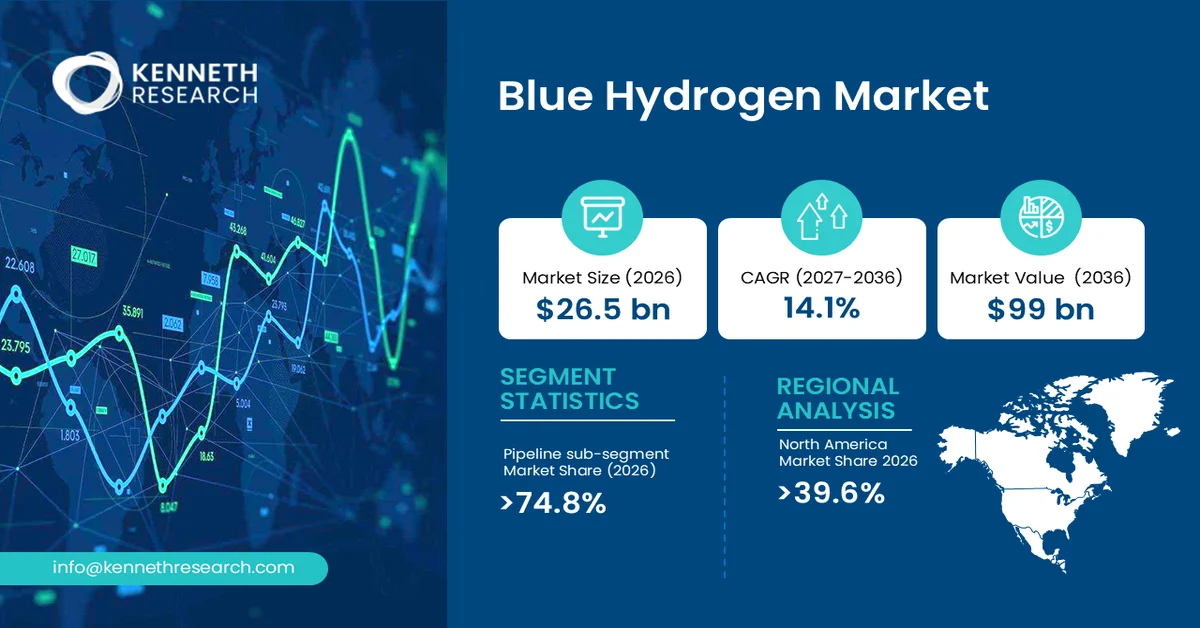
Blue Hydrogen Market size was valued at USD 26.5 billion in 2026 and is projected to reach USD 99 billion by the end of 2036, rising at a CAGR of 14.1% during the forecast period, i.e., 2027–2036. In 2027, the industry size of the blue hydrogen market is estimated at USD 30.2 billion.
The expansion of carbon capture, utilization, and storage infrastructure is a major growth driver for the blue hydrogen market.
The blue hydrogen market refers to the production, processing, transportation, and supply of hydrogen generated primarily from natural gas or other hydrocarbon feedstocks, combined with carbon capture and storage or utilization systems to manage associated carbon dioxide emissions. The production process commonly uses steam methane reforming or related technologies, with carbon dioxide separated from process and combustion streams and subsequently transported for permanent geological storage or utilization.
Key characteristics include hydrogen-production plants, reformers, gas-processing systems, carbon-capture equipment, compression facilities, CO₂ transportation infrastructure, geological storage sites, hydrogen pipelines, and distribution networks. The market therefore combines conventional hydrogen-production capabilities with additional carbon-management infrastructure.
Key Blue Hydrogen Market Insights Summary:
Key Takeaways: Market Trends & Insights
- Blue hydrogen market is projected to grow from USD 26.5 billion in 2026 to USD 99 billion by 2036, expanding at a 14.1% CAGR during the forecast period.
- North America accounted for the largest regional share at 39.6% in 2026, supported by abundant natural-gas resources, established hydrogen infrastructure, and growing investment in carbon capture and storage across the U.S. and Canada.
- Pipeline remained the leading Transportation Mode segment with a 74.8% share in 2026, supported by its suitability for continuous, high-volume hydrogen transportation between production facilities, storage locations, and industrial consumers.
- Steam Methane Reforming is expected to remain a key technology due to its established industrial base, compatibility with natural-gas infrastructure, and potential for integration with carbon-capture systems.
Market Drivers
- Expansion of carbon capture, utilization, and storage infrastructure
- Established natural gas reforming infrastructure
- Growing industrial demand for lower-carbon hydrogen
- Development of integrated hydrogen and CO₂ transportation networks
Challenges
- Dependence on Carbon Capture Performance
- Natural Gas and Infrastructure Exposure
Blue Hydrogen Market: Market Overview & Supply Chain
Global adoption of blue hydrogen is increasing as energy-intensive industries seek lower-carbon hydrogen while leveraging established natural-gas infrastructure and mature hydrogen-production technologies. Blue hydrogen can integrate hydrogen production with carbon capture, utilization, and storage, creating opportunities for decarbonization in refining, chemicals, fertilizers, power generation, and other industrial applications.
The blue hydrogen value chain begins with natural-gas extraction, processing, and pipeline supply, followed by hydrogen production through reforming technologies such as steam methane reforming or autothermal reforming. Carbon-capture systems separate CO₂ from production streams, after which the gas is compressed and transported through pipelines or other dedicated infrastructure to utilization sites or geological storage facilities. Hydrogen is then conditioned, stored, transported, and supplied to industrial and energy users.
Blue Hydrogen Market: Growth Drivers & Challenges
Growth Drivers
- Expansion of Carbon Capture Infrastructure: The development of carbon capture, utilization, and storage infrastructure is strengthening the commercial potential of blue hydrogen by enabling established natural-gas-based production facilities to incorporate emissions-management systems. This approach allows hydrogen producers to build on existing reforming expertise while adding carbon capture and storage capabilities. The U.S. Department of Energy has supported engineering work for a commercial-scale carbon-capture system at an existing steam methane reforming hydrogen plant in Texas, demonstrating the integration of capture technology with established hydrogen production.
- Established Natural Gas Reforming Infrastructure: Blue hydrogen benefits from the maturity of natural gas reforming technologies and the availability of associated energy infrastructure. Steam methane reforming is a commercially established process, allowing producers to utilize existing technical expertise, natural-gas supply networks, industrial sites, and hydrogen distribution systems. The U.S. Department of Energy identifies natural gas reforming as an established hydrogen-production pathway that builds on existing natural-gas pipeline infrastructure.
Challenges
- Dependence on Carbon Capture Performance: The environmental and commercial positioning of blue hydrogen depends heavily on effective carbon capture and permanent management of captured CO₂. Reforming produces emissions from both the hydrogen-production process and associated combustion activities, requiring appropriately designed capture systems. The U.S. Department of Energy's National Energy Technology Laboratory identifies multiple CO₂ capture points in steam methane reforming facilities, highlighting the technical complexity involved in capturing emissions throughout the production process.
- Natural Gas and Infrastructure Exposure: Blue hydrogen remains closely linked to natural-gas availability, pricing, transportation infrastructure, and upstream emissions. Changes in gas costs can directly influence production economics, while disruptions in supply can affect hydrogen output. Projects also require coordinated access to hydrogen infrastructure and CO₂ management systems, which may not be available in every industrial region. This dependence can create commercial risks for producers and industrial customers evaluating long-term hydrogen supply contracts.
Blue Hydrogen Market Size and Forecast:
| Report Attribute | Details |
|---|---|
| Base Year |
2026 |
| Forecast Year |
2027-2036 |
| CAGR |
14.1% |
| Base Year Market Size (2026) |
USD 26.5 billion |
| Forecast Year Market Size (2036) |
USD 99 billion |
| Regional Scope |
|
Blue Hydrogen Market: Segment Analysis
Transportation Mode Segment Analysis
In the transportation mode segment, the Pipeline sub-segment is anticipated to capture the largest market share of 74.8% by the end of 2036.
Its dominance is supported by the suitability of pipelines for continuous, high-volume hydrogen movement between centralized production facilities, storage locations, industrial clusters, and major consumption centers. Pipeline transportation can provide consistent supply and is particularly relevant for blue hydrogen projects integrated with existing natural-gas and industrial infrastructure.
The U.S. Energy Information Administration has incorporated hydrogen infrastructure into its market modeling and identifies pipeline development as an important component of future hydrogen supply systems. Its 2025 Hydrogen Market Module specifically models hydrogen supply, consumption, infrastructure expansion, and interregional pipeline development.
Technology Segment Analysis
In the technology segment, the Steam Methane Reforming sub-segment is positioned for continued growth because of its established industrial base, compatibility with natural-gas infrastructure, and suitability for integration with carbon-capture systems. SMR converts natural gas into hydrogen through a mature thermochemical process, making it familiar to hydrogen producers and industrial consumers.
The U.S. Department of Energy identifies steam methane reforming as a commercial hydrogen-production technology using natural gas, with pre- and post-combustion carbon-dioxide removal available for emissions management. This established technological foundation reduces the need for completely new production architectures when existing hydrogen facilities are upgraded toward lower-carbon production.
SMR also benefits from established engineering expertise, reformer equipment, natural-gas supply infrastructure, and hydrogen-processing systems.
Our in-depth analysis of the global blue hydrogen market includes the following segments:
|
Segment |
Sub-segment |
|
Technology |
|
|
Transportation Mode |
|
|
Application |
|
Blue Hydrogen Market Regional Insights
North America Market Trends & Insights:
North America holds the dominant position in the blue hydrogen market, accounting for 39.6% in 2026.
The region benefits from abundant natural-gas resources, established hydrogen production capabilities, extensive industrial infrastructure, and growing investment in carbon capture and hydrogen hubs. The U.S. Department of Energy has supported regional hydrogen hubs designed to connect producers, consumers, and infrastructure, including projects that combine natural-gas-based hydrogen production with carbon capture and storage.
U.S. is the leading country within the region, supported by its extensive natural-gas network, established refining and chemical industries, and federal support for integrated hydrogen production and infrastructure. The Gulf Coast Hydrogen Hub specifically plans to produce hydrogen from natural gas while utilizing carbon capture and storage, strengthening the country's position in blue hydrogen development.
Canada is also developing a strong hydrogen ecosystem supported by natural resources, industrial clusters, and government-backed hydrogen strategies. Natural Resources Canada identifies projects using natural-gas reforming with carbon capture across the country's hydrogen development landscape, while hydrogen hubs are emerging around established industrial centers.
Asia-Pacific Market Trends & Insights:
Asia-Pacific represents a significant opportunity for the blue hydrogen market, supported by expanding hydrogen demand, industrial decarbonization programs, established natural-gas infrastructure, and government efforts to develop integrated hydrogen supply chains. Japan has enacted the Hydrogen Society Promotion Act to encourage low-carbon hydrogen supply and utilization, including support for hydrogen hubs and related infrastructure.
Japan is developing hydrogen as part of its broader energy-transition strategy, with policy support focused on low-carbon hydrogen, industrial applications, and supply-chain development.
China has a large industrial hydrogen ecosystem and is expanding hydrogen-related infrastructure and applications. Government-backed initiatives emphasize development across the hydrogen value chain, creating opportunities for both conventional and lower-carbon hydrogen production technologies.
Blue Hydrogen Market: Competitive Landscape
Here is a list of upstream, downstream, and key players operating in the global blue hydrogen market competitive ecosystem:
- Linde (Germany)
- Company Overview
- Business Strategy
- Key Product Offerings
- Financial Performance
- Key Performance Indicators
- Risk Analysis
- Recent Development
- Regional Presence
- SWOT Analysis
- Air Products (U.S)
- Shell (United Kingdom)
Recent Developments
- June 2026: Air Products announced the cancellation of a major natural-gas-based hydrogen project with carbon capture and storage in the U.S.
- May 2026: Shell continued development of its hydrogen infrastructure, with construction progressing through equipment installation and facility completion activities during the first half of 2026.
Frequently Asked Question
In 2026, the blue hydrogen market exceeded USD 26.5 billion.
The blue hydrogen market is projected to reach USD 99 billion by the end of 2036, expanding at a CAGR of 14.1% over the forecast period (2027-2036).
The major players in the market are Linde, Air Products, Shell, Technip Energies, and others.
In the transportation mode segment, the Pipeline sub-segment is anticipated to capture the largest market share of 74.8% in the future and exhibit lucrative growth opportunities during 2027-2036.
North America is projected to hold the largest market share of 39.6% by the end of 2026 and provide more business opportunities in the future.
Why Choose Kenneth Research ?
-
Insight with Impact : We don’t just gather data — we uncover stories, trends, and opportunities that fuel business growth.
-
Experts Who Get It : Our team speaks your industry’s language and knows what really matters to your customers and market.
-
Custom-Built for You : Forget one-size-fits-all. We craft research and consulting solutions as unique as your business vision.
-
Partners, Not Just Providers : We work with you, not for you — collaborating closely to turn insights into smart, strategic moves.
-
Results That Speak : Our work powers brands, startups, and industry leaders alike — with a track record of ideas that work in the real world.
Report ID: 1315 |
Published Date: 11 Sep 2026 |
Report Format: |
Delivery Timeline: 48-72 Business Hours

Copyright © 2025 Kenneth Research. All rights reserved. Terms of Use | Privacy Policy
