Report ID: 1301 |
Published Date: 11 Sep 2026 |
Report Format: |
Delivery Timeline: 48-72 Business Hours
Blown Film Extrusion Machinery Market Outlook:
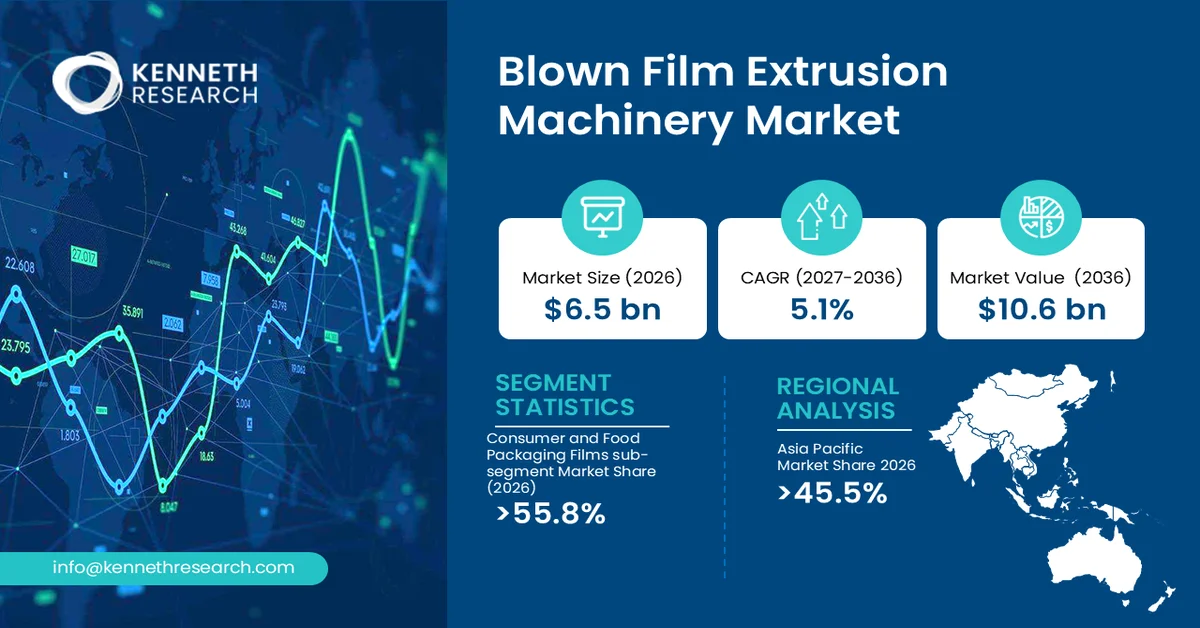
Blown Film Extrusion Machinery Market size was valued at USD 6.5 billion in 2026 and is projected to reach USD 10.6 billion by the end of 2036, rising at a CAGR of 5.1% during the forecast period, i.e., 2027–2036. In 2027, the industry size of the blown film extrusion machinery market is estimated at USD 6.8 billion.
The growing use of flexible packaging across food, beverages, consumer products, healthcare, and household goods is driving investment in blown film extrusion machinery.
The blown film extrusion machinery market comprises equipment and integrated production lines used to manufacture plastic films through the blown-film extrusion process. In this process, polymer resin is melted and extruded through a circular die to form a tubular film, which is expanded using air, cooled, collapsed, and subsequently wound or processed into finished film rolls.
Key characteristics include extrusion capacity, screw and die design, multilayer capability, automation, temperature control, bubble stability, thickness uniformity, energy efficiency, and compatibility with different polymer materials. Advanced systems increasingly incorporate precise process controls, automatic gauge regulation, monitoring technologies, and configurations capable of producing high-performance multilayer films.
Key Blown Film Extrusion Machinery Market Insights Summary:
Key Takeaways: Market Trends & Insights
- Blown film extrusion machinery market is projected to grow from USD 6.5 billion in 2026 to USD 10.6 billion by 2036, expanding at a CAGR of 5.1% during the forecast period.
- Asia-Pacific accounted for the largest regional share at 45.5% in 2026, supported by strong plastics-processing capabilities, packaging manufacturing activity, polymer supply chains, and industrial investment across Japan and China.
- Consumer and food packaging films remained the leading application segment with a 55.8% share in 2026, driven by sustained demand for flexible, lightweight, durable, and high-performance packaging solutions.
- Polyethylene resins are positioned for continued growth within the material segment because of their flexibility, toughness, moisture resistance, processability, and suitability for multilayer blown-film structures.
Market Drivers
- Rising demand for flexible packaging films
- Increasing adoption of advanced multilayer extrusion technology
- Growing emphasis on production efficiency and material optimization
- Increasing investment in automated and high-precision film-conversion equipment
Challenges
- High capital requirements and complex equipment integration
- Sustainability and film-recycling constraints
Blown Film Extrusion: Market Overview & Supply Chain
Global adoption of blown film extrusion machinery is increasing alongside demand for flexible packaging, particularly in food, consumer goods, household products, and industrial applications. Manufacturers are investing in extrusion systems capable of delivering consistent film thickness, multilayer structures, material efficiency, and improved production flexibility as packaging producers respond to performance and sustainability requirements.
The value chain begins with polymer-resin producers supplying polyethylene and other thermoplastic materials used as extrusion inputs. Resin is transported to film converters, where extrusion machinery melts, mixes, and forms the material through a circular die before cooling, collapsing, trimming, and winding the film. Machinery manufacturers supply extruders, dies, cooling systems, bubble-control equipment, haul-off units, automation systems, and winders, while specialized engineering firms may provide installation, commissioning, and process optimization.
Blown Film Extrusion Machinery Market: Growth Drivers & Challenges
Growth Drivers
- Rising Demand for Flexible Packaging Films: The expansion of flexible packaging is strengthening demand for blown film extrusion machinery because converters require equipment capable of producing consistent, lightweight, and application-specific films for food, consumer products, household goods, and industrial packaging. The U.S. Census Bureau classifies plastics packaging film and sheet manufacturing as an industry that converts plastic resins into flexible packaging film and sheet, confirming the direct manufacturing relationship between polymer processing and packaging applications. In its 2023 Annual Integrated Economic Survey, the sector recorded $15.94 billion in sales, value of shipments, or revenue, demonstrating the scale of the downstream manufacturing base that uses film-conversion technologies.
- Increasing Adoption of Advanced Multilayer Extrusion Technology: Film converters are increasingly adopting sophisticated extrusion equipment capable of producing multilayer structures with differentiated functional properties. Multilayer blown-film technology enables manufacturers to combine polymers and additives within a single film structure, allowing individual layers to provide characteristics such as strength, sealing performance, barrier protection, stiffness, or printability. This creates opportunities for machinery suppliers to differentiate through coextrusion capabilities, advanced die systems, automated gauge control, process monitoring, and energy-efficient equipment.
Challenges
- High Capital Requirements and Complex Equipment Integration: Blown film extrusion lines require substantial investment in extrusion units, dies, cooling systems, bubble-control equipment, haul-off systems, automation, and winding technology. The complexity increases further when converters require multilayer coextrusion, automated thickness control, advanced process monitoring, or rapid product changeovers. For smaller and mid-sized film manufacturers, the resulting capital burden can lengthen equipment replacement cycles and make technology upgrades dependent on clear productivity or material-efficiency gains. Integration also requires specialized commissioning, operator training, maintenance capabilities, and process optimization to achieve consistent film quality.
- Sustainability and Film-Recycling Constraints: The increasing emphasis on packaging sustainability is creating technical and commercial pressure for machinery manufacturers and film converters. Conventional flexible films can be difficult to collect, sort, and recycle, particularly when multilayer structures combine polymers with different properties. This challenge encourages converters to develop recyclable mono-material structures, incorporate recycled content where technically feasible, and optimize film designs to reduce material consumption.
Blown Film Extrusion Machinery Market Size and Forecast:
| Report Attribute | Details |
|---|---|
| Base Year |
2026 |
| Forecast Year |
2027-2036 |
| CAGR |
5.1% |
| Base Year Market Size (2026) |
USD 6.5 billion |
| Forecast Year Market Size (2036) |
USD 10.6 billion |
| Regional Scope |
|
Blown Film Extrusion Machinery Market: Segment Analysis
Application Segment Analysis
In the application segment, the Consumer and Food Packaging Films sub-segment is anticipated to capture the largest market share of 55.8% in 2026.
Its leading position is supported by the extensive use of flexible films for food protection, product containment, transportation, retail packaging, and consumer goods. Blown-film extrusion machinery is particularly valuable for converters because it enables continuous production of films with controlled thickness, mechanical strength, sealing performance, and multilayer structures. China’s Ministry of Industry and Information Technology reported that national plastics-product output reached 77.076 million tonnes in 2024, reflecting the scale of downstream plastics manufacturing that supports demand for film-conversion equipment.
Material Segment Analysis
In the material segment, the polyethylene resins sub-segment is anticipated to witness strong growth as polyethylene offers a combination of flexibility, toughness, moisture resistance, processability, and cost efficiency that makes it well suited to blown-film production. Demand is supported by extensive use of polyethylene films in food packaging, shopping bags, industrial liners, agricultural applications, and other flexible-film formats. Polyethylene's compatibility with multilayer extrusion also allows converters to engineer films with differentiated barrier, sealing, strength, and mechanical properties.
From the supply side, established polyethylene manufacturing infrastructure provides converters with access to multiple resin grades tailored to different film-performance requirements.
Our in-depth analysis of the global blown film extrusion machinery market includes the following segments:
|
Segment |
Sub-segment |
|
By Layer |
|
|
By Application |
|
|
By Material |
|
Blown Film Extrusion Machinery Market: Regional Analysis
Asia-Pacific Market Trends & Insights:
Asia-Pacific holds the dominant regional position, accounting for 45.5% in 2026 according to the provided market input.
The region benefits from a large plastics-processing base, extensive packaging manufacturing, established polymer-resin supply chains, and continuing investment in manufacturing automation.
Japan contributes through its advanced manufacturing ecosystem, sophisticated packaging sector, precision machinery capabilities, and emphasis on production efficiency and resource circulation. Government initiatives supporting plastic-resource recycling are also encouraging manufacturers to develop more sustainable processing and packaging solutions.
China represents a major production and consumption center, supported by extensive plastics processing, packaging manufacturing, and polymer conversion infrastructure. Recent national standards activity concerning polyethylene blown film for packaging applications further demonstrates ongoing development of the country's film-processing ecosystem.
North America Market Trends & Insights:
North America represents an attractive market for blown film extrusion machinery, supported by established flexible-packaging manufacturing, advanced plastics-processing capabilities, and increasing investment in recycling-compatible film production. Demand is being shaped by food and consumer packaging requirements, industrial films, and the transition toward more sustainable packaging structures.
The U.S. benefits from a large and diversified packaging manufacturing base, strong resin-processing capabilities, and established demand for flexible films across food, consumer, medical, and industrial applications.
Canada provides opportunities through its flexible-packaging manufacturing base and increasing emphasis on circular plastics. Government support for projects involving flexible packaging and advanced plastic-processing equipment is encouraging manufacturers to modernize production capabilities and integrate sustainability-oriented technologies.
Blown Film Extrusion Machinery Market: Competitive Landscape
Here is a list of upstream, downstream, and key players operating in the global blown film extrusion machinery market:
- Windmöller & Hölscher (Germany)
- Company Overview
- Business Strategy
- Key Product Offerings
- Financial Performance
- Key Performance Indicators
- Risk Analysis
- Recent Development
- Regional Presence
- SWOT Analysis
- Hosokawa Alpine (Germany)
- Reifenhäuser Blown Film (Germany)
Recent Developments
- December 2025: Hosokawa Alpine introduced a new modular calibration basket for its blown film lines.
- October 2025: Reifenhäuser launched its EVO GEN3 blown film line at K 2025, combining higher productivity with automated assistance, connectivity, advanced control architecture, and digital process capabilities.
Frequently Asked Question
In 2026, the Blown Film Extrusion Machinery Market exceeded USD 6.5 billion.
The blown film extrusion machinery market is projected to reach USD 10.6 billion by the end of 2036, expanding at a CAGR of 5.1% over the forecast period (2027-2036).
The major players in the market are Windmöller & Hölscher, Hosokawa Alpine, Reifenhäuser Blown Film and others.
In the Application segment, the Consumer and food packaging films sub-segment is anticipated to capture the largest market share of 55.8% in the future and exhibit lucrative growth opportunities during 2027-2036.
Asia-Pacific is projected to hold the largest market share of 45.5% by the end of 2026 and provide more business opportunities in the future.
Why Choose Kenneth Research ?
-
Insight with Impact : We don’t just gather data — we uncover stories, trends, and opportunities that fuel business growth.
-
Experts Who Get It : Our team speaks your industry’s language and knows what really matters to your customers and market.
-
Custom-Built for You : Forget one-size-fits-all. We craft research and consulting solutions as unique as your business vision.
-
Partners, Not Just Providers : We work with you, not for you — collaborating closely to turn insights into smart, strategic moves.
-
Results That Speak : Our work powers brands, startups, and industry leaders alike — with a track record of ideas that work in the real world.
Report ID: 1301 |
Published Date: 11 Sep 2026 |
Report Format: |
Delivery Timeline: 48-72 Business Hours

Copyright © 2025 Kenneth Research. All rights reserved. Terms of Use | Privacy Policy
