Report ID: 1041 |
Published Date: 27 Jul 2026 |
Report Format: |
Delivery Timeline: 48-72 Business Hours
Blood Cancer Diagnostics Market Outlook:
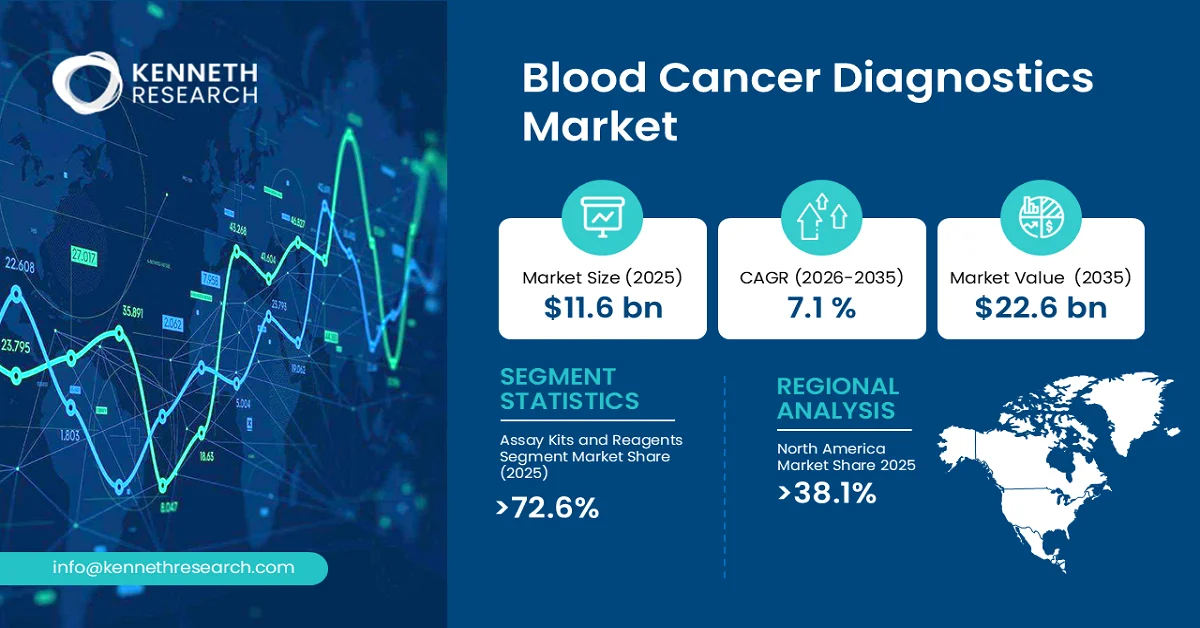
Blood Cancer Diagnostics Market size was valued at USD 11.6 billion in 2025 and is projected to reach USD 22.6 billion by the end of 2035, rising at a CAGR of 7.1% during the forecast period, i.e., 2026–2035. In 2026, the industry size of the blood cancer diagnostics market is estimated at USD 12.4 billion.
The blood cancer diagnostics market is primarily driven by the increasing global burden of hematological malignancies and the growing adoption of precision diagnostic technologies. Expanding government-supported cancer screening initiatives, advances in molecular diagnostics, and rising demand for early disease detection are accelerating the integration of accurate and rapid diagnostic solutions across healthcare systems.
The blood cancer diagnostics market comprises diagnostic products, assays, instruments, and laboratory services used to detect, classify, monitor, and manage hematological malignancies, including leukemia, lymphoma, and multiple myeloma. The market encompasses a broad range of diagnostic approaches such as blood tests, bone marrow analysis, flow cytometry, molecular diagnostics, cytogenetics, immunohistochemistry, and next-generation sequencing, enabling clinicians to identify disease subtypes and guide personalized treatment decisions.
Blood cancer diagnostics are characterized by high analytical sensitivity, specificity, and the ability to detect genetic, molecular, and cellular abnormalities associated with disease progression. Continuous technological advancements have improved testing accuracy, reduced turnaround times, and facilitated the integration of companion diagnostics into routine clinical practice. The market includes assay kits and reagents, analytical instruments, software solutions, and laboratory-based testing services that support diagnosis from initial screening through treatment monitoring.
The market plays a vital role in modern healthcare by enabling timely diagnosis, risk stratification, therapeutic selection, and disease surveillance. Its importance continues to increase as precision oncology, biomarker-driven therapies, and personalized medicine become central components of hematology and cancer care.
Key Blood Cancer Diagnostics Market Insights Summary:
Key Takeaways: Market Trends & Insights
- The blood cancer diagnostics market is projected to grow from USD 11.6 billion in 2025 to USD 22.6 billion by 2035, registering a CAGR of 7.1% during the forecast period of 2026–2035.
- Assay Kits and Reagents accounted for the largest 72.6% share in 2025, supported by their extensive use in molecular diagnostics, biomarker detection, and routine blood cancer testing.
- The Blood Test segment is expected to witness significant growth through 2035 owing to increasing adoption of minimally invasive diagnostic methods, liquid biopsy technologies, and precision oncology.
- North America held the largest regional share of 38.1% in 2025, driven by advanced healthcare infrastructure, strong oncology research, and widespread adoption of genomic diagnostics across the United States and Canada.
- Asia Pacific is anticipated to emerge as the fastest-growing regional market through 2035, with China and Japan investing heavily in precision medicine, laboratory modernization, and advanced cancer diagnostic capabilities.
Market Drivers
- Rising incidence of hematological malignancies and increasing emphasis on early disease detection
- Continuous technological advancements in molecular diagnostics, flow cytometry, and next-generation sequencing
- Growing integration of precision medicine and genomic diagnostics
- Expanding automation and digitalization of clinical laboratories
Challenges
- High complexity and cost of advanced diagnostic technologies
- Stringent regulatory and clinical validation requirements
Blood Cancer Diagnostics Market Overview & Supply Chain
Adoption of blood cancer diagnostics is increasing globally as healthcare systems prioritize early detection, precision medicine, and personalized treatment pathways for hematological malignancies. Continuous advances in molecular diagnostics, flow cytometry, cytogenetics, and next-generation sequencing have significantly improved diagnostic accuracy while enabling clinicians to identify disease subtypes and monitor treatment response more effectively. Regulatory emphasis on expanding access to cancer diagnostics and strengthening laboratory infrastructure has further accelerated implementation across hospitals, specialty cancer centers, and diagnostic laboratories. The growing burden of cancer is also reinforcing investment in advanced diagnostic capabilities. According to the World Health Organization (WHO) and the International Agency for Research on Cancer (IARC), there were an estimated 20 million new cancer cases worldwide in 2022, highlighting the increasing need for robust diagnostic services across oncology, including blood cancers. This trend continues to support innovation and wider clinical adoption of blood cancer diagnostic technologies.
The blood cancer diagnostics market value chain begins with the sourcing of specialized raw materials and components, including antibodies, enzymes, nucleic acid reagents, chemical buffers, primers, probes, laboratory plastics, optical components, semiconductors, and precision electronic assemblies used in diagnostic instruments. Manufacturers integrate these inputs into assay kits, reagents, flow cytometers, molecular diagnostic platforms, sequencing systems, imaging equipment, and laboratory software while complying with stringent quality management and regulatory standards. Following production, products are distributed through direct sales channels, authorized distributors, laboratory supply networks, and healthcare procurement organizations to hospitals, independent diagnostic laboratories, academic research institutes, cancer centers, and specialty clinics. Diagnostic testing is performed by pathologists, hematologists, molecular biologists, and laboratory professionals who generate clinically actionable results. Major stakeholders across the value chain include raw material suppliers, diagnostic manufacturers, contract manufacturers, logistics providers, healthcare institutions, regulatory agencies, reimbursement organizations, and research institutions collaborating to advance precision oncology.
Blood Cancer Diagnostics Market: Growth Drivers & Challenges
Growth Drivers:
- Growing Integration of Precision Medicine and Genomic Diagnostics: The increasing adoption of precision medicine is a major growth driver for the blood cancer diagnostics market, as clinicians increasingly rely on molecular and genomic testing to identify disease-specific mutations and select targeted therapies. Advanced diagnostic platforms enable comprehensive characterization of leukemia, lymphoma, and multiple myeloma, supporting accurate classification, prognosis assessment, and treatment monitoring. This shift is encouraging healthcare providers to invest in high-sensitivity diagnostic technologies capable of delivering rapid and reproducible results. The trend is further reinforced by public investment in genomic research. In 2023, the National Institutes of Health (NIH) announced continued support for the All of Us Research Program, which had enrolled more than 750,000 participants, creating one of the world's largest and most diverse biomedical datasets to accelerate precision medicine research. Such initiatives are expected to strengthen biomarker discovery and expand the clinical adoption of advanced blood cancer diagnostics.
- Expanding Automation and Digitalization of Clinical Laboratories: The growing automation of clinical laboratories is accelerating demand for advanced blood cancer diagnostic solutions by improving workflow efficiency, reducing manual errors, and increasing testing throughput. Modern laboratories are integrating automated sample preparation, digital pathology, artificial intelligence-assisted image analysis, and laboratory information management systems to deliver faster and more standardized diagnostic outcomes. These technologies enable laboratories to process larger testing volumes while maintaining analytical consistency, making them increasingly attractive to hospitals and specialized cancer centers. As healthcare systems continue to face workforce shortages and rising diagnostic demand, automation is expected to become a strategic priority. Future investments in interoperable diagnostic platforms, cloud-enabled data management, and AI-supported clinical decision tools will further enhance laboratory productivity, improve diagnostic accuracy, and support broader implementation of precision oncology practices across both developed and emerging healthcare markets.
Challenges:
- High Complexity and Cost of Advanced Diagnostic Technologies: The adoption of advanced blood cancer diagnostic technologies is constrained by the high capital investment required for sophisticated molecular diagnostic systems, flow cytometers, next-generation sequencing platforms, and automated laboratory infrastructure. Beyond equipment acquisition, healthcare providers must invest in specialized laboratory facilities, maintenance contracts, quality assurance programs, bioinformatics capabilities, and highly trained personnel to ensure accurate test interpretation. These cumulative costs create substantial financial barriers, particularly for community hospitals, independent laboratories, and healthcare systems in resource-constrained regions. Commercially, diagnostic manufacturers often face longer procurement cycles and slower penetration into cost-sensitive markets, limiting the pace of technology adoption. Although technological innovation and greater automation are expected to improve operational efficiency over time, affordability and reimbursement challenges are likely to remain significant considerations influencing purchasing decisions and broader market expansion.
- Stringent Regulatory and Clinical Validation Requirements: Blood cancer diagnostic products are subject to rigorous regulatory review and extensive clinical validation before they can be introduced into routine clinical practice. Developers must demonstrate analytical accuracy, clinical validity, reproducibility, and long-term reliability across diverse patient populations while complying with evolving regulatory standards and quality management requirements. These processes increase development timelines, require substantial financial investment, and delay commercialization of innovative diagnostic technologies. Frequent updates to regulatory frameworks and evolving expectations for companion diagnostics further increase compliance complexity for manufacturers operating across multiple regions. Commercially, prolonged approval pathways can reduce the speed of product launches, intensify development risks, and extend return-on-investment periods. Looking ahead, companies that establish robust clinical evidence generation capabilities and proactive regulatory strategies will be better positioned to accelerate product approvals and maintain long-term competitiveness.
Blood Cancer Diagnostics Market Size and Forecast:
| Report Attribute | Details |
|---|---|
| Base Year |
2025 |
| Forecast Year |
2026-2035 |
| CAGR |
7.1% |
| Base Year Market Size (2025) |
USD 11.6 billion |
| Forecast Year Market Size (2035) |
USD 22.6 billion |
| Regional Scope |
|
Blood Cancer Diagnostics Market Segmentation Analysis:
Product Segment Analysis
In the product segment, the Assay Kits and Reagents sub-segment is anticipated to capture the largest market share of more than 72.6% by the end of 2025.
The Assay Kits and Reagents segment accounted for the largest share of the blood cancer diagnostics market in 2025 due to its indispensable role in routine diagnostic workflows, disease classification, biomarker detection, and treatment monitoring. These products are consumed repeatedly during molecular diagnostics, flow cytometry, immunoassays, cytogenetic testing, and polymerase chain reaction (PCR)-based analyses, creating consistent demand across hospitals, diagnostic laboratories, and cancer research institutions. The increasing adoption of precision oncology has further accelerated the use of specialized assay kits capable of detecting genetic mutations and disease-specific biomarkers with high analytical accuracy. On the supply side, manufacturers continue to expand reagent portfolios, improve assay sensitivity, and develop standardized kits compatible with automated laboratory platforms, ensuring reliable and scalable testing. Demand is further reinforced by the growing burden of cancer worldwide. Looking ahead, continuous innovation in multiplex assays and companion diagnostics is expected to strengthen the long-term dominance of this segment.
Test Segment Analysis
The blood test is projected to grow as the second-largest segment in the blood cancer diagnostics market due to four converging demand drivers.
The Blood Test segment is projected to witness significant growth owing to its minimally invasive nature, rapid turnaround time, and ability to support disease detection, monitoring, and treatment response assessment throughout the patient care pathway. Blood-based diagnostic techniques are increasingly being integrated with molecular diagnostics, flow cytometry, and liquid biopsy approaches to identify hematological malignancies with greater precision while reducing the need for repeated invasive procedures. Healthcare providers are adopting these tests because they improve patient convenience, facilitate serial monitoring, and enable personalized treatment decisions. On the supply side, manufacturers are expanding their portfolios with highly sensitive biomarker assays, automated analyzers, and companion diagnostic solutions that improve laboratory efficiency and testing accuracy. Looking ahead, continued advances in circulating tumor DNA analysis, multiplex biomarker detection, and artificial intelligence-supported interpretation are expected to accelerate the clinical adoption of blood-based diagnostics. The U.S. National Institutes of Health (NIH) notes that liquid biopsy tests have been used successfully for years to select people for certain targeted cancer therapies and are now being evaluated for applications ranging from early detection to treatment guidance, reinforcing the growing importance of blood-based diagnostics in oncology.
Our in-depth analysis of the global blood cancer diagnostics market includes the following segments:
|
Segment |
Sub-segment |
|
Product |
|
|
Test |
|
|
End Use |
|
Blood Cancer Diagnostics Market Regional Insights:
North America Market Trends & Insights:
North America blood cancer diagnostics market is projected to hold the largest revenue share of 38.1% by the end of 2025.
It is the leading regional market due to its advanced healthcare infrastructure, widespread availability of specialized oncology centers, and strong adoption of precision diagnostic technologies. The region benefits from significant investments in molecular diagnostics, genomic testing, and laboratory automation, enabling rapid integration of innovative blood cancer diagnostic solutions into clinical practice. Favorable reimbursement frameworks, well-established regulatory pathways, and sustained public and private investment in cancer research further reinforce market leadership. The presence of major diagnostic manufacturers, extensive clinical research networks, and high awareness of early cancer detection continues to support robust demand for assay kits, reagents, molecular testing platforms, and laboratory services. These factors collectively strengthen North America's position as a global hub for the development, commercialization, and adoption of advanced blood cancer diagnostics.
The United States remains the primary contributor to regional growth through its extensive network of hospitals, reference laboratories, academic medical centers, and biotechnology companies focused on oncology innovation. According to the U.S. Centers for Disease Control and Prevention (CDC), 1,851,238 new cancer cases were reported in the United States in 2022, underscoring the sustained need for advanced diagnostic testing and precision oncology services.
Canada complements regional leadership through continuous investments in cancer research, nationwide healthcare coverage, and expanding access to molecular diagnostic technologies across provincial healthcare systems. The country's emphasis on precision medicine, collaborative clinical research, and modernization of diagnostic laboratories is supporting broader adoption of advanced blood cancer testing and strengthening North America's long-term competitive position.
Asia Pacific Market Trends & Insights:
Asia Pacific is expected to experience strong growth in the blood cancer diagnostics market, supported by expanding healthcare infrastructure, rising awareness of hematological malignancies, and increasing adoption of advanced diagnostic technologies. The region is witnessing substantial investments in molecular diagnostics, precision medicine, and laboratory modernization as healthcare providers seek to improve early disease detection and personalized treatment outcomes. Government initiatives aimed at strengthening national cancer control programs, expanding access to diagnostic services, and promoting domestic biotechnology innovation are encouraging the deployment of advanced blood cancer diagnostic platforms across hospitals and specialty laboratories. Increasing collaboration between healthcare institutions, academic research organizations, and diagnostic manufacturers is further accelerating technological adoption. Future opportunities are expected to arise from the growing integration of artificial intelligence in laboratory workflows, wider availability of genomic testing, and continued expansion of specialized oncology care in emerging economies.
China represents a major growth engine due to its large patient population, ongoing expansion of tertiary hospitals, and sustained investment in precision medicine and biotechnology. The country's focus on strengthening molecular diagnostic capabilities, improving laboratory automation, and fostering domestic innovation is supporting the broader adoption of advanced blood cancer diagnostic solutions.
Japan continues to play a significant role through its mature healthcare system, strong emphasis on early cancer diagnosis, and leadership in medical technology development. Continuous investments in genomic medicine, high-quality clinical research, and advanced diagnostic infrastructure are enabling the integration of sophisticated blood cancer testing into routine clinical practice, reinforcing the region's long-term growth potential.
Leading Companies Operating in the Global Blood Cancer Diagnostics Market:
Here is a list of upstream, downstream, and key players operating in the global blood cancer diagnostics market competitive ecosystem:
- NeoGenomics Laboratories, Inc. (United States)
- Natera, Inc. (United States)
- Guardant Health, Inc. (United States)
- Exact Sciences Corporation (United States)
- Revvity, Inc. (United States)
- Siemens Healthineers AG (Germany)
- SkylineDx B.V. (Netherlands)
Recent Developments
- In January 2025, Roche announced that the U.S. FDA cleared the VENTANA® Kappa and Lambda Dual ISH mRNA Probe Cocktail, the first clinically approved in-situ hybridization assay designed to improve the diagnosis of B-cell lymphoma. The assay enables pathologists to differentiate malignant B-cell lymphoma from reactive immune responses, supporting faster and more accurate clinical decision-making.
- In February 2025, Roche unveiled its Sequencing by Expansion (SBX) technology, introducing a next-generation sequencing platform capable of significantly reducing sequencing time while improving scalability and flexibility. The innovation is expected to strengthen genomic research and clinical applications, including blood cancer diagnostics and precision oncology.
- In March 2025, Invivoscribe announced the registration of the LeukoStrat® CDx FLT3 Mutation Assay in the United Kingdom and Switzerland. The expanded availability of the companion diagnostic supports accurate detection of FLT3 mutations in acute myeloid leukemia (AML), enabling clinicians to make informed targeted treatment decisions.
Frequently Asked Question
In 2025, the blood cancer diagnostics market exceeded USD 11.6 billion.
The blood cancer diagnostics market is projected to reach USD 22.6 billion by the end of 2035, expanding at a CAGR of 7.1% over the forecast period (2026–2035).
The major players in the market are Roche, Abbott Laboratories, Danaher Corporation, Thermo Fisher Scientific, Bio-Rad Laboratories, QIAGEN, Illumina, Quest Diagnostics, Invivoscribe, Sysmex Corporation, and others.
In the product segment, the assay Kits and reagents sub-segment is anticipated to capture the largest market share of 72.6% in the future and exhibit lucrative growth opportunities during 2026–2035. This growth trajectory is largely attributed to the increasing adoption of precision medicine and the expanding use of molecular and biomarker-based diagnostic testing for hematological malignancies.
North America is projected to hold the largest market share of 38.1% by the end of 2035 and provide more business opportunities in the future. Continuous investments in precision oncology, advanced diagnostic technologies, and healthcare infrastructure across the United States and Canada are fostering the region's dominance.
Why Choose Kenneth Research ?
-
Insight with Impact : We don’t just gather data — we uncover stories, trends, and opportunities that fuel business growth.
-
Experts Who Get It : Our team speaks your industry’s language and knows what really matters to your customers and market.
-
Custom-Built for You : Forget one-size-fits-all. We craft research and consulting solutions as unique as your business vision.
-
Partners, Not Just Providers : We work with you, not for you — collaborating closely to turn insights into smart, strategic moves.
-
Results That Speak : Our work powers brands, startups, and industry leaders alike — with a track record of ideas that work in the real world.
Report ID: 1041 |
Published Date: 27 Jul 2026 |
Report Format: |
Delivery Timeline: 48-72 Business Hours

Copyright © 2025 Kenneth Research. All rights reserved. Terms of Use | Privacy Policy
