Report ID: 1111 |
Published Date: 19 Aug 2026 |
Report Format: |
Delivery Timeline: 48-72 Business Hours
Bioplastic Composite Market Outlook:
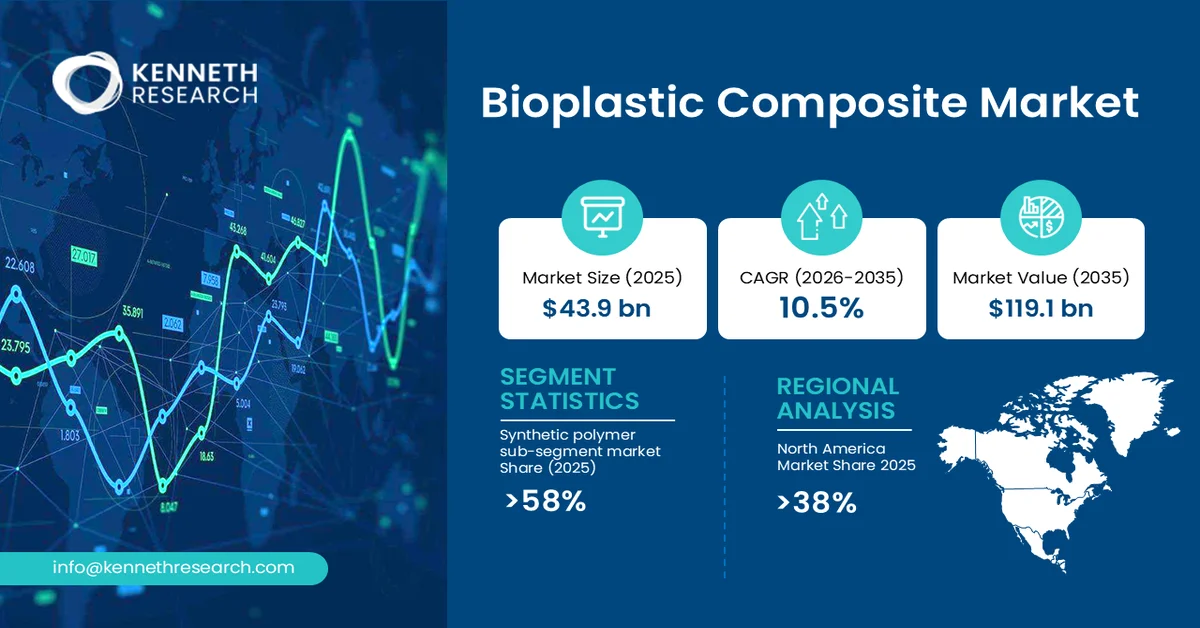
Bioplastic Composite Market size was valued at USD 43.9 billion in 2025 and is projected to reach USD 119.1 billion by the end of 2035, rising at a CAGR of 10.5% during the forecast period, i.e., 2026-2035. In 2026, the industry size of the bioplastic composite is estimated at USD 48.5 billion.
The primary growth driver for the bioplastic composite market is the expanding industrial shift toward renewable and circular-material solutions supported by government-backed bioeconomy initiatives. Public investment in biopolymer innovation, sustainable feedstocks, and industrial-scale commercialization is accelerating adoption of bioplastic composites across packaging, transportation, consumer goods, and construction applications.
The bioplastic composite market comprises engineered composite materials manufactured by combining bio-based or biodegradable polymer matrices with reinforcing materials such as natural fibers, wood flour, agricultural residues, mineral fillers, or other performance-enhancing additives. These composites are designed to improve mechanical strength, thermal stability, stiffness, durability, and processing performance while reducing dependence on conventional petroleum-based materials. Depending on the application, manufacturers employ both biodegradable and durable bio-based polymer systems to achieve specific functional and environmental requirements.
Bioplastic composites are increasingly utilized in automotive components, transportation equipment, consumer products, packaging, construction materials, electronics, and industrial applications because they offer a balance between lightweight performance, design flexibility, and improved sustainability characteristics. Their compatibility with conventional manufacturing processes, including injection molding, extrusion, compression molding, and thermoforming, enables integration into existing production infrastructure. Industrial relevance continues to increase as manufacturers pursue lower-carbon material solutions, comply with evolving environmental regulations, and support circular economy objectives through renewable feedstocks, recyclable designs, and innovative biopolymer technologies. Ongoing government-supported research into advanced biopolymers and composite processing is further strengthening commercialization opportunities across multiple end-use industries.
Key Bioplastic Composite Market Insights Summary:
Key Takeaways: Market Trends & Insights
- Bioplastic Composite Market projected to grow from USD 43.9 billion in 2025 to USD 119.1 billion by 2035 at a 10.5% CAGR
- North America accounted for the largest regional share at 38% in 2025, supported by a mature bioeconomy, advanced polymer research capabilities, and strong investments in sustainable manufacturing
- Synthetic Polymer is expected to remain the leading polymer segment with a 58% market share by 2025, driven by its superior processability, mechanical performance, and compatibility with conventional manufacturing technologies
- Transportation is projected to emerge as one of the fastest-growing application segments owing to increasing adoption of lightweight, durable, and sustainable composite materials in automotive and mobility manufacturing
- The market is gaining momentum through expanding government support for bio-based materials, increasing adoption of circular economy practices, advancements in biopolymer technologies, and rising demand for renewable composite solutions across packaging, construction, transportation, and consumer goods industries
Market Drivers
- Increasing adoption of natural fiber-reinforced composites in automotive lightweighting.
- Advancements in biodegradable polymer processing and composite manufacturing technologies.
- Growing investment in circular economy and renewable feedstock utilization.
- Expansion of sustainable packaging and eco-friendly consumer product applications.
Challenges
- Limited feedstock consistency and complex material standardization.
- End-of-life infrastructure and recycling compatibility constraints.
Market Overview & Supply Chain
Global adoption of bioplastic composites is accelerating as manufacturers pursue renewable material platforms that align with sustainability regulations, decarbonization strategies, and circular economy objectives. Industries including transportation, packaging, construction, and consumer goods are integrating bio-based composite materials to reduce reliance on fossil-derived polymers while maintaining mechanical performance and manufacturing efficiency. Continuous advances in bio-based resins, natural-fiber reinforcement technologies, and industrial processing have expanded commercial applications across multiple sectors. Government support for the bioeconomy is further strengthening innovation and commercialization. According to the U.S. Department of Agriculture (USDA), the U.S. biobased products industry contributed USD 489 billion to the national economy in 2021, demonstrating the growing industrial significance of bio-based materials and products that underpin markets such as bioplastic composites. This expanding bioeconomy is encouraging investments in advanced material development, domestic manufacturing, and sustainable supply chains.
The bioplastic composite market value chain begins with the sourcing of renewable feedstocks, including corn, sugarcane, cassava, cellulose, vegetable oils, wood flour, flax, hemp, bamboo, and other natural fibers that are converted into bio-based polymer resins and reinforcement materials. Material producers formulate composite compounds by blending polymer matrices with fibers, fillers, compatibilizers, and performance additives to achieve required mechanical and thermal properties. Compound manufacturers then supply pellets or intermediate materials to component manufacturers using established processing technologies such as injection molding, extrusion, compression molding, and thermoforming. Finished products move through distributors, original equipment manufacturers (OEMs), packaging converters, and industrial suppliers before reaching end-use sectors including transportation, construction, consumer products, electronics, agriculture, and packaging. Key stakeholders throughout the value chain include agricultural producers, biopolymer manufacturers, additive suppliers, composite processors, equipment manufacturers, logistics providers, regulatory authorities, research institutions, OEMs, and industrial end users.
Bioplastic Composite Market: Growth Drivers & Challenges
Growth Drivers:
- Expanding government support for the bioeconomy and sustainable materials: Government policies promoting renewable materials, circular manufacturing, and reduced dependence on fossil-based resources are significantly accelerating the adoption of bioplastic composites. Public investments in bio-based innovation, sustainable feedstocks, and industrial-scale biopolymer technologies are encouraging manufacturers to commercialize advanced composite materials for transportation, packaging, construction, and consumer applications. Such initiatives reduce commercialization risks while strengthening domestic supply chains and fostering collaboration between research institutions and industry. A notable example is the USDA Agricultural Research Service (ARS), which reported ongoing development of compostable plastics and composites, novel biopolymer production technologies, and industrially relevant biopolymer processing under its Bioproducts and Biopolymers from Agricultural Feedstocks project (FY2023). These government-backed programs are expected to enhance material performance, expand industrial applications, and support long-term adoption of bioplastic composites across multiple manufacturing sectors.
- Rising demand for lightweight and high-performance sustainable materials: Manufacturers across transportation, consumer goods, electronics, and construction industries are increasingly seeking materials that combine sustainability with high mechanical performance. Bioplastic composites satisfy these requirements by integrating renewable polymer matrices with reinforcing fibers, delivering improved stiffness, durability, and weight reduction without requiring significant changes to existing processing technologies. Their compatibility with injection molding, extrusion, and compression molding enables easier integration into established manufacturing operations while supporting corporate sustainability objectives. Continuous improvements in fiber treatment, polymer compatibility, and composite formulation are broadening application possibilities and improving lifecycle performance. As industries pursue product differentiation through environmentally responsible materials, demand for bioplastic composites is expected to expand into more structural and functional applications, creating long-term opportunities for material suppliers, compounders, and original equipment manufacturers.
Challenges:
- Limited feedstock consistency and complex material standardization: The production of bioplastic composites depends heavily on renewable feedstocks and natural reinforcing materials whose physical and chemical characteristics can vary due to agricultural conditions, harvesting practices, geographic origin, and processing methods. Such variability makes it challenging to maintain consistent mechanical strength, moisture resistance, dimensional stability, and long-term durability across production batches. Manufacturers must invest in additional material testing, quality control, and formulation optimization to ensure products meet stringent industrial specifications. These requirements increase production complexity and can slow product qualification cycles for industries such as transportation, construction, and electronics, where material reliability is essential. Looking ahead, broader adoption will depend on improved feedstock standardization, advanced preprocessing technologies, and harmonized material specifications that enable predictable performance across large-scale manufacturing operations.
- End-of-life infrastructure and recycling compatibility constraints: Despite their sustainability advantages, many bioplastic composites face challenges related to end-of-life management because different polymer matrices, reinforcing fibers, and additives require distinct disposal or recycling pathways. Existing waste management systems are often optimized for conventional plastics and may not efficiently separate or process composite materials containing bio-based constituents. This creates uncertainty for manufacturers seeking to meet circular economy objectives and environmental compliance requirements. Commercial users may also hesitate to adopt materials when disposal routes differ across regions or when recycling compatibility is unclear. These limitations can increase lifecycle management costs and complicate sustainability reporting for industrial users. Future market development will increasingly rely on improved recycling technologies, standardized labeling practices, dedicated collection systems, and composite designs that better align with evolving circular material infrastructure.
Bioplastic Composite Market Size and Forecast:
| Report Attribute | Details |
|---|---|
| Base Year |
2025 |
| Forecast Year |
2026-2035 |
| CAGR |
10.5% |
| Base Year Market Size (2025) |
USD 43.9 billion |
| Forecast Year Market Size (2035) |
USD 119.1 billion |
| Regional Scope |
|
Bioplastic Composite Market Segmentation Analysis:
Polymer Segment Analysis
In the polymer segment, the synthetic polymer sub-segment is anticipated to capture the largest market share of 58% by the end of 2025.
The synthetic polymer segment dominates the bioplastic composite market because it offers a combination of processability, durability, dimensional stability, and compatibility with established industrial manufacturing systems. Biodegradable synthetic polymers such as bio-based polyesters enable manufacturers to produce high-performance composite materials that meet demanding requirements across transportation, packaging, consumer products, and construction applications. Their compatibility with conventional processing methods, including injection molding and extrusion, minimizes production modifications and supports cost-efficient commercialization. On the supply side, continuous investments in advanced polymer chemistry, resin formulation, and industrial-scale production have strengthened material availability and broadened application potential. Demand is also reinforced by increasing regulatory emphasis on sustainable materials and the need for lower-carbon alternatives without compromising product performance. Supporting this trend, the European Environment Agency (EEA) reported that global bio-based plastics production capacity reached approximately 2 million tonnes in 2023, reflecting the growing industrial foundation supporting advanced polymer development and commercialization. Looking ahead, continued innovation in high-performance biodegradable polymers and improved material functionality is expected to reinforce the segment’s leadership across diverse industrial applications.
Application Type Segment Analysis
The transportation segment is projected to witness strong growth as vehicle manufacturers increasingly adopt lightweight and sustainable materials to improve resource efficiency, reduce lifecycle emissions, and comply with evolving environmental regulations. Bioplastic composites are gaining traction in interior trims, door panels, seat components, cargo areas, and non-structural parts because they combine reduced weight with favorable mechanical performance and design flexibility. Automotive and mobility manufacturers are also integrating renewable materials into product development to support corporate sustainability targets and meet customer expectations for environmentally responsible vehicles. On the supply side, advancements in composite compounding, fiber treatment technologies, and automated processing are improving production consistency and enabling larger-scale adoption by original equipment manufacturers (OEMs). Supporting this trend, the U.S. Department of Energy, Alternative Fuels Data Center, notes that lightweight materials can reduce a vehicle's weight by up to 10%, improving fuel economy by approximately 6%–8%, reinforcing the industry's focus on advanced lightweight materials, including bioplastic composites, for transportation applications. Continued material innovation and closer collaboration between material suppliers and OEMs are expected to further accelerate adoption across future mobility platforms.
Our in-depth analysis of the global bioplastic composite market includes the following segments:
|
Segment |
Sub-segment |
|
Polymer |
|
|
FiberType |
|
|
Processing Technology |
|
|
End User |
|
Bioplastic Composite Market Regional Insights:
North America Market Trends & Insights:
North America accounted for 38% of the bioplastic composite market in 2025, making it the leading regional market.
The region's leadership is supported by its well-established bioeconomy, advanced polymer research capabilities, strong industrial manufacturing base, and growing commercialization of sustainable materials across transportation, packaging, consumer products, and construction industries. Continuous investment in bio-based material innovation, collaboration between research institutions and manufacturers, and supportive regulatory initiatives encouraging renewable resources have strengthened the regional ecosystem. In addition, mature processing infrastructure enables manufacturers to integrate bioplastic composites into existing production lines with relatively limited operational disruption. The presence of leading biopolymer developers, compounders, and original equipment manufacturers further reinforces North America's position as a major innovation and commercialization hub for advanced composite materials.
The United States leads regional demand through extensive research and development activities, commercialization of bio-based technologies, and widespread industrial adoption of sustainable materials across multiple manufacturing sectors.
Canada complements regional growth through investments in clean manufacturing, bio-based innovation, and sustainable resource utilization supported by its strong forestry and agricultural sectors, which provide important renewable feedstocks for composite production. Supporting North America's leadership, the U.S. Department of Agriculture (USDA) reported that the U.S. biobased products industry supported approximately 4.6 million jobs in 2017, highlighting the economic scale of the nation's bioeconomy and its importance in advancing industries such as bioplastic composites. Continued policy support, technological innovation, and industrial collaboration are expected to sustain the region's leadership over the coming years.
Europe Market Trends & Insights:
Asia Pacific is emerging as a high-growth region for the bioplastic composite market due to rapid industrialization, expanding manufacturing capabilities, and increasing emphasis on sustainable material adoption across multiple industries. Demand is being driven by the growing use of bio-based materials in transportation, packaging, consumer goods, electronics, and construction as manufacturers seek to reduce environmental impacts while maintaining product performance. Governments across the region are promoting circular economy strategies, encouraging the development of bio-based industries, and supporting innovation through research funding and sustainability-oriented industrial policies. At the same time, abundant agricultural resources provide a reliable supply of renewable feedstocks for biopolymer and natural-fiber production, strengthening regional supply chains. Ongoing investments in advanced processing technologies and material research are expected to create new opportunities for domestic production, product innovation, and export-oriented manufacturing, positioning Asia Pacific as a key growth center for bioplastic composites.
Japan is strengthening its position through advanced materials research, high-value manufacturing, and continuous development of bio-based polymer technologies. Strong collaboration among chemical producers, automotive manufacturers, and research institutions is fostering the commercialization of high-performance bioplastic composites for applications requiring quality, precision, and durability.
China is accelerating market expansion through large-scale manufacturing capabilities, growing investment in sustainable materials, and increasing integration of renewable polymers into industrial production. The country's extensive manufacturing ecosystem, combined with supportive environmental policies and expanding downstream industries, is encouraging wider adoption of bioplastic composites across transportation, packaging, electronics, and consumer products, reinforcing Asia Pacific's long-term growth potential.
Leading Companies Operating in the Global Bioplastic Composite Market:
Here is a list of upstream, downstream, and key players operating in the global bioplastic composite market competitive ecosystem:
- TECNARO GmbH(Germany)
- Company Overview
- Business Strategy
- Key Product Offerings
- Financial Performance
- Key Performance Indicators
- Risk Analysis
- Recent Development
- Regional Presence
- SWOT Analysis
- FKuR Kunststoff GmbH(Germany)
- Green Dot Bioplastics(United States)
- UPM Biocomposites(Finland)
Recent Developments
- May 2025: UBQ materials launched the UBQ Masterbatch product line to simplify integration of its bio-based thermoplastic composite into conventional plastic manufacturing processes.
- May 2025: UPM Biocomposites introduced UPM Formi 3D biocomposite materials for additive manufacturing applications, expanding its portfolio of wood-based composite solutions.
Frequently Asked Question
In 2025, the bioplastic composite market exceeded USD 43.9 billion.
The bioplastic composite market is projected to reach USD 119.1 billion by the end of 2035, expanding at a CAGR of 10.5% over the forecast period (2026-2035).
The major players in the market are TECNARO GmbH, FKuR Kunststoff GmbH, Green Dot Bioplastics, UPM Biocomposites, Bio-on S.p.A., and others.
In the polymer segment, the synthetic polymer sub-segment is anticipated to capture the largest market share of 58% in the future and exhibit lucrative growth opportunities during 2026-2035. This growth trajectory is largely attributed to increasing adoption of high-performance bio-based polymers that combine processing efficiency with enhanced mechanical performance across transportation, packaging, construction, and consumer product applications.
North America is projected to hold the largest market share of 38% by the end of 2025 and provide more business opportunities in the future. Continuous investments in bio-based material innovation, advanced manufacturing, and sustainable industrial technologies across the U.S. and Canada are fostering the region's dominance.
Why Choose Kenneth Research ?
-
Insight with Impact : We don’t just gather data — we uncover stories, trends, and opportunities that fuel business growth.
-
Experts Who Get It : Our team speaks your industry’s language and knows what really matters to your customers and market.
-
Custom-Built for You : Forget one-size-fits-all. We craft research and consulting solutions as unique as your business vision.
-
Partners, Not Just Providers : We work with you, not for you — collaborating closely to turn insights into smart, strategic moves.
-
Results That Speak : Our work powers brands, startups, and industry leaders alike — with a track record of ideas that work in the real world.
Report ID: 1111 |
Published Date: 19 Aug 2026 |
Report Format: |
Delivery Timeline: 48-72 Business Hours

Copyright © 2025 Kenneth Research. All rights reserved. Terms of Use | Privacy Policy
