Report ID: 1028 |
Published Date: 28 Jul 2026 |
Report Format: |
Delivery Timeline: 48-72 Business Hours
Biologics Market Outlook:
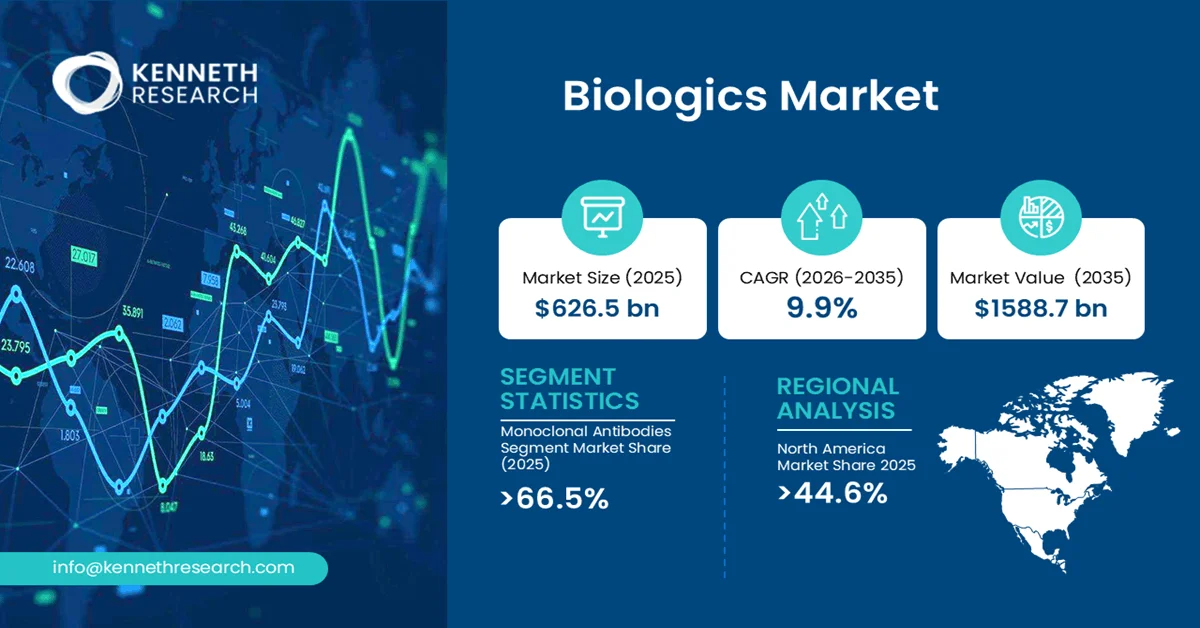
Biologics Market size was valued at USD 626.5 billion in 2025 and is projected to reach USD 1,588.7 billion by the end of 2035, rising at a CAGR of 9.9% during the forecast period, i.e., 2026-2035. In 2026, the industry size of the biologics is estimated at USD 691.4 billion.
Rising regulatory approvals for biologic therapies, particularly in oncology and advanced therapeutic areas, are accelerating commercialization and expanding treatment options. Increasing investments in monoclonal antibodies, cell therapies, and recombinant biologics, combined with supportive regulatory pathways, continue to strengthen innovation pipelines and encourage wider adoption of biologics across healthcare systems worldwide.
The biologics market comprises medicinal products derived from living organisms or biological processes, including monoclonal antibodies, recombinant proteins, vaccines, blood-derived products, cell therapies, gene therapies, and other advanced biologic formulations. Unlike conventional chemically synthesized pharmaceuticals, biologics are produced using biotechnology techniques involving living cells, microorganisms, or engineered biological systems, resulting in highly targeted therapeutic mechanisms. Their complex molecular structures require sophisticated manufacturing, quality control, cold-chain logistics, and stringent regulatory oversight throughout development and commercialization.
Biologics play a pivotal role in modern healthcare by addressing chronic, autoimmune, infectious, genetic, and oncological diseases that often require highly specific treatment approaches. They have transformed clinical practice through precision medicine by enabling targeted interventions with improved therapeutic outcomes for many complex conditions. The market supports pharmaceutical innovation by encouraging advances in biotechnology research, bioprocessing technologies, and biosimilar development while fostering collaboration between research institutions, biotechnology companies, manufacturers, healthcare providers, and regulatory agencies. Continuous regulatory approvals for biologic products further reinforce their industrial importance, strengthening long-term investment across global biopharmaceutical manufacturing and life sciences value chains.
Key Biologics Market Insights Summary:
Key Takeaways: Market Trends & Insights
- Biologics Market valued at USD 626.5 billion in 2025 and projected to reach USD 1,588.7 billion by 2035, registering a 9.9% CAGR during the forecast period
- Monoclonal Antibodies dominated the Product segment with a 66.5% share in 2025, supported by expanding adoption across oncology and autoimmune disease treatment
- North America accounted for the largest regional share of 44.6% in 2025, driven by advanced biopharmaceutical manufacturing capabilities and strong biotechnology innovation
- The market reached USD 691.4 Billion in 2026, reflecting continued expansion fueled by biologics research, regulatory approvals, and increasing clinical adoption
- Oncology remained a key disease category driving biologics demand, supported by growing precision medicine adoption and expanding therapeutic development pipelines
Market Drivers
- Growing investments in biopharmaceutical manufacturing infrastructure and advanced bioprocessing technologies
- Increasing development and commercialization of biosimilars improving patient access worldwide
- Rising strategic collaborations between biotechnology companies, research institutions, and contract manufacturing organizations
- Expanding application of biologics across autoimmune diseases, rare diseases, infectious diseases, and chronic inflammatory conditions
Challenges
- Complex manufacturing processes and high production costs
- Regulatory complexity and supply chain vulnerabilities
Biologics Market Overview & Supply Chain
The global adoption of biologics continues to increase as healthcare systems prioritize targeted therapies for complex diseases, while advances in biotechnology, cell engineering, recombinant DNA technology, and bioprocess automation improve product development efficiency and manufacturing consistency. Regulatory agencies are also strengthening frameworks that support the evaluation and oversight of increasingly sophisticated biologic medicines, reinforcing confidence among manufacturers, healthcare providers, and patients. These factors have encouraged greater investment in biologics research, manufacturing capacity, and cross-border commercialization. Reflecting this regulatory momentum, the European Medicines Agency issued 114 positive opinions for human medicines in 2024, including 46 new active substances, demonstrating the continued expansion of innovative biologic and advanced therapeutic products entering regulatory review and commercialization pathways.
The biologics industry value chain begins with the procurement of specialized biological inputs, including cell lines, microbial cultures, recombinant genetic materials, culture media, enzymes, growth factors, and highly purified raw materials sourced from biotechnology suppliers. Research organizations and biopharmaceutical developers perform discovery, molecular engineering, preclinical evaluation, and clinical development before transferring validated processes to commercial manufacturing facilities. Production involves upstream cell cultivation followed by downstream purification, formulation, sterile filling, packaging, and rigorous quality assurance under current Good Manufacturing Practice standards. Specialized cold-chain logistics providers maintain product integrity throughout storage and transportation to wholesalers, hospital pharmacies, specialty pharmacies, and healthcare institutions. End users primarily include hospitals, specialty clinics, ambulatory care centers, and patients receiving advanced biologic therapies under physician supervision. Key stakeholders across the ecosystem include biotechnology companies, contract development and manufacturing organizations, raw material suppliers, regulatory authorities, distributors, healthcare providers, reimbursement agencies, and research institutions that collectively support innovation, compliance, commercialization, and long-term patient access.
Biologics Market: Growth Drivers & Challenges
Growth Drivers:
- Expanding Biopharmaceutical Innovation and Regulatory Approvals: Continuous innovation in biologics is accelerating the development of therapies that address diseases with significant unmet medical needs. Advances in antibody engineering, recombinant technologies, cell-based platforms, and precision medicine are enabling developers to create highly targeted treatments with improved efficacy profiles. Regulatory agencies are supporting this progress through structured review pathways and scientific guidance, allowing innovative biologics to reach healthcare providers more efficiently while maintaining rigorous safety and quality standards. This environment encourages biotechnology companies to invest in advanced research, manufacturing capabilities, and diversified product pipelines. Future growth is expected to be reinforced by expanding biologic indications, next-generation therapeutic platforms, and increased collaboration among research institutions, manufacturers, and healthcare systems.
- Increasing Adoption of Precision and Personalized Medicine: The growing shift toward precision medicine is strengthening demand for biologics because these therapies can target specific molecular pathways and disease mechanisms more effectively than many conventional treatments. Healthcare providers are increasingly integrating biomarker-based diagnostics with biologic therapies to improve treatment selection and patient outcomes across oncology, autoimmune disorders, and rare diseases. Simultaneously, advancements in genomic research, companion diagnostics, and digital health technologies are supporting individualized therapeutic strategies that enhance clinical decision-making. Pharmaceutical companies are expanding investments in biologic research to develop therapies for increasingly defined patient populations, creating opportunities for differentiated products and long-term portfolio expansion. Looking ahead, greater integration of artificial intelligence, real-world evidence, and precision diagnostics is expected to improve biologic development efficiency while expanding access to personalized treatment approaches across global healthcare systems.
Challenges:
- Complex Manufacturing Processes and High Production Costs: The production of biologics requires sophisticated manufacturing infrastructure, specialized bioprocessing equipment, highly controlled cleanroom environments, and stringent quality assurance systems. Unlike conventional pharmaceuticals, biologics are highly sensitive to variations in cell culture conditions, purification processes, and storage environments, making production technically demanding and costly. These complexities increase operational expenses, extend development timelines, and elevate the financial risks associated with commercial-scale manufacturing. Smaller biotechnology companies often face significant barriers when expanding production capacity or complying with evolving regulatory standards. Commercially, high manufacturing costs can limit pricing flexibility and delay market entry in cost-sensitive regions. Looking ahead, investments in continuous bioprocessing, process automation, and advanced manufacturing technologies are expected to improve production efficiency, although substantial capital requirements will continue to challenge new entrants and emerging manufacturers.
- Regulatory Complexity and Supply Chain Vulnerabilities: Biologics are subject to rigorous regulatory requirements covering clinical evaluation, manufacturing validation, product consistency, pharmacovigilance, and lifecycle management across multiple jurisdictions. Differences in regulatory expectations between countries create additional compliance burdens for manufacturers seeking global commercialization. At the same time, biologics depend on highly specialized raw materials, single-use manufacturing components, cold-chain logistics, and qualified suppliers, making the supply chain vulnerable to disruptions. Delays in raw material availability or transportation can interrupt manufacturing schedules and product distribution, affecting healthcare providers and patients. Commercially, these challenges increase operational risks, inventory management costs, and regulatory compliance expenditures. Future improvements in supply chain diversification, digital monitoring technologies, and greater international regulatory harmonization may strengthen resilience, but maintaining uninterrupted biologics production will remain a critical industry challenge.
Biologics Market Size and Forecast:
| Report Attribute | Details |
|---|---|
| Base Year |
2025 |
| Forecast Year |
2026-2035 |
| CAGR |
9.9% |
| Base Year Market Size (2025) |
USD 626.5 billion |
| Forecast Year Market Size (2035) |
USD 1,588.7 billion |
| Regional Scope |
|
Biologics Market Segmentation Analysis:
Product Segment Analysis
In the product segment, the Monoclonal Antibodies sub-segment is anticipated to capture the largest market share of 66.5% by the end of 2025.
The monoclonal antibodies segment dominates the biologics market due to its broad therapeutic applicability, strong clinical efficacy, and extensive adoption across oncology, autoimmune disorders, inflammatory diseases, and rare conditions. Healthcare providers increasingly prefer monoclonal antibody therapies because they can selectively target disease-specific pathways, improving treatment precision while supporting long-term disease management. Industry adoption has accelerated through expanded indications, combination therapies, and the integration of biomarker-driven treatment strategies, particularly in cancer care. On the supply side, manufacturers have established mature production platforms, large-scale cell culture facilities, and advanced purification technologies that support reliable commercial manufacturing and global distribution. Regulatory familiarity with monoclonal antibody development has also reduced operational uncertainty for established developers. Future growth is expected to be supported by next-generation antibody engineering, bispecific antibodies, antibody-drug conjugates, and broader use in precision medicine programs. Reflecting the strength of oncology-related demand, the U.S. National Cancer Institute estimated 2,041,910 new cancer cases in the United States in 2025, reinforcing the substantial clinical need that continues to support monoclonal antibody utilization.
Disease Category Segment Analysis
The oncology is projected to grow as the second-largest segment in the biologics market due to four converging demand drivers.
The oncology segment is projected to witness significant growth in the biologics market as the global burden of cancer continues to increase, driving demand for targeted therapies that offer improved efficacy and more personalized treatment approaches. Biologics, including monoclonal antibodies, antibody-drug conjugates, immune checkpoint inhibitors, and cell-based therapies, are becoming integral to modern oncology treatment protocols because of their ability to selectively target cancer cells while supporting better clinical outcomes. Healthcare providers are increasingly adopting these therapies as clinical evidence expands across multiple tumor types and earlier lines of treatment. On the supply side, manufacturers are strengthening biologics production capacity, investing in advanced bioprocessing technologies, and expanding research collaborations to accelerate oncology pipeline development. Future growth will also be supported by biomarker-guided therapies, precision oncology, and combination treatment strategies. According to the World Health Organization and the International Agency for Research on Cancer, there were an estimated 20 million new cancer cases worldwide in 2022, highlighting the growing clinical demand for advanced oncology biologics.
Our in-depth analysis of the global biologics market includes the following segments:
|
Segment |
Sub-segment |
|
Source |
|
|
Product |
|
|
Disease Category |
|
|
Manufacturing |
|
Biologics Market Regional Insights:
North America Market Trends & Insights:
North America biologics market is projected to hold the largest revenue share of 44.6% by the end of 2025.
The region maintains its dominant position due to its well-established biopharmaceutical ecosystem, advanced biotechnology research capabilities, extensive biologics manufacturing infrastructure, and strong commercialization networks. Significant investments in research and development, widespread adoption of innovative biologic therapies, and robust regulatory frameworks continue to support product innovation and market expansion. The presence of leading biotechnology companies, contract development and manufacturing organizations, academic research institutions, and specialized cold-chain logistics providers further strengthens regional competitiveness. Continuous public and private investment in advanced therapeutic platforms, including monoclonal antibodies, cell therapies, and gene-based medicines, has reinforced North America's leadership across the biologics value chain.
The United States serves as the primary contributor to regional leadership through its extensive biologics research ecosystem, commercial-scale manufacturing facilities, and high rate of innovative drug approvals.
Canada complements this position by expanding domestic biomanufacturing capacity, supporting biotechnology research, and strengthening life sciences investments to improve long-term supply chain resilience. Supporting North America's innovation leadership, the U.S. Food and Drug Administration's Center for Drug Evaluation and Research (CDER) approved 50 novel drugs during 2024, reflecting continued advancement in innovative pharmaceuticals and therapeutic biologics entering the healthcare system.
Asia Pacific Market Trends & Insights:
Asia Pacific is emerging as a strategically important region in the biologics market due to expanding healthcare expenditure, increasing demand for advanced therapies, and rapid growth of the regional biopharmaceutical industry. Governments across the region are implementing policies that encourage biotechnology innovation, strengthen domestic manufacturing capabilities, and improve access to biologic medicines through healthcare modernization initiatives. Increasing investments in bioprocessing infrastructure, research collaborations, and advanced manufacturing technologies are enabling local companies to enhance production capacity while attracting international partnerships. The region is also benefiting from a large patient population, growing clinical research activity, and supportive regulatory reforms that facilitate the development and commercialization of innovative biologics and biosimilars. These factors are expected to create substantial opportunities for manufacturers seeking long-term expansion across both developed and emerging healthcare markets.
China continues to strengthen its position through significant investments in biotechnology research, commercial biomanufacturing, and innovation-driven pharmaceutical development. Regulatory reforms, expanding clinical trial capabilities, and increased collaboration between domestic and multinational companies are accelerating the introduction of advanced biologic therapies.
Japan remains a key contributor through its mature pharmaceutical industry, strong research ecosystem, and focus on regenerative medicine and next-generation biologics. The country's emphasis on scientific innovation, quality manufacturing standards, and industry-academia collaboration supports continued development of high-value biologic products, while strategic investments in precision medicine and advanced therapeutic technologies are expected to reinforce its role in the regional biologics landscape.
Leading Companies Operating in the Global Biologics Market:
Here is a list of upstream, downstream, and key players operating in the global biologics narket competitive ecosystem:
- WuXi Biologics (Cayman) Inc. (China)
- Company Overview
- Business Strategy
- Key Product Offerings
- Financial Performance
- Key Performance Indicators
- Risk Analysis
- Recent Development
- Regeneron Pharmaceuticals Inc. (United States)
- Catalent, Inc. (United States)
Recent Developments
- In May 2025, the FDA granted interchangeability designations to two high-concentration adalimumab biosimilars—Hadlima® (adalimumab-bwwd) and Yuflyma® (adalimumab-aaty)—for Humira®. These designations allow pharmacists to substitute these biosimilars for the reference product without consulting prescribers (subject to state law), potentially improving patient access and reducing healthcare costs.
- In November 2025, Samsung biologics announced plans to establish its first U.S. manufacturing facility in Rockville, Maryland, by acquiring a GSK facility for $280 million. The company plans to retain over 500 jobs and expand drug substance manufacturing capacity to support growing demand for biologic medicines in the U.S. market.
- In October 2025, Novartis announced a definitive merger agreement to acquire Avidity Biosciences for approximately $11.3 billion. This acquisition provides Novartis with Avidity's neuroscience pipeline and its proprietary RNA-targeting delivery platform (AOCs™), including late-stage programs for Duchenne muscular dystrophy and myotonic dystrophy type 1
Frequently Asked Question
In 2025, the biologics market exceeded USD 626.5 billion.
The biologics market is projected to reach USD 1,588.7 billion by the end of 2035, expanding at a CAGR of 9.9% over the forecast period (2026–2035).
The major players in the market are WuXi Biologics (Cayman) Inc., Regeneron Pharmaceuticals Inc., Catalent, Inc., and others.
In the product segment, the monoclonal antibodies sub-segment is anticipated to capture the largest market share of 66.5% in the future and exhibit lucrative growth opportunities during 2026–2035. This growth trajectory is largely attributed to increasing regulatory approvals, expanding oncology applications, and continuous innovation in antibody engineering and precision medicine.
North America is projected to hold the largest market share of 44.6% by the end of 2035 and provide more business opportunities in the future. Continuous investments in biotechnology research, advanced biologics manufacturing, and pharmaceutical innovation across the United States and Canada are fostering the region's dominance.
Why Choose Kenneth Research ?
-
Insight with Impact : We don’t just gather data — we uncover stories, trends, and opportunities that fuel business growth.
-
Experts Who Get It : Our team speaks your industry’s language and knows what really matters to your customers and market.
-
Custom-Built for You : Forget one-size-fits-all. We craft research and consulting solutions as unique as your business vision.
-
Partners, Not Just Providers : We work with you, not for you — collaborating closely to turn insights into smart, strategic moves.
-
Results That Speak : Our work powers brands, startups, and industry leaders alike — with a track record of ideas that work in the real world.
Report ID: 1028 |
Published Date: 28 Jul 2026 |
Report Format: |
Delivery Timeline: 48-72 Business Hours

Copyright © 2025 Kenneth Research. All rights reserved. Terms of Use | Privacy Policy
