Report ID: 1325 |
Published Date: 09 Sep 2026 |
Report Format: |
Delivery Timeline: 48-72 Business Hours
Biochar for Electric Arc Furnace Steelmaking Market Outlook:
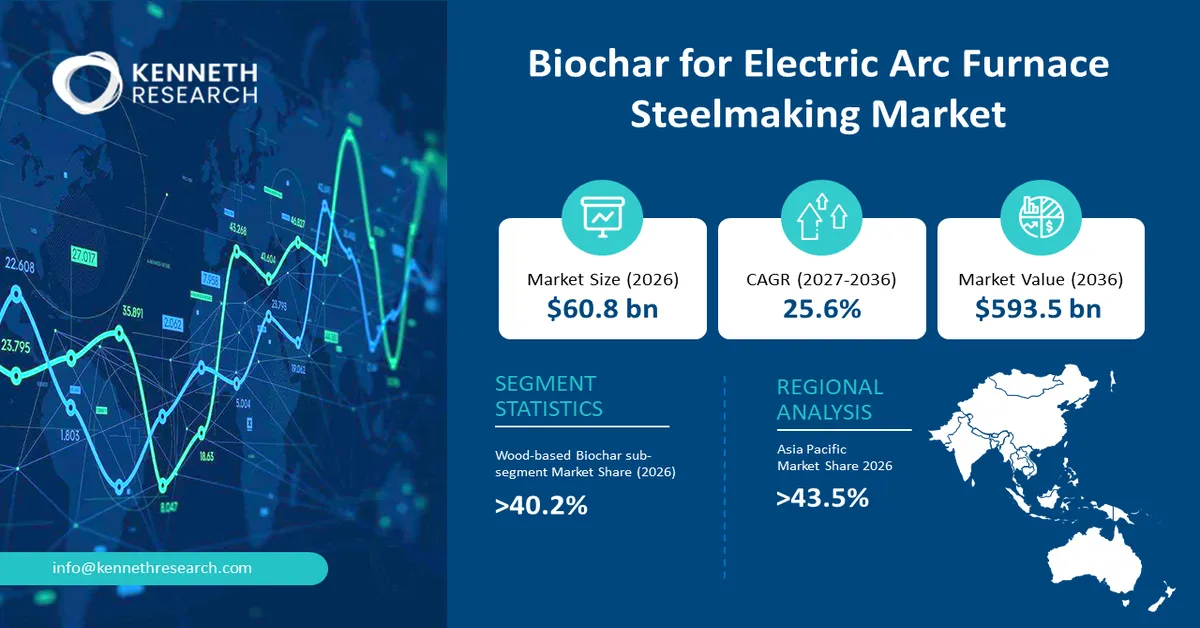
Biochar for Electric Arc Furnace Steelmaking Market size was valued at USD 60.8 billion in 2026 and is projected to reach USD 593.5 billion by the end of 2036, rising at a CAGR of 25.6% during the forecast period, i.e., 2027-2036. In 2027, the industry size of the biochar for electric arc furnace steelmaking is estimated at USD 76.3 billion.
The transition toward lower-carbon steel production is accelerating interest in biochar as a renewable carbonaceous material for electric arc furnaces.
The biochar for electric arc furnace steelmaking market comprises the production, processing, supply, and application of biochar as a carbonaceous input in electric arc furnace (EAF) steelmaking. Biochar is produced by thermochemically converting biomass under oxygen-limited conditions, generating a carbon-rich solid that can be engineered for specific physical and chemical properties.
Key characteristics include feedstock origin, fixed-carbon content, ash composition, volatile matter, particle size, porosity, moisture, and production technology. Wood-based feedstocks can provide a relatively consistent source of carbon-rich material, while pyrolysis conditions can be adjusted to influence the resulting biochar characteristics.
Key Biochar for Electric Arc Furnace Steelmaking Market Insights Summary:
Key Takeaways: Market Trends & Insights
- Biochar for electric arc furnace steelmaking market is projected to grow from USD 60.8 billion in 2026 to USD 593.5 billion by 2036, expanding at a CAGR of 25.6% during the forecast period.
- Asia-Pacific accounted for the largest regional share at 43.5% in 2026, supported by steelmaking capacity, industrial decarbonization initiatives, and investments in lower-carbon production technologies across Japan and China.
- Wood-based Biochar is expected to remain the leading Type of Biochar segment, accounting for 40.2% in 2026, supported by the availability of woody biomass feedstocks and suitability for producing carbon-rich materials for metallurgical applications.
- Slow Pyrolysis is positioned for strong growth within the Production Technology segment due to its ability to convert biomass into application-specific biochar while supporting controlled carbon characteristics and integration with renewable-carbon supply chains.
Market Drivers
- Increasing adoption of low-carbon carbon inputs in steelmaking
- Development of specialized biochar production technologies
- Growing investment in EAF-based low-carbon steel production
- Increasing utilization of biomass residues and circular carbon resources
Challenges
- Variability in feedstock quality and biochar properties
- High production costs and supply-chain integration
Biochar for Electric Arc Furnace Steelmaking Market Overview & Supply Chain
Global interest in biochar for electric arc furnace steelmaking is increasing as steel producers seek lower-emission production pathways and alternative carbon inputs. Electric arc furnaces are particularly relevant to decarbonization because they can melt steel scrap using electricity, while biochar offers a potential renewable carbon source for selected EAF applications. The International Energy Agency identifies hydrogen-based direct reduced iron coupled with electric arc furnaces as an emerging low-emissions steelmaking pathway and emphasizes the need for accelerated deployment of near-zero-emission technologies across the steel industry.
The value chain begins with biomass feedstocks such as forestry residues, wood waste, agricultural residues, and other suitable organic materials. Feedstock suppliers collect, process, dry, and prepare biomass according to the requirements of biochar producers. Manufacturers then convert the material through controlled thermochemical processes such as pyrolysis, followed by cooling, screening, sizing, storage, and quality testing. Depending on steelmaking requirements, biochar may undergo additional processing to achieve appropriate carbon content, particle characteristics, ash properties, and handling performance.
Biochar for Electric Arc Furnace Steelmaking Market: Growth Drivers & Challenges
Growth Drivers:
- Increasing adoption of low-carbon carbon inputs in steelmaking: The shift toward lower-emission steel production is creating opportunities for biochar as an alternative carbonaceous input. EAF operators require carbon-bearing materials for slag foaming, process control, and metallurgical performance, creating an avenue for renewable biocarbon to replace a portion of fossil-derived inputs where technical specifications permit. Government policy is also increasingly recognizing biochar as a steel-sector decarbonization pathway.
- Development of specialized biochar production technologies: Advances in pyrolysis and biomass-conversion technologies are improving the potential to produce biochar tailored for metallurgical applications. Producers can optimize feedstock preparation and thermal processing to influence fixed-carbon content, volatile matter, ash characteristics, porosity, moisture, and particle structure. These characteristics are important because steelmakers require carbon inputs that can be handled consistently and perform predictably within demanding furnace environments. The emergence of dedicated metallurgical biochar technologies is also strengthening the connection between biomass suppliers and steel producers.
Challenges:
- Variability in feedstock quality and biochar properties: The performance of biochar in EAF steelmaking can vary substantially according to biomass source and conversion conditions. Differences in ash content, fixed carbon, volatile matter, moisture, density, reactivity, and particle characteristics can affect injection behavior, slag interaction, carbon efficiency, and overall furnace performance. This creates a significant qualification challenge because steelmakers require predictable metallurgical inputs and cannot compromise product quality or process stability.
- High production costs and supply-chain integration: The commercial deployment of biochar faces challenges associated with production economics, logistics, feedstock availability, and integration into established EAF operations. Biochar production requires controlled thermochemical processing, while steelmaking applications may require additional drying, sizing, pelletization, briquetting, or other conditioning to achieve suitable handling and injection characteristics. These additional steps can increase delivered costs compared with established fossil-carbon inputs. Supply chains can also be difficult to establish because suitable biomass must be available consistently and close enough to processing facilities to limit transportation burdens.
Biochar for Electric Arc Furnace Steelmaking Market Size and Forecast:
| Report Attribute | Details |
|---|---|
| Base Year |
2026 |
| Forecast Period |
2027-2036 |
| CAGR |
25.6% |
| Base Year Market Size (2026) |
USD 60.8 billion |
| Forecast Year Market Size (2036) |
USD 593.5 billion |
| Regional Scope |
|
Biochar for Electric Arc Furnace Steelmaking Market Segmentation Analysis:
Type of Biochar Segment Analysis
In the type of biochar segment, the Wood-based Biochar sub-segment is anticipated to capture the largest market share of 40.2% in 2026.
Its leading position is supported by the suitability of woody biomass for producing carbon-rich material with characteristics relevant to metallurgical applications. Wood-derived biochar can be processed and engineered to achieve the carbon content, reactivity, particle characteristics, and handling properties required for EAF applications. The availability of woody residues also provides an opportunity to connect biomass utilization with industrial decarbonization. Research published in 2024 identifies wood-based biochar as a particularly relevant pathway for reducing emissions in iron and steel production, while highlighting the importance of feedstock and production conditions in determining performance.
Production Technology Segment Analysis
In the production technology segment, the slow pyrolysis sub-segment is anticipated to witness strong growth due to its suitability for producing solid biocarbon from biomass feedstocks for steelmaking applications. Slow pyrolysis enables controlled thermal conversion of biomass and can produce biochar with characteristics that can be tailored for metallurgical use. Natural Resources Canada identifies slow pyrolysis as a pathway for producing solid biocarbon that can potentially replace fossil carbon in steelmaking, including applications involving EAF slag foaming.
The technology also offers opportunities for integrated systems in which process gases can be utilized on-site, improving overall process economics and resource efficiency. This integration can make slow-pyrolysis facilities more attractive to steel producers seeking localized renewable-carbon supply.
Our in-depth analysis of the global biochar for electric arc furnace steelmaking market includes the following segments:
|
Segment |
Sub-segment |
|
Type of Biochar |
|
|
Production Technology |
|
|
Application |
|
Biochar for Electric Arc Furnace Steelmaking Market Regional Insights:
Asia-Pacific Market Trends & Insights:
Asia-Pacific holds the dominant regional position, accounting for 43.5% in 2026 according to the provided market input.
Regional leadership is supported by the concentration of steel production, expanding EAF deployment, industrial decarbonization programs, and substantial investment in low-carbon steelmaking technologies. Japan is particularly active in transitioning toward lower-emission steel production, while China combines a large steelmaking base with growing interest in alternative carbon and energy pathways.
Japan is advancing EAF-based steelmaking alongside hydrogen reduction and other decarbonization technologies. Nippon Steel has already operated an integrated EAF process for high-grade electrical steel, while government-backed GX initiatives are supporting further transformation of steel production.
China benefits from its extensive steelmaking ecosystem, large industrial base, biomass-resource availability, and expanding focus on energy efficiency and emissions reduction.
North America Market Trends & Insights:
North America represents an attractive market for biochar-based EAF applications because steelmakers are increasingly investing in lower-emission production routes, furnace modernization, and alternative carbon inputs. The region's established biomass resources, developed industrial infrastructure, and policy emphasis on industrial decarbonization create opportunities for integrating biochar production with steelmaking operations.
The U.S. offers significant opportunities through federal support for industrial decarbonization and EAF technology development. The U.S. Department of Energy has supported technical development and industrial demonstration of net-zero-carbon EAF steelmaking, creating an enabling environment for alternative injection and carbon technologies.
Canada is advancing EAF adoption through major industrial transformation projects. Government support for Algoma Steel's transition to EAF production and ArcelorMittal Dofasco's lower-emission steelmaking pathway is strengthening the regional ecosystem for low-carbon steel and alternative carbon inputs.
Leading Companies Operating in the Global Biochar for Electric Arc Furnace Steelmaking Market:
Here is a list of upstream, downstream, and key players operating in the global biochar for electric arc furnace steelmaking market competitive ecosystem:
- BioCarbon (Australia)
- Company Overview
- Business Strategy
- Key Product Offerings
- Financial Performance
- Key Performance Indicators
- Risk Analysis
- Recent Development
- Regional Presence
- SWOT Analysis
- Green Steele (Germany)
- Wuxi Powermax Renewable Energy Technology (China)
Recent Developments
- January 2026: BioCarbon announced that it secured support from the Australian Renewable Energy Agency (ARENA) for its first commercial-scale biochar steelmaking project at Bulahdelah, New South Wales.
- May 2026: Wuxi Powermax published a detailed development guide for its biocarbon production plant, describing an industrial solution for converting biomass residues into carbon-rich material for steel and metal processing.
Frequently Asked Question
In 2026, the biochar for electric arc furnace steelmaking market exceeded USD 60.8 billion.
The biochar for electric arc furnace steelmaking market is projected to reach USD 593.5 billion by the end of 2036, expanding at a CAGR of 25.6% over the forecast period (2027-2036).
The major players in the market are BioCarbon, Green Steele, Wuxi Powermax Renewable Energy Technology, and others.
In the Type of Biochar segment, the Wood-based Biochar sub-segment is anticipated to capture the largest market share of 40.2% in the future and exhibit lucrative growth opportunities during 2027-2036.
Asia-Pacific is projected to hold the largest market share of 43.5% by the end of 2026 and provide more business opportunities in the future.
Why Choose Kenneth Research ?
-
Insight with Impact : We don’t just gather data — we uncover stories, trends, and opportunities that fuel business growth.
-
Experts Who Get It : Our team speaks your industry’s language and knows what really matters to your customers and market.
-
Custom-Built for You : Forget one-size-fits-all. We craft research and consulting solutions as unique as your business vision.
-
Partners, Not Just Providers : We work with you, not for you — collaborating closely to turn insights into smart, strategic moves.
-
Results That Speak : Our work powers brands, startups, and industry leaders alike — with a track record of ideas that work in the real world.
Report ID: 1325 |
Published Date: 09 Sep 2026 |
Report Format: |
Delivery Timeline: 48-72 Business Hours

Copyright © 2025 Kenneth Research. All rights reserved. Terms of Use | Privacy Policy
