Report ID: 1173 |
Published Date: 25 Aug 2026 |
Report Format: |
Delivery Timeline: 48-72 Business Hours
Bio-based Epoxy Resin Market Outlook:
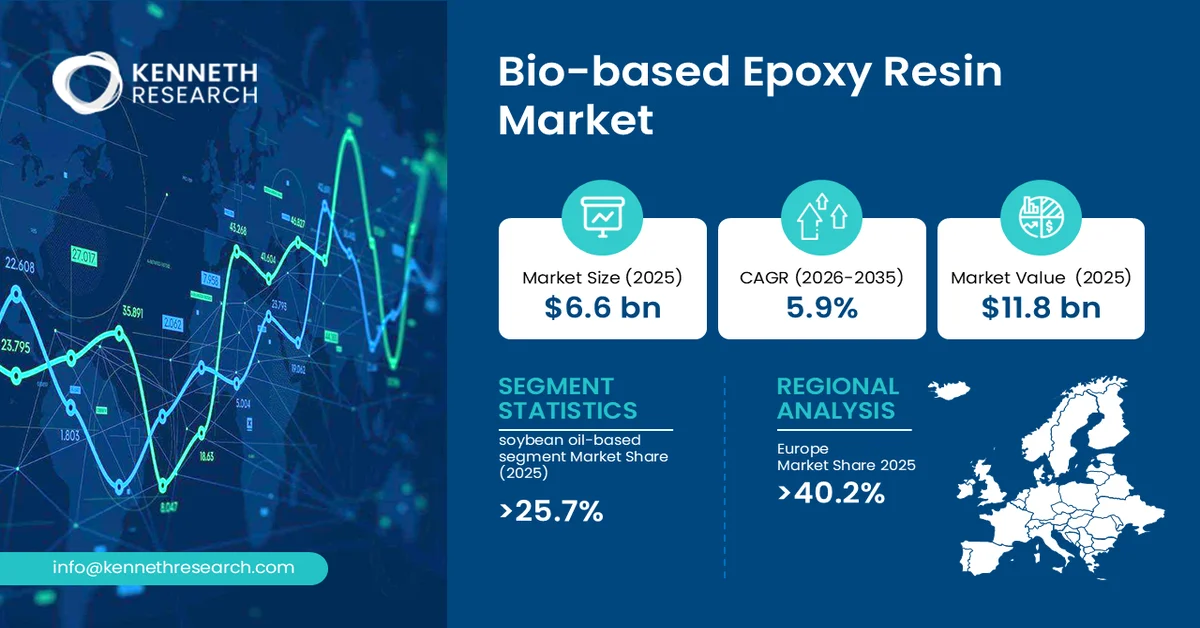
Bio-based Epoxy Resin Market size was valued at USD 6.6 billion in 2025 and is projected to reach USD 11.8 billion by the end of 2035, rising at a CAGR of 5.9% during the forecast period, i.e., 2026-2035. In 2026, the industry size of bio-based epoxy resin is estimated at USD 7 billion.
The primary growth driver is the chemical industry’s transition from fossil-derived feedstocks toward renewable biological resources. Bio-based epoxy resins enable manufacturers to incorporate plant-derived and other renewable raw materials into thermoset systems while maintaining industrial functionality, supporting decarbonization objectives, resource diversification, circular-economy strategies, and demand for more sustainable material solutions.
The bio-based epoxy resin market comprises epoxy resin systems in which some or all of the carbon-based raw materials are derived from renewable biological resources rather than exclusively from fossil-based feedstocks. These resources can include vegetable oils, lignocellulosic biomass, agricultural residues, natural phenolic compounds, and other biologically derived materials.
Bio-based epoxy resins retain the fundamental characteristics associated with epoxy systems, including strong adhesion, chemical resistance, mechanical durability, dimensional stability, electrical insulation, and compatibility with reinforcing materials and additives. Depending on formulation and feedstock, bio-based content can be incorporated into epoxy monomers, reactive diluents, hardeners, or related formulation components.
Industrial relevance stems from the ability to integrate renewable feedstocks into established resin-processing and end-use applications. These materials can serve sectors including coatings, adhesives, composites, construction materials, transportation, electrical and electronics, and other engineered-material applications. Their development supports industrial efforts to reduce dependence on fossil resources while creating higher-value applications for renewable biological feedstocks and waste-derived materials. The European Commission identifies bio-based chemicals as materials applicable across industries including paints, coatings, lubricants, and adhesives.
Key Bio-Based Epoxy Resin Market Insights Summary:
Key Takeaways: Market Trends & Insights
- The Bio-based Epoxy Resin Market was valued at USD 6.6 billion in 2025 and is projected to reach USD 11.8 billion by 2035
- The market is estimated at USD 7 billion in 2026, indicating continued expansion from the previous year
- The market is projected to expand at a CAGR of 5.9% during 2026–2035
- Soybean Oil-based led the Type segment with a 25.7% market share in 2025
- Europe dominated the regional landscape with a 40.2% market share in 2025
Market Drivers
- Advancements in recyclable and multifunctional bio-based epoxy technology
- Expansion and diversification of renewable feedstock utilization
- Increasing industrial demand for reduced dependence on fossil-derived resources
- Growing integration of bio-based resins into coatings, composites, adhesives, and engineered materials
Challenges
- Feedstock consistency and supply-chain complexity
- Performance qualification and manufacturing compatibility
Bio-Based Epoxy Resin Market Overview & Supply Chain
Bio-based epoxy resin adoption is increasing as manufacturers seek to substitute fossil-derived carbon with renewable biological feedstocks while preserving the performance characteristics required in coatings, composites, adhesives, and engineered materials. The shift is supported by broader industrial decarbonization, renewable-resource utilization, innovation in bio-based chemistry, and policy interest in developing competitive bioeconomy value chains. The European Commission’s Joint Research Centre reports that biomass-producing and converting sectors generated 17.1 million jobs in the EU in 2023, demonstrating the substantial industrial and employment relevance of the broader bioeconomy ecosystem in which bio-based chemical materials are developing.
The bio-based epoxy resin value chain begins with renewable feedstocks sourced from agricultural crops, vegetable oils, forestry resources, lignocellulosic biomass, industrial residues, and other biological materials. Feedstock suppliers and processors convert these resources into suitable chemical intermediates or functional bio-based building blocks. Resin manufacturers then undertake chemical modification, formulation, curing-system integration, quality control, and performance optimization to produce application-specific epoxy systems. Distribution typically involves chemical distributors, specialty-material suppliers, and direct manufacturer-to-industrial-user channels, depending on formulation complexity and purchasing requirements. Downstream users include coatings formulators, composite manufacturers, adhesive producers, construction-material companies, transportation manufacturers, electrical and electronics producers, and other industrial processors. Major stakeholders therefore span farmers and biomass suppliers, chemical processors, resin producers, additive and hardener suppliers, distributors, formulators, industrial manufacturers, certification bodies, regulators, and technology developers.
Bio-based Epoxy Resin Market: Growth Drivers & Challenges
Growth Drivers:
- Advancements in recyclable bio-based epoxy technology: Technological advancement is strengthening the commercial case for bio-based epoxy resins by enabling renewable formulations to address performance and end-of-life requirements simultaneously. Research is increasingly focused on developing epoxy systems that combine bio-derived feedstocks with improved recyclability, particularly for high-performance composite applications. In 2022, the U.S. Department of Energy’s National Renewable Energy Laboratory reported a plant-based epoxy development intended to enable recyclable carbon-fiber composites. This demonstrates how bio-based epoxy technology is progressing beyond feedstock substitution toward materials engineered for broader sustainability and circularity objectives. Such developments can expand the applicability of bio-based epoxy systems across transportation, composites, and advanced manufacturing. Continued improvements in curing chemistry, thermal stability, mechanical performance, and recycling compatibility could reduce technical barriers to adoption. Over time, these advances may help bio-based epoxy formulations compete more effectively in demanding industrial applications where both material performance and resource efficiency influence purchasing decisions.
- Expansion and diversification of renewable feedstocks: The expanding range of renewable feedstocks is creating additional pathways for bio-based epoxy resin production. Vegetable oils, agricultural residues, forestry-derived resources, biomass components, and other biological materials can provide chemical building blocks suitable for epoxy formulation. This diversification enables manufacturers to reduce dependence on conventional fossil-derived raw materials while creating opportunities to convert renewable resources and industrial by-products into higher-value chemical intermediates. It can also encourage collaboration between agricultural suppliers, biomass processors, chemical companies, and resin manufacturers. For producers, access to different feedstock pathways can support formulation flexibility and enable the development of application-specific resin systems. However, successful commercialization requires reliable feedstock processing, chemical consistency, and integration with existing manufacturing infrastructure. Continued innovation in biomass conversion and purification should broaden the range of usable biological inputs. This can strengthen the industry's ability to develop bio-based epoxy systems for coatings, composites, adhesives, and engineered materials.
Challenges:
- Feedstock consistency and supply-chain complexity: Bio-based epoxy production relies on biological resources whose chemical composition can vary according to agricultural conditions, geographic origin, processing methods, and feedstock characteristics. Such variability can make it more difficult for manufacturers to achieve consistent intermediate quality and predictable resin performance. Producers may therefore require additional purification, characterization, blending, and quality-control procedures before renewable inputs can meet industrial specifications. This complexity can increase procurement risk and create additional requirements for supplier qualification and long-term sourcing arrangements. Competition for agricultural and biomass resources can also emerge because these materials may already serve food, feed, fuel, animal-feed, or other industrial applications. Commercially, manufacturers must balance renewable-feedstock availability with quality, cost, traceability, and supply reliability. Future competitiveness will depend on diversified sourcing strategies, improved preprocessing technologies, standardized feedstock specifications, and closer integration between biomass suppliers, chemical processors, and epoxy resin manufacturers.
- Performance qualification and manufacturing compatibility: Achieving higher renewable content while maintaining the performance expected from conventional epoxy systems remains a significant commercialization challenge. Industrial users typically require predictable curing behavior, adhesion, thermal stability, chemical resistance, mechanical strength, storage stability, and compatibility with established production processes. Changes in molecular structure resulting from bio-based feedstocks can influence formulation behavior and may require additional formulation development and application testing. These requirements increase qualification time and can create switching costs for downstream manufacturers. The issue is particularly important in demanding applications where material performance affects product durability, reliability, or operational safety. Consequently, industrial customers may initially favor bio-based epoxy systems in applications where sustainability benefits can be achieved without substantial process modification. Future adoption will depend on formulation engineering that delivers consistent renewable content while matching established technical specifications and minimizing changes to customers’ existing manufacturing processes.
Bio-Based Epoxy Resin Market Size and Forecast:
| Report Attribute | Details |
|---|---|
| Base Year |
2025 |
| Forecast Year |
2026-2035 |
| CAGR |
5.9% |
| Base Year Market Size (2025) |
USD 6.6 billion |
| Forecast Year Market Size (2035) |
USD 11.8 billion |
| Regional Scope |
|
Bio-based Epoxy Resin Market Segmentation Analysis:
Type Segment Analysis
In the type segment, the Soybean Oil-based sub-segment is anticipated to capture the largest market share of 25.7% by the end of 2025.
The soybean oil-based segment dominates because soybean oil provides an established, renewable feedstock with broad industrial availability and adaptable chemical functionality for epoxy modification. Demand is supported by manufacturers seeking plant-derived alternatives to petroleum-based inputs, while established soybean crushing and processing infrastructure facilitates feedstock access. USDA reports that U.S. soybean oil used for biofuels reached 12.5 billion pounds in marketing year 2022/23, demonstrating strong and expanding industrial utilization of soybean oil beyond food applications. This established industrial ecosystem can support downstream development of soybean-derived chemical intermediates and resin formulations. Supply-side advantages include mature agricultural production, established oil-extraction infrastructure, and existing international trade channels. Adoption is also supported by the versatility of soybean oil as a starting material for bio-based products, including applications investigated by USDA Agricultural Research Service.
Application Segment Analysis
The coatings are projected to grow as the second-largest segment in the bio-based epoxy resin market due to four converging demand drivers.
The coatings segment is projected to grow as manufacturers increasingly seek resin systems that combine surface protection, durability, and improved environmental attributes. Demand is supported by stricter emissions controls, sustainability requirements, and the need for coating formulations compatible with evolving industrial specifications. The U.S. Environmental Protection Agency’s 2023 amendments for miscellaneous coating manufacturing are designed to reduce 4,900 tons per year of hazardous air pollutant emissions from existing facilities, illustrating the regulatory pressure shaping coating formulation and production practices. Such requirements encourage coating producers to evaluate lower-impact raw materials and formulation technologies, creating opportunities for bio-based epoxy resins. Adoption is also supported by their suitability for protective, industrial, and specialty coatings where adhesion, chemical resistance, and durability remain important.
Our in-depth analysis of the global bio-based epoxy resin market includes the following segments:
|
Segment |
Sub-segment |
|
Form |
|
|
Type |
|
|
Application |
|
|
End-Use |
|
Bio-based Epoxy Resin Market Regional Insights:
Europe Market Trends & Insights:
Europe bio-based epoxy resin market is projected to hold the largest revenue share of 40.2% by the end of 2025.
Europe is the dominant regional market, accounting for 40.2% market share in 2025. Its leadership is supported by a mature chemical-manufacturing base, established research capabilities, strong downstream demand for coatings and composites, and policy support for replacing fossil-derived materials with renewable alternatives. The European Commission’s bioeconomy strategy explicitly identifies bio-based chemicals and other bio-based materials as strategic lead markets, reinforcing investment and commercialization opportunities across renewable-carbon value chains. The region also benefits from sophisticated regulatory frameworks that encourage resource efficiency, circular production, and lower dependence on imported fossil resources.
Germany represents a key European manufacturing hub, supported by its extensive chemical, automotive, engineering, and coatings industries. Although energy costs and industrial restructuring create near-term pressure, the country's technical capabilities provide a strong platform for higher-value bio-based materials.
The United Kingdom contributes through its advanced chemical, coatings, construction, and specialty-material industries. Its manufacturing base and sustainability-oriented industrial policies support opportunities for renewable-content resin technologies, particularly where customers seek alternatives compatible with established coating and composite processes. Ongoing innovation and industrial decarbonization should sustain Europe's position as a major development and adoption center for bio-based epoxy systems.
North America Market Trends & Insights:
North America represents an important secondary market for bio-based epoxy resins, supported by established chemical manufacturing, advanced materials research, composite production, and demand for lower-fossil-resource solutions. Market demand is being reinforced by industrial customers seeking renewable-content materials for coatings, adhesives, composites, construction products, transportation components, and other engineered applications. Government-backed research and sustainability programs are encouraging development of renewable carbon technologies, improved biomass utilization, and more resource-efficient manufacturing pathways. The region also has a strong ecosystem linking agricultural producers, chemical companies, research institutions, specialty-material manufacturers, and downstream industrial users. These conditions create opportunities for bio-based epoxy producers to develop application-specific formulations while leveraging existing resin-processing and distribution infrastructure. Future opportunities are likely to center on higher-performance formulations, renewable feedstock diversification, recyclable thermoset technologies, and integration of bio-based materials into advanced composite and protective-coating applications.
The United States is the principal country within North America, benefiting from its large chemical industry, extensive agricultural feedstock base, sophisticated research infrastructure, and broad end-user industries. Its transportation, construction, aerospace, electronics, and industrial-coatings sectors provide multiple pathways for adoption.
Canada complements the regional market through its forestry resources, agricultural base, chemical-processing capabilities, and growing interest in bioeconomy development. Canadian producers and technology developers can leverage renewable-resource availability to support bio-based chemical innovation while serving domestic and cross-border industrial supply chains. Together, the United States and Canada provide complementary strengths in feedstock availability, technology development, manufacturing, and downstream demand, creating a favorable environment for continued commercialization of bio-based epoxy systems.
Bio-Based Epoxy Resin Market Competitive Landscape
Here is a list of upstream, downstream, and key players operating in the global bio-based epoxy resin market competitive ecosystem:
- Gougeon Brothers (United States)
- Company Overview
- Business Strategy
- Key Product Offerings
- Financial Performance
- Key Performance Indicators
- Risk Analysis
- Recent Development
- Regional Presence
- SWOT Analysis
- Sicomin (France)
- Wessex Resins (United Kingdom)
- ATL Composites (Australia)
- Westlake Epoxy (United States)
- EcoPoxy Inc. (Canada)
Recent Developments
- In October 2025, Sicomin launched SR GreenPoxy 550, a bio-based epoxy system engineered for bonding and lamination of timber-and-fibre composites. Derived in part from plant sources, the formulation eliminates all carcinogenic, mutagenic, and reprotoxic (CMR) substances while delivering high strength and stiffness at room temperature. The first major implementation is the Greenscow offshore racing yacht project, which can reduce construction footprint by up to 80% compared to traditional carbon composite hulls.
Frequently Asked Question
In 2025, the bio-based epoxy resin market exceeded USD 6.6 billion.
The bio-based epoxy resin market is projected to reach USD 11.8 billion by the end of 2035, expanding at a CAGR of 5.9% over the forecast period (2026–2035).
The major players in the market are Gougeon Brothers, Sicomin, Wessex Resins, ATL Composites, Westlake Epoxy, and others.
In the Type segment, the Soybean Oil-based sub-segment is anticipated to capture the largest market share of 25.7% in the future and exhibit lucrative growth opportunities during 2026–2035. This growth trajectory is largely attributed to the availability of renewable soybean-derived feedstocks and their suitability for developing bio-based epoxy formulations.
Europe is projected to hold the largest market share of 40.2% by the end of 2035 and provide more business opportunities in the future. Strong chemical manufacturing capabilities and sustainability-oriented industrial policies across Germany and the United Kingdom are fostering the region's dominance.
Why Choose Kenneth Research ?
-
Insight with Impact : We don’t just gather data — we uncover stories, trends, and opportunities that fuel business growth.
-
Experts Who Get It : Our team speaks your industry’s language and knows what really matters to your customers and market.
-
Custom-Built for You : Forget one-size-fits-all. We craft research and consulting solutions as unique as your business vision.
-
Partners, Not Just Providers : We work with you, not for you — collaborating closely to turn insights into smart, strategic moves.
-
Results That Speak : Our work powers brands, startups, and industry leaders alike — with a track record of ideas that work in the real world.
Report ID: 1173 |
Published Date: 25 Aug 2026 |
Report Format: |
Delivery Timeline: 48-72 Business Hours

Copyright © 2025 Kenneth Research. All rights reserved. Terms of Use | Privacy Policy
