Report ID: 1300 |
Published Date: 11 Sep 2026 |
Report Format: |
Delivery Timeline: 48-72 Business Hours
Bearings Market Outlook:
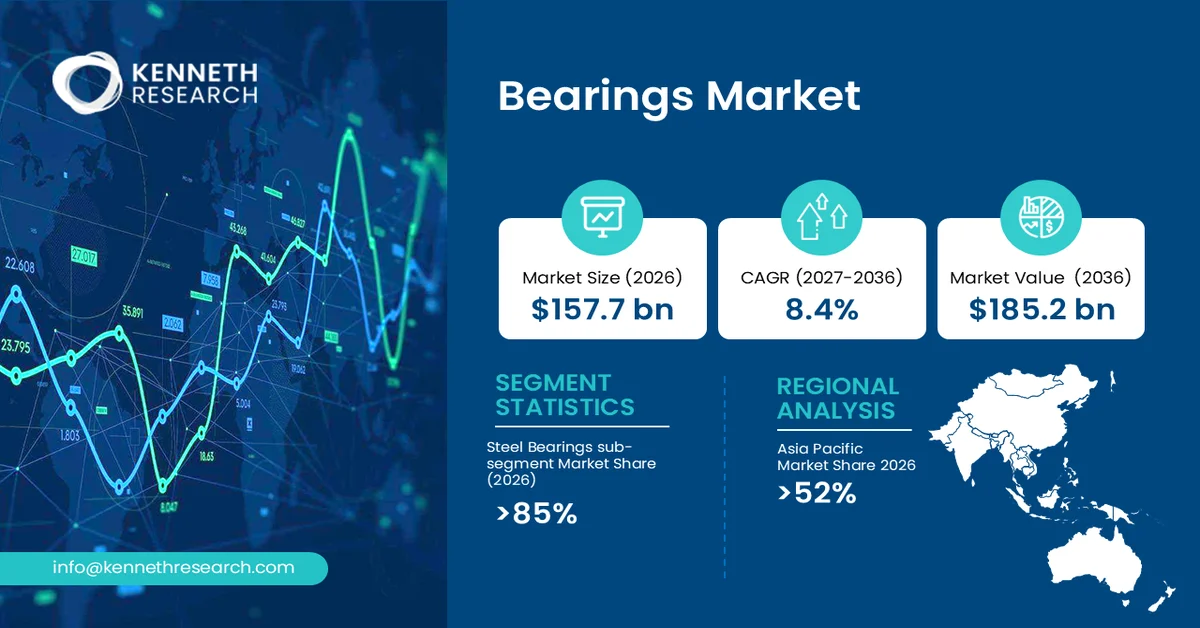
Bearings Market size was valued at USD 157.7 billion in 2026 and is projected to reach USD 185.2 billion by the end of 2036, rising at a CAGR of 8.4% during the forecast period, i.e., 2027–2036. In 2027, the industry size of the bearings market is estimated at USD 170.9 billion.
Rising automation across automotive, machinery, robotics, machine tools, and precision manufacturing is increasing demand for bearings engineered for higher speeds, accuracy, durability, and lower friction.
The bearings market comprises mechanical components designed to support and guide rotating or moving elements while reducing friction between machine parts. Bearings typically consist of components such as inner and outer rings, rolling elements, cages, seals, and lubrication systems, depending on their design and application. Major bearing configurations include ball bearings, roller bearings, and specialized variants engineered for particular load, speed, precision, temperature, and environmental requirements.
A defining characteristic of bearings is their ability to manage radial, axial, or combined loads while facilitating controlled motion. Material selection, dimensional precision, surface finishing, lubrication, sealing, and manufacturing tolerances directly influence service life and operating reliability.
Key Bearings Market Insights Summary:
Key Takeaways: Market Trends & Insights
- Bearings market is projected to grow from USD 157.7 billion in 2026 to USD 185.2 billion by 2036, expanding at a CAGR of 8.4% over the forecast period.
- Asia-Pacific accounted for the largest regional share at 52% in 2026, supported by strong automotive and industrial manufacturing activity across Japan and China.
- Steel bearings will remain the leading Material Type segment, holding an 85% share in 2026, supported by their durability, load-bearing capability, dimensional stability, and broad industrial applicability.
- Ball Bearings are positioned for continued growth within the Product Type segment, driven by demand for low-friction, compact, high-speed, and efficient rotating components across automotive, electric motors, industrial machinery, and robotics.
Market Drivers
- Expansion of industrial automation and electrified machinery
- Increasing demand for high-performance and predictive-maintenance components
- Growth of electric vehicles and electrically driven powertrain systems
- Expansion of robotics, precision machinery, and advanced manufacturing infrastructure
Challenges
- Volatility in steel supply and input costs
- Intensifying competitive pressure and manufacturing complexity
Bearings Market: Market Overview & Supply Chain
Global adoption of bearings is increasing as manufacturing, transportation, electrification, and industrial equipment become more dependent on reliable rotating machinery. Bearings are critical to motors, pumps, compressors, machine tools, conveyors, turbines, and automotive systems because they reduce friction and enable controlled movement under demanding operating conditions. The expansion of electricity-intensive manufacturing is particularly relevant: the International Energy Agency reported that global electricity demand increased by 4.3% in 2024, with industrial electricity use rising by nearly 4% as electro-intensive manufacturing and broader industrial activity expanded. This reinforces the importance of efficient motion components capable of supporting increasingly electrified and automated equipment.
The bearings market value chain begins with raw-material suppliers providing bearing-grade steel, alloying elements, lubricants, seals, and other specialized inputs. Manufacturers then transform these materials through forging, machining, heat treatment, grinding, polishing, assembly, lubrication, and quality-control processes. Precision manufacturing is particularly important because dimensional accuracy and surface characteristics determine bearing performance, operating life, noise, and load-handling capability.
Bearings Market: Growth Drivers & Challenges
Growth Drivers
- Expansion of Industrial Automation and Electrified Machinery: The increasing deployment of automated production equipment, electric motors, robotics, machine tools, pumps, compressors, and other rotating machinery is strengthening demand for bearings that can operate reliably under continuous and increasingly precise operating conditions. Automation raises the importance of motion accuracy, low friction, vibration control, thermal stability, and predictable maintenance because component failure can interrupt interconnected production processes. Electrification reinforces this requirement by increasing the number of electrically driven systems across industrial facilities and transport applications.
- Demand for Higher-Performance and Predictive-Maintenance Components: Industrial users are increasingly shifting from basic component replacement toward engineered bearing solutions that improve equipment reliability, operating efficiency, and maintenance planning. This is encouraging manufacturers to develop bearings with optimized internal geometries, improved sealing, specialized lubrication, enhanced surface treatments, and greater resistance to heat, contamination, and demanding loads. The integration of condition-monitoring technologies is also changing procurement criteria, particularly in machinery where unexpected downtime carries significant operational costs.
Challenges
- Volatility in Steel Supply and Input Costs: Steel is a critical input for bearing manufacturing, making producers sensitive to fluctuations in raw-material availability, energy costs, trade flows, and steelmaking capacity. Changes in steel markets can affect procurement costs and complicate production planning, particularly for manufacturers operating under long-term supply contracts or serving price-sensitive industrial customers. The challenge is amplified by the geographically concentrated nature of global steel production and changing international trade patterns.
- Intensifying Competitive Pressure and Manufacturing Complexity: Bearing manufacturers face increasing pressure to deliver higher precision, durability, efficiency, and application-specific performance while maintaining commercially competitive pricing. Customers in automotive, industrial machinery, robotics, and energy applications increasingly expect components to operate reliably under higher speeds, heavier loads, tighter tolerances, and more demanding thermal or contamination conditions. Meeting these requirements requires investment in advanced machining, heat treatment, surface engineering, quality assurance, application engineering, and increasingly digital monitoring capabilities.
Bearings Market Size and Forecast:
| Report Attribute | Details |
|---|---|
| Base Year |
2026 |
| Forecast Year |
2027-2036 |
| CAGR |
8.4% |
| Base Year Market Size (2026) |
USD 157.7 billion |
| Forecast Year Market Size (2036) |
USD 185.2 billion |
| Regional Scope |
|
Bearings Market - Segment Analysis
Material Type Segment Analysis
In the material type segment, the Steel Bearings sub-segment is anticipated to capture the largest market share of 85% in 2026.
Steel bearings maintain their leading position because steel provides the combination of hardness, fatigue resistance, dimensional stability, load-bearing capability, and manufacturability required across high-duty rotating equipment. Demand is supported by automotive systems, industrial machinery, electric motors, machine tools, pumps, compressors, conveyors, and robotics, where bearings must withstand repetitive loads while maintaining controlled friction and alignment. The expansion of automated manufacturing is particularly supportive because increasingly sophisticated production equipment requires dependable motion components. On the supply side, established steelmaking infrastructure, mature forging and machining processes, standardized production methods, and extensive bearing-grade material expertise support scalable manufacturing.
Product Type Segment Analysis
Ball bearings are positioned for continued growth because they offer low friction, compact dimensions, high rotational efficiency, and suitability for applications requiring smooth and relatively high-speed motion. Demand is supported by automotive systems, electric motors, industrial machinery, appliances, robotics, pumps, and precision equipment, where minimizing friction and maintaining consistent rotation are important for operating efficiency and component reliability. Automotive electrification is creating an additional application opportunity because electric powertrains and auxiliary systems require numerous compact rotating components. China provides a strong demand signal: according to the Chinese government, the country produced 31.282 million vehicles in 2024, while new-energy-vehicle production exceeded 10 million units for the first time.
Our in-depth analysis of the global bearings market includes the following segments:
|
Segment |
Sub-segment |
|
Product Type |
|
|
Roller Bearing Type |
|
|
Material Type |
|
|
Application |
|
|
End-User Industry |
|
|
Distribution Channel |
|
Bearings Market: Regional Analysis
Asia-Pacific Market Trends & Insights:
Asia-Pacific holds the dominant regional position, accounting for 52% in 2026 according to the provided market input. Its leadership is underpinned by a dense manufacturing ecosystem spanning automotive production, industrial machinery, machine tools, electronics, robotics, and power equipment. The region combines substantial bearing manufacturing capacity with strong downstream consumption, enabling suppliers to serve both OEM and replacement demand efficiently.
Japan remains important because of its highly developed automotive, precision machinery, robotics, machine-tool, and engineering industries. Its manufacturers emphasize high-precision bearings, application engineering, reliability, and advanced production technologies.
China represents a major manufacturing and consumption base, supported by extensive automotive, machinery, industrial automation, and equipment manufacturing activity.
North America Market Trends & Insights:
North America represents an important market for bearings because of its established automotive, aerospace, industrial machinery, energy, construction, mining, and advanced manufacturing industries. Demand is closely connected with equipment modernization, factory automation, maintenance requirements, and replacement activity across installed machinery. The region also benefits from a strong engineering ecosystem and established OEM relationships, allowing bearing manufacturers to develop application-specific solutions for demanding operating environments.
The U.S. remains the principal demand center because of its broad industrial base spanning automotive, aerospace, machinery, energy, defense, and logistics equipment.
Canada offers opportunities through mining, energy, transportation, aerospace, and heavy industrial applications. Its resource-intensive industries require durable bearing solutions capable of operating under demanding loads, contamination, temperature variations, and extended maintenance cycles.
Bearings Market: Competitive Landscape
Here is a list of upstream, downstream, and key players operating in the global bearings market competitive ecosystem:
- Schaeffler (Germany)
- Company Overview
- Business Strategy
- Key Product Offerings
- Financial Performance
- Key Performance Indicators
- Risk Analysis
- Recent Development
- Regional Presence
- SWOT Analysis
- NSK (Japan)
- Timken (U.S)
Recent Developments
- September 2025: Schaeffler introduced its PTB series of precision angular-contact ball bearings for driven tools at EMO 2025.
- September 2025: NSK launched a verification program focused on bearing reconditioning and reuse, combining non-destructive fatigue diagnosis, reconditionable bearing designs, and lifecycle traceability.
Frequently Asked Question
In 2026, the bearings market exceeded USD 157.7 billion.
The bearings market is projected to reach USD 185.2 billion by the end of 2036, expanding at a CAGR of 8.4% over the forecast period (2027-2036).
The major players in the market are Schaeffler, NSK, Timken, JTEKT, and others.
In the Material Type segment, the Steel bearings sub-segment is anticipated to capture the largest market share of 85% in the future and exhibit lucrative growth opportunities during 2027-2036.
Asia-Pacific is projected to hold the largest market share of 52% by the end of 2026 and provide more business opportunities in the future.
Why Choose Kenneth Research ?
-
Insight with Impact : We don’t just gather data — we uncover stories, trends, and opportunities that fuel business growth.
-
Experts Who Get It : Our team speaks your industry’s language and knows what really matters to your customers and market.
-
Custom-Built for You : Forget one-size-fits-all. We craft research and consulting solutions as unique as your business vision.
-
Partners, Not Just Providers : We work with you, not for you — collaborating closely to turn insights into smart, strategic moves.
-
Results That Speak : Our work powers brands, startups, and industry leaders alike — with a track record of ideas that work in the real world.
Report ID: 1300 |
Published Date: 11 Sep 2026 |
Report Format: |
Delivery Timeline: 48-72 Business Hours

Copyright © 2025 Kenneth Research. All rights reserved. Terms of Use | Privacy Policy
