Report ID: 1313 |
Published Date: 10 Sep 2026 |
Report Format: |
Delivery Timeline: 48-72 Business Hours
Battery Separator Market Outlook:
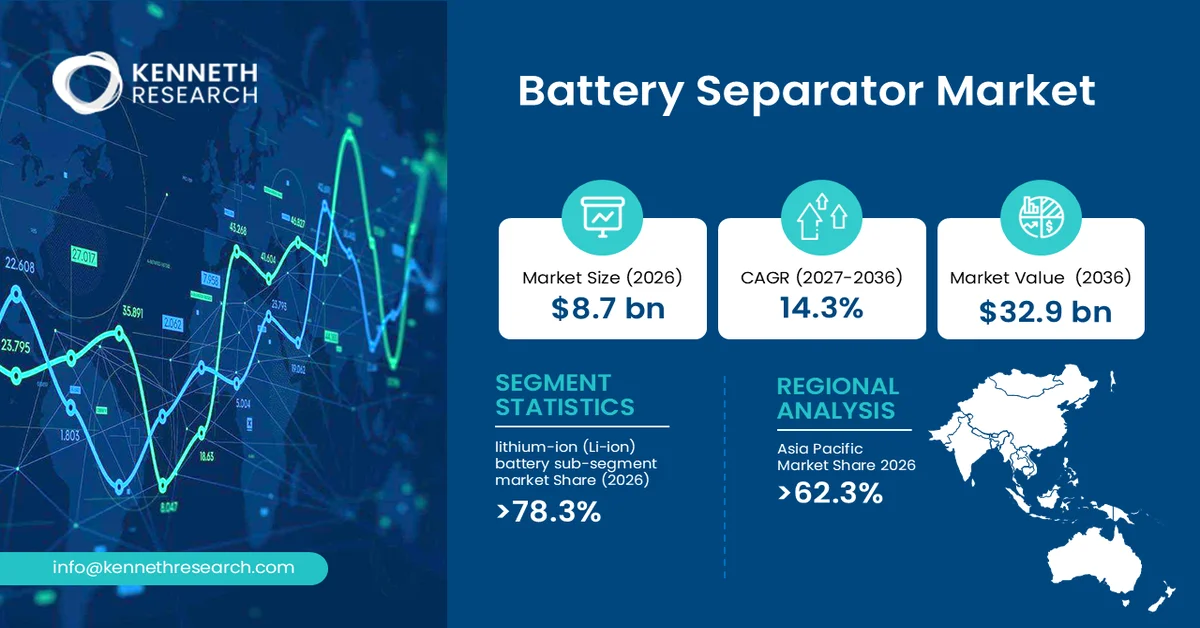
Battery Separator Market size was valued at USD 8.7 billion in 2026 and is projected to reach USD 32.9 billion by the end of 2036, rising at a CAGR of 14.3% during the forecast period, i.e., 2027–2036. In 2027, the industry size of the Battery Separator Market is estimated at USD 9.9 billion.
The rapid expansion of lithium-ion battery manufacturing is a primary growth driver for the battery separator market.
The battery separator market comprises specialized porous membrane materials positioned between the positive and negative electrodes of rechargeable batteries to prevent direct electrical contact while permitting ionic movement between the electrodes. Separators are essential internal battery components because they help maintain electrochemical operation while reducing the risk of internal short circuits.
Key characteristics include controlled pore structure, chemical compatibility with electrolytes, mechanical strength, dimensional stability, wettability, and resistance to thermal deformation. Common separator configurations include microporous polymer membranes, multilayer structures, and coated separators incorporating ceramic or other functional materials. Manufacturing processes can include film extrusion, stretching, coating, and surface treatment, depending on the separator design and battery chemistry.
Key Battery Separator Market Insights Summary:
Key Takeaways: Market Trends & Insights
- Battery Separator Market is projected to grow from USD 8.7 billion in 2026 to USD 32.9 billion by 2036, expanding at a 14.3% CAGR during the forecast period.
- Asia-Pacific accounted for the largest regional share at 62.3% in 2026, supported by strong battery manufacturing ecosystems and expanding electric-vehicle production in Japan and China.
- Lithium-ion (Li-ion) Battery remained the leading Battery Type segment with a 78.3% share in 2026, driven by widespread deployment of lithium-ion cells across automotive, energy storage, electronics, and industrial applications.
- Automotive is expected to remain a key End Use segment as vehicle electrification increases demand for separators offering improved thermal stability, mechanical strength, and safety performance.
Market Drivers
- Expansion of electric vehicle battery manufacturing
- Increasing energy storage deployment
- Rising demand for high-energy-density lithium-ion cells
- Technological development of coated and multilayer separators
Challenges
- Raw Material Price Volatility
- Stringent Performance and Safety Requirements
Battery Separator Market Overview & Supply Chain
Global adoption of battery separators is increasing alongside the expansion of rechargeable-battery manufacturing for electric mobility, energy storage, consumer electronics, and industrial applications. Separator technology is particularly important for lithium-ion cells because it combines electrical isolation with ion transport and contributes to cell safety. The International Energy Agency reported that global electric-car sales exceeded 17 million in 2024, demonstrating continued expansion of a major application base for lithium-ion batteries and, consequently, separator demand.
The battery separator value chain begins with polymer and other functional-material inputs, including polyolefin resins and coating materials. Separator manufacturers convert these inputs through film formation, stretching, pore development, coating, drying, and quality-control processes. Finished separator films are supplied to battery-cell manufacturers, where they are incorporated between electrodes during cell assembly. Distribution typically occurs through direct supply agreements and specialized industrial channels because separator specifications must align closely with cell chemistry and manufacturing processes.
Battery Separator Market: Growth Drivers & Challenges
Growth Drivers
- Expansion of electric vehicle battery manufacturing: The continued expansion of electric mobility is strengthening demand for battery separators because every lithium-ion cell requires a separator to maintain electrical isolation between electrodes while allowing ion transport. As automakers and battery manufacturers scale cell production, separator suppliers benefit from increasing requirements for consistent, high-performance internal battery materials. The International Energy Agency reported that electric car sales approached 14 million units globally in 2023, confirming sustained expansion of the vehicle segment that relies heavily on rechargeable battery technologies.
- Increasing energy storage deployment: The expansion of stationary battery energy-storage systems is creating an additional demand channel for battery separators. Renewable-energy projects increasingly require storage systems capable of balancing variable electricity generation, shifting electricity availability, and supporting grid flexibility. Lithium-ion batteries remain widely used for these applications, creating corresponding requirements for separators that can deliver reliable electrical isolation and stable ion transport.
Challenges
- Raw material price volatility: Battery separator manufacturing depends on polymer-based feedstocks and specialized coating materials whose availability and pricing can influence production economics. Fluctuations in petrochemical markets, supply disruptions, and changes in material availability can raise manufacturing costs and complicate long-term procurement planning. Separator producers must maintain consistent material specifications because variations in feedstock characteristics can affect film thickness, porosity, mechanical strength, and thermal performance.
- Stringent performance and safety requirements: Battery separators must satisfy demanding mechanical, chemical, and thermal requirements because separator failure can contribute to internal short circuits and serious cell-performance problems. Automotive and energy-storage customers therefore require tight control over thickness, pore structure, dimensional stability, electrolyte compatibility, and thermal behavior. Meeting these specifications increases manufacturing complexity and requires sophisticated process controls, inspection systems, and testing capabilities. Coated and multilayer separators can further increase production complexity because multiple processing stages must remain consistent across high-volume manufacturing.
Battery Separator Market Size and Forecast:
| Report Attribute | Details |
|---|---|
| Base Year |
2026 |
| Forecast Period |
2027-2036 |
| CAGR |
14.3% |
| Base Year Market Size (2026) |
USD 8.7 billion |
| Forecast Year Market Size (2036) |
USD 32.9 billion |
| Regional Scope |
|
Battery Separator Market Segmentation Analysis:
Battery Type Segment Analysis
In the Battery Type segment, the lithium-ion (Li-ion) battery sub-segment is anticipated to capture the largest market share of 78.3% by the end of 2036. Its dominance is supported by the extensive use of lithium-ion cells across electric vehicles, energy-storage systems, consumer electronics, and industrial applications. Separators are essential internal components of these cells because they prevent direct contact between electrodes while enabling ionic movement through the electrolyte.
The U.S. Department of Energy identifies battery separators as critical components in lithium-ion batteries and highlights their role in preventing electrical shorts while permitting ionic conduction. Demand for lithium-ion separators is also supported by continued expansion of battery manufacturing capacity and investment in localized supply chains. Separator producers are responding by developing wet-process films, ceramic-coated structures, multilayer membranes, and application-specific designs for automotive and storage cells. Supply-side investment is increasingly focused on scalable production and regional manufacturing resilience.
End Use Segment Analysis
In the End Use segment, the Automotive sub-segment is projected to experience strong growth as electric-vehicle manufacturers increasingly require high-performance lithium-ion cells with enhanced safety, durability, and thermal stability. Battery separators are particularly important in automotive cells because they provide electrical isolation between electrodes while allowing ion movement, making separator quality directly relevant to vehicle battery reliability.
The Government of India’s eMobility R&D Roadmap identifies advanced separator development as a specific research priority for lithium-ion batteries, emphasizing improvements in thermal stability, charging performance, safety, and integration with existing battery manufacturing processes. Automotive battery manufacturers are therefore encouraging separator suppliers to develop thinner, stronger, and more thermally stable materials, including ceramic-coated and other advanced separator designs.
Our in-depth analysis of the global battery separator market includes the following segments:
|
Segment |
Sub-segment |
|
Battery Type |
|
|
Type |
|
|
Material Type |
|
|
Thickness |
|
|
Technology |
|
|
End Use |
|
Battery Separator Market Regional Insights:
Asia-Pacific Market Trends & Insights:
Asia-Pacific is the dominant region in the battery separator market, accounting for 62.3% in 2026. The region benefits from its concentration of lithium-ion battery manufacturing, electric-vehicle production, advanced materials capabilities, and established electronics supply chains. China and Japan are particularly important because they combine large battery-industry ecosystems with strong technical capabilities in separator production and related materials.
Japan maintains a strong position through advanced battery-materials research, precision manufacturing capabilities, and established relationships with automotive and electronics manufacturers. Its industry is positioned toward higher-performance separator technologies, including wet-process and coated solutions designed to improve battery safety and durability.
China represents the region's largest manufacturing hub, supported by extensive battery-cell production, electric-vehicle manufacturing, and domestic supply-chain integration. The country's large-scale battery ecosystem creates substantial downstream demand for separator films while encouraging investment in domestic production capacity and advanced separator technologies.
North America Market Trends & Insights:
North America is an important growth region for the battery separator market, supported by expanding electric-vehicle manufacturing, battery-cell investments, supply-chain localization, and government-backed efforts to strengthen domestic battery production.
U.S. is strengthening its position through investments in domestic battery manufacturing, component production, and recycling infrastructure. Federal programs support commercial-scale facilities for battery components and advanced battery manufacturing, creating opportunities for separator suppliers to establish localized production and supply relationships.
Canada is developing an integrated EV and battery ecosystem spanning critical minerals, cell manufacturing, and battery components. Government-backed projects include separator manufacturing alongside new EV and battery facilities, strengthening opportunities for domestic separator supply.
Leading Companies Operating in the Global Battery Separator Market:
Here is a list of upstream, downstream, and key players operating in the global battery separator market competitive ecosystem:
- Asahi Kasei (Japan)
- Company Overview
- Business Strategy
- Key Product Offerings
- Financial Performance
- Key Performance Indicators
- Risk Analysis
- Recent Development
- Regional Presence
- SWOT Analysis
- Toray Industries (Japan)
- ENTEK (U.S)
Recent Developments
- August 2026 —Asahi Kasei opened a new Hipore™ wet-process lithium-ion battery separator coating line at its existing Celgard facility in Charlotte, North Carolina. Commercial production is scheduled for the second half of fiscal 2026.
- September 2025-- The U.S. Department of Energy approved the first disbursement under a federal loan supporting ENTEK's lithium-ion battery separator manufacturing facility in Terre Haute, Indiana.
Frequently Asked Question
In 2026, the Battery Separator Market exceeded USD 8.7 billion.
The Battery Separator Market is projected to reach USD 32.9 billion by the end of 2036, expanding at a CAGR of 14.3% over the forecast period (2027-2036).
The major players in the market are Asahi Kasei, Toray Industries, SK IE Technology, ENTEK, SEMCORP, and others.
In the Battery Type segment, the lithium-ion (Li-ion) battery sub-segment is anticipated to capture the largest market share of 78.3% in the future and exhibit lucrative growth opportunities during 2027-2036.
Asia-Pacific is projected to hold the largest market share of 62.3% by the end of 2036 and provide more business opportunities in the future.
Why Choose Kenneth Research ?
-
Insight with Impact : We don’t just gather data — we uncover stories, trends, and opportunities that fuel business growth.
-
Experts Who Get It : Our team speaks your industry’s language and knows what really matters to your customers and market.
-
Custom-Built for You : Forget one-size-fits-all. We craft research and consulting solutions as unique as your business vision.
-
Partners, Not Just Providers : We work with you, not for you — collaborating closely to turn insights into smart, strategic moves.
-
Results That Speak : Our work powers brands, startups, and industry leaders alike — with a track record of ideas that work in the real world.
Report ID: 1313 |
Published Date: 10 Sep 2026 |
Report Format: |
Delivery Timeline: 48-72 Business Hours

Copyright © 2025 Kenneth Research. All rights reserved. Terms of Use | Privacy Policy
