Report ID: 1317 |
Published Date: 11 Sep 2026 |
Report Format: |
Delivery Timeline: 48-72 Business Hours
Battery Management System Market Outlook:
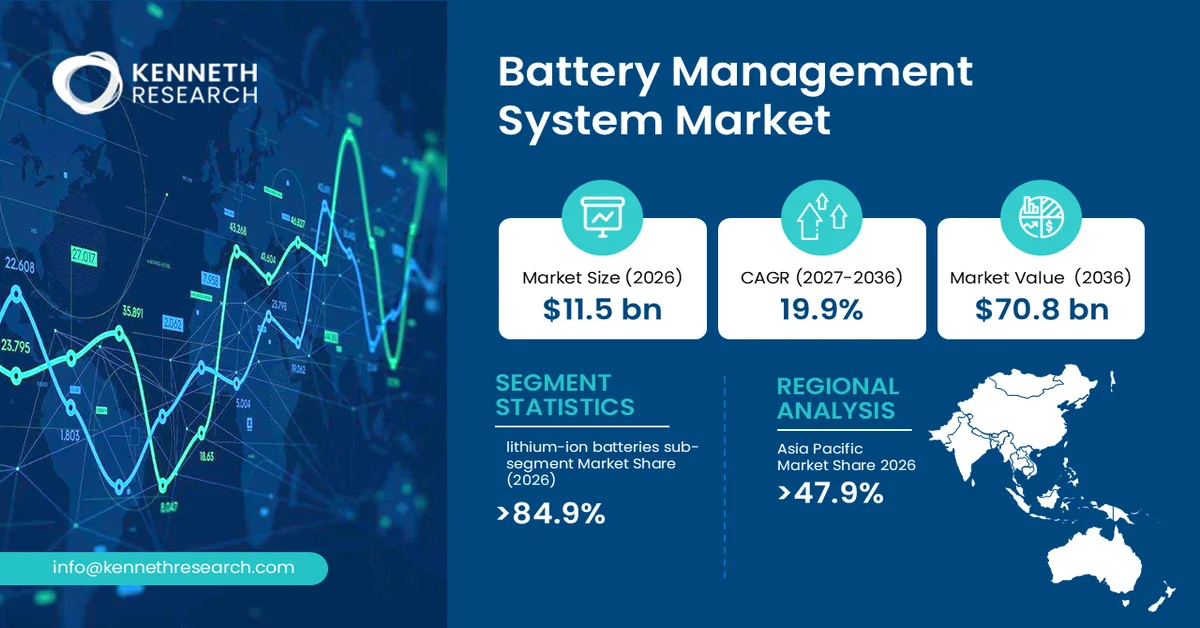
Battery Management System Market size was valued at USD 11.5 billion in 2026 and is projected to reach USD 70.8 billion by the end of 2036, rising at a CAGR of 19.9% during the forecast period, i.e., 2027–2036. In 2027, the industry size of the global battery management systems market is estimated at USD 13.8 billion.
Rising electric-vehicle adoption is the primary growth driver for battery management systems, as expanding battery deployment increases the need for monitoring, balancing, protection, thermal control, and performance optimization.
A battery management system is an electronic control system designed to monitor, manage, and protect rechargeable battery packs throughout their operating lifecycle. It integrates hardware and software functions that measure electrical and thermal conditions, estimate battery operating states, regulate charging and discharging, balance individual cells, identify abnormal conditions, and communicate operational information to connected equipment.
Key characteristics include continuous sensing, control logic, cell balancing, protection against electrical and thermal operating risks, state estimation, fault detection, and communication with vehicle or energy-management systems. The configuration and sophistication of a system vary according to battery chemistry, pack architecture, power requirements, operating environment, and application.
Key Battery Management System Market Insights Summary:
Key Takeaways: Market Trends & Insights
- The battery management systems market is projected to rise from USD 11.5 billion in 2026 to USD 70.8 billion by 2036, reflecting a CAGR of 19.9% over 2027–2036
- Lithium-Ion Batteries lead the Battery Type segment with an 84.9% market share in 2026, supported by broad adoption across electric mobility and energy storage
- Automotive is identified as the second and fastest analysis segment under Application, driven by expanding vehicle electrification and increasing demand for advanced battery monitoring and safety systems
- Asia Pacific dominates the regional landscape with a 47.9% market share in 2026, supported by established battery manufacturing and electrification ecosystems in China and Japan
- North America represents the secondary regional opportunity, with the United States and Canada positioned as important markets through battery manufacturing, energy storage, electric mobility, and supply-chain development
Market Drivers
- Accelerating electric vehicle adoption
- Increasing emphasis on battery safety, reliability, and lifecycle optimization
- Expansion of stationary energy storage deployment
- Advancement of intelligent sensing, connectivity, and software-based battery controls
Challenges
- High integration and validation complexity
- Cybersecurity and connected-system exposure
Battery Management System Market Overview & Supply Chain
Global adoption is increasing as electrification expands across electric mobility, stationary energy storage, consumer electronics, and industrial equipment, raising the need for systems that continuously monitor and protect rechargeable batteries. Battery management systems support safer operation, cell balancing, thermal management, charging control, fault detection, and performance optimization. Their relevance is strengthened by the growing role of batteries in power-system flexibility and decarbonization.
The battery management systems market value chain begins upstream with battery-cell materials, electronic components, sensors, semiconductors, communication components, thermal-management hardware, and embedded software. Battery manufacturers and component suppliers provide the technical inputs required for system integration. BMS manufacturers then design control architectures, develop firmware and algorithms, assemble electronic control units, and validate systems against application-specific safety and performance requirements. Distribution typically involves direct supply to battery manufacturers, automotive and energy-storage integrators, original equipment manufacturers, and specialized electronics channels. Downstream users include electric-vehicle manufacturers, stationary-storage operators, consumer-electronics producers, industrial-equipment manufacturers, and other electrified-asset providers.
Battery Management System Market - Growth Drivers & Challenges
Growth Drivers
- Accelerating Electric Vehicle Adoption: The accelerating transition toward electric mobility is expanding the addressable requirement for sophisticated battery management systems. Electric vehicles depend on coordinated monitoring of cell voltage, temperature, current, state of charge, and state of health to maintain battery performance and operational safety. As vehicle platforms become more electrified, BMS functionality is increasingly integrated with charging, thermal-management, powertrain, and vehicle-control architectures.
- Increasing Emphasis on Battery Safety, Reliability, and Lifecycle Optimization: Growing reliance on rechargeable batteries is increasing the importance of technologies that can detect abnormal operating conditions and optimize battery utilization throughout the asset lifecycle. Battery management systems provide a critical control layer by monitoring individual cells, balancing charge, estimating battery condition, managing temperature-related risks, and identifying faults before they escalate. This becomes particularly important as battery packs are deployed in applications where reliability, uptime, and safety directly influence operational costs and user confidence.
Challenges
- High Integration and Validation Complexity: The increasing technical sophistication of battery packs makes BMS integration more difficult, particularly where systems must coordinate cell monitoring, balancing, thermal management, charging control, diagnostics, and vehicle communication. Different battery chemistries and pack architectures require tailored algorithms, sensing configurations, control strategies, and validation procedures. This raises engineering effort because changes to one component can affect safety, performance, software calibration, and system interoperability.
- Cybersecurity and Connected-System Exposure: The growing connectivity of battery management systems creates a structural restraint as BMS platforms increasingly exchange information with vehicle controllers, charging infrastructure, cloud services, and remote diagnostic systems. This connectivity expands the potential attack surface and requires security to be incorporated into hardware, firmware, communication protocols, authentication mechanisms, and software-update processes. A security weakness can have consequences beyond data confidentiality because unauthorized manipulation of battery-control functions could affect charging, energy delivery, diagnostics, or safety-related operations.
Battery Management System Market Size and Forecast:
| Report Attribute | Details |
|---|---|
| Base Year |
2026 |
| Forecast Year |
2027-2036 |
| CAGR |
19.9% |
| Base Year Market Size (2026) |
USD 11.5 billion |
| Forecast Year Market Size (2036) |
USD 70.8 billion |
| Regional Scope |
|
Battery Management System Market - Segment Analysis
Battery Type Segment Analysis
In the battery type segment, lithium-ion batteries sub-segment is anticipated to capture the largest market share of 84.9% by the end of 2026.
Lithium-ion batteries dominate the battery type segment because their combination of energy density, efficiency, rechargeability, established manufacturing infrastructure, and suitability for compact, high-performance applications makes them the preferred chemistry across electric mobility and energy storage. Demand is reinforced by the rapid electrification of transportation and increasing deployment of battery-based storage, both of which require sophisticated battery management systems for cell monitoring, balancing, thermal control, charging management, and safety protection. The International Energy Agency reports that the energy sector now accounts for over 90% of annual lithium-ion battery demand, reflecting the chemistry’s central role in modern electrification.
Application Segment Analysis
The automotive is projected to grow as the second-largest segment in the battery management systems market due to four converging demand drivers.
The automotive sub-segment is projected to grow rapidly as vehicle electrification increases the requirement for sophisticated battery monitoring, protection, balancing, thermal management, and state-estimation capabilities. Electric vehicles increasingly incorporate larger and more complex battery packs, making BMS performance integral to vehicle safety, range management, charging efficiency, and battery longevity. Automotive adoption is also supported by expanding model availability, charging infrastructure, regulatory decarbonization policies, and investment across the EV manufacturing ecosystem. On the supply side, established automakers, battery manufacturers, semiconductor suppliers, and BMS developers are increasingly collaborating to integrate sensing, control software, connectivity, and diagnostics into vehicle architectures.
Our in-depth analysis of the global battery management system market includes the following segments:
|
Segment |
Sub-segment |
|
Topology |
|
|
Battery Type |
|
|
Component |
|
|
Application |
|
Battery Management System Market - Regional Analysis
Asia Pacific Market Trends & Insights:
Asia Pacific battery management systems market is projected to hold the largest revenue share of 47.9% by the end of 2026.
It is supported by concentrated battery manufacturing, expanding electric-vehicle adoption, energy-storage deployment, and strong electronics production capabilities. China, Japan, South Korea, and other regional manufacturing hubs provide an extensive ecosystem spanning battery cells, semiconductors, sensors, power electronics, and vehicle production.
China remains the principal regional manufacturing and consumption center, supported by a deep battery supply chain, extensive vehicle production base, and continued investment in electrification. Its large domestic market also enables BMS suppliers to develop and commercialize technologies at scale.
Japan maintains a strategically important position through established automotive, battery, electronics, and precision-engineering capabilities. Japanese manufacturers continue to contribute expertise in battery technologies, vehicle electrification, and advanced electronic control systems. Together, China’s manufacturing scale and Japan’s technology-oriented industrial base strengthen Asia Pacific’s position as a major center for BMS development, integration, and deployment. Continued investment in electric mobility, stationary storage, and battery manufacturing should sustain regional demand for increasingly sophisticated BMS architectures.
North America Market Trends & Insights:
North America is a significant market for battery management systems, supported by expanding electric-vehicle manufacturing, stationary energy-storage deployment, advanced battery research, and efforts to establish resilient domestic supply chains. Industrial activity is increasingly concentrated around battery materials, cell manufacturing, pack integration, recycling, and power-electronics technologies, creating a broader ecosystem for BMS suppliers.
The United States represents the region’s principal industrial center, with substantial activity spanning EV batteries, energy storage, semiconductor technologies, automotive manufacturing, and battery recycling. Federal support is encouraging domestic production and strengthening the ecosystem available to BMS developers and integrators.
Canada complements this position through critical-mineral resources, battery research, clean-technology manufacturing, and emerging cell-production capabilities. Government-backed programs are supporting battery innovation and domestic supply-chain development, creating opportunities for BMS suppliers across mining, manufacturing, vehicle electrification, and energy storage.
Battery Management System Market Competitive Landscape
Here is a list of upstream, downstream, and key players operating in the battery management system market competitive ecosystem:
- Analog Devices, Inc. (United States)
- Company Overview
- Business Strategy
- Key Product Offerings
- Financial Performance
- Key Performance Indicators
- Risk Analysis
- Recent Development
- Regional Presence
- SWOT Analysis
- DENSO Corporation (Japan)
- Eberspaecher Vecture Inc. (Canada)
- LG Energy Solution, Ltd. (South Korea)
Recent Developments
- In April 2026, Analog Devices made its EVAL-ESS1-SYS scalable BMS solution kit available through distributors. The complete kit includes an application processor, isoSPI adapter, two 16-cell battery monitors, two 16-cell battery emulators, and a battery pack monitor, delivering precise voltage and current measurement capabilities for modular BMS integration in IoT, industrial, and portable energy storage applications.
- In April 2026, Eberspaecher Vecture expanded its BMS portfolio for UAVs and autonomous platforms with the GuardIon-IQ™ modular platform. Supporting 12V–1,500V (3S–16S) systems in an ultra-compact 80×55×12 mm footprint, the platform features smart SoC/SoH algorithms, CAN bootloader with optional BLE/Wi-Fi updates, and GUI-based configuration for rapid prototyping in SWaP-constrained applications.
Frequently Asked Question
In 2026, the battery management systems market exceeded USD 11.5 billion.
The battery management systems market is projected to reach USD 70.8 billion by the end of 2036, expanding at a CAGR of 19.9% over the forecast period (2027-2036).
The major players in the market are Analog Devices, Inc., DENSO Corporation, Eberspaecher Vecture Inc., LG Energy Solution, Ltd., and others.
In the battery type segment, the Lithium-Ion Batteries sub-segment is anticipated to capture the largest market share of 84.9% in the future and exhibit lucrative growth opportunities during 2027-2036. This growth trajectory is largely attributed to the expanding adoption of electric vehicles and battery-based energy storage.
Asia Pacific is projected to hold the largest market share of 47.9% by the end of 2026 and provide more business opportunities in the future. Continuous investments in battery manufacturing, electric mobility, electronics, and energy storage in China and Japan are fostering the region's dominance.
Why Choose Kenneth Research ?
-
Insight with Impact : We don’t just gather data — we uncover stories, trends, and opportunities that fuel business growth.
-
Experts Who Get It : Our team speaks your industry’s language and knows what really matters to your customers and market.
-
Custom-Built for You : Forget one-size-fits-all. We craft research and consulting solutions as unique as your business vision.
-
Partners, Not Just Providers : We work with you, not for you — collaborating closely to turn insights into smart, strategic moves.
-
Results That Speak : Our work powers brands, startups, and industry leaders alike — with a track record of ideas that work in the real world.
Report ID: 1317 |
Published Date: 11 Sep 2026 |
Report Format: |
Delivery Timeline: 48-72 Business Hours

Copyright © 2025 Kenneth Research. All rights reserved. Terms of Use | Privacy Policy
