Report ID: 1331 |
Published Date: 09 Sep 2026 |
Report Format: |
Delivery Timeline: 48-72 Business Hours
Battery Backup Market Outlook:
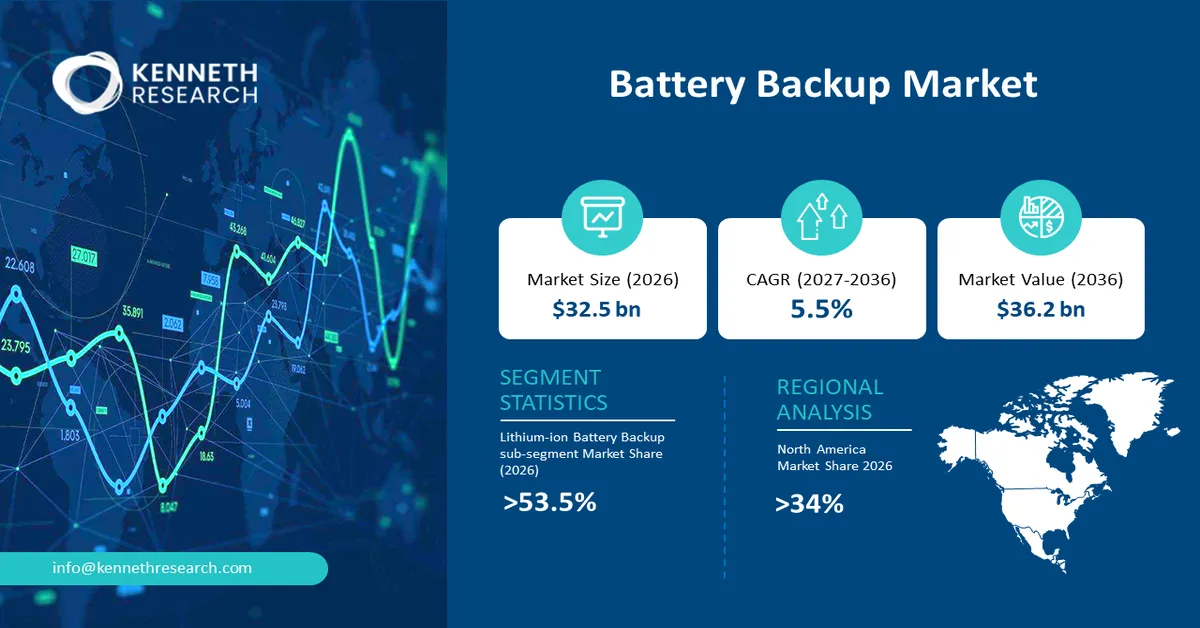
Battery Backup Market size was valued at USD 32.5 billion in 2026 and is projected to reach USD 36.2 billion by the end of 2036, rising at a CAGR of 5.5% during the forecast period, i.e., 2027-2036. In 2027, the industry size of the battery backup is estimated at USD 34.3 billion.
Growing demand for reliable and uninterrupted electricity is driving adoption of battery backup systems across residential, commercial, industrial, telecommunications, and critical infrastructure applications.
The battery backup market encompasses rechargeable battery-based systems designed to provide electricity when the primary power supply is interrupted, unstable, or unavailable. These systems store electrical energy and release it when required, supporting continuity of operations across residential, commercial, industrial, telecommunications, data center, healthcare, and critical infrastructure applications. Battery backup solutions can range from compact backup units and uninterruptible power supply systems to larger stationary battery energy storage installations.
Key characteristics include rechargeable battery technologies, battery-management systems, power-conversion equipment, monitoring and control systems, thermal-management mechanisms, and protection features. Lithium-ion batteries are increasingly important because of their energy density, efficiency, modularity, and suitability for applications requiring frequent cycling or rapid response.
Key Battery Backup Market Insights Summary:
Key Takeaways: Market Trends & Insights
- Battery backup market is projected to grow from USD 32.5 billion in 2026 to USD 36.2 billion by 2036, expanding at a 5.5% CAGR during the forecast period.
- North America accounted for the largest regional share at 34% in 2026, supported by grid modernization, power-resilience requirements, and increasing deployment of battery storage across the U.S. and Canada.
- Lithium-ion Battery Backup represented the leading Battery Type segment with a 53.5% share in 2026, supported by high energy density, rapid response capabilities, and suitability for critical-power applications.
- OEM/Direct Sales is expected to remain an important sales channel as commercial and industrial buyers increasingly seek integrated solutions, manufacturer-backed technical support, and application-specific battery backup systems.
Market Drivers
- Rising demand for power resilience and continuity
- Expansion of renewable energy and distributed power systems
- Increasing deployment of data centers and other critical digital infrastructure
- Growing adoption of microgrids and decentralized energy systems
Challenges
- High Initial Investment and System Integration Complexity
- Battery Degradation, Safety, and Lifecycle Management
Battery Backup Market Overview & Supply Chain
Global adoption of battery backup systems is increasing as businesses, critical facilities, and electricity networks place greater emphasis on power continuity, resilience, and flexible energy management. Battery systems can provide backup power during outages while also supporting grid stability and integrating variable renewable generation. The U.S. Energy Information Administration reported that utility-scale battery storage capacity in the United States exceeded 20.7 GW in July 2024, demonstrating the expanding role of battery-based storage within the electricity system.
The battery backup value chain begins with raw-material and battery-cell production, involving inputs such as lithium-based materials, cathode and anode materials, electrolytes, separators, metals, and electronic components. Cell manufacturers assemble these materials into battery cells, while battery-system manufacturers integrate cells into modules and packs with battery-management systems, thermal controls, protection systems, and enclosures. Power-electronics manufacturers supply inverters, chargers, rectifiers, and related equipment required to connect batteries with electrical loads. System integrators configure complete backup systems for specific applications and operating requirements.
Battery Backup Market: Growth Drivers & Challenges
Growth Drivers:
- Rising demand for power resilience: Growing requirements for reliable electricity across critical infrastructure, commercial facilities, and community services are strengthening demand for battery backup systems. Battery storage can provide rapid-response power during grid interruptions while also supporting microgrids and distributed energy systems. Government-backed projects increasingly demonstrate this application. In 2025, the U.S. Department of Energy approved a resilience project involving a 9.1 MW / 36.4 MWh battery energy storage system intended to strengthen grid reliability and help prevent outages.
- Expansion of renewable energy and distributed power systems: The increasing deployment of variable renewable energy is creating additional opportunities for battery backup systems because batteries can store electricity and provide flexible power when generation and demand do not align. Solar and wind generation can fluctuate with weather conditions, while battery systems can respond rapidly to changes in electricity supply and demand. This makes storage increasingly relevant not only for emergency backup but also for broader power-management strategies. For commercial and industrial users, battery systems can operate alongside renewable generation to improve energy continuity and provide greater control over electricity consumption.
Challenges:
- High initial investment and system integration complexity: Battery backup systems require investment in batteries, inverters, controls, thermal management, protection equipment, installation, and monitoring infrastructure. Costs can increase further when systems must be integrated with existing electrical networks, renewable generation, microgrids, or mission-critical loads. Businesses must therefore evaluate both equipment expenditure and long-term operating requirements before deployment. Integration complexity can also require specialized engineering and commissioning expertise, particularly for large commercial and industrial installations.
- Battery degradation, safety, and lifecycle management: Battery backup systems must maintain reliable performance over extended operating periods while managing degradation, thermal conditions, and safety risks. Repeated charging and discharging can gradually reduce usable capacity, affecting system performance and replacement planning. Operators must also implement appropriate monitoring, thermal management, protection systems, maintenance procedures, and end-of-life strategies. These requirements increase the technical responsibilities of system owners and service providers. Battery safety considerations can also influence site design, equipment selection, ventilation, fire protection, and regulatory compliance.
Battery Backup Market Size and Forecast:
| Report Attribute | Details |
|---|---|
| Base Year |
2026 |
| Forecast Period |
2027-2036 |
| CAGR |
5.5% |
| Base Year Market Size (2026) |
USD 32.5 billion |
| Forecast Year Market Size (2036) |
USD 36.2 billion |
| Regional Scope |
|
Battery Backup Market Segmentation Analysis:
Battery Type Segment Analysis
In the battery type segment, the Lithium-ion Battery Backup sub-segment is anticipated to capture the largest market share of 53.5% by the end of 2026.
Its leading position is supported by established commercial deployment, high energy density, rapid response capabilities, and suitability for applications ranging from critical infrastructure to distributed energy storage. Lithium-ion technology is also supported by a mature manufacturing ecosystem encompassing cells, battery-management systems, power electronics, and integrated storage platforms. The U.S. Department of Energy identifies lithium-ion batteries as a major commercialized electrochemical storage technology and notes their ability to provide both energy and power across stationary-storage applications.
Sales Channel Segment Analysis
In the sales channel segment, the OEM/Direct Sales sub-segment is positioned for continued growth as commercial and industrial buyers increasingly seek integrated battery backup solutions, technical support, warranty coverage, and application-specific system configurations directly from manufacturers. Direct procurement can simplify system specification and enable customers to obtain equipment designed around their particular load, power-quality, and reliability requirements.
Manufacturers are strengthening direct engagement by offering dedicated product portfolios, technical assistance, configuration tools, and direct sales support. Schneider Electric, for example, provides battery backup and UPS solutions through its APC portfolio and directs customers toward product selectors, sales enquiries, and authorized procurement channels.
Our in-depth analysis of the global battery backup market includes the following segments:
|
Segment |
Sub-segment |
|
Battery Type |
|
|
Power Rating |
|
|
Application |
|
|
Sales Channel |
|
Battery Backup Market Regional Insights:
North America Market Trends & Insights:
North America holds the dominant regional position in the battery backup market, accounting for 34% in 2026. The region benefits from mature electricity infrastructure, rising requirements for grid resilience, increasing renewable-energy integration, and strong investment in battery storage technologies. The U.S. Energy Information Administration reported that U.S. utility-scale battery storage capacity had surpassed 20.7 GW by July 2024, highlighting the region’s expanding battery-storage infrastructure.
U.S. demand is supported by increasing deployment of battery storage alongside renewable generation and continued modernization of electricity infrastructure. The country's extensive technology ecosystem also supports innovation in battery management, power electronics, grid integration, and distributed storage.
Canada is strengthening its battery-storage ecosystem through government-supported clean-electricity initiatives and investments in grid modernization. Federal and provincial programs are encouraging storage deployment as part of a more flexible and reliable electricity system.
Asia-Pacific Market Trends & Insights:
Asia-Pacific is emerging as a significant opportunity for the battery backup market, supported by expanding electricity demand, rapid industrialization, digital infrastructure development, and increasing renewable-energy deployment. Governments across the region are promoting energy storage to improve grid flexibility and power reliability. The region also benefits from a strong battery manufacturing ecosystem, creating opportunities for local production, system integration, and technology development.
Japan offers opportunities through its advanced power infrastructure, established electronics industry, and emphasis on energy resilience. Battery storage is increasingly relevant for supporting distributed energy systems and maintaining electricity continuity across commercial and industrial facilities.
China represents a major growth opportunity because of its extensive battery manufacturing capabilities, expanding renewable-energy base, and continued development of energy-storage infrastructure.
Leading Companies Operating in the Global Battery Backup Market:
Here is a list of upstream, downstream, and key players operating in the global battery backup market competitive ecosystem:
- Schneider Electric (France)
- Company Overview
- Business Strategy
- Key Product Offerings
- Financial Performance
- Key Performance Indicators
- Risk Analysis
- Recent Development
- Regional Presence
- SWOT Analysis
- Eaton (Ireland)
- ABB (Switzerland)
Recent Developments
- August 2026: Schneider Electric introduced the next-generation APC Smart-UPS, a multi-chemistry UPS platform compatible with VRLA and lithium-ion batteries and designed to accommodate future battery chemistries.
- March 2026: Eaton announced that its 9PX G2 lithium-ion UPS models in the 6–11 kVA range would become available, extending its lithium-ion backup-power portfolio.
Frequently Asked Question
In 2026, the battery backup market exceeded USD 32.5 billion.
The battery backup market is projected to reach USD 36.2 billion by the end of 2036, expanding at a CAGR of 5.5% over the forecast period (2027-2036).
The major players in the market are Schneider Electric, Eaton, Vertiv, ABB, and others.
In the Battery Type segment, the lithium-ion Battery Backup sub-segment is anticipated to capture the largest market share of 53.5% in the future and exhibit lucrative growth opportunities during 2027-2036. This growth trajectory is largely attributed to the increasing adoption of lithium-ion technology across critical power and energy storage applications.
North America is projected to hold the largest market share of 34% by the end of 2026 and provide more business opportunities in the future. Continued investments in grid resilience, renewable-energy integration, and battery storage infrastructure across the U.S. and Canada are fostering the region's dominance.
Why Choose Kenneth Research ?
-
Insight with Impact : We don’t just gather data — we uncover stories, trends, and opportunities that fuel business growth.
-
Experts Who Get It : Our team speaks your industry’s language and knows what really matters to your customers and market.
-
Custom-Built for You : Forget one-size-fits-all. We craft research and consulting solutions as unique as your business vision.
-
Partners, Not Just Providers : We work with you, not for you — collaborating closely to turn insights into smart, strategic moves.
-
Results That Speak : Our work powers brands, startups, and industry leaders alike — with a track record of ideas that work in the real world.
Report ID: 1331 |
Published Date: 09 Sep 2026 |
Report Format: |
Delivery Timeline: 48-72 Business Hours

Copyright © 2025 Kenneth Research. All rights reserved. Terms of Use | Privacy Policy
