Report ID: 1342 |
Published Date: 28 Sep 2026 |
Report Format: |
Delivery Timeline: 48-72 Business Hours
Bamboo Packaging Market Outlook:
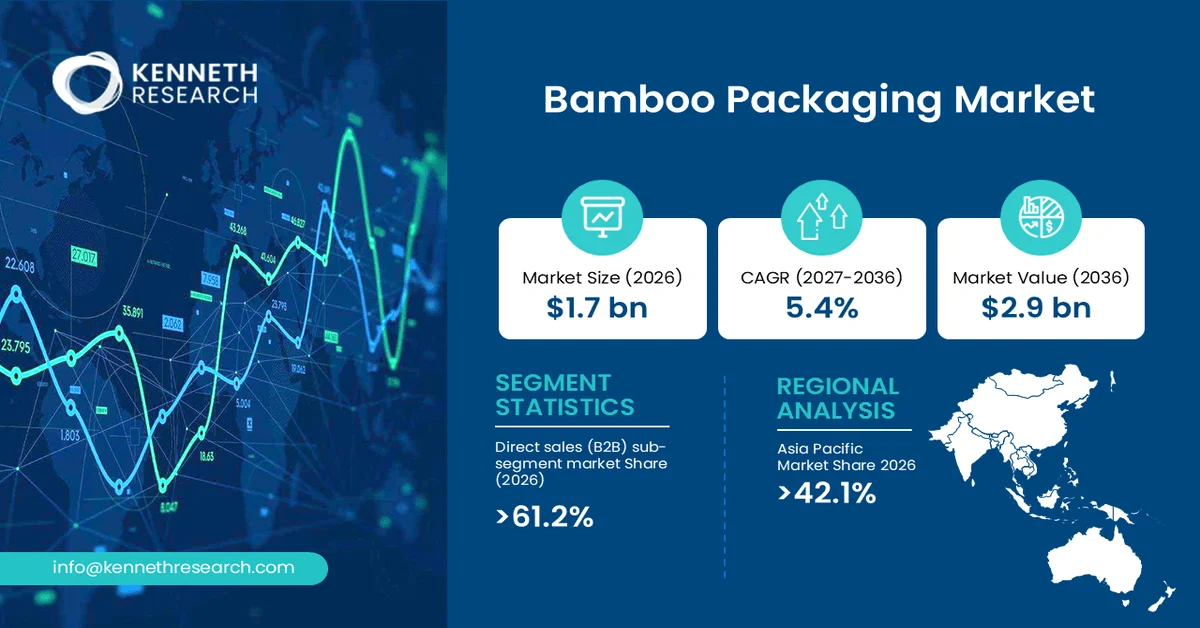
Bamboo Packaging Market size was valued at USD 1.7 billion in 2026 and is projected to reach USD 2.9 billion by the end of 2036, rising at a CAGR of 18.4% during the forecast period, i.e., 2027-2036. In 2027, the industry size of the bamboo packaging is estimated at USD 1.8 billion.
The primary growth driver for the bamboo packaging market is increasing demand for renewable, plant-based packaging alternatives as businesses seek to reduce dependence on conventional plastic materials.
The bamboo packaging market comprises packaging products manufactured wholly or partly from bamboo materials and designed to protect, contain, transport, present, or dispense commercial products. Products can include rigid containers, boxes, trays, bowls, molded-fiber formats, food-service packaging, and specialty packaging components.
Key characteristics include renewable biomass sourcing, mechanical strength, relatively low weight, versatility in processing, and compatibility with various packaging designs. Bamboo can be processed into strips, fibers, pulp, sheets, or composite materials depending on the intended packaging format and performance requirements. The market is industrially relevant because manufacturers and brand owners are seeking packaging materials that can support sustainability objectives while maintaining functional requirements such as structural integrity, product protection, handling efficiency, and presentation.
Key Bamboo Packaging Market Insights Summary:
Key Takeaways & Market Insights
- Bamboo packaging market is projected to expand from USD 1.7 billion in 2026 to USD 2.9 billion by 2036, supported by increasing demand for renewable and alternative packaging materials.
- Direct Sales (B2B) is the leading distribution channel segment, accounting for 61.2% in 2026, as commercial buyers prioritize customized specifications, reliable supply, and direct supplier coordination.
- Rigid Packaging is a key form factor segment, supported by demand for structurally durable packaging suitable for food, consumer goods, cosmetics, and specialty applications.
- Asia-Pacific dominates the market with a 42.1% share in 2026, supported by established bamboo-processing capabilities and large manufacturing ecosystems in Japan and China.
Market Drivers
- Rising demand for sustainable and alternative packaging
- Expansion of bamboo processing and value-added manufacturing
- Increasing adoption of bamboo-based food-contact packaging
- Growing investment in bamboo value-chain infrastructure and product innovation
Challenges
- Material standardization and quality consistency
- Limited processing infrastructure and scale
Bamboo Packaging Market Overview & Supply Chain
Adoption of the bamboo packaging market is increasing as businesses seek renewable alternatives to conventional packaging materials while responding to sustainability objectives and evolving packaging policies. Government initiatives are also strengthening the bamboo ecosystem by supporting cultivation, processing, product development, and market linkages. In 2025, India's National Bamboo Mission was being implemented across 24 States/UTs, supporting cultivation, processing, value addition, entrepreneurship, and marketing activities.
The bamboo packaging value chain begins with bamboo cultivation, harvesting, aggregation, and primary processing. Raw bamboo is treated, dried, split, and converted into strips, mats, fibers, boards, pulp, or other intermediate materials according to packaging requirements. Secondary manufacturers then process these materials through cutting, molding, pressing, lamination, finishing, and assembly to produce rigid containers, trays, boxes, food-service products, and specialty packaging. Packaging manufacturers may integrate coatings, liners, closures, printing, and other functional components to meet product-protection requirements.
Bamboo Packaging Market: Growth Drivers & Challenges
Growth Drivers
- Rising demand for sustainable and alternative packaging: Growing regulatory and commercial emphasis on sustainable packaging is accelerating demand for renewable materials such as bamboo. Food, beverage, retail, and consumer-goods companies are increasingly evaluating packaging formats that can reduce reliance on conventional plastics while maintaining functional performance. India's Food Safety and Standards Authority has specifically issued guidelines permitting bamboo as a food-contact material, supporting its use in food packaging and demonstrating increasing regulatory recognition of alternative packaging materials. This regulatory direction can encourage packaging manufacturers to expand bamboo-based product portfolios and help brand owners incorporate renewable materials into their packaging strategies.
- Expansion of bamboo processing and value-added manufacturing: Increasing investment in bamboo cultivation, processing, and value-added manufacturing is strengthening the supply base available to bamboo packaging producers. Government programs are supporting an end-to-end bamboo ecosystem covering cultivation, primary processing, product development, market infrastructure, and commercialization. India's National Bamboo Mission reported the establishment of 528 product development and processing units as part of its efforts to develop bamboo-based value chains. Greater availability of processed bamboo materials can help manufacturers improve production consistency and develop packaging formats suited to commercial requirements. The expansion of treatment, preservation, processing, and product-development capabilities can also reduce supply constraints and encourage investment in specialized packaging machinery.
Challenges:
- Material standardization and quality consistency: Bamboo is a natural material whose physical characteristics can vary according to species, growing conditions, moisture content, maturity, and processing methods. This variability can create challenges for packaging manufacturers that require consistent dimensions, strength, moisture resistance, and food-contact performance. Standardization therefore requires controlled treatment, drying, processing, and testing, potentially increasing manufacturing complexity.
- Limited processing infrastructure and scale: The bamboo packaging market can face supply-chain constraints where local processing capacity, treatment facilities, specialized machinery, and standardized manufacturing infrastructure are insufficient. Converting raw bamboo into consistent packaging-grade material requires multiple processing stages before final manufacturing. Government initiatives are addressing this constraint by promoting processing units, treatment facilities, product development, and market infrastructure. However, uneven infrastructure can still increase procurement complexity and production costs.
Bamboo Packaging Market Size and Forecast:
| Report Attribute | Details |
|---|---|
| Base Year |
2026 |
| Forecast Period |
2027-2036 |
| CAGR |
5.4% |
| Base Year Market Size (2026) |
USD 1.7 billion |
| Forecast Year Market Size (2036) |
USD 2.9 billion |
| Regional Scope |
|
Bamboo Packaging Market Segmentation Analysis:
Distribution Channel Segment Analysis
In the distribution channel segment, the direct sales (B2B) sub-segment is anticipated to capture the largest market share of 61.2% in 2026.
Its leadership is supported by the requirements of commercial packaging buyers for customized specifications, consistent supply, quality assurance, and direct coordination with manufacturers. Direct procurement enables food and beverage companies, retailers, hospitality operators, and consumer-goods manufacturers to communicate packaging dimensions, material requirements, branding specifications, and compliance needs directly to suppliers.
The importance of controlled sourcing is particularly relevant for food-contact packaging. The U.S. Department of Agriculture's Agricultural Research Service has examined bamboo baskets as food-contact surfaces and evaluated cleaning and sanitation methods, highlighting the need for controlled handling and hygiene practices when bamboo is used around food products. This supports the importance of closer manufacturer–buyer relationships for commercial applications. On the supply side, direct B2B channels also allow producers to offer tailored packaging formats, recurring procurement arrangements, and technical support.
Form Factor Segment Analysis
In the form factor segment, the rigid packaging sub-segment is projected to grow as businesses seek packaging formats that provide structural strength, product protection, stacking capability, and a distinctive natural appearance. Rigid bamboo formats are particularly relevant to food service, consumer goods, cosmetics, hospitality, and specialty retail applications where packaging durability and presentation are important.
Government-backed initiatives supporting bamboo processing and value addition can strengthen the supply ecosystem for rigid packaging manufacturers by improving access to processed bamboo materials and encouraging product development. India's National Bamboo Mission supports activities across cultivation, processing, value addition, and marketing, helping develop an integrated bamboo-based industrial ecosystem.
Our in-depth analysis of the global bamboo packaging market includes the following segments:
|
Segment |
Sub-segment |
|
Product Type |
|
|
Material Type |
|
|
End-Use Industry |
|
|
Form Factor |
|
|
Distribution Channel |
|
Bamboo Packaging Market Regional Insights:
Asia-Pacific Market Trends & Insights:
Asia-Pacific is the leading region in the bamboo packaging market, accounting for 42.1% in 2026.
Its position is supported by established bamboo cultivation and processing capabilities, expanding packaging manufacturing, and strong demand for renewable materials. Government-backed bamboo development programs are also strengthening the regional value chain.
Japan benefits from a mature packaging industry and strong manufacturing capabilities. Japan's packaging industry recorded substantial activity in 2021, demonstrating the scale of its broader packaging ecosystem and providing an established industrial base for alternative packaging materials.
China benefits from extensive bamboo resources, large-scale processing capabilities, and an integrated manufacturing ecosystem. Its role as a major bamboo producer and exporter strengthens access to raw materials and supports downstream packaging production.
North America Market Trends & Insights:
North America is an important growth region for the bamboo packaging market, supported by rising demand for sustainable packaging, established consumer-goods industries, and growing interest in renewable and plastic-alternative materials. The region offers opportunities across food and beverage, personal care, retail, and e-commerce packaging, particularly for brands seeking differentiated and environmentally oriented packaging solutions.
In the U.S., demand is supported by large food, beverage, cosmetics, and retail industries, creating opportunities for bamboo containers, rigid packaging, and specialty formats.
Canada also provides opportunities through its sustainability-focused packaging ecosystem and growing interest in alternative materials. Together, the U.S. and Canada provide a favorable environment for bamboo packaging suppliers, particularly those offering customized B2B solutions, reliable material quality, and packaging formats suited to commercial applications.
Leading Companies Operating in the Global Bamboo Packaging Market:
Here is a list of upstream, downstream, and key players operating in the global bamboo packaging market competitive ecosystem:
- Matsumoto Co., Ltd. (Japan)
- Company Overview
- Business Strategy
- Key Product Offerings
- Financial Performance
- Key Performance Indicators
- Risk Analysis
- Recent Development
- Regional Presence
- SWOT Analysis
- Oriental Corporation (Japan)
- ECO-BAMBOO (China)
Recent Developments
- March 2025: Matsumoto released information on its natural bamboo-skin packaging material, highlighting its use as a packaging option that can provide a premium appearance while supporting cost-conscious packaging designs.
- March 2026: ECO-BAMBOO updated its manufacturing and supply terms for bamboo and glass cosmetic packaging, covering OEM/ODM manufacturing, custom mold development, mass production, and surface finishing.
Frequently Asked Question
In 2026, the bamboo packaging market exceeded USD 1.7 billion.
The bamboo packaging market is projected to reach USD 2.9 billion by the end of 2036, expanding at a CAGR of 18.4% over the forecast period (2027-2036).
The major players in the market are Matsumoto Co., Ltd., Oriental Corporation, ECO-BAMBOO and others.
In the distribution channel segment, the direct sales (B2B) sub-segment is anticipated to capture the largest market share of 61.2% in the future and exhibit lucrative growth opportunities during 2027-2036.
Asia-Pacific is projected to hold the largest market share of 42.1% by the end of 2026 and provide more business opportunities in the future.
Why Choose Kenneth Research ?
-
Insight with Impact : We don’t just gather data — we uncover stories, trends, and opportunities that fuel business growth.
-
Experts Who Get It : Our team speaks your industry’s language and knows what really matters to your customers and market.
-
Custom-Built for You : Forget one-size-fits-all. We craft research and consulting solutions as unique as your business vision.
-
Partners, Not Just Providers : We work with you, not for you — collaborating closely to turn insights into smart, strategic moves.
-
Results That Speak : Our work powers brands, startups, and industry leaders alike — with a track record of ideas that work in the real world.
Report ID: 1342 |
Published Date: 28 Sep 2026 |
Report Format: |
Delivery Timeline: 48-72 Business Hours

Copyright © 2025 Kenneth Research. All rights reserved. Terms of Use | Privacy Policy
