Report ID: 1309 |
Published Date: 10 Sep 2026 |
Report Format: |
Delivery Timeline: 48-72 Business Hours
Aviation Test Equipment Market Outlook:
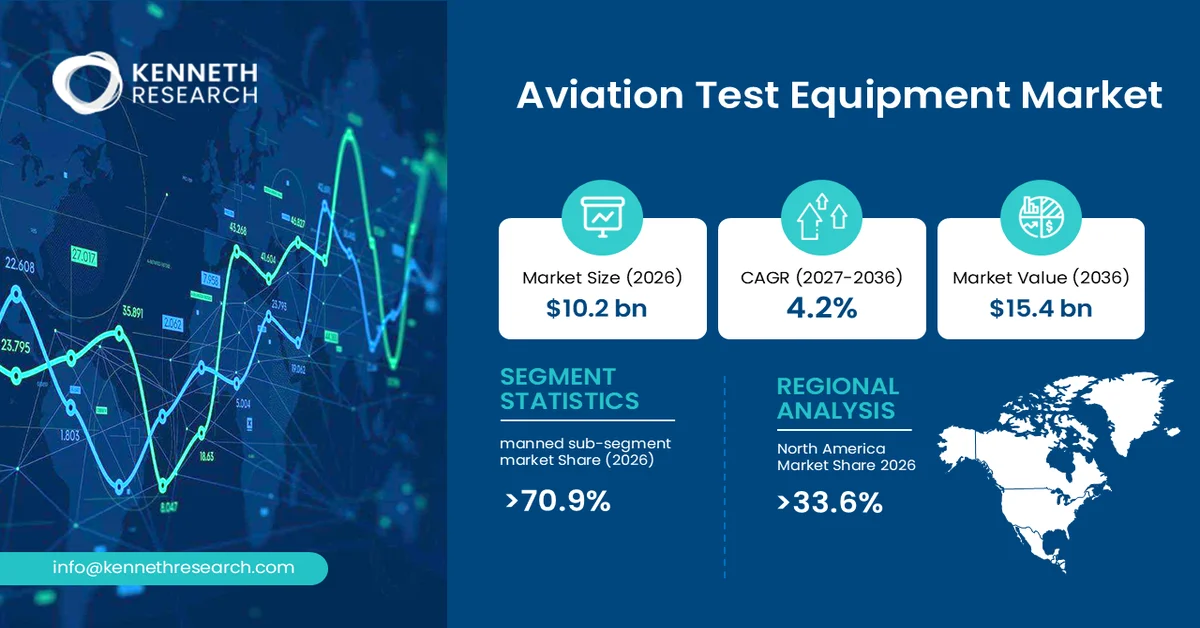
Aviation Test Equipment Market size was valued at USD 10.2 billion in 2026 and is projected to reach USD 15.4 billion by the end of 2036, rising at a CAGR of 4.2% during the forecast period, i.e., 2027–2036. In 2027, the industry size of the global aviation test equipment market is estimated at USD 10.6 billion.
The growing adoption of advanced aircraft technologies is driving demand for aviation test equipment because new propulsion, avionics, flight-control, and safety systems require rigorous validation before operational deployment. Government-led aviation research continues to emphasize flight and ground testing as essential mechanisms for demonstrating technology performance, supporting certification, and improving aviation safety.
The global aviation test equipment market comprises specialized hardware, software, instrumentation, and integrated testing systems used to evaluate, diagnose, validate, and certify aircraft, aircraft components, avionics, propulsion systems, electrical systems, communication equipment, navigation systems, and related aerospace technologies. These solutions support testing across development, manufacturing, maintenance, repair, overhaul, certification, and operational environments.
Key characteristics include measurement and diagnostic capabilities designed to assess system performance, identify malfunctions, verify compliance with technical requirements, and support airworthiness. Equipment can be deployed in laboratories, manufacturing facilities, maintenance environments, ground-test facilities, and during flight-testing activities. The Federal Aviation Administration identifies avionics maintenance as encompassing the installation and proper operation of aircraft electronic systems, while its aviation safety framework incorporates maintenance and service-difficulty information for monitoring aircraft malfunctions and defects.
Key Aviation Test Equipment Market Insights Summary:
Key Takeaways: Market Trends & Insights
- Global aviation test equipment market reached USD 10.2 billion in 2026 and is projected to reach USD 15.4 billion by 2036 at a 4.2% CAGR
- Manned aircraft represented the leading aircraft-type segment with a 70.9% market share in 2026, supported by extensive testing, maintenance, safety, and airworthiness requirements
- Defense/military is identified as the second key segment, driven by aircraft modernization, advanced avionics, mission-system upgrades, and specialized testing requirements
- North America led the market with a 33.6% share in 2026, supported by strong aerospace manufacturing, defense aviation, MRO infrastructure, and technology investment across the United States and Canada
- Asia Pacific represents an important future opportunity, with China and India supported by aviation infrastructure development, fleet modernization, connectivity expansion, and growing aerospace capabilities
Market Drivers
- Increasing aircraft safety, certification, and regulatory compliance requirements
- Advancement of electric and next-generation aircraft technologies
- Expansion of digital avionics, connected aircraft systems, and automated testing
- Growing requirements for predictive maintenance, component diagnostics, and lifecycle testing
Challenges
- High certification complexity and specialized testing requirements
- Cybersecurity and interoperability risks in connected test environments
Aviation Test Equipment Market Overview & Supply Chain
Adoption of aviation test equipment is increasing globally as aircraft platforms, propulsion architectures, avionics, and flight-control technologies become more sophisticated and require rigorous validation across development, certification, production, and maintenance. Testing is therefore integral to aviation safety, technological commercialization, and regulatory compliance. The International Civil Aviation Organization (ICAO) reported 4.528 billion passengers transported worldwide in 2024, demonstrating the extensive operational environment in which aircraft safety, reliability, and performance must be continuously maintained.
Technological development is further strengthening the requirement for advanced testing capabilities. NASA's aeronautics programs demonstrate the industry's movement toward electrified propulsion, sustainable aircraft configurations, autonomous systems, advanced flight controls, and other emerging technologies, all of which require progressively sophisticated ground and flight validation. NASA notes that flight testing helps demonstrate new technologies and provides evidence that supports certification, while preflight validation incorporates simulation, wind-tunnel testing, and ground testing.
Aviation Test Equipment Market: Growth Drivers & Challenges
Growth Drivers
- Rising aircraft safety, certification, and compliance requirements: The increasing emphasis on aircraft safety, airworthiness, and regulatory compliance is strengthening demand for aviation test equipment across aircraft development, production, maintenance, and certification activities. Testing provides manufacturers and operators with measurable evidence that aircraft systems perform within approved parameters, while regulators increasingly require systematic verification of designs and operating conditions.
- Advancement of electric and next-generation aircraft technologies: The transition toward electric, hybrid-electric, autonomous, connected, and other advanced aircraft technologies is expanding the technical scope of aviation testing. New propulsion architectures require validation of batteries, electric motors, power electronics, thermal-management systems, control software, and interactions between electrical and mechanical subsystems. NASA's development programs illustrate this shift: its Electrified Powertrain Flight Demonstration project involves industry collaboration to advance hybrid-electric aircraft technologies, while testing at NASA's Electric Aircraft Testbed has been used to evaluate battery-powered propulsion under simulated high-altitude conditions.
Challenges
- High certification complexity and specialized testing requirements: The increasing complexity of aircraft architectures is raising the technical and procedural burden associated with test-equipment development and deployment. Modern aircraft integrate software, airborne electronic hardware, avionics, communications, navigation, and interconnected systems that must be validated under stringent development-assurance frameworks. The root challenge is that test equipment must itself provide sufficiently reliable, traceable, and technically appropriate evidence for highly safety-critical systems.
- Cybersecurity and interoperability risks in connected test environments: The growing connectivity of aircraft systems introduces cybersecurity and interoperability challenges that extend beyond conventional functional testing. Aircraft increasingly exchange information with ground infrastructure and other connected systems, creating additional interfaces that must be evaluated for unauthorized access and potential safety consequences. Regulators therefore increasingly expect cybersecurity considerations to be incorporated into aircraft certification and system assurance.
Global Aviation Test Equipment Market Size and Forecast:
| Report Attribute | Details |
|---|---|
| Base Year |
2026 |
| Forecast Period |
2027-2036 |
| CAGR |
4.2% |
| Base Year Market Size (2026) |
USD 10.2 Billion |
| Forecast Year Market Size (2036) |
USD 15.4 Billion |
| Regional Scope |
|
Aviation Test Equipment Market Segmentation Analysis:
Aircraft Type Segment Analysis
In the aircraft type segment, manned sub-segment is anticipated to capture the largest market share of 70.9% by the end of 2026.
The manned aircraft segment dominates because commercial, general aviation, business aviation, and other crewed platforms continue to represent a broad installed base requiring recurring inspection, maintenance, calibration, avionics verification, and flight-test support. Demand is reinforced by stringent airworthiness requirements, which require aircraft systems and components to undergo systematic testing throughout development and operational life. The U.S. Federal Aviation Administration reported 214,222 active general aviation aircraft in 2023, providing a substantial installed base for testing, diagnostics, and maintenance activities.
End User Segment Analysis
The defense/military sector is projected to grow as the second-largest segment in the global aviation test equipment market due to four converging demand drivers.
The defense/military sector is projected to grow as governments prioritize modernization of tactical aircraft, advanced propulsion, avionics, unmanned systems, and mission-critical technologies. Demand for aviation test equipment rises alongside these programs because new and upgraded military aircraft require extensive development, verification, maintenance, and operational testing. Adoption is also being shaped by aging fleets, increasingly sophisticated aircraft architectures, and requirements to validate upgrades before deployment. The supply side is responding through advanced simulation, automated diagnostics, integrated test systems, and specialized instrumentation capable of evaluating complex avionics and mission systems. Testing requirements are particularly important where new technologies must transition rapidly from development into operational capability.
Our in-depth analysis of the global aviation test equipment market includes the following segments:
|
Segment |
Sub-segment |
|
System |
|
|
Aircraft Type |
|
|
End User |
|
Aviation Test Equipment Market Regional Insights:
North America Market Trends & Insights:
North America global aviation test equipment market is projected to hold the largest revenue share of 33.6% by the end of 2026.
Regional leadership is supported by an established aerospace manufacturing ecosystem, extensive commercial and defense aviation activity, sophisticated MRO infrastructure, and sustained investment in aircraft technologies.
The United States remains the principal regional hub because of its extensive aircraft manufacturing, defense procurement, avionics, propulsion, and MRO ecosystem, creating broad requirements for sophisticated testing and validation systems.
Canada strengthens the regional supply chain through its aerospace manufacturing and aviation-services base. Statistics Canada reported 89.8 million passengers carried by Canadian air carriers in 2023, reflecting substantial operational activity that supports ongoing inspection, maintenance, and testing requirements. Together, the two countries provide complementary demand and supply capabilities, supporting continued regional investment in advanced, automated, and software-enabled aviation test equipment.
Asia Pacific Market Trends & Insights:
Asia Pacific is positioned as a significant growth region for the global aviation test equipment market, supported by expanding air transport networks, aircraft fleet development, airport modernization, and government-led aviation infrastructure programs. China is strengthening its position as an international aviation hub through coordinated infrastructure planning, operational integration, and technology development, while India is expanding connectivity and aviation infrastructure through government-supported programs.
China represents a major opportunity because its aviation strategy combines infrastructure expansion with technological advancement and development of international aviation hubs. The policy direction supports greater demand for advanced testing across aircraft systems, airport operations, and aviation technology development.
India offers substantial opportunities through airport expansion, regional connectivity, fleet modernization, and increasing private-sector participation. The Ministry of Civil Aviation's UDAN program is supporting the development and operationalization of underserved aviation routes and airports, while planned infrastructure expansion should broaden requirements for inspection, maintenance, avionics, and testing capabilities. India's growing aircraft ecosystem also creates opportunities for localized test-equipment manufacturing and aviation engineering services.
Leading Companies Operating in the Global Aviation Test Equipment Market:
Here is a list of upstream, downstream, and key players operating in global aviation test equipment market competitive ecosystem:
- Sun Test Systems B.V. (Netherlands)
- Company Overview
- Business Strategy
- Key Product Offerings
- Financial Performance
- Key Performance Indicators
- Risk Analysis
- Recent Development
- Regional Presence
- SWOT Analysis
- Laversab Inc. (United States)
- Astronics Corporation (United States)
- Safran S.A. (France)
Recent Developments
- In March 2025, Sun Test Systems was awarded a $230 million, five-year production contract by the U.S. Army for the Aviation Ground Power Unit (AGPU) 1.1. The new system features a quieter diesel engine, a digital interface, and an integrated hydraulic fluid purification system, with fuel cost avoidance projected to exceed $1 billion over its service life.
- In December 2025, Safran introduced microMA, a wireless, modular, ultra-compact data acquisition system for flight testing. The battery-powered system enables rapid deployment in inaccessible areas and supports applications including flight test instrumentation, in-service troubleshooting, final assembly line testing, and predictive maintenance.
Frequently Asked Question
In 2026, the aviation test equipment market exceeded USD 10.2 billion.
The aviation test equipment market is projected to reach USD 15.4 billion by the end of 2036, expanding at a CAGR of 4.2% over the forecast period (2027-2036).
The major players in the market are sun test systems b.v., laversab inc., astronics corporation, safran s.a., and others.
In the aircraft type segment, the manned sub-segment is anticipated to capture the largest market share of 70.9% in the future and exhibit lucrative growth opportunities during 2027-2036. This growth trajectory is largely attributed to stringent airworthiness and safety requirements.
North america is projected to hold the largest market share of 33.6% by the end of 2036 and provide more business opportunities in the future. Continuous aerospace manufacturing, defense aviation, aircraft modernization, and MRO activities in the united states and canada are fostering the region's dominance.
Why Choose Kenneth Research ?
-
Insight with Impact : We don’t just gather data — we uncover stories, trends, and opportunities that fuel business growth.
-
Experts Who Get It : Our team speaks your industry’s language and knows what really matters to your customers and market.
-
Custom-Built for You : Forget one-size-fits-all. We craft research and consulting solutions as unique as your business vision.
-
Partners, Not Just Providers : We work with you, not for you — collaborating closely to turn insights into smart, strategic moves.
-
Results That Speak : Our work powers brands, startups, and industry leaders alike — with a track record of ideas that work in the real world.
Report ID: 1309 |
Published Date: 10 Sep 2026 |
Report Format: |
Delivery Timeline: 48-72 Business Hours

Copyright © 2025 Kenneth Research. All rights reserved. Terms of Use | Privacy Policy
