Report ID: 1183 |
Published Date: 26 Aug 2026 |
Report Format: |
Delivery Timeline: 48-72 Business Hours
Aviation and Defense Cyber Security Market Outlook:
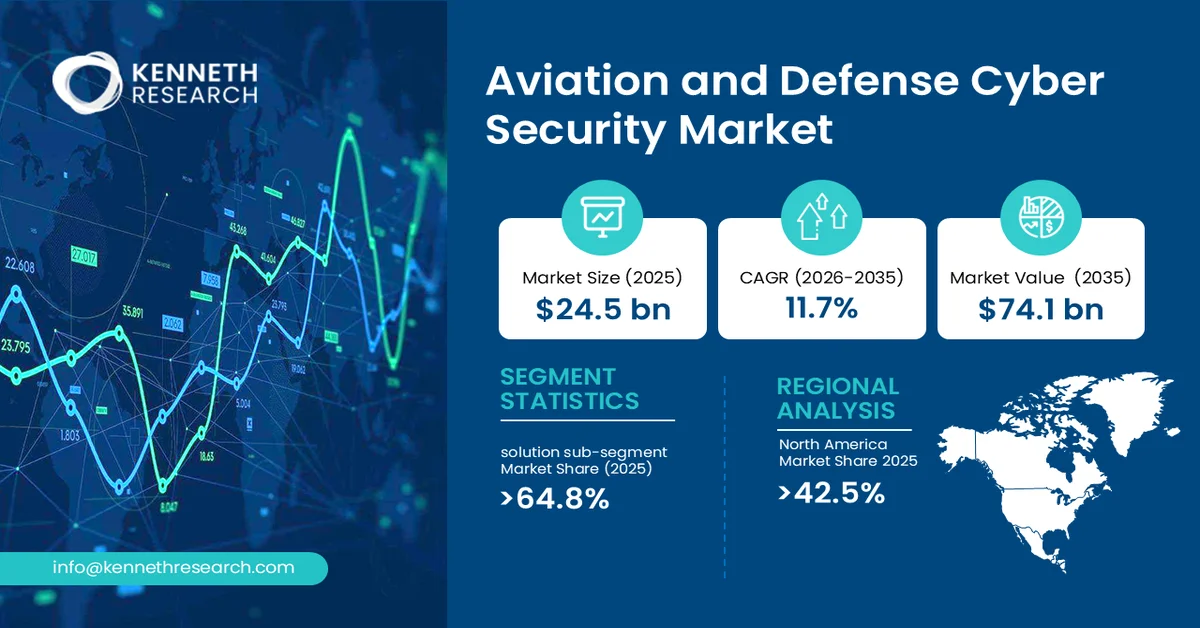
Aviation and Defense Cyber Security Market size was valued at USD 24.5 billion in 2025 and is projected to reach USD 74.1 billion by the end of 2035, rising at a CAGR of 11.7% during the forecast period, i.e., 2026-2035. In 2026, the industry size of the aviation and defense cyber security is estimated at USD 27.4 billion.
The primary growth driver for the aviation and defense cyber security market is the increasing digitalization and interconnectedness of aviation and defense infrastructure. Modern aircraft, air-traffic management systems, airports, military platforms, communications networks, and mission systems increasingly depend on interconnected software, sensors, cloud infrastructure, and data networks.
The aviation and defense cyber security market encompasses cybersecurity technologies, solutions, and services designed to protect aviation and defense platforms, infrastructure, networks, communications systems, data, and mission-critical applications from cyber threats. The market covers security across aircraft systems, airports, air-traffic management infrastructure, defense platforms, command-and-control systems, military communications, intelligence systems, and associated IT and operational technology environments.
Key capabilities include network security, endpoint protection, identity and access management, encryption, threat detection, vulnerability management, security monitoring, incident response, secure communications, and cyber-resilience.
Key Aviation and Defense Cyber Security Market Insights Summary:
Key Takeaways: Market Trends & Insights
- Aviation and Defense Cyber Security Market projected to grow from USD 24.5 billion in 2025 to USD 74.1 billion by 2035 at an 11.7% CAGR.
- Increasing digitalization and interconnectedness of aviation and defense infrastructure is driving demand for cybersecurity across aircraft, airports, military platforms, communications networks, and mission systems.
- The market is benefiting from growing cybersecurity requirements across interconnected, software-driven aviation and defense systems, particularly as reliance on cloud infrastructure, sensors, software, and digital networks increases.
Market Drivers
- Rising cybersecurity requirements across the defense industrial base
- Increasing digitalization of aviation infrastructure
- Growing adoption of connected aircraft and networked defense platforms
- Increasing focus on cyber resilience, threat intelligence, and secure supply chains
Challenges
- Complex and expanding attack surface
- Cybersecurity compliance across distributed supply chains
Aviation and Defense Cyber Security Market: Market Overview & Supply Chain
The aviation and defense cyber security market is expanding as aviation and defense systems become increasingly interconnected, software-driven, and dependent on digital infrastructure. Aircraft systems, airport networks, air-traffic management, military platforms, command-and-control systems, and defense-industry networks all require protection against cyber intrusion, disruption, data theft, and unauthorized access.
The defense sector is similarly strengthening cybersecurity requirements across its industrial ecosystem. In 2024, the U.S. Department of Defense released its Defense Industrial Base Cybersecurity Strategy, focused on strengthening the cybersecurity posture and resilience of defense contractors and critical industrial capabilities.
The value chain begins with cybersecurity software, secure communications technologies, network-security hardware, encryption systems, identity-management platforms, endpoint protection, threat-intelligence tools, and security-monitoring technologies. Cybersecurity providers develop these capabilities for integration into aircraft systems, airport infrastructure, military platforms, defense networks, and supporting IT environments.
Aviation and Defense Cyber Security Market: Growth Drivers & Challenges
Growth Drivers:
- Rising cybersecurity requirements across the defense industrial base: Increasing cyber threats against defense contractors, weapons-system suppliers, and supporting infrastructure are driving greater adoption of cybersecurity solutions. The U.S. Department of Defense's Defense Industrial Base Cybersecurity Strategy, released in 2024, established a framework focused on strengthening cybersecurity, improving cyber resilience, identifying vulnerabilities, enhancing threat information sharing, and improving recovery from malicious cyber activity across the defense industrial base.
- Increasing digitalization of aviation infrastructure: The aviation sector is becoming increasingly dependent on interconnected digital systems spanning aircraft, airports, air-navigation infrastructure, communications, and operational platforms. This growing digital dependency is increasing the importance of cybersecurity for maintaining safe and resilient aviation operations.
Challenges
- Complex and expanding attack surface: The increasing connectivity of aircraft, airports, defense platforms, communications networks, and supporting digital infrastructure is creating a broader cybersecurity attack surface. Aviation and defense organizations must protect a combination of information technology, operational technology, embedded systems, communications equipment, and mission-critical applications.
- Cybersecurity compliance across distributed supply chains: Aviation and defense organizations increasingly depend on extensive networks of contractors, subcontractors, technology suppliers, and service providers, making supply-chain cybersecurity a significant challenge. The U.S. Department of Defense's Cybersecurity Maturity Model Certification framework requires defense contractors to demonstrate that their networks and cybersecurity practices adequately protect sensitive government information.
Aviation and Defense Cyber Security Market Size and Forecast:
| Report Attribute | Details |
|---|---|
| Base Year |
2025 |
| Forecast Year |
2026-2035 |
| CAGR |
11.7% |
| Base Year Market Size (2025) |
USD 24.5 billion |
| Forecast Year Market Size (2035) |
USD 74.1 billion |
| Regional Scope |
|
Aviation and Defense Cyber Security Market Segmentation Analysis:
Component Segment Analysis
In the component segment, the solution sub-segment is anticipated to capture the largest market share of 64.8% in 2025.
Its dominance is supported by the increasing requirement for integrated cybersecurity capabilities across aircraft systems, airport infrastructure, military platforms, command-and-control networks, and defense industrial-base environments. Solutions such as network security, endpoint protection, identity management, encryption, threat detection, and security monitoring enable organizations to address multiple attack vectors across interconnected aviation and defense systems.
The U.S. Department of Defense's Defense Industrial Base Cybersecurity Stra tegy emphasizes strengthening the cybersecurity posture and resilience of defense-industry partners, including through improved governance, security capabilities, and collaboration.
On-premise Type Segment Analysis
The On-premise segment within the Deployment category is expected to maintain an important position in the aviation and defense cyber security market because mission-critical aviation and defense environments often require direct control over security infrastructure, data, access policies, and system configurations. Organizations operating sensitive networks may prefer on-premise cybersecurity deployments where security controls can be integrated directly into existing classified, restricted, or operational environments.
The U.S. Department of Defense continues to support cybersecurity across multi-cloud and on-premise network environments, including centralized security monitoring and cybersecurity controls across different classification levels.
Our in-depth analysis of the global aviation and defense cyber security market includes the following segments:
|
Segment |
Sub-segment |
|
Component |
|
|
Deployment |
|
|
By Application |
|
Aviation and Defense Cyber Security Market Regional Insights:
North America Market Trends & Insights:
North America is the dominant region in the aviation and defense cyber security market, accounting for 42.5% in 2025.
The region benefits from its large aerospace and defense ecosystem, extensive aviation infrastructure, advanced cybersecurity capabilities, and strong government emphasis on protecting critical defense and aviation systems.
The U.S. represents the principal regional market, supported by federal cybersecurity programs spanning both defense and aviation. The U.S. Department of Defense's 2024 Defense Industrial Base Cybersecurity Strategy focuses on strengthening the cybersecurity posture and cyber resilience of defense contractors and improving collaboration between the government and industry.
Canada contributes to regional growth through its aerospace and defense capabilities and increasing emphasis on protecting critical infrastructure and government networks. The country's close integration with the U.S. defense and aviation ecosystem further supports demand for cybersecurity solutions across aircraft systems, airports, defense networks, and supporting supply chains.
Europe Market Trends & Insights:
Asia Pacific represents a significant growth region for the aviation and defense cyber security market, supported by expanding aviation infrastructure, increasing digitalization of airports and aircraft systems, modernization of defense platforms, and stronger government attention to cybersecurity.
Japan is strengthening cybersecurity across its aviation ecosystem. Japan's Ministry of Land, Infrastructure, Transport and Tourism maintains dedicated information-security guidelines for both the aviation and airport sectors, with the guidelines designed to establish security measures and verification processes for critical infrastructure operators.
China offers substantial opportunities as its civil aviation system continues to expand and modernize. The Civil Aviation Administration of China maintains comprehensive aviation-security and operational oversight frameworks, while the country's revised Civil Aviation Law, effective July 2026, further updates the regulatory framework governing civil aviation safety and development.
Leading Companies Operating in the Global Aviation and Defense Cyber Security Market:
Here is a list of upstream, downstream, and key players operating in the global aviation and defense cyber security market competitive ecosystem:
- Airbus(Netherlands)
- Company Overview
- Business Strategy
- Key Product Offerings
- Financial Performance
- Key Performance Indicators
- Risk Analysis
- Recent Development
- Regional Presence
- SWOT Analysis
- Thales(France)
- Lockheed Martin(United States)
Recent Developments
- April 2026 – Airbus entered into an agreement to acquire Quarkslab, a French cybersecurity company, to strengthen its sovereign cybersecurity capabilities.
- July 2026 –Lockheed Martin expanded its focus on cybersecurity compliance and risk assessment for suppliers, highlighting cybersecurity as a critical requirement across the defense supply chain.
Frequently Asked Question
In 2025, the aviation and defense cyber security market exceeded USD 24.5 billion.
The aviation and defense cyber security market is projected to reach USD 74.1 billion by the end of 2035, expanding at a CAGR of 11.7% over the forecast period (2026-2035).
The major players in the market are Thales, Lockheed Martin, BAE Systems, Airbus, Northrop Grumman, and others.
In the component segment, the Solution sub-segment is anticipated to capture the largest market share of 64.8% in the future and exhibit lucrative growth opportunities during 2026-2035.
North America is projected to hold the largest market share of 42.5% by the end of 2025 and provide more business opportunities in the future.
Why Choose Kenneth Research ?
-
Insight with Impact : We don’t just gather data — we uncover stories, trends, and opportunities that fuel business growth.
-
Experts Who Get It : Our team speaks your industry’s language and knows what really matters to your customers and market.
-
Custom-Built for You : Forget one-size-fits-all. We craft research and consulting solutions as unique as your business vision.
-
Partners, Not Just Providers : We work with you, not for you — collaborating closely to turn insights into smart, strategic moves.
-
Results That Speak : Our work powers brands, startups, and industry leaders alike — with a track record of ideas that work in the real world.
Report ID: 1183 |
Published Date: 26 Aug 2026 |
Report Format: |
Delivery Timeline: 48-72 Business Hours

Copyright © 2025 Kenneth Research. All rights reserved. Terms of Use | Privacy Policy
