Report ID: 1348 |
Published Date: 10 Sep 2026 |
Report Format: |
Delivery Timeline: 48-72 Business Hours
Automotive Hub Bearing Market Outlook:
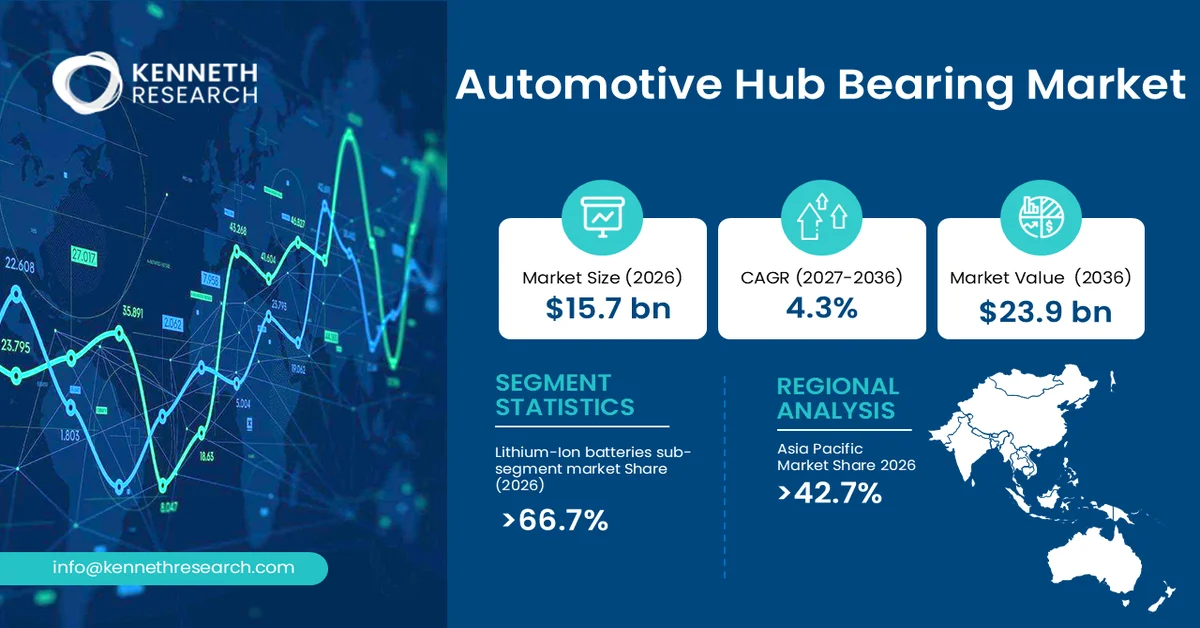
Automotive Hub Bearing Market size was valued at USD 15.7 billion in 2026 and is projected to reach USD 23.9 billion by the end of 2036, rising at a CAGR of 4.3% during the forecast period, i.e., 2027–2036. In 2027, the industry size of the global automotive hub bearing is estimated at USD 16.4 Billion.
The primary growth driver for the global automotive hub bearing market is the increasing integration of advanced wheel-end systems in modern vehicles to improve safety, durability, handling, and overall vehicle efficiency.
The global automotive hub bearing market refers to the industry supplying integrated bearing assemblies used at a vehicle’s wheel hub to enable smooth wheel rotation while supporting radial and axial loads generated during driving, braking, cornering, and acceleration. These assemblies typically integrate bearings with wheel hubs and may incorporate additional features such as wheel-speed sensors, mounting flanges, and sealing systems.
They are widely used in passenger cars, light commercial vehicles, heavy commercial vehicles, and other road vehicles. The market encompasses hub bearing products supplied through original equipment manufacturers (OEMs) as well as the replacement and aftermarket channels. Increasing requirements for vehicle safety, improved ride and handling, reduced frictional losses, and compact wheel-end architectures are encouraging manufacturers to develop increasingly integrated and application-specific hub bearing solutions.
Key Automotive Hub Bearing Market Insights Summary:
Key Takeaways: Market Trends & Insights
- The Global Automotive Hub Bearing Market is projected to grow from USD 15.7 billion in 2026 to USD 23.9 billion by 2036, expanding at a 4.3% CAGR during 2027–2036.
- Asia-Pacific is expected to remain the dominant regional market, accounting for 42.7% in 2026, supported by its strong automotive manufacturing ecosystem and established bearing-production capabilities across Japan and China.
- OEM sales channel is the leading segment, accounting for 67.9% in 2026, as vehicle manufacturers increasingly source application-specific hub bearing assemblies for new vehicle platforms.
- Steel remains an important material for automotive hub bearings because of its high strength, fatigue resistance, dimensional stability, and suitability for precision manufacturing and heat treatment.
Market Drivers
- Rising global vehicle production and OEM assembly volumes
- Increasing adoption of integrated wheel-end systems
- Growing emphasis on vehicle safety and wheel-speed sensing
- Demand for durable, low-friction, and maintenance-efficient bearing assemblies
Challenges
- High Manufacturing Precision and Quality Requirements
- Cost Pressure and Raw Material Price Volatility
Automotive Hub Bearing Market Overview & Supply Chain
The global automotive hub bearing market is supported by continued vehicle production and expanding road-transport activity, which sustain demand for durable and reliable wheel-end components. Increasing vehicle safety requirements, higher expectations for wheel-end durability, and the integration of sensing capabilities into hub-bearing assemblies are also reinforcing adoption across modern vehicle platforms. OEM demand remains particularly important as automakers increasingly specify application-specific hub bearing assemblies to meet vehicle performance, efficiency, and safety requirements.
The supply chain begins with steel and other engineered materials used to manufacture bearing rings, rolling elements, hubs, seals, and related components. Material suppliers provide inputs to bearing manufacturers, which undertake forging, machining, heat treatment, grinding, assembly, sealing, and quality testing. Manufacturers then supply finished hub bearing assemblies primarily to vehicle OEMs and, through separate channels, to aftermarket distributors and service networks.
Automotive Hub Bearing Market: Growth Drivers & Challenges
Growth Drivers
- Rising global vehicle production: The expansion of global vehicle manufacturing is supporting demand for automotive hub bearings because every new vehicle requires reliable wheel-end assemblies for safe and efficient operation. Higher production volumes create recurring OEM requirements for hub bearing assemblies, while increasing model diversity encourages manufacturers to supply application-specific designs for different vehicle platforms. The trend is particularly relevant across Asia-Pacific, where large automotive manufacturing bases provide a strong customer pool for bearing producers.
- Increasing demand for integrated wheel-end systems: Automakers are increasingly adopting integrated hub bearing assemblies that combine multiple wheel-end functions into compact units. These assemblies can incorporate wheel hubs, bearings, seals, mounting interfaces, and sensing capabilities, helping reduce assembly complexity while supporting vehicle safety and performance requirements. The shift toward electronically controlled braking, stability systems, and advanced vehicle architectures is increasing the importance of accurate wheel-speed information, encouraging the integration of sensing technologies within wheel-end components.
Challenges
- High manufacturing precision and quality requirements: Automotive hub bearings operate under continuous mechanical loads and demanding wheel-end conditions, requiring precise dimensional tolerances, controlled surface finishes, effective sealing, and consistent material properties. Manufacturing defects or inadequate quality control can lead to premature wear, noise, vibration, or bearing failure, creating significant safety and warranty concerns for vehicle manufacturers. Suppliers therefore need sophisticated machining, heat-treatment, grinding, assembly, and inspection capabilities to maintain consistent product quality.
- Cost pressure and raw material price volatility: Automotive hub bearing manufacturers face persistent cost pressures because steel and other engineered materials represent important inputs in bearing and hub assembly production. Fluctuations in material costs can affect manufacturing economics, while OEM purchasing practices often place strong emphasis on competitive pricing and long-term cost optimization. Suppliers must balance material quality, manufacturing precision, durability, and pricing without compromising product performance.
Global Automotive Hub Bearing Market Size and Forecast:
| Report Attribute | Details |
|---|---|
| Base Year |
2026 |
| Forecast Period |
2027-2036 |
| CAGR |
4.3% |
| Base Year Market Size (2026) |
USD 15.7 billion |
| Forecast Year Market Size (2036) |
USD 23.9 billion |
| Regional Scope |
|
Automotive Hub Bearing Market Segmentation Analysis:
Sales Channel Segment Analysis
In the sales channel segment, the OEM sub-segment is anticipated to capture the largest market share of 67.9% in 2026.
The OEM sales channel is expected to maintain its leading position in the global automotive hub bearing market because hub bearing assemblies are critical wheel-end components installed during vehicle manufacturing. OEM procurement enables bearing manufacturers to secure high-volume, platform-specific contracts and develop products according to automaker requirements for durability, dimensional accuracy, noise control, sealing, and wheel-speed sensing. The continued expansion of global vehicle manufacturing provides a direct foundation for OEM demand. According to OICA, global vehicle production increased from 92.7 million units in 2024 to 96.4 million units in 2025, reflecting continued growth in the vehicle manufacturing base.
Material Type Segment Analysis
The Steel segment is projected to remain a significant material choice in the global automotive hub bearing market because steel provides the strength, hardness, fatigue resistance, and dimensional stability required for wheel-end applications. Hub bearing assemblies operate under continuous radial and axial loads, making material durability essential for maintaining reliable wheel rotation and supporting vehicle safety. Steel is widely suited to bearing rings, rolling elements, and hub structures because it can undergo heat treatment and precision machining to achieve the mechanical properties required for demanding automotive applications. Demand for steel-based hub bearings is further supported by the established manufacturing ecosystem surrounding automotive bearings.
Our in-depth analysis of the global automotive hub bearing market includes the following segments:
|
Segment |
Sub-segment |
|
Sales Channel |
|
|
Material |
|
|
Bearing Type |
|
|
Vehicle Type |
|
|
Application |
|
Automotive Hub Bearing Market Regional Insights:
Asia-Pacific Market Trends & Insights:
Asia-Pacific is projected to remain the dominant regional market for automotive hub bearings, accounting for 42.7% of the market in 2026.
The region benefits from its extensive automotive manufacturing base, established bearing-production ecosystem, and strong presence of major vehicle manufacturers and component suppliers. High vehicle production volumes create substantial OEM demand for wheel-end assemblies, while the continued development of passenger and commercial vehicle platforms supports recurring requirements for durable, precision-engineered hub bearings. The region also provides a mature industrial environment for forging, machining, heat treatment, bearing assembly, and automotive component integration.
Japan represents a highly developed automotive and precision-engineering market within Asia-Pacific. Its established vehicle manufacturing industry, sophisticated component supply chain, and strong emphasis on manufacturing quality support demand for technologically advanced hub bearing assemblies.
China is the region's largest automotive manufacturing market and provides significant demand potential for hub bearings across passenger and commercial vehicles. Its large-scale vehicle production, extensive supplier network, and continued development of new vehicle platforms create substantial opportunities for OEM-oriented hub bearing manufacturers.
North America Market Trends & Insights:
North America represents an important secondary region for the global automotive hub bearing market, supported by a mature automotive manufacturing ecosystem, substantial vehicle parc, established aftermarket infrastructure, and continued investment in vehicle technologies. Demand for hub bearings is generated through both OEM vehicle assembly and replacement requirements, while stringent expectations for wheel-end reliability and vehicle safety support the use of high-quality bearing assemblies. The region also benefits from an established network of automotive component manufacturers, distributors, repair facilities, and technology suppliers. According to the International Organization of Motor Vehicle Manufacturers (OICA), the Americas produced 18.74 million vehicles in 2025, demonstrating the scale of the regional automotive manufacturing base.
U.S. is the principal automotive market within North America and provides significant opportunities for hub bearing manufacturers through its large vehicle manufacturing and aftermarket ecosystem.
Canada complements the regional market through its integrated automotive manufacturing sector and close connection with the broader North American vehicle supply chain. The country's proximity to major U.S. automotive production centers facilitates cross-border component sourcing and supports demand for precision wheel-end components.
Leading Companies Operating in the Global Automotive Hub Bearing Market:
Here is a list of upstream, downstream, and key players operating in the global automotive hub bearing market competitive ecosystem:
- SKF (Sweden)
- Company Overview
- Business Strategy
- Key Product Offerings
- Financial Performance
- Key Performance Indicators
- Risk Analysis
- Recent Development
- Regional Presence
- SWOT Analysis
- NTN Corporation (Japan)
- Schaeffler (Germany)
Recent Developments
- May 2026 — NTN announced the development of new hub bearings designed to improve battery-electric vehicle efficiency. The company stated that the new bearings reduce rotational friction through a newly developed seal and are intended to support longer EV driving range.
- January 2025 —SKF highlighted its new Hub Bearing Unit for EVs as an example of technology designed to improve customer value through reduced component weight and improved mileage per battery charge.
Frequently Asked Question
In 2026, the global automotive hub bearing market exceeded USD 15.7 billion.
The global automotive hub bearing market is projected to reach USD 23.9 billion by the end of 2036, expanding at a CAGR of 4.3% over the forecast period (2027-2036).
The major players in the market are SKF, NTN Corporation, Schaeffler, JTEKT, and NSK and others.
In the sales channel segment, the OEM sub-segment is anticipated to capture the largest market share of 67.9% in the future and exhibit lucrative growth opportunities during 2027-2036.
Asia-Pacific is projected to hold the largest market share of 42.7% by the end of 2036 and provide more business opportunities in the future.
Why Choose Kenneth Research ?
-
Insight with Impact : We don’t just gather data — we uncover stories, trends, and opportunities that fuel business growth.
-
Experts Who Get It : Our team speaks your industry’s language and knows what really matters to your customers and market.
-
Custom-Built for You : Forget one-size-fits-all. We craft research and consulting solutions as unique as your business vision.
-
Partners, Not Just Providers : We work with you, not for you — collaborating closely to turn insights into smart, strategic moves.
-
Results That Speak : Our work powers brands, startups, and industry leaders alike — with a track record of ideas that work in the real world.
Report ID: 1348 |
Published Date: 10 Sep 2026 |
Report Format: |
Delivery Timeline: 48-72 Business Hours

Copyright © 2025 Kenneth Research. All rights reserved. Terms of Use | Privacy Policy
