Report ID: 1416 |
Published Date: 29 Sep 2026 |
Report Format: |
Delivery Timeline: 48-72 Business Hours
Automotive Energy Recovery Systems Market Outlook:
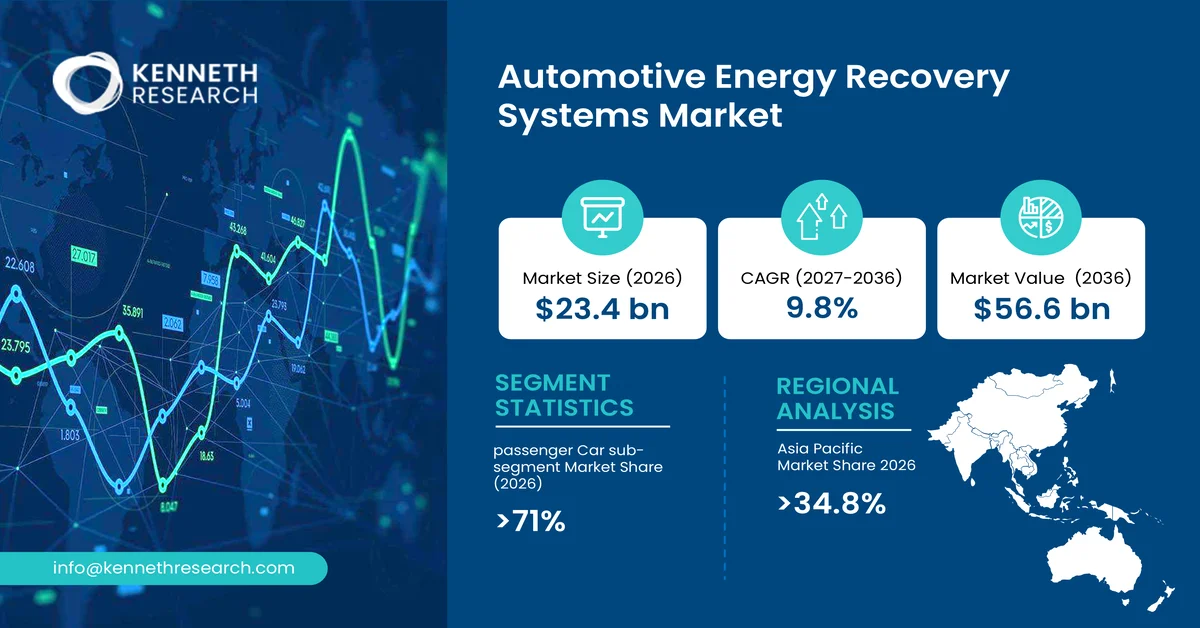
Automotive Energy Recovery Systems Market size was valued at USD 23.4 billion in 2026 and is projected to reach USD 59.6 billion by the end of 2036, rising at a CAGR of 9.8% during the forecast period, i.e., 2027–2036. In 2027, the industry size of the automotive energy recovery systems market is estimated at USD 25.7 billion.
The primary growth driver for the automotive energy recovery systems market is the increasing emphasis on vehicle fuel efficiency, energy optimization, and electrification across the automotive industry.
The automotive energy recovery systems market comprises technologies that capture energy otherwise lost during vehicle operation and convert or reuse it to improve overall vehicle efficiency. These systems include regenerative braking, exhaust energy recovery, turbocharger-related recovery, thermal energy recovery, and associated control technologies used across passenger cars and other vehicle categories.
Key Automotive Energy Recovery Systems Market Insights Summary:
Key Takeaways: Market Trends & Insights
- The automotive energy recovery systems market is projected to grow from USD 23.4 billion in 2026 to USD 59.6 billion by 2036, at a 9.8% CAGR.
- Rising vehicle electrification and the adoption of regenerative braking are strengthening demand for automotive energy recovery technologies.
- Passenger Cars dominate the Vehicle Type segment, accounting for 71% in 2026, supported by broad integration of energy-efficiency technologies across passenger-vehicle platforms.
- Asia-Pacific leads the market with a 34.8% share in 2026, supported by strong automotive manufacturing and electrification activity in China and Japan.
Market Drivers
- Rising vehicle electrification and regenerative braking adoption
- Increasing focus on vehicle efficiency and energy optimization
- Growing adoption of hybrid powertrains and advanced energy-management technologies
- Increasing regulatory emphasis on vehicle fuel efficiency and emissions reduction
Challenges
- High System Integration and Development Costs
- Technical and Performance Limitations Under Variable Driving Conditions
Automotive Energy Recovery Systems Market – Market Overview & Supply Chain
The automotive energy recovery systems market is developing alongside the automotive industry's shift toward electrification, hybridization, and higher vehicle efficiency. Energy recovery technologies capture kinetic, thermal, or exhaust energy that would otherwise be dissipated and convert it into useful electrical or mechanical energy. Regenerative braking is particularly important in electrified powertrains because recovered braking energy can be stored and reused to support vehicle propulsion and auxiliary loads.
The supply chain begins with manufacturers of motors, generators, power electronics, sensors, thermal-management equipment, braking components, control units, and energy-storage interfaces. System manufacturers and automotive Tier-1 suppliers integrate these components into complete energy recovery systems and develop control architectures compatible with specific vehicle platforms. Automakers subsequently incorporate these systems into passenger cars and commercial vehicles during vehicle development and production.
Automotive Energy Recovery Systems Market – Growth Drivers & Challenges
Growth Drivers
- Rising Vehicle Electrification and Regenerative Braking Adoption: The increasing electrification of passenger vehicles is strengthening demand for automotive energy recovery systems, particularly regenerative braking technologies. These systems recover kinetic energy during deceleration and convert it into electrical energy that can be stored or reused, improving powertrain efficiency. As automakers expand hybrid and battery-electric vehicle portfolios, energy recovery is becoming an increasingly integrated part of vehicle energy-management architecture rather than a standalone efficiency feature. The shift is also encouraging suppliers to develop more compact motors, power electronics, control units, and energy-storage interfaces that can operate efficiently within electrified platforms.
- Increasing Focus on Vehicle Efficiency and Energy Optimization: Automakers are increasingly prioritizing energy efficiency as they seek to reduce fuel consumption, operating costs, and vehicle emissions while maintaining performance. This is encouraging the integration of technologies that recover energy from braking, exhaust gases, thermal losses, and other processes that would otherwise be dissipated. Energy recovery systems can complement improvements in engines, transmissions, hybrid powertrains, and electronic controls, allowing manufacturers to improve the efficiency of complete vehicle architectures rather than relying on a single technology.
Challenges
- High System Integration and Development Costs: Automotive energy recovery systems often require integration with braking systems, power electronics, batteries, engines, transmissions, thermal-management systems, and electronic control architectures. This complexity increases engineering and validation requirements for automakers and Tier-1 suppliers. Each vehicle platform can require customized calibration and control strategies, increasing development time and testing costs. The challenge is particularly significant when manufacturers attempt to integrate recovery technologies into existing vehicle architectures rather than developing them as part of a new platform.
- Technical and Performance Limitations Under Variable Driving Conditions: Energy recovery performance varies according to vehicle speed, braking intensity, road conditions, battery state of charge, temperature, traffic patterns, and overall vehicle operating conditions. A recovery system cannot always capture the maximum theoretically available energy, particularly when the battery or energy-storage system has limited capacity to accept additional energy. Thermal constraints and component durability can also affect sustained operation under demanding driving conditions.
Automotive Energy Recovery Systems Market Size and Forecast:
| Report Attribute | Details |
|---|---|
| Base Year |
2026 |
| Forecast Year |
2027-2036 |
| CAGR |
9.8% |
| Base Year Market Size (2026) |
USD 23.4 billion |
| Forecast Year Market Size (2036) |
USD 59.6 billion |
| Regional Scope |
|
Automotive Energy Recovery Systems Market – Segment Analysis
Vehicle Type Segment Analysis
In the Vehicle Type segment, the passenger Car sub-segment dominates with a share of 71% in 2026, primarily because passenger vehicles represent the largest application base for energy-efficiency and electrification technologies. Automakers are increasingly integrating regenerative braking, thermal recovery, and other energy-management technologies into passenger-car platforms to improve efficiency and meet evolving emissions requirements. Consumer demand for fuel-efficient and electrified vehicles is further encouraging manufacturers to incorporate energy recovery into new vehicle architectures. On the supply side, Tier-1 suppliers are developing compact recovery components, power electronics, control units, and integrated energy-management systems tailored to high-volume passenger-car platforms. Government-supported electrification is also strengthening demand.
Product Type Segment Analysis
In the Product Type segment, the component sub-segment is projected to experience strong growth as automakers increasingly require individual energy-recovery components for integration into complex vehicle powertrain and energy-management architectures. Motors, generators, power electronics, control units, sensors, and related components form the technological foundation of regenerative and other energy-recovery systems. Demand is being reinforced by the expansion of hybrid and electric vehicle platforms, where efficient component-level energy management is essential for maximizing recovered energy.
Our in-depth analysis of the global automotive energy recovery systems market includes the following segments:
|
Segment |
Sub-segment |
|
Product Type |
|
|
Vehicle Type |
|
Automotive Energy Recovery Systems Market – Regional Analysis
Asia-Pacific Market Trends & Insights
Asia-Pacific dominated the automotive energy recovery systems market, accounting for 34.8% in 2026. The region benefits from a large automotive manufacturing base, expanding electrified-vehicle production, strong domestic vehicle demand, and substantial investment in advanced powertrain technologies.
China represents a major regional opportunity because of its extensive passenger-vehicle manufacturing base and rapid expansion of new-energy vehicles. The country’s large-scale EV ecosystem supports demand for regenerative braking, power electronics, energy-management systems, and other recovery technologies.
Japan remains an important technology and manufacturing hub, with established automakers and suppliers investing in hybrid, battery-electric, and high-efficiency vehicle platforms.
North America Market Trends & Insights
North America represents an important market for the automotive energy recovery systems market, supported by demand for fuel-efficient vehicles, increasing electrification, advanced automotive manufacturing capabilities, and continued development of energy-efficient powertrain technologies.
U.S. remains the leading market in North America because of its large passenger-vehicle industry, established automotive technology ecosystem, and increasing investment in electrified powertrains.
Canada offers additional opportunities through its automotive manufacturing base and growing focus on clean transportation and vehicle electrification. The country's integration with the broader North American automotive supply chain supports the adoption of advanced components and energy-recovery technologies.
Automotive Energy Recovery Systems Market – Competitive Landscape
Here is a list of upstream, downstream, and key players operating in the global automotive energy recovery systems market competitive ecosystem:
- ZF (Germany)
- Company Overview
- Business Strategy
- Key Product Offerings
- Financial Performance
- Key Performance Indicators
- Risk Analysis
- Recent Development
- Regional Presence
- SWOT Analysis
- BOSCH (Germany)
- Denso Corporation (Japan)
- ADVICS (Japan)
- Valeo (France)
- BorgWarner (U.S)
Recent Developments
- July 2025: ZF highlighted its Brake-by-Wire systems as a foundational technology for modern vehicle architectures, particularly for software-defined, electrified, and autonomous vehicles.
- May 2025 – AISIN showcased its Future Brake System, developed by ADVICS, at the Automotive Engineering Exposition 2025. The system was presented as an electrification technology designed to improve energy consumption and ride comfort in electric vehicles.
Frequently Asked Question
In 2026, the automotive energy recovery systems market exceeded USD 23.4 billion.
The automotive energy recovery systems market is projected to reach USD 59.6 billion by the end of 2036, expanding at a CAGR of 9.8% over the forecast period (2027-2036).
The major players in the market are Bosch, ZF, Continental, AISIN, ADVICS, and others.
In the vehicle type segment, the passenger car sub-segment is anticipated to capture the largest market share of 71% in the future and exhibit lucrative growth opportunities during 2027-2036.
Asia-Pacific is projected to hold the largest market share of 34.8% by the end of 2036 and provide more business opportunities in the future.
Why Choose Kenneth Research ?
-
Insight with Impact : We don’t just gather data — we uncover stories, trends, and opportunities that fuel business growth.
-
Experts Who Get It : Our team speaks your industry’s language and knows what really matters to your customers and market.
-
Custom-Built for You : Forget one-size-fits-all. We craft research and consulting solutions as unique as your business vision.
-
Partners, Not Just Providers : We work with you, not for you — collaborating closely to turn insights into smart, strategic moves.
-
Results That Speak : Our work powers brands, startups, and industry leaders alike — with a track record of ideas that work in the real world.
Report ID: 1416 |
Published Date: 29 Sep 2026 |
Report Format: |
Delivery Timeline: 48-72 Business Hours

Copyright © 2025 Kenneth Research. All rights reserved. Terms of Use | Privacy Policy
