Report ID: 1377 |
Published Date: 15 Sep 2026 |
Report Format: |
Delivery Timeline: 48-72 Business Hours
Automotive E-Compressor Market Outlook:
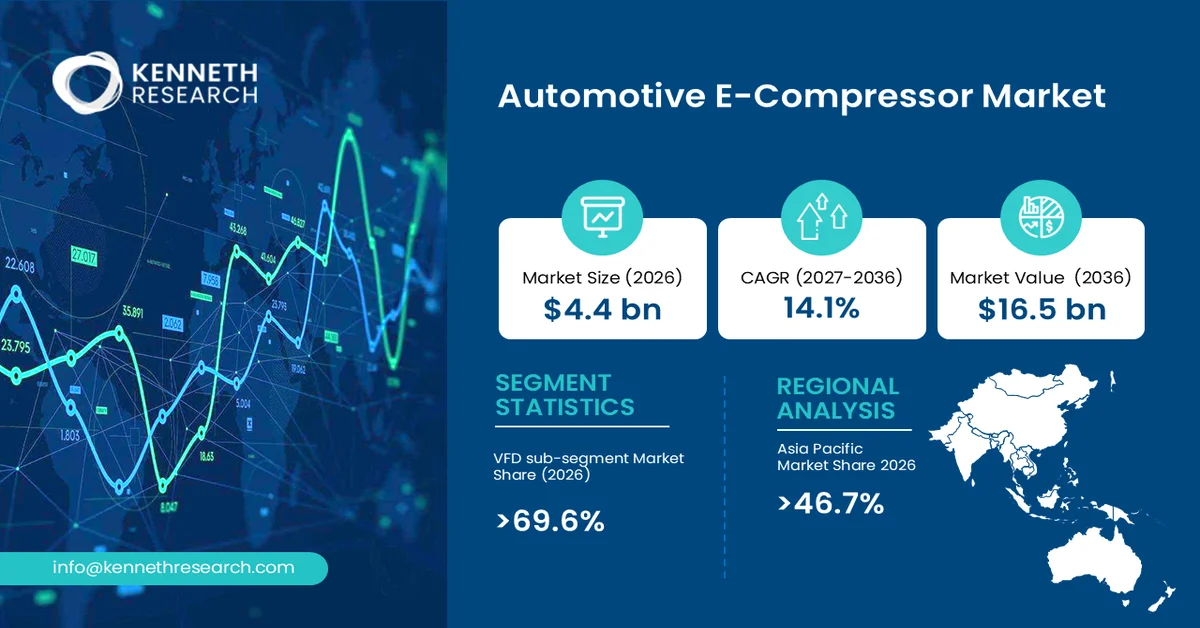
Automotive E-Compressor Market size was valued at USD 4.4 billion in 2026 and is projected to reach USD 16.5 billion by the end of 2036, rising at a CAGR of 14.1% during the forecast period, i.e., 2027–2036. In 2027, the industry size of the automotive e-compressor market is estimated at USD 5 billion.
The primary growth driver is accelerating vehicle electrification, which increases demand for electrically powered thermal-management components that can operate independently of conventional engine systems. The International Energy Agency reported that global electric car sales exceeded 10 million in 2022, reinforcing the expanding addressable vehicle base for e-compressor applications.
An automotive e-compressor is an electrically driven compressor used primarily within a vehicle’s heating, ventilation, and air-conditioning (HVAC) and thermal-management systems. Unlike conventional belt-driven compressors, an e-compressor is powered by an electric motor, enabling compressor operation independently of the vehicle’s internal-combustion engine. This architecture makes the technology particularly relevant to battery-electric, hybrid, and other electrified vehicle platforms.
Key characteristics include compact construction, electronically controlled operation, variable-speed capability, and compatibility with integrated vehicle thermal-management architectures. E-compressors can support cabin climate control while also contributing to temperature regulation for batteries, power electronics, and other heat-sensitive vehicle systems. Their operating flexibility allows thermal-management functions to remain available when the propulsion system is inactive.
Key Automotive E-Compressor Market Insights Summary:
Key Takeaways: Market Trends & Insights
- Automotive e-compressor market value is projected to increase from USD 4.4 billion in 2026 to USD 16.5 billion by 2036
- The automotive e-compressor market is projected to expand at a CAGR of 14.1% from 2027 to 2036
- VFD leads the Technology Type segment with a 69.6% market share in 2026
- Asia Pacific dominates the automotive e-compressor market with a 46.7% market share in 2026
- Passenger Cars represent the fastest-growing analysis segment within the Vehicle Type category
Market Drivers
- Accelerating vehicle electrification
- Increasing integration of vehicle thermal management
- Rising adoption of heat-pump-based climate-control systems
- Advancement of electronically controlled, variable-speed compressor technology
Challenges
- High System Integration and Validation Complexity
- Refrigerant Transition and Component Compatibility
Automotive E-Compressor Market Overview & Supply Chain
Global adoption of the automotive e-compressor market is increasing alongside the shift toward vehicle electrification and integrated thermal management. Electrified vehicles require electrically driven HVAC and thermal-management systems that can operate independently of an internal-combustion engine. The technology is therefore relevant to battery-electric and hybrid vehicle architectures, where cabin conditioning and thermal regulation must be coordinated with battery, power-electronics, and drivetrain requirements.
The automotive e-compressor market value chain begins with sourcing inputs such as aluminum and steel for housings and structural components, copper for motor windings, electronic components for control systems, refrigerant-compatible materials, bearings, seals, and specialized insulation. Component suppliers process these inputs into motors, inverters, compressor mechanisms, sensors, and electronic control assemblies. E-compressor manufacturers then integrate these components, perform precision machining, winding, assembly, software calibration, leak testing, and performance validation. Distribution typically occurs through direct supply relationships with vehicle manufacturers and automotive Tier-1 suppliers, supported by regional logistics and aftermarket channels. End users include passenger vehicles, commercial vehicles, hybrid vehicles, and battery-electric vehicles.
Automotive E-Compressor Market - Growth Drivers & Challenges
Growth Drivers
- Accelerating Vehicle Electrification: The expansion of electric and hybrid vehicle production is strengthening demand for electrically driven compressors because these vehicles require thermal-management systems that function independently of conventional engine-driven accessories. E-compressors can support cabin conditioning while also integrating with broader thermal architectures for batteries, power electronics, and electric motors.
- Increasing Integration of Vehicle Thermal Management: Growing emphasis on whole-vehicle thermal management is creating another structural growth opportunity for e-compressors. Modern electrified vehicles must coordinate cabin comfort with the thermal requirements of batteries, electric motors, power electronics, and other heat-sensitive systems. This encourages automakers and Tier-1 suppliers to move beyond conventional air-conditioning architectures toward integrated systems in which compressors, chillers, heat exchangers, valves, sensors, and electronic controls operate as a coordinated thermal network.
Challenges
- High System Integration and Validation Complexity: The shift from conventional air-conditioning toward integrated electric-vehicle thermal management increases engineering complexity for e-compressor suppliers. An e-compressor must operate as part of a coordinated system involving batteries, power electronics, cabin conditioning, sensors, valves, and electronic controls, creating demanding requirements for calibration and validation across multiple operating modes. This raises development costs, extends qualification cycles, and increases the engineering resources required from compressor manufacturers and automotive Tier-1 suppliers.
- Refrigerant Transition and Component Compatibility: The transition toward lower-impact refrigerants creates technical and commercial pressure across the e-compressor supply chain. Different refrigerants exhibit distinct pressure, temperature, lubrication, sealing, and material-compatibility characteristics, requiring compressor designs to be validated for specific operating conditions. CO₂-based systems can be particularly demanding because their higher operating pressures require robust compressor construction and specialized supporting components.
Automotive E-Compressor Market Size and Forecast:
| Report Attribute | Details |
|---|---|
| Base Year |
2026 |
| Forecast Year |
2027-2036 |
| CAGR |
14.1% |
| Base Year Market Size (2026) |
USD 4.4 Billion |
| Forecast Year Market Size (2036) |
USD 16.5 Billion |
| Regional Scope |
|
Automotive E-Compressor Market - Segment Analysis
Technology Type Segment Analysis
In the technology type segment, VFD sub-segment is anticipated to capture the largest market share of 69.6% by the end of 2026.
The VFD segment dominates the technology-type category because variable-frequency control enables e-compressors to adjust motor speed according to real-time thermal demand, improving energy management, cabin comfort, and compressor responsiveness. This capability is particularly valuable in electrified vehicles, where auxiliary energy consumption directly affects overall vehicle efficiency. The International Energy Agency reported that electric car sales reached 21 million units in 2025, reinforcing the expanding deployment base for electrically controlled thermal-management technologies. From the supply side, VFD-enabled architectures benefit from established electronic-control capabilities and compatibility with increasingly sophisticated vehicle thermal-management systems. Automakers and Tier-1 suppliers are consequently emphasizing controllable compressor operation rather than fixed-output architectures.
Vehicle Type Segment Analysis
The passenger cars is projected to grow as the second-largest segment in the automotive e-compressor market due to four converging demand drivers.
Passenger cars are projected to remain the fastest-growing vehicle-type sub-segment as electrification increasingly penetrates mainstream personal transportation. Passenger vehicles require efficient cabin conditioning and increasingly integrated thermal management, creating sustained opportunities for electrically driven compressors across battery-electric and hybrid platforms. Supply-side development is also supported by increasing specialization in electric powertrains, thermal systems, electronic controls, and compact compressor architectures. Going forward, passenger cars should benefit from broader EV adoption, greater thermal-system integration, and increasing demand for efficient cabin and battery temperature management.
Our in-depth analysis of the automotive e-compressor market includes the following segments:
|
Segment |
Sub-segment |
|
Vehicle Type |
|
|
Compressor Type |
|
|
Capacity |
|
|
Propulsion Type |
|
|
Technology Type |
|
Automotive E-Compressor Market - Regional Analysis
Asia Pacific Market Trends & Insights:
Asia Pacific automotive e-compressor market is projected to hold the largest revenue share of 46.7% by the end of 2026.
Its leadership reflects the region’s combination of large automotive manufacturing ecosystems, expanding electrification, established component supply chains, and sustained investment in advanced vehicle technologies.
China remains a critical production and consumption hub, supported by extensive automotive manufacturing capacity, a mature component ecosystem, and strong development of new-energy vehicles.
Japan complements this position through technologically sophisticated OEMs and suppliers, established manufacturing capabilities, and continued electrification initiatives. Together, China and Japan provide a substantial combination of production depth, engineering capability, domestic demand, and export connectivity, supporting Asia Pacific’s continued importance for e-compressor suppliers and automotive thermal-management stakeholders.
North America Market Trends & Insights:
North America represents an important market for automotive e-compressors because of its established vehicle manufacturing base, growing electrification activity, advanced thermal-management requirements, and increasingly localized EV supply chains.
Within the region, the United States remains a key center for vehicle innovation, OEM activity, component engineering, and commercialization of electrified platforms. Its combination of established automotive capabilities and clean-transportation initiatives creates opportunities for suppliers offering efficient, electronically controlled compressor technologies.
Canada complements the U.S. ecosystem through investments in EV and battery manufacturing, critical-material processing, and automotive supply-chain development. Government initiatives have attracted major anchor investments across EV assembly and battery production, strengthening the country’s role within the integrated North American automotive supply chain. These developments should support future demand for e-compressors as vehicle manufacturers expand electrified production and suppliers localize component capabilities.
Automotive E-Compressor Market Competitive Landscape
Here is a list of upstream, downstream, and key players operating in automotive e-compressor market competitive ecosystem:
- Mahle GmbH (Germany)
- Company Overview
- Business Strategy
- Key Product Offerings
- Financial Performance
- Key Performance Indicators
- Risk Analysis
- Recent Development
- Regional Presence
- SWOT Analysis
- Sanden Corporation (Japan)
- Guchen EAC (China)
- Garrett Motion Inc. (Switzerland)
Recent Developments
- In March 2026, Sanden Corporation accelerated its e-compressor development by adopting Simcenter Testlab blocked force methodology. This advanced testing approach enabled Sanden to decouple vibration source characterization from the test bench, achieving 50% faster development cycles and reducing costs by avoiding late-stage redesigns. The methodology allows for accurate NVH prediction and virtual prototyping before physical builds, facilitating seamless OEM integration as vehicle electrification continues.
- In November 2025, Garrett Motion announced a collaboration with Honda to supply its Electric Compressor for Honda's first electric-boosted sport motorcycle. The e-compressor enables Honda's new V3 engine to significantly lower CO2 emissions while delivering instant low-end torque and predictable power delivery without compromising performance. This partnership marks a milestone in integrating e-compressor technology into two-wheeler applications.
Frequently Asked Question
In 2026, the automotive e-compressor market exceeded USD 4.4 billion.
The automotive e-compressor market is projected to reach USD 16.5 billion by the end of 2036, expanding at a CAGR of 14.1% over the forecast period (2027-2036).
The major players in the market are Mahle GmbH (Germany), Sanden Corporation (Japan), Guchen EAC (China), and Garrett Motion Inc. (Switzerland), and others.
In the Technology Type segment, the VFD sub-segment is anticipated to capture the largest market share of 69.6% in the future and exhibit lucrative growth opportunities during 2027-2036. This growth trajectory is largely attributed to increasing integration of vehicle thermal management.
Asia Pacific is projected to hold the largest market share of 46.7% by the end of 2026 and provide more business opportunities in the future. Continuous investments and expanding automotive manufacturing and electrification activity in China and Japan are fostering the region's dominance.
Why Choose Kenneth Research ?
-
Insight with Impact : We don’t just gather data — we uncover stories, trends, and opportunities that fuel business growth.
-
Experts Who Get It : Our team speaks your industry’s language and knows what really matters to your customers and market.
-
Custom-Built for You : Forget one-size-fits-all. We craft research and consulting solutions as unique as your business vision.
-
Partners, Not Just Providers : We work with you, not for you — collaborating closely to turn insights into smart, strategic moves.
-
Results That Speak : Our work powers brands, startups, and industry leaders alike — with a track record of ideas that work in the real world.
Report ID: 1377 |
Published Date: 15 Sep 2026 |
Report Format: |
Delivery Timeline: 48-72 Business Hours

Copyright © 2025 Kenneth Research. All rights reserved. Terms of Use | Privacy Policy
