Report ID: 1287 |
Published Date: 01 Sep 2026 |
Report Format: |
Delivery Timeline: 48-72 Business Hours
Automotive Display System Market Outlook:
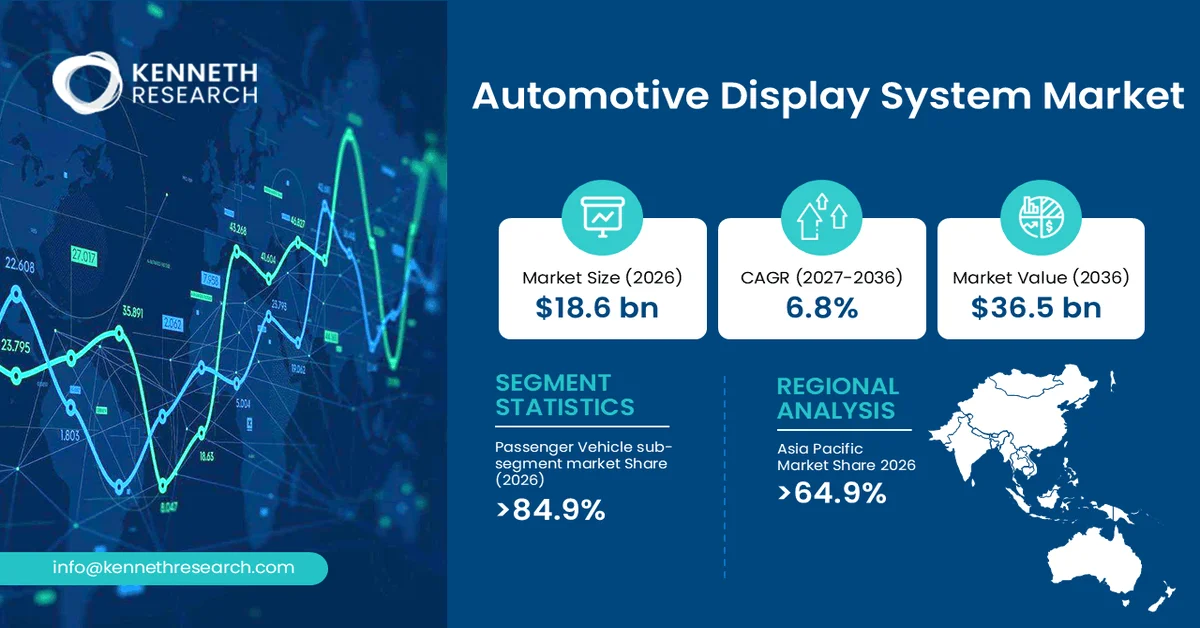
Automotive Display System Market size was valued at USD 18.6 billion in 2026 and is projected to reach USD 36.5 billion by the end of 2036, rising at a CAGR of 6.8% during the forecast period, i.e., 2027-2036. In 2027, the industry size of the automotive display system is estimated at USD 20.2 billion.
The primary growth driver is the rapid electrification and digitalization of vehicles, increasing demand for integrated interfaces that communicate vehicle status, navigation, safety alerts, infotainment and connected functions. The IEA reports that global electric-car sales exceeded 17 million in 2024, reinforcing OEM investment in software-rich, display-centric vehicle architectures.
The automotive display system market comprises electronic visual interfaces integrated into vehicles to present information and enable interaction between occupants and vehicle functions. These systems include instrument-cluster displays, center-stack or infotainment screens, rear-seat displays, head-up displays and other digital interfaces used for vehicle information, navigation, communications, entertainment and safety-related notifications.
Key characteristics include high-resolution visualization, touch or other human-machine interaction methods, connectivity with vehicle electronics, and integration with advanced driver-assistance and increasingly software-defined vehicle functions. Automotive displays must also balance information accessibility with driver attention and usability. The United Nations Economic Commission for Europe identifies display elements as an important component of vehicle human-machine interfaces and emphasizes principles intended to help drivers understand and use vehicle functions effectively.
Key Automotive Display System Market Insights Summary:
Key Takeaways: Market Trends & Insights
- 18.6 billion USD is the 2026 value of the global automotive display system market
- 20.2 billion USD is the projected market value for 2027
- 36.5 billion USD is the projected market value by 2036
- 6.8% CAGR is expected for the automotive display system market during 2027–2036
- Passenger Vehicles hold 84.9% share in 2026 while Asia Pacific leads with 64.9% share in 2026
Market Drivers
- Rising integration of advanced driver-assistance systems
- Expansion of connected and software-defined vehicle architectures
- Increasing demand for immersive infotainment and personalized in-vehicle experiences
- Growing adoption of digital instrument clusters and multi-display vehicle interiors
Challenges
- Complex regulatory and cybersecurity compliance
- High integration complexity across vehicle electronics
Automotive Display System Market Overview & Supply Chain
Global adoption is increasing as vehicles become more electronically integrated and safety functions increasingly depend on visual and interactive human-machine interfaces. Displays now connect drivers with navigation, vehicle status, warnings, infotainment and advanced driver-assistance functions, making them increasingly important to vehicle usability and safety.
The automotive display system market value chain begins with raw-material and component inputs, including glass substrates, display materials, semiconductor devices, LEDs, optical films, electronic controllers, touch sensors, plastics and metals. Component suppliers manufacture display panels, backlighting units, driver integrated circuits, touch modules and related electronic assemblies. Specialized display manufacturers and Tier-1 automotive suppliers then integrate these components into instrument clusters, infotainment displays, head-up displays and other vehicle interfaces, incorporating software, electronics and vehicle communication capabilities. Distribution typically occurs through direct OEM procurement, Tier-1 sourcing arrangements and specialized automotive electronics channels. Automakers integrate finished systems during vehicle assembly, while replacement and aftermarket channels provide secondary distribution. End users include passenger-vehicle and commercial-vehicle occupants.
Automotive Display System Market: Growth Drivers & Challenges
Growth Drivers
- Rising integration of advanced driver-assistance systems: Advanced driver-assistance systems are strengthening demand for automotive displays because safety functions increasingly require clear visual communication between vehicle systems and drivers. Forward-collision warnings, lane-departure alerts, blind-spot notifications and automatic emergency braking depend on timely presentation of system status or warnings through the driver interface. Regulatory development is reinforcing this integration. In 2024, NHTSA finalized FMVSS No. 127, requiring automatic emergency braking and pedestrian automatic emergency braking to become standard on passenger cars and light trucks by September 2029.
- Expansion of connected and software-defined vehicle architectures: The transition toward connected and software-defined vehicles is increasing the strategic role of displays from relatively simple information panels toward multifunctional digital interfaces. Modern vehicle architectures consolidate navigation, media, communication, vehicle settings, driver-assistance information and other functions within electronically controlled environments. This creates demand for larger, higher-resolution and more flexible display solutions capable of supporting frequent software updates and multiple user interfaces. For automakers, display systems can also become an important differentiation point because interface design increasingly influences perceived vehicle sophistication and usability. For suppliers, the shift encourages development of integrated hardware-software platforms rather than standalone display components.
Challenges
- Complex regulatory and cybersecurity compliance: The increasing software content of vehicle displays creates a more demanding compliance environment. Display systems are no longer isolated visual components; they can interact with vehicle networks, software functions, connectivity systems and driver-assistance features. Consequently, suppliers must address cybersecurity, secure software management, validation, traceability and protection against unauthorized modification alongside conventional display performance requirements. UNECE’s regulatory framework places explicit responsibilities on manufacturers for managing cyber risks and securely controlling software updates, increasing engineering, testing and documentation requirements across the supply chain. For display suppliers, this can extend development cycles and increase certification complexity, particularly when products are customized for different vehicle platforms or jurisdictions.
- High integration complexity across vehicle electronics: Automotive displays must operate as part of increasingly interconnected vehicle architectures, creating substantial integration challenges for manufacturers and suppliers. A display may need to coordinate with vehicle controllers, sensors, infotainment platforms, navigation systems, driver-assistance functions and communication interfaces while maintaining consistent performance and user interaction. This complexity increases validation requirements because changes to one electronic or software subsystem can affect display behavior elsewhere in the vehicle. Commercially, suppliers must invest in specialized engineering capabilities, platform compatibility testing and long-term technical support rather than treating displays as standalone hardware. OEMs also face greater coordination requirements across Tier-1 suppliers and technology partners, potentially extending program-development timelines.
Automotive Display System Market Size and Forecast:
| Report Attribute | Details |
|---|---|
| Base Year |
2026 |
| Forecast Period |
2027-2036 |
| CAGR |
6.8% |
| Base Year Market Size (2026) |
USD 18.6 billion |
| Forecast Year Market Size (2036) |
USD 36.5 billion |
| Regional Scope |
|
Automotive Display System Market Segmentation Analysis:
Vehicle Type Segment Analysis
In the vehicle type segment, Passenger Vehicle sub-segment is anticipated to capture the largest market share of 84.9% by the end of 2026.
The Passenger Vehicle segment dominates because displays are increasingly embedded across the cabin as primary interfaces for instrument information, infotainment, navigation, connectivity and driver-assistance communication. Demand is supported by the growing electronic content of passenger cars and the shift toward connected and electrified vehicle architectures, where digital interfaces become central to everyday vehicle operation. The IEA reports that the global electric passenger-car fleet reached almost 58 million at the end of 2024, demonstrating the expanding installed base of electronically intensive passenger vehicles. This transition encourages OEMs to deploy integrated instrument clusters, center displays, head-up displays and rear-seat interfaces across vehicle platforms.
Technology Segment Analysis
The TFT-LCD is projected to grow as the second-largest segment in the automotive display system market due to four converging demand drivers.
The TFT-LCD segment is projected to grow as automakers require display technologies that combine mature manufacturing capabilities, strong visual performance, touch functionality and compatibility with increasingly sophisticated vehicle electronics. Demand is supported by instrument clusters, infotainment interfaces and other in-cabin applications requiring reliable, high-resolution information presentation. The European Commission’s customs regulation specifically identifies a multifunctional instrument cluster with a curved TFT LCD display and touch-sensitive surfaces for use in electric passenger cars, demonstrating direct integration of TFT-LCD technology into modern vehicle architectures. Supply-side advantages include established panel manufacturing ecosystems, scalable production processes and broad availability of supporting components, enabling suppliers to adapt TFT-LCD solutions across vehicle platforms. Industry adoption is also supported by the technology’s ability to accommodate curved formats, integrated touch interfaces and vehicle-network connectivity.
Our in-depth analysis of the global automotive display system market includes the following segments:
|
Segment |
Sub-segment |
|
Technology |
|
|
Display Size |
|
|
Application |
|
|
Vehicle Type |
|
|
Sales Channel |
|
Automotive Display System Market Regional Insights:
Asia Pacific Market Trends & Insights:
Asia Pacific automotive display system market is projected to hold the largest revenue share of 64.9% by the end of 2026.
It is supported by its concentration of vehicle manufacturing, electronics production, component suppliers and large automotive-consumer markets. The region benefits from deep manufacturing ecosystems spanning displays, semiconductors, automotive electronics and vehicle assembly, while investment in electrification and connected-vehicle technologies is reinforcing demand for sophisticated in-cabin interfaces.
China remains the principal regional manufacturing hub, supported by extensive domestic OEM and supplier networks and rapid deployment of new-energy vehicles. Its scale enables display suppliers to participate across multiple vehicle platforms and technology tiers.
Japan provides a complementary strength through established automakers, electronics expertise and sophisticated automotive-component supply chains. Government production statistics maintained through Japan’s e-Stat system provide detailed automotive manufacturing data covering 2021 onward, supporting the country’s continued importance to the regional automotive technology ecosystem.
North America Market Trends & Insights:
North America presents a strong environment for automotive display-system adoption because vehicle manufacturers are investing in electrification, connected mobility, advanced safety and software-enabled vehicle architectures. These developments increase the need for sophisticated digital interfaces across instrument clusters, infotainment systems and driver-assistance displays. Government policy is also supporting the broader automotive technology transition.
The U.S. remains the region's principal automotive technology and manufacturing hub, supported by established OEMs, Tier-1 suppliers, semiconductor capabilities and substantial investment in vehicle electrification. Federal initiatives linking EV infrastructure with domestic manufacturing are likely to encourage further localization of automotive electronics and display-system supply chains.
Canada complements the regional ecosystem through automotive manufacturing, battery-related investment and cross-border supply-chain integration. Government policy is supporting development of an integrated EV manufacturing ecosystem, while cooperation with the United States is strengthening cross-border mobility infrastructure and automotive supply chains.
Leading Companies Operating in the Global Automotive Display System Market:
Here is a list of upstream, downstream, and key players operating in the automotive display system market competitive ecosystem:
- DENSO Corporation (Japan)
- Company Overview
- Business Strategy
- Key Product Offerings
- Financial Performance
- Key Performance Indicators
- Risk Analysis
- Recent Development
- Regional Presence
- SWOT Analysis
- Visteon Corporation (United States)
- LG Display Co., Ltd. (South Korea)
- Nippon Seiki Co., Ltd. (Japan)
Recent Developments
- In June 2026, Visteon announced that its 12.3-inch Narrow Border Driver Display is featured in the all-new Lexus ES, marking the company's first production program in Lexus driver information systems. The full LCD panel features an ultra-slim border, optical bonding for high contrast and reduced glare, and high-brightness optimization for superior readability under direct sunlight, with premium animations crafted specifically to reflect the Lexus brand.
- In June 2026, Nippon Seiki introduced the NS-6000 Head-Up Display, a compact projection unit that places speed, navigation, and warning symbols directly in the driver's field of view. The system uses an LED light source and CAN interface for vehicle integration, with a two-stage brightness control logic combining mechanical and electronic adjustment to maintain contrast stability in both night and bright sunlight conditions.
Frequently Asked Question
In 2026, the automotive display system market is USD 18.6 billion.
The automotive display system market is projected to reach USD 36.5 billion by the end of 2036, expanding at a CAGR of 6.8% over the forecast period (2027-2036).
The major players in the market are DENSO Corporation, Visteon Corporation, LG Display Co., Ltd., Nippon Seiki Co., Ltd., and others.
In the Vehicle Type segment, the Passenger Vehicle sub-segment is anticipated to capture the largest market share of 84.9% in the future and exhibit lucrative growth opportunities during 2027-2036. This growth trajectory is largely attributed to the increasing integration of advanced driver-assistance systems and digital vehicle interfaces.
Asia Pacific is projected to hold the largest market share of 64.9% by the end of 2026 and provide more business opportunities in the future. Continuous investments in automotive manufacturing, vehicle electrification, connected vehicles and automotive electronics across China and Japan are fostering the region's dominance.
Why Choose Kenneth Research ?
-
Insight with Impact : We don’t just gather data — we uncover stories, trends, and opportunities that fuel business growth.
-
Experts Who Get It : Our team speaks your industry’s language and knows what really matters to your customers and market.
-
Custom-Built for You : Forget one-size-fits-all. We craft research and consulting solutions as unique as your business vision.
-
Partners, Not Just Providers : We work with you, not for you — collaborating closely to turn insights into smart, strategic moves.
-
Results That Speak : Our work powers brands, startups, and industry leaders alike — with a track record of ideas that work in the real world.
Report ID: 1287 |
Published Date: 01 Sep 2026 |
Report Format: |
Delivery Timeline: 48-72 Business Hours

Copyright © 2025 Kenneth Research. All rights reserved. Terms of Use | Privacy Policy
