Report ID: 1187 |
Published Date: 26 Aug 2026 |
Report Format: |
Delivery Timeline: 48-72 Business Hours
Automotive Cyber Security Market Outlook:
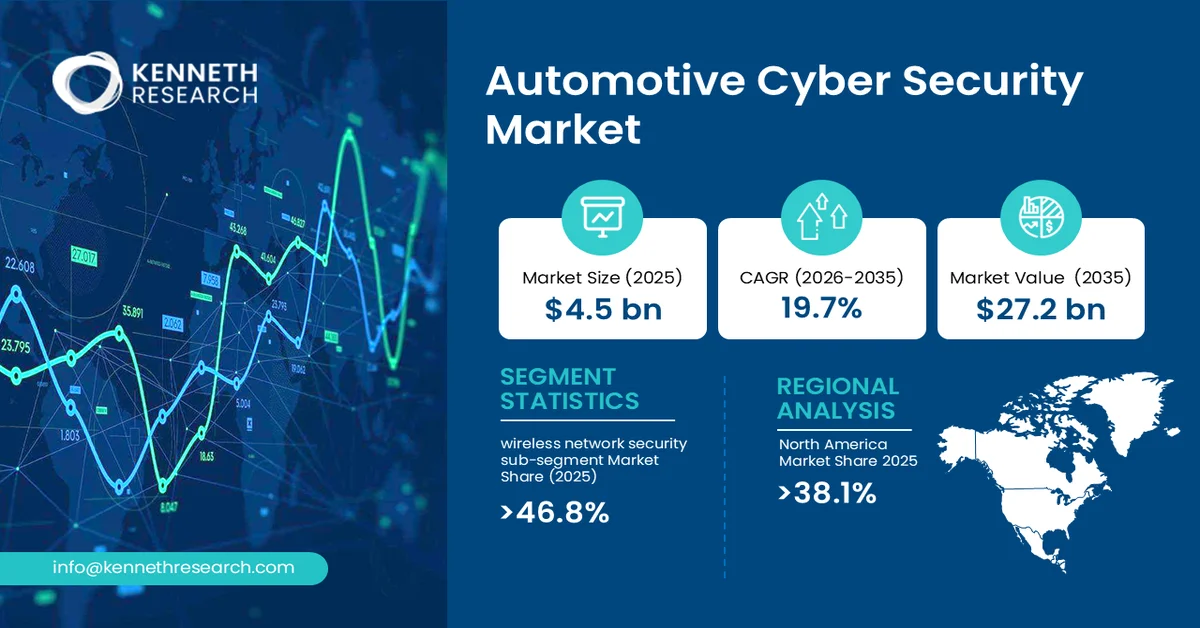
Automotive Cyber Security Market size was valued at USD 4.5 billion in 2025 and is projected to reach USD 27.2 billion by the end of 2035, rising at a CAGR of 19.7% during the forecast period, i.e., 2026-2035. In 2026, the industry size of the automotive cyber security is estimated at USD 5.4 billion.
The primary growth driver for the automotive cyber security market is the increasing integration of connected, software-defined, and electronically controlled systems into modern vehicles. Wireless connectivity, telematics, over-the-air updates, infotainment, vehicle-to-everything communication, and advanced driver-assistance systems are expanding the number of digital interfaces that require protection.
The automotive cyber security market encompasses technologies and services designed to protect vehicle electronic systems, communication networks, software, control systems, connected devices, and automotive data from unauthorized access, manipulation, disruption, and cyberattacks. The market covers security solutions deployed across vehicle networks, wireless communication interfaces, telematics systems, electronic control units, infotainment platforms, cloud-connected services, and software-update mechanisms. Automotive cybersecurity is increasingly becoming a lifecycle requirement rather than a one-time vehicle-development function. Manufacturers and suppliers must address cybersecurity during vehicle design, development, production, operation, software updates, and post-production support.
Key Automotive Cyber Security Market Insights Summary:
Key Takeaways: Market Trends & Insights
- Automotive cyber security market is projected to expand significantly through the forecast period, supported by increasing connectivity, software-defined vehicle architectures, and cybersecurity requirements.
- North america remains the dominant regional market, supported by a mature automotive ecosystem, advanced connected-vehicle technologies, and strong cybersecurity initiatives across the u.s. and canada.
- Wireless network security remains the leading security type segment, reflecting the growing number of wireless interfaces connecting vehicles with external networks, devices, cloud platforms, and infrastructure.
- Passenger cars represent a major opportunity within the vehicle type segment as manufacturers increasingly integrate telematics, infotainment, over-the-air updates, advanced driver-assistance systems, and other connected functions.
Market Drivers
- Expansion of connected and software-defined vehicles
- Strengthening automotive cybersecurity regulations
- Increasing adoption of wireless connectivity and over-the-air updates
- Growing integration of advanced electronic and software-controlled vehicle functions
Challenges
- Increasing complexity of connected vehicle architectures
- Evolving regulatory and compliance requirements
Automotive Cyber Security Market Overview & Supply Chain
The automotive cyber security market is expanding as vehicles become increasingly connected, software-defined, and dependent on wireless communication. Modern vehicles integrate telematics, infotainment, cloud connectivity, electronic control units, over-the-air software updates, and advanced driver-assistance technologies, creating additional interfaces that require protection. The U.S. National Highway Traffic Safety Administration (NHTSA) identifies automotive cybersecurity as the protection of vehicle electronic systems, communication networks, control algorithms, software, users, and underlying data from malicious attacks, unauthorized access, or manipulation.
The automotive cybersecurity value chain begins with cybersecurity software, intrusion-detection technologies, secure communication systems, encryption solutions, authentication technologies, security gateways, monitoring platforms, and other automotive security components. Cybersecurity technology providers develop solutions that are integrated into vehicle electronic architectures by automotive OEMs and Tier 1 suppliers. Security capabilities are increasingly incorporated across vehicle development and lifecycle-management processes, including software development, system validation, production, connected services, and post-production updates.
Automotive Cyber Security Market: Growth Drivers & Challenges
Growth Drivers:
- Expansion of connected and software-defined vehicles: The increasing integration of wireless connectivity, telematics, vehicle-to-everything communication, over-the-air updates, and software-controlled functions is expanding the automotive cybersecurity attack surface. NHTSA notes that remote wireless communications interacting with driving-control technologies create additional interfaces and cybersecurity risks, increasing the need for robust protection throughout vehicle architectures. This is encouraging OEMs and Tier 1 suppliers to incorporate authentication, intrusion detection, secure communications, encryption, and continuous monitoring into vehicle platforms.
- Strengthening automotive cybersecurity regulations: Regulatory requirements are increasingly encouraging vehicle manufacturers to implement formal cybersecurity management processes. UN Regulation No. 155, which entered into force in 2021, established an international framework for vehicle cybersecurity and requires manufacturers to assess and manage cybersecurity risks. Regulatory alignment is encouraging OEMs and suppliers to adopt cybersecurity-by-design practices, risk assessments, vulnerability management, incident response, and continuous monitoring. These requirements are creating opportunities for cybersecurity software providers, testing specialists, security-platform vendors, and automotive technology companies
Challenges:
- Increasing complexity of connected vehicle architectures: The rapid integration of wireless connectivity, electronic control units, telematics, advanced driver-assistance systems, and software-defined functions is creating a broader and more complex automotive attack surface. NHTSA highlights that modern vehicles contain multiple wireless and wired entry points that can potentially be exploited, requiring layered cybersecurity protection across safety-critical systems.
- Evolving regulatory and compliance requirements: Automotive manufacturers face increasingly structured cybersecurity obligations as governments and international regulatory bodies strengthen vehicle-security frameworks. UNECE Regulation No. 155 established an international framework requiring manufacturers to manage cybersecurity risks, maintain cybersecurity management systems, and demonstrate effective risk mitigation. The regulatory framework was subsequently expanded to additional vehicle categories, demonstrating its continuing evolution. Compliance requires manufacturers and suppliers to maintain risk assessments, testing procedures, monitoring capabilities, incident-response processes, and documentation throughout the vehicle lifecycle.
Automotive Cyber Security Market Size and Forecast:
| Report Attribute | Details |
|---|---|
| Base Year |
2025 |
| Forecast Year |
2026-2035 |
| CAGR |
19.7% |
| Base Year Market Size (2025) |
USD 4.5 billion |
| Forecast Year Market Size (2035) |
USD 27.2 billion |
| Regional Scope |
|
Automotive Cyber Security Market Segmentation Analysis:
Security Type Segment Analysis
In the security type segment, the wireless network security sub-segment is anticipated to capture the largest market share of 46.8% by the end of 2025.
Its leadership is supported by the growing integration of wireless connectivity into modern vehicles, including cellular communication, Bluetooth, Wi-Fi, telematics, and other connected functions. These interfaces create additional pathways that require authentication, encryption, monitoring, and intrusion prevention to protect vehicle systems and data. The U.S. National Highway Traffic Safety Administration recognizes vehicle connectivity and electronic systems as important cybersecurity considerations and emphasizes protection against unauthorized access, malicious attacks, and manipulation. Increasing adoption of connected and software-defined vehicles is further strengthening demand for wireless security capabilities. OEMs and cybersecurity providers are increasingly incorporating secure communication protocols, threat detection, access controls, and continuous monitoring into vehicle architectures.
Passenger Car Type Segment Analysis
The passenger car segment is projected to remain a significant growth area in the vehicle type category as passenger vehicles increasingly incorporate connected infotainment, telematics, wireless communication, over-the-air software updates, and advanced electronic systems.
The U.S. Department of Transportation's automotive cybersecurity guidance emphasizes the need for cybersecurity processes covering vehicle design, development, manufacturing, and the full operational lifecycle. This is particularly relevant to passenger cars as manufacturers continue transitioning toward software-defined and connected vehicle architectures.
Demand is also being reinforced by the growing importance of cybersecurity in connected-car ecosystems, where vehicle systems interact with mobile applications, cloud platforms, external networks, and other vehicles. Government-backed cybersecurity initiatives are consequently encouraging OEMs and suppliers to integrate security-by-design principles, vulnerability management, secure software development, and continuous monitoring into passenger-vehicle platforms.
Our in-depth analysis of the global automotive cyber security market includes the following segments:
|
Segment |
Sub-segment |
|
Security Type |
|
|
Vehicle Type |
|
|
By service |
|
|
Application |
|
Automotive Cyber Security Market Regional Insights:
North America Market Trends & Insights:
North America is the dominant region in the automotive cyber security market, accounting for 38.1% in 2025.
Regional leadership is supported by a mature automotive ecosystem, extensive connected-vehicle deployment, advanced cybersecurity capabilities, and strong regulatory attention to vehicle cybersecurity. The U.S. National Highway Traffic Safety Administration (NHTSA) emphasizes layered protection for wireless and wired vehicle entry points and promotes continuous cybersecurity risk management for modern vehicles.
U.S. represents a major opportunity due to its large automotive technology ecosystem and continued development of connected and advanced vehicles. NHTSA is actively researching areas including intrusion detection, firmware-update security, and cybersecurity of vehicle electronic architectures, supporting continued demand for automotive cybersecurity technologies.
Canada is also strengthening its automotive cybersecurity ecosystem as connected and automated vehicle technologies become more integrated into transportation infrastructure. Transport Canada's Vehicle Cyber Security Strategy focuses on strengthening cyber resilience across connected and automated vehicles and the infrastructure supporting them.
Asia Pacific Market Trends & Insights:
Asia Pacific represents an important growth region for the automotive cyber security market, supported by expanding connected-vehicle ecosystems, increasing vehicle digitalization, software-defined architectures, and government-led cybersecurity initiatives.
Japan is advancing cybersecurity considerations alongside the development of automated and connected vehicles. Japan's Ministry of Land, Infrastructure, Transport and Tourism (MLIT) has identified cybersecurity as one of the emerging safety challenges associated with increasingly advanced vehicles and has continued examining safety measures for electric and automated vehicles.
China is developing a particularly structured cybersecurity environment for intelligent connected vehicles. In 2024, China's authorities released GB 44495-2024, Technical Requirements for Vehicle Cybersecurity, covering requirements for vehicle information-security management, external connections, communications, software upgrades, and data security.
Leading Companies Operating in the Global Automotive Cyber Security Market:
Here is a list of upstream, downstream, and key players operating in the global automotive cyber security market competitive ecosystem:
- Bosch(Germany)
- Company Overview
- Business Strategy
- Key Product Offerings
- Financial Performance
- Key Performance Indicators
- Risk Analysis
- Recent Development
- Regional Presence
- SWOT Analysis
- Continental(Germany)
- HARMAN(United States)
Recent Developments
- April 2026 –Bosch advanced its work on software supply-chain security through open-source initiatives supporting Software Bill of Materials (SBOM) exchange and validation.
- 2026 –HARMAN continued expanding its automotive cybersecurity engineering capabilities, covering vehicle data protection, driver privacy, system integrity, and secure automotive software.
Frequently Asked Question
In 2025, the automotive cyber security market was valued at USD 4.5 billion.
The automotive cyber security market is projected to reach USD 27.2 billion by the end of 2035, expanding at a CAGR of 19.7% over the forecast period (2026-2035).
The major players in the market include Bosch, Continental, HARMAN, Aptiv, Argus Cyber Security, and others.
In the security type segment, wireless network security is anticipated to capture the largest market share of 46.8%.
North America is projected to remain the leading regional market, supported by connected-vehicle adoption, advanced automotive technologies, cybersecurity initiatives, and regulatory attention across the U.S. and Canada.
Why Choose Kenneth Research ?
-
Insight with Impact : We don’t just gather data — we uncover stories, trends, and opportunities that fuel business growth.
-
Experts Who Get It : Our team speaks your industry’s language and knows what really matters to your customers and market.
-
Custom-Built for You : Forget one-size-fits-all. We craft research and consulting solutions as unique as your business vision.
-
Partners, Not Just Providers : We work with you, not for you — collaborating closely to turn insights into smart, strategic moves.
-
Results That Speak : Our work powers brands, startups, and industry leaders alike — with a track record of ideas that work in the real world.
Report ID: 1187 |
Published Date: 26 Aug 2026 |
Report Format: |
Delivery Timeline: 48-72 Business Hours

Copyright © 2025 Kenneth Research. All rights reserved. Terms of Use | Privacy Policy
