Report ID: 1289 |
Published Date: 28 Sep 2026 |
Report Format: |
Delivery Timeline: 48-72 Business Hours
Automotive Camera and Integrated Radar and Camera Market Outlook:
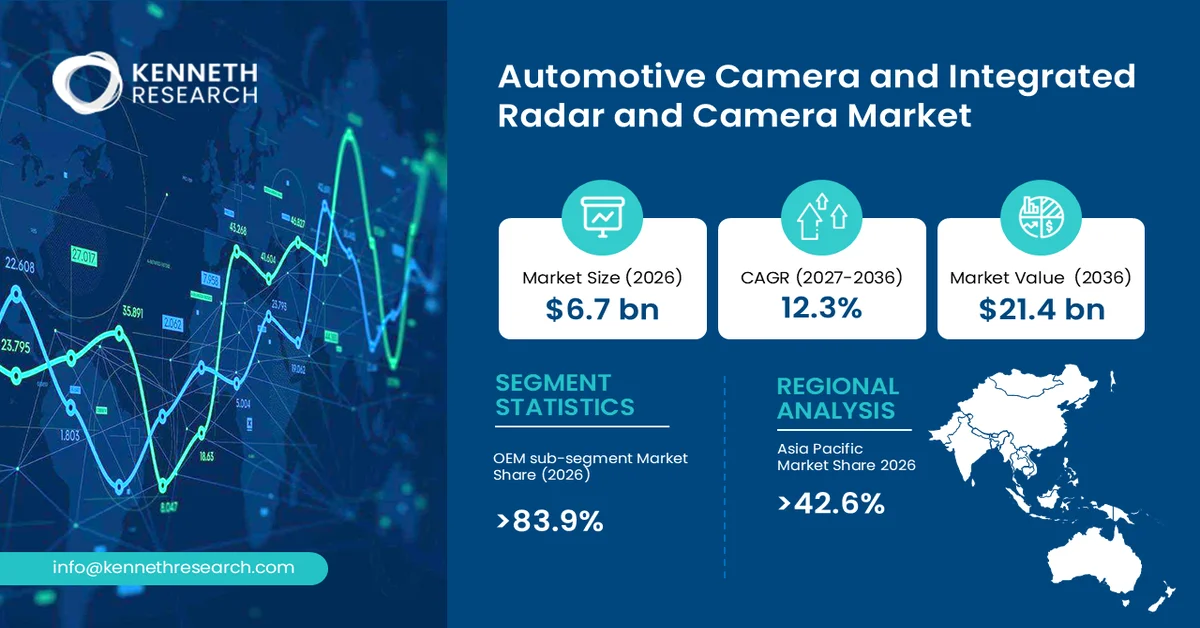
Automotive Camera and Integrated Radar and Camera Market size was valued at USD 6.7 billion in 2026 and is projected to reach USD 21.4 billion by the end of 2036, rising at a CAGR of 12.3% during the forecast period, i.e., 2027–2036. In 2027, the industry size of the automotive camera and integrated radar and camera is estimated at USD 7.5 billion.
The primary growth driver is the expanding deployment of advanced driver assistance systems (ADAS) to improve vehicle safety. Camera- and radar-based sensing enables vehicles to detect hazards, monitor lanes, identify surrounding objects, and support automated interventions. Government safety initiatives and evolving vehicle-technology oversight are reinforcing demand for increasingly capable sensing architectures.
The automotive camera and integrated radar and camera market comprises sensing hardware and integrated perception solutions used in road vehicles to capture, interpret, and communicate information about the vehicle’s surroundings. The market includes automotive cameras, radar sensors, and systems that combine camera and radar inputs to support driver assistance, safety, parking, object detection, lane-related functions, and automated-driving capabilities.
Key characteristics include multi-sensor perception, real-time environmental monitoring, electronic integration, and increasing coordination between sensing hardware and vehicle-control systems. Camera systems provide visual information such as lane markings, vehicles, pedestrians, and road features, while radar contributes distance and motion information. Combining these sensing modalities can strengthen environmental perception across different driving conditions. NHTSA identifies technologies such as forward-collision warning, lane-departure warning, blind-spot warning, automatic emergency braking, and pedestrian automatic emergency braking as important driver-assistance functions.
Key Automotive Camera and Integrated Radar and Camera Market Insights Summary:
Key Takeaways: Market Trends & Insights
- The automotive camera and integrated radar and camera market is valued at USD 6.7 billion in 2026 and is projected to reach USD 21.4 billion by 2036
- The market is expected to expand at a CAGR of 12.3% during 2027–2036, supported by increasing adoption of advanced driver assistance and integrated vehicle sensing technologies
- OEM is the leading Sales Channel sub-segment, accounting for 83.9% market share in 2026, reflecting strong factory-level integration of sensing systems
- Asia Pacific is the dominant region with a 42.6% market share in 2026, supported by automotive manufacturing strength and intelligent-vehicle development across China and Japan
Market Drivers
- Regulatory adoption of advanced vehicle safety requirements
- Expansion of multi-sensor perception and sensor-fusion architectures
- Increasing integration of ADAS across passenger-vehicle platforms
- Advancement of automotive vision, radar, and real-time processing technologies
Challenges
- Sensor calibration complexity and lifecycle performance degradation
- Cybersecurity vulnerabilities and sensor-signal manipulation risks
Automotive Camera and Integrated Radar and Camera Market Overview & Supply Chain
Global adoption of automotive cameras, radar, and integrated sensing systems is increasing as vehicle manufacturers strengthen advanced driver assistance and automated-driving capabilities. These technologies support functions such as collision avoidance, lane monitoring, blind-spot detection, driver assistance, and environmental perception. Regulatory programs are also reinforcing technology integration: the U.S. National Highway Traffic Safety Administration expanded safety evaluation of advanced driver assistance systems, while the European Commission has introduced mandatory advanced driver-assistance requirements for new vehicles. Industry relevance is reflected in NHTSA’s 2021 model-year testing program, which covered vehicles representing approximately 86% of the new vehicle fleet and included verification testing of advanced driver assistance technologies.
The value chain begins with raw-material and component inputs, including semiconductor devices, image sensors, radar components, optical elements, electronic substrates, housings, wiring, and specialized materials used in sensing modules. Component suppliers provide these inputs to sensor manufacturers and Tier 1 automotive suppliers, which engineer cameras, radar units, integrated perception modules, electronic control units, and associated software. Manufacturing involves precision assembly, calibration, testing, environmental validation, and integration according to automotive quality requirements. Distribution typically moves through Tier 1 suppliers and automotive procurement networks into vehicle manufacturing plants, where sensing systems are incorporated into vehicle platforms and electronic architectures. End users include passenger-vehicle and commercial-vehicle manufacturers and, ultimately, vehicle operators.
Automotive Camera and Integrated Radar and Camera Market - Growth Drivers & Challenges
Growth Drivers
- Regulatory Push for Advanced Safety Systems: Regulatory pressure is accelerating adoption of automotive cameras, radar, and integrated sensing architectures by converting advanced safety functions from optional features into increasingly expected vehicle capabilities. Mandatory performance requirements for automatic emergency braking (AEB) encourage manufacturers to deploy reliable environmental-sensing systems capable of identifying vehicles and pedestrians and triggering timely interventions. Because AEB can draw on radar and camera inputs, regulatory requirements directly strengthen demand for sensing hardware, processing capability, and sensor-fusion technologies.
- Expansion of Multi-Sensor Vehicle Perception: Increasing vehicle intelligence is driving demand for complementary sensing technologies that provide broader and more reliable environmental awareness. Cameras deliver visual information for lane markings, traffic signs, vehicles, pedestrians, and other road features, while radar provides distance and motion information. Integrating these inputs allows vehicle systems to combine different sensing characteristics rather than relying on a single modality. This architecture is particularly valuable as automakers expand automated parking, collision avoidance, lane-related assistance, and higher levels of driving automation. The resulting shift is increasing demand for sensor fusion, compact electronic architectures, improved processing, and software capable of interpreting multiple data streams in real time. For suppliers, this creates opportunities to move beyond individual components toward integrated perception platforms.
Challenges
- Sensor Calibration and Performance Degradation: A major restraint is the difficulty of maintaining accurate sensor calibration throughout the vehicle lifecycle. Camera and radar performance can deteriorate because of physical displacement, contamination, component aging, repairs, collisions, or changes to vehicle geometry. These effects can alter the perception inputs used by safety-critical functions, requiring specialized diagnostic equipment, technical procedures, and validation. NHTSA research specifically examines how degradation affects camera, radar, and LiDAR perception performance, demonstrating that sensor condition is an ongoing engineering concern rather than a one-time manufacturing issue. Commercially, calibration requirements increase service complexity, after-sales costs, technician training needs, and warranty exposure. They can also create friction for independent repair networks when proprietary procedures or system information are unavailable.
- Cybersecurity and Sensor-Spoofing Exposure: Increasing connectivity and software dependence create a structural cybersecurity challenge for camera, radar, and integrated perception systems. Modern ADAS architectures connect sensors with electronic control units, vehicle networks, software, and external communication interfaces, creating multiple potential attack pathways. Manipulation of sensor inputs can compromise perception even when the underlying hardware remains operational. NHTSA identifies risks including radar jamming or spoofing, camera blinding, and manipulation designed to generate machine-learning false positives. The commercial impact extends beyond cybersecurity expenditure: manufacturers must incorporate threat assessment, secure software development, intrusion detection, incident response, and system resilience into product engineering.
Automotive Camera and Integrated Radar and Camera Market Size and Forecast:
| Report Attribute | Details |
|---|---|
| Base Year |
2026 |
| Forecast Year |
2027-2036 |
| CAGR |
12.3% |
| Base Year Market Size (2026) |
USD 6.7 billion |
| Forecast Year Market Size (2036) |
USD 21.4 billion |
| Regional Scope |
|
Automotive Camera and Integrated Radar and Camera Market - Segment Analysis
Sales Channel Segment Analysis
In the sales channel segment, the OEM sub-segment is anticipated to capture the largest market share of 83.9% by the end of 2026.
OEM dominates the sales-channel segment because automotive cameras, radar sensors, and integrated perception systems are increasingly engineered directly into vehicle platforms during original production rather than added through aftermarket channels. Factory installation enables automakers to coordinate sensors with electronic control units, braking, steering, software, and vehicle architecture, while meeting safety-validation and regulatory requirements from the outset. Demand is therefore supported by the rising integration of ADAS functions such as forward-collision warning, automatic emergency braking, lane assistance, and pedestrian detection into new vehicles. NHTSA reported that 91 percent of model year 2023 vehicles were equipped with forward-collision warning systems as standard equipment, demonstrating the increasingly embedded nature of safety sensing within original vehicle production.
Vehicle Type Segment Analysis
The Passenger Cars is projected to grow as the second-largest segment in the automotive camera and integrated radar and camera market due to four converging demand drivers.
Passenger cars are projected to remain the fastest-growing vehicle-type sub-segment as safety assistance, automated driving functions, and increasingly sophisticated vehicle electronics become more deeply integrated into consumer vehicles. Demand is being supported by the expansion of camera-based lane monitoring, radar-enabled collision detection, parking assistance, and sensor-fusion architectures across new passenger-car platforms. The European Commission reports that ADAS are available in almost all new car models, highlighting the broad penetration of safety-oriented sensing technology in this vehicle category. Industry adoption is also being reinforced by regulatory requirements. In Europe, mandatory ADAS provisions apply to new vehicle types and subsequently to all new vehicles, with passenger cars receiving requirements for features including lane-keeping systems and automated braking.
Our in-depth analysis of the global automotive camera and integrated radar and camera market includes the following segments:
|
Segment |
Sub-segment |
|
Component |
|
|
Technology |
|
|
Application |
|
|
Vehicle Type |
|
|
Sales Channel |
|
Automotive Camera and Integrated Radar and Camera Market - Regional Analysis
Asia Pacific Market Trends & Insights:
Asia Pacific automotive camera and integrated radar and camera market is projected to hold the largest revenue share of 42.6% by the end of 2026.
Asia Pacific maintains the leading regional position in the automotive camera and integrated radar and camera market, supported by its deep automotive manufacturing base, high vehicle production, expanding electrification, and rapid integration of intelligent vehicle technologies. The region benefits from concentrated supply chains spanning automakers, Tier 1 suppliers, semiconductor manufacturers, sensor producers, and electronics companies. China, Japan, South Korea, and other regional manufacturing centers also provide a strong platform for deploying camera, radar, and sensor-fusion technologies at scale.
China is the region’s principal production and consumption engine, supported by extensive automotive manufacturing capacity, accelerating intelligent-vehicle development, and a mature domestic supplier ecosystem.
Japan remains strategically important through its established automakers, advanced electronics capabilities, precision manufacturing expertise, and continued development of driver-assistance technologies. Together, China and Japan provide complementary strengths: China contributes manufacturing scale and rapidly expanding intelligent-vehicle deployment, while Japan contributes established automotive engineering and sophisticated component-development capabilities. This combination supports continued regional investment in integrated perception, sensor fusion, vehicle electronics, and safety systems.
Europe Market Market Trends & Insights:
Europe represents a strategically important market for automotive cameras, radar, and integrated perception systems because vehicle manufacturers face strong demand for advanced safety, automated-driving capabilities, and increasingly sophisticated electronic architectures. Regulatory intervention is a major catalyst: European vehicle-safety rules require new vehicles to incorporate advanced assistance functions including lane-keeping, automated emergency braking, reversing detection using cameras or sensors, driver-attention monitoring, and cybersecurity measures.
Germany remains a key European automotive technology center, supported by established vehicle manufacturers, Tier 1 suppliers, engineering expertise, and a strong industrial base for electronics and vehicle systems. Its ecosystem provides favorable conditions for developing and integrating sophisticated camera-radar architectures across passenger-vehicle platforms.
France offers complementary opportunities through government-backed automotive industrial policy emphasizing electrification, innovation, and technological transformation. Its automotive-sector strategy promotes collaboration among manufacturers, suppliers, research organizations, and technology stakeholders, creating opportunities for sensing-system developers as vehicle architectures evolve. Together, Germany and France provide a strong foundation for European demand, technology development, supplier collaboration, and deployment of advanced vehicle-perception systems.
Automotive Camera and Integrated Radar and Camera Market Competitive Landscape
Here is a list of upstream, downstream, and key players operating in the global automotive camera and integrated radar and camera market competitive ecosystem:
- Ambarella Inc. (United States)
- Company Overview
- Business Strategy
- Key Product Offerings
- Financial Performance
- Key Performance Indicators
- Risk Analysis
- Recent Development
- Regional Presence
- SWOT Analysis
- NVIDIA Corporation (United States)
- Sony Group Corporation (Japan)
- Panasonic Corporation (Japan)
Recent Developments
- At CES 2026, Ambarella demonstrated its full autonomous driving stack running on the CV3-AD SoC, integrating camera data with Oculii 4D imaging radar to build environmental models without relying on pre-generated HD maps. In side-by-side demos, Ambarella's N1-655-class silicon delivered close to three times the AI performance, memory efficiency, and power efficiency compared to competing embedded GPUs on the same workload.
- In December 2025, Panasonic Automotive Systems announced it will change its company name and brand to Mobitera effective April 1, 2027, to better represent its commitment to creating a safe, comfortable, and sustainable mobility experience. The new name combines "mobility" with the Latin word "iter" (meaning path) and the Japanese word "terasu" (meaning to illuminate), reflecting the company's vision to power the future of mobility.
Frequently Asked Question
In 2026, the automotive camera and integrated radar and camera market exceeded USD 6.7 billion.
The automotive camera and integrated radar and camera market is projected to reach USD 21.4 billion by the end of 2036, expanding at a CAGR of 12.3% over the forecast period (2027-2036).
The major players in the market are Ambarella Inc., NVIDIA Corporation, Sony Group Corporation, Panasonic Corporation, and others.
In the Sales Channel segment, the OEM sub-segment is anticipated to capture the largest market share of 83.9% in the future and exhibit lucrative growth opportunities during 2027-2036. This growth trajectory is largely attributed to the increasing integration of advanced driver assistance systems into new vehicles.
Asia Pacific is projected to hold the largest market share of 42.6% by the end of 2026 and provide more business opportunities in the future. Continuous automotive manufacturing activity and investments in intelligent-vehicle technologies across China and Japan are fostering the region's dominance.
Why Choose Kenneth Research ?
-
Insight with Impact : We don’t just gather data — we uncover stories, trends, and opportunities that fuel business growth.
-
Experts Who Get It : Our team speaks your industry’s language and knows what really matters to your customers and market.
-
Custom-Built for You : Forget one-size-fits-all. We craft research and consulting solutions as unique as your business vision.
-
Partners, Not Just Providers : We work with you, not for you — collaborating closely to turn insights into smart, strategic moves.
-
Results That Speak : Our work powers brands, startups, and industry leaders alike — with a track record of ideas that work in the real world.
Report ID: 1289 |
Published Date: 28 Sep 2026 |
Report Format: |
Delivery Timeline: 48-72 Business Hours

Copyright © 2025 Kenneth Research. All rights reserved. Terms of Use | Privacy Policy
