Report ID: 1320 |
Published Date: 11 Sep 2026 |
Report Format: |
Delivery Timeline: 48-72 Business Hours
Automotive Battery Rental Market Outlook:
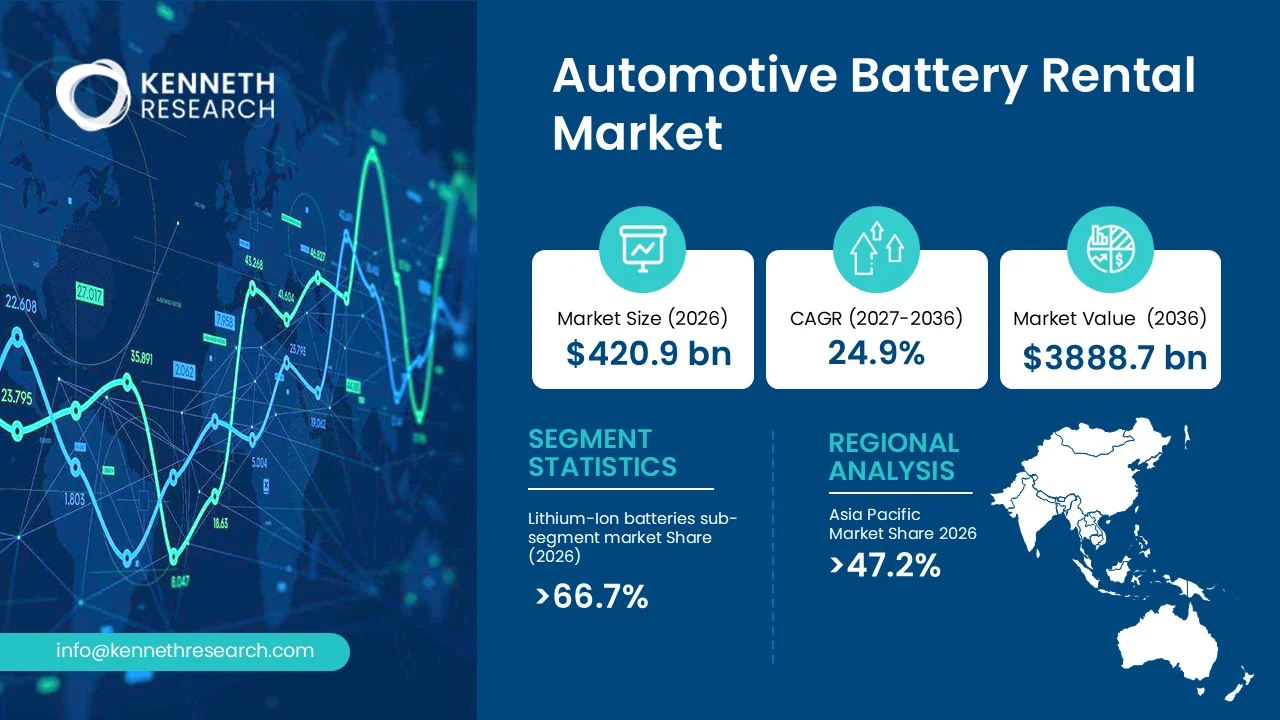
Automotive Battery Rental Market size was valued at USD 420.9 billion in 2026 and is projected to reach USD 3,888.7 billion by the end of 2036, rising at a CAGR of 24.9% during the forecast period, i.e., 2027–2036. In 2027, the industry size of the automotive battery rental is estimated at USD 525.7 billion.
The rapid expansion of electric mobility and demand for convenient energy replenishment are driving adoption of automotive battery rental models.
The automotive battery rental market refers to the provision of rechargeable vehicle batteries to automotive users through rental, subscription, leasing, or battery-swapping arrangements rather than requiring the vehicle owner to purchase and permanently own the battery. The model is particularly relevant to electric vehicles, where the battery represents a substantial portion of vehicle value and directly influences operating economics, charging convenience, and vehicle utilization.
Key characteristics include battery-as-a-service arrangements, standardized or compatible battery packs, swapping infrastructure, subscription-based access, battery lifecycle management, remote monitoring, charging and storage facilities, and digital platforms for managing battery availability and usage. Depending on the operating model, service providers may retain battery ownership while vehicle users pay recurring fees or usage-based charges.
Key Automotive Battery Rental Market Insights Summary:
Key Takeaways: Market Trends & Insights
- Automotive Battery Rental Market is projected to grow from USD 420.9 billion in 2026 to USD 3,888.7 billion by 2036, expanding at a 24.9% CAGR during the forecast period.
- Asia-Pacific accounted for the largest regional share at 47.2% in 2026, supported by accelerating electric-mobility adoption, established battery manufacturing ecosystems, and expanding battery-swapping infrastructure in Japan and China.
- Lithium-Ion batteries represented the leading battery type with a 66.7% share in 2026, supported by their established automotive applications, mature supply chains, and suitability for repeated charging and swapping cycles.
- Fleet Operators are expected to remain a key end-user group as battery rental models help commercial mobility providers reduce battery ownership burdens, improve vehicle utilization, and minimize downtime.
Market Drivers
- Growing adoption of battery-as-a-service business models
- Increasing demand for rapid EV energy replenishment
- Expansion of commercial and fleet electric mobility
- Development of standardized and interoperable battery-swapping ecosystems
Challenges
- Battery Standardization and Interoperability
- High Infrastructure and Battery Management Requirements
Automotive Battery Rental Market Overview & Supply Chain
Global adoption of automotive battery rental is increasing as electric-vehicle operators seek alternatives to conventional plug-in charging and vehicle owners look for ways to reduce battery-related upfront costs and operational downtime. Battery-as-a-service models can separate battery ownership from vehicle ownership, while swapping infrastructure enables rapid replacement of depleted batteries. Regulatory frameworks are also becoming more supportive.
The industry value chain begins with battery-cell and pack manufacturing, where lithium-ion cells, battery-management systems, thermal-management components, enclosures, connectors, and power electronics are integrated into automotive battery packs. Battery manufacturers and specialized service providers then establish charging, storage, diagnostics, and swapping infrastructure. Automotive OEMs integrate compatible battery systems into vehicles, while battery-rental operators own or manage battery inventories and provide access through subscription, leasing, or usage-based models.
Automotive Battery Rental Market: Growth Drivers & Challenges
Growth Drivers
- Growing battery-as-a-service adoption: Battery-as-a-service models are gaining traction because they allow EV users and commercial operators to access batteries without purchasing and managing them as permanent vehicle assets. This structure can reduce upfront vehicle costs, improve battery utilization, and transfer battery-management responsibilities to specialized providers. India’s Ministry of Power explicitly defines battery-as-a-service as a model in which a manufacturer or third-party provider owns and manages swappable EV batteries and leases or rents them to EV owners or fleet operators.
- Increasing demand for rapid ev energy replenishment: The need to minimize vehicle downtime is encouraging adoption of battery rental and swapping models, particularly among users whose vehicles operate intensively throughout the day. Battery swapping allows a depleted battery to be exchanged for a charged unit rather than requiring the vehicle to remain connected to a charger for an extended period. This operating model is particularly relevant to commercial mobility, delivery services, passenger transport, and fleet applications where vehicle utilization directly affects revenue generation. The ability to separate battery charging from vehicle operation also enables providers to manage charging schedules centrally and optimize battery inventory across a network.
Challenges
- Battery Standardization and Interoperability
- High Infrastructure and Battery Management Requirements
Automotive Battery Rental Market Size and Forecast:
| Report Attribute | Details |
|---|---|
| Base Year |
2026 |
| Forecast Period |
2027-2036 |
| CAGR |
24.9% |
| Base Year Market Size (2026) |
USD 420.9 billion |
| Forecast Year Market Size (2036) |
USD 3888.7 billion |
| Regional Scope |
|
Automotive Battery Rental Market Segmentation Analysis:
Battery Type Segment Analysis
In the battery type segment, the Lithium-Ion batteries sub-segment is anticipated to capture the largest market share of 66.7% by the end of 2026.
Its dominance is supported by established use in electric vehicles, high energy-storage capability, rechargeable performance, and a mature manufacturing ecosystem. These characteristics make lithium-ion technology well suited to rental and battery-swapping models, where batteries must support repeated operating cycles while maintaining predictable performance.
Demand is also reinforced by continued investment in advanced battery technologies and manufacturing. The U.S. Department of Energy announced funding for projects focused on improving EV battery performance, manufacturing, safety, and supply-chain resilience, including research into lithium-ion battery cells and advanced battery materials.
End User Segment Analysis
In the end-user segment, the fleet operators sub-segment is positioned for strong growth as commercial mobility providers increasingly prioritize vehicle uptime, predictable operating costs, and efficient energy replenishment. Fleet operators are particularly suited to battery-rental models because vehicles are used intensively and battery ownership can be separated from vehicle ownership, allowing operators to access energy services without managing the full battery asset lifecycle.
Government policy is also recognizing fleet operators as a relevant customer group. India’s Ministry of Power defines Battery-as-a-Service as a model in which a battery provider owns and manages swappable EV batteries and leases or rents them to EV owners or fleet operators. The government’s battery-swapping framework further permits captive swapping and charging facilities specifically for fleet operators, supporting dedicated infrastructure for high-utilization applications.
Our in-depth analysis of the global automotive battery rental market includes the following segments:
|
Segment |
Sub-segment |
|
Rental Type |
|
|
Battery Type |
|
|
Vehicle Type |
|
|
End User |
|
Automotive Battery Rental Market Regional Insights:
Asia-Pacific Market Trends & Insights:
Asia-Pacific holds the dominant position in the automotive battery rental market, accounting for 47.2% in 2026.
The region benefits from rapid electric-mobility adoption, strong battery manufacturing capabilities, expanding charging and swapping infrastructure, and active government support for new-energy vehicles. China has particularly strong policy support for battery-swapping ecosystems. China’s government introduced measures encouraging the development of charging and battery-swapping facilities alongside broader new-energy vehicle adoption initiatives.
Japan represents an important market because of its advanced automotive industry, established battery-technology capabilities, and focus on developing efficient electric-mobility infrastructure.
China remains a major regional hub for battery-rental and swapping ecosystem development, supported by domestic EV manufacturing, battery production, and government-backed infrastructure initiatives. The country has also established a national standard for battery-swapping stations, GB/T 29772-2024, which specifies general technical requirements for EV battery-swapping stations and entered into force in 2025.
North America Market Trends & Insights:
North America represents a significant opportunity for the automotive battery rental market, supported by accelerating vehicle electrification, expanding domestic battery manufacturing, and government-backed investment across the EV ecosystem.
U.S. remains the principal market in the region, supported by federal initiatives aimed at strengthening domestic battery production and EV technology.
Canada is also strengthening its position through investments spanning EV assembly, battery manufacturing, materials processing, and related supply-chain activities. The Canadian government identifies vehicle electrification and battery supply chains as priorities within its automotive-sector strategy.
Leading Companies Operating in the Global Automotive Battery Rental Market:
Here is a list of upstream, downstream, and key players operating in the global automotive battery rental market competitive ecosystem:
- Gogoro (Taiwan)
- Company Overview
- Business Strategy
- Key Product Offerings
- Financial Performance
- Key Performance Indicators
- Risk Analysis
- Recent Development
- Regional Presence
- SWOT Analysis
- NIO (China)
- SUN Mobility (India)
Recent Developments
- March 2026: Gogoro announced a US$16.7 million new equity investment from Gold Sino to support its strategic priorities and battery-swapping ecosystem.
- February 2026: NIO completed its 100 millionth battery swap, reinforcing the operational maturity of its battery-swapping ecosystem.
Frequently Asked Question
In 2026, the automotive battery rental market exceeded USD 420.9 billion.
The automotive battery rental market is projected to reach USD 3888.7 billion by the end of 2036, expanding at a CAGR of 24.9% over the forecast period (2027-2036).
The major players in the market are Gogoro, NIO, SUN Mobility, Ample, and others.
In the Battery Type segment, the Lithium-Ion batteries sub-segment is anticipated to capture the largest market share of 66.7% in the future and exhibit lucrative growth opportunities during 2027-2036.
Asia-Pacific is projected to hold the largest market share of 47.2% by the end of 2036 and provide more business opportunities in the future.
Why Choose Kenneth Research ?
-
Insight with Impact : We don’t just gather data — we uncover stories, trends, and opportunities that fuel business growth.
-
Experts Who Get It : Our team speaks your industry’s language and knows what really matters to your customers and market.
-
Custom-Built for You : Forget one-size-fits-all. We craft research and consulting solutions as unique as your business vision.
-
Partners, Not Just Providers : We work with you, not for you — collaborating closely to turn insights into smart, strategic moves.
-
Results That Speak : Our work powers brands, startups, and industry leaders alike — with a track record of ideas that work in the real world.
Report ID: 1320 |
Published Date: 11 Sep 2026 |
Report Format: |
Delivery Timeline: 48-72 Business Hours

Copyright © 2025 Kenneth Research. All rights reserved. Terms of Use | Privacy Policy
