Report ID: 1402 |
Published Date: 25 Sep 2026 |
Report Format: |
Delivery Timeline: 48-72 Business Hours
Automated Suturing Devices Market Outlook:
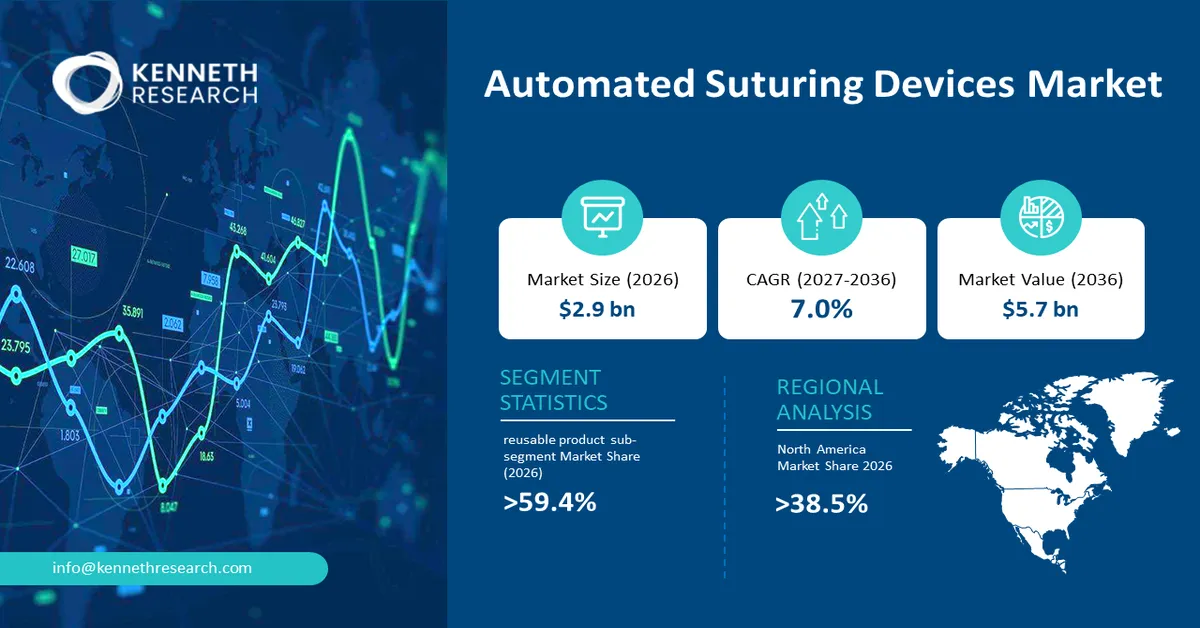
Automated Suturing Devices Market size was valued at USD 2.9 billion in 2026 and is projected to reach USD 5.7 billion by the end of 2036, expanding at a CAGR of 7.0% during the forecast period, i.e., 2027-2036. In 2027, the industry size of the automated suturing devices is estimated at USD 3.1 billion.
The rising volume of complex surgical procedures is driving demand for automated suturing devices by increasing the need for consistent, controlled, and efficient tissue closure.
Automated suturing devices are surgical instruments engineered to assist, mechanize, or automate the placement of sutures for tissue approximation and wound closure. Unlike conventional manual suturing, these systems integrate mechanical, powered, endoscopic, or computer-controlled mechanisms that can help clinicians position, deploy, tighten, or manage sutures with greater procedural consistency.
Key characteristics include controlled suture placement, ergonomic operation, compatibility with minimally invasive techniques, and designs intended to facilitate closure in anatomically constrained surgical fields. Depending on the device architecture, automation can range from mechanically assisted stitch deployment to computer-controlled robotic manipulation. The U.S. Food and Drug Administration classifies endoscopic tissue approximation devices as medical devices used for placing interrupted or running stitches in soft tissue; recent FDA-cleared systems demonstrate continued development of specialized suturing technologies for endoscopic procedures.
Key Automated Suturing Devices Market Insights Summary:
Key Takeaways: Market Trends & Insights
- The automated suturing devices market is valued at USD 2.9 billion in 2026 and is projected to reach USD 5.7 billion by 2036
- The market is expected to expand at a CAGR of 7.0% from 2027 to 2036
- The reusable product segment holds the leading position with a 59.4% market share in 2026
- North America dominates the regional landscape with a 38.5% market share in 2026
- The cardiac application segment is projected to register significant growth during 2027-2036
Market Drivers
- Expansion of minimally invasive and ambulatory surgery
- Integration of advanced automation and surgical technologies
- Increasing demand for procedural precision and standardized tissue closure
- Growing adoption of specialized surgical technologies across complex procedures
Challenges
- High device complexity and procedural learning requirements
- High development, validation, and regulatory burden
Automated Suturing Devices Market Overview & Supply Chain
Adoption of automated suturing devices is increasing as healthcare systems seek greater consistency, procedural efficiency, and precision in tissue closure, particularly across minimally invasive, robotic, and complex surgical procedures. The technology also aligns with broader patient-safety priorities, where controlled closure and reproducible surgical techniques can support efforts to reduce avoidable complications.
The automated suturing devices value chain begins with specialized inputs including medical-grade polymers, metals, electronic components, motors, sensors, sterile packaging materials, and surgical-grade suture materials. Component suppliers provide the precision materials and subassemblies required for device reliability, biocompatibility, and controlled mechanical performance. Manufacturers then undertake device engineering, component integration, assembly, sterilization, quality assurance, and regulatory compliance before products enter commercial distribution. Distributors and specialized medical-device suppliers connect manufacturers with hospitals, ambulatory surgical centers, specialty clinics, and other healthcare institutions, while procurement organizations influence product selection through clinical, operational, and economic criteria. Surgeons, operating-room teams, hospital administrators, and sterile-processing personnel are key end users or stakeholders.
Automated Suturing Devices Market: Growth Drivers & Challenges
Growth Drivers:
- Expansion of minimally invasive and ambulatory surgery: The increasing adoption of minimally invasive and ambulatory surgical techniques is strengthening demand for automated suturing devices because these procedures often require precise tissue approximation within restricted operating fields. Automated suturing technologies can help address limitations associated with conventional manual suturing by improving instrument ergonomics, supporting repeatable stitch placement, and simplifying closure in technically demanding procedures.
- Integration of advanced automation and surgical technologies: Advances in surgical automation, robotics, mechanical actuation, visualization, and instrument design are creating a stronger technological foundation for automated suturing devices. Modern systems can reduce the physical complexity associated with needle manipulation and suture placement while giving surgeons more controlled interaction with difficult anatomical locations. Integration with minimally invasive platforms can also enable manufacturers to design devices around specific procedural requirements rather than relying solely on generalized manual instruments.
Challenges:
- High device complexity and procedural learning requirements: Automated suturing devices can involve specialized mechanisms, articulated components, powered actuation, or integration with minimally invasive platforms, making their operation more complex than conventional manual suturing instruments. The root challenge is the need for surgeons and operating-room teams to develop familiarity with device-specific controls, loading procedures, troubleshooting, and appropriate tissue-handling techniques.
- High development, validation, and regulatory burden: Automated suturing devices require rigorous engineering validation because failures in needle deployment, suture placement, tissue approximation, or mechanical actuation can directly affect surgical outcomes. The root cause is the combination of mechanical precision, biocompatibility, sterility, electrical or software functionality where applicable, and clinical-use requirements within a single medical device.
Automated Suturing Devices Market Size and Forecast:
| Report Attribute | Details |
|---|---|
| Base Year |
2026 |
| Forecast Period |
2027-2036 |
| CAGR |
7.0% |
| Base Year Market Size (2026) |
USD 2.9 billion |
| Forecast Year Market Size (2036) |
USD 5.7 billion |
| Regional Scope |
|
Automated Suturing Devices Market Segmentation Analysis:
Product Segment Analysis
In the product segment, reusable sub-segment is anticipated to capture the largest market share of 59.4% by the end of 2026.
The reusable segment leads the product category because healthcare providers increasingly value devices that can support repeated procedural use within established sterilization and reprocessing systems. Reusable automated suturing platforms can offer hospitals greater operational flexibility, particularly where surgical departments conduct diverse procedures and require durable instrumentation. Demand is also supported by the continued role of ambulatory surgical centers and hospitals in procedural care. In its 2024 Medicare payment rule, the U.S. Centers for Medicare & Medicaid Services reported that its policies would affect approximately 6,000 ambulatory surgical centers, demonstrating the breadth of facilities representing potential demand for reusable surgical instrumentation.
Application Segment Analysis
The cardiac is projected to grow as the second-largest segment in the automated suturing devices market due to four converging demand drivers.
The cardiac segment is projected to grow as cardiovascular procedures increasingly incorporate minimally invasive approaches that require controlled, reliable tissue approximation in technically constrained anatomical environments. Automated suturing devices can support surgeons by facilitating consistent needle manipulation and suture placement, particularly in valve repair, coronary procedures, and other reconstructive cardiac interventions. Demand is reinforced by the continuing volume and complexity of cardiac surgery. The Society of Thoracic Surgeons' 2024 update reported that its Adult Cardiac Surgery Database encompassed more than 8.3 million procedures and more than 1,000 participating institutions, reflecting the extensive clinical infrastructure surrounding cardiac surgery in the United States.
Our in-depth analysis of the automated suturing devices market includes the following segments:
|
Segment |
Sub-segment |
|
Product |
|
|
Application |
|
|
End-Use |
|
Automated Suturing Devices Market Regional Insights:
North America Market Trends & Insights:
North America automated suturing devices market is projected to hold the largest revenue share of 38.5% by the end of 2026.
The region's leadership reflects its advanced surgical infrastructure, established medical-device manufacturing base, high adoption of minimally invasive and robotic procedures, and substantial hospital investment in specialized surgical technologies.
The United States remains the primary regional market, supported by extensive hospital capacity, sophisticated surgical centers, medical-device innovation, and strong investment in automation and minimally invasive procedures.
Canada represents a complementary market, supported by government-backed healthcare infrastructure, specialist surgical services, and continued modernization of clinical technologies. Together, the two countries strengthen North America's position as a leading environment for development, adoption, and commercialization of automated suturing technologies.
Asia Pacific Market Trends & Insights:
Asia Pacific represents an important opportunity for automated suturing devices as healthcare systems expand advanced surgical capabilities, minimally invasive procedures, and technology-enabled operating environments. Industrial activity is supported by growing domestic medical-device ecosystems and government efforts to strengthen surgical robotics, intelligent medical equipment, and clinical innovation.
China offers strong opportunities through its expanding medical-robotics ecosystem, supported by national and regional programs targeting intelligent medical equipment, surgical robotics, domestic technology development, and clinical demonstration. Beijing's 2024–2026 medical-device action plan specifically promotes surgical-robot applications and intelligent medical-device development.
Japan provides a technologically advanced base for adoption and innovation. Japan's National Cancer Center has established a dedicated robotic surgery and development center focused on minimally invasive treatment, surgical-device development, and clinician training, strengthening the country's potential as both an adoption and innovation hub.
Leading Companies Operating in the Automated Suturing Devices Market:
Here is a list of upstream, downstream, and key players operating in automated suturing devices market competitive ecosystem:
- Medtronic plc (Ireland)
- Company Overview
- Business Strategy
- Key Product Offerings
- Financial Performance
- Key Performance Indicators
- Risk Analysis
- Recent Development
- Regional Presence
- SWOT Analysis
- Boston Scientific Corporation (United States)
- LSI Solutions, Inc. (United States)
- B. Braun Melsungen AG (Germany)
- Suturion (Sweden)
Recent Developments
- In June 2025, Suturion's SutureTOOL™ is a semi-automated device for abdominal wall closure using the small-bites technique. A clinical study published in Hernia confirmed safe and efficient closure, with an average closure time of only 7.4 minutes compared to 14–30 minutes for manual suturing.
Frequently Asked Question
In 2026, the automated suturing devices market exceeded USD 2.9 billion.
The automated suturing devices market is projected to reach USD 5.7 billion by the end of 2036, expanding at a CAGR of 7.0% over the forecast period (2027-2036).
The major players in the market are Medtronic plc, Boston Scientific Corporation, LSI Solutions, Inc., B. Braun Melsungen AG, Suturion, and others.
In the product segment, the reusable sub-segment is anticipated to capture the largest market share of 59.4% in the future and exhibit lucrative growth opportunities during 2027-2036. This growth trajectory is largely attributed to demand for durable surgical instruments that support repeated procedural use within established sterilization and reprocessing workflows.
North America is projected to hold the largest market share of 38.5% by the end of 2026 and provide more business opportunities in the future. Continuous investments in advanced surgical technologies, supported by the established healthcare and medical-device ecosystems of the United States and Canada, are fostering the region's dominance.
Why Choose Kenneth Research ?
-
Insight with Impact : We don’t just gather data — we uncover stories, trends, and opportunities that fuel business growth.
-
Experts Who Get It : Our team speaks your industry’s language and knows what really matters to your customers and market.
-
Custom-Built for You : Forget one-size-fits-all. We craft research and consulting solutions as unique as your business vision.
-
Partners, Not Just Providers : We work with you, not for you — collaborating closely to turn insights into smart, strategic moves.
-
Results That Speak : Our work powers brands, startups, and industry leaders alike — with a track record of ideas that work in the real world.
Report ID: 1402 |
Published Date: 25 Sep 2026 |
Report Format: |
Delivery Timeline: 48-72 Business Hours

Copyright © 2025 Kenneth Research. All rights reserved. Terms of Use | Privacy Policy
