Report ID: 1365 |
Published Date: 28 Sep 2026 |
Report Format: |
Delivery Timeline: 48-72 Business Hours
Asphalt Additives Market Outlook:
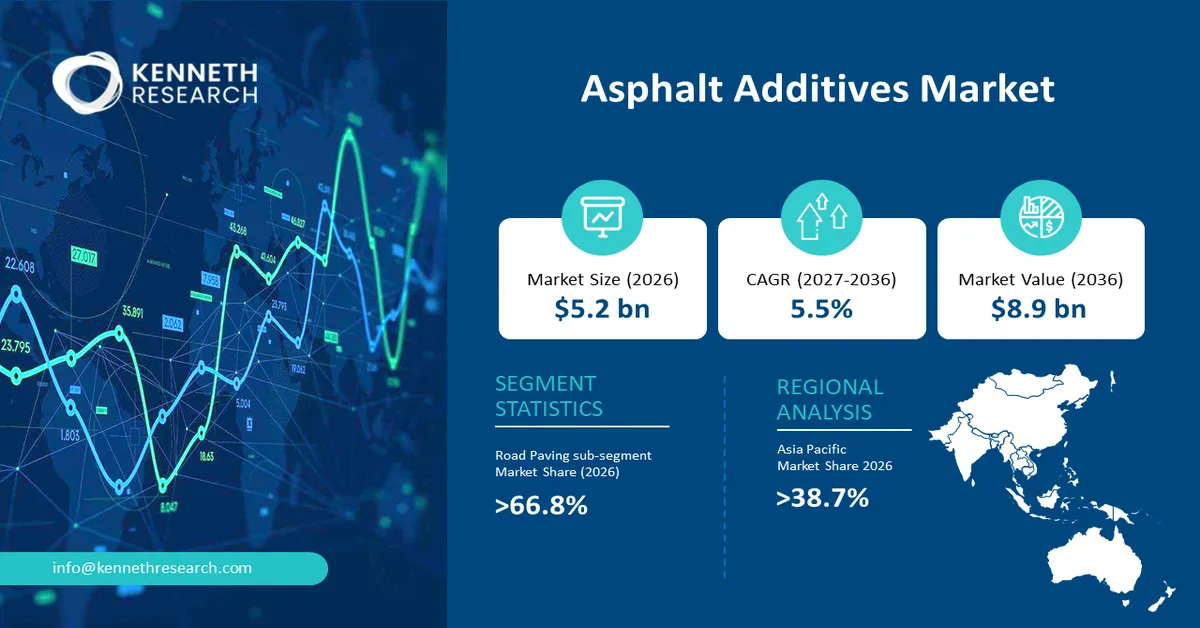
Asphalt Additives Market size was valued at USD 5.2 billion in 2026 and is projected to reach USD 8.9 billion by the end of 2036, rising at a CAGR of 5.5% during the forecast period, i.e., 2027-2036. In 2027, the industry size of the asphalt additives is estimated at USD 5.5 billion.
The primary growth driver for the asphalt additives market is the increasing need for durable, high-performance road infrastructure.
The asphalt additives market comprises specialized chemical and mineral-based materials incorporated into asphalt mixtures or binders to enhance pavement performance, durability, workability, and resistance to environmental and operational stresses. These additives modify specific properties of asphalt, including viscosity, adhesion, elasticity, temperature susceptibility, moisture resistance, and aging behavior. Key product categories include polymers, anti-stripping agents, warm-mix additives, rejuvenators, fibers, and other performance-enhancing formulations designed for different pavement requirements.
The market serves road paving and maintenance applications across highways, urban roads, bridges, airport pavements, and other transportation infrastructure. Its industrial relevance stems from the need to extend pavement service life while improving construction efficiency and reducing maintenance frequency.
Key Asphalt Additives Market Insights Summary:
Key Takeaways: Market Trends & Insights
- asphalt additives market projected to grow from USD 5.2 billion in 2026 to USD 8.9 billion by 2036 at a 5.5% CAGR
- Asia-Pacific accounted for the largest regional share at 38.7% in 2026, supported by extensive road infrastructure, ongoing highway development, and increasing pavement investment across Japan and China
- Road Paving is expected to remain the leading Application segment, accounting for 66.8% of the market in 2026, driven by demand for durable, high-performance asphalt for new construction and road rehabilitation
- Liquid Asphalt Additives are positioned for continued growth as their convenient handling, controlled dosing, and compatibility with asphalt production processes support applications including adhesion enhancement, moisture resistance, and pavement performance optimization
Market Drivers
- Expansion of road infrastructure
- Increasing focus on pavement performance and resource efficiency
Challenges
- High formulation and implementation complexity
- Higher costs and specification constraints
Asphalt Additives Market Overview & Supply Chain
The asphalt additives market is gaining importance as road agencies, contractors, and asphalt producers focus on pavement durability, traffic performance, construction efficiency, and lifecycle maintenance. Additives enable asphalt formulations to withstand demanding loading and environmental conditions while improving properties such as adhesion, flexibility, workability, moisture resistance, and temperature performance. The relevance of performance-enhanced asphalt is reinforced by sustained road usage.
The supply chain begins with raw-material and specialty-chemical inputs used to formulate polymers, fibers, surfactants, adhesion promoters, rejuvenators, anti-stripping agents, and other performance-enhancing compounds. Manufacturers then blend, modify, and formulate these inputs into application-specific additives compatible with asphalt binders and mixtures. Product quality depends on formulation consistency, compatibility with asphalt chemistry, storage stability, and performance under targeted pavement conditions.
Asphalt Additives Market: Growth Drivers & Challenges
Growth Drivers:
- Expansion of road infrastructure: Expansion of highway and road infrastructure is increasing the addressable demand for asphalt additives because new pavements and upgraded corridors require asphalt mixtures capable of delivering reliable performance under heavy traffic and varying environmental conditions. Additives can improve binder and mixture characteristics, supporting resistance to deformation, cracking, moisture-related deterioration, and other pavement distresses. This creates opportunities for polymer modifiers, anti-stripping agents, rejuvenators, fibers, and other performance-enhancing formulations across both new construction and rehabilitation projects.
- Increasing focus on pavement performance and resource efficiency: Growing emphasis on pavement longevity and efficient use of existing road materials is encouraging asphalt producers and contractors to adopt additives that can tailor binder and mixture performance to specific project requirements. Recycled asphalt pavement can alter the characteristics of asphalt mixtures, creating a need for formulation strategies that address stiffness, aging, cracking susceptibility, and compatibility between reclaimed and virgin binder. This supports demand for recycling agents, rejuvenators, polymers, and other additives designed to balance performance requirements.
Challenges:
- High formulation and implementation complexity: Asphalt additives must be carefully matched with the binder, aggregate characteristics, pavement design, climate, and intended operating conditions. Different additive chemistries can produce different performance outcomes, making formulation and dosage optimization important before commercial deployment. Compatibility and storage stability can also create operational challenges, particularly when additives require specific handling or mixing procedures.
- Higher costs and specification constraints: The commercial adoption of advanced asphalt additives can be constrained by higher formulation, testing, and processing costs compared with conventional asphalt materials. Polymer modifiers, specialty chemicals, fibers, and emerging additive technologies may require additional equipment, controlled dosing, specialized storage, or modified production procedures. Industry specifications and qualification requirements can further lengthen adoption cycles because infrastructure owners typically require demonstrated field performance before approving new formulations.
Asphalt Additives Market Size and Forecast:
| Report Attribute | Details |
|---|---|
| Base Year |
2026 |
| Forecast Period |
2027-2036 |
| CAGR |
5.5% |
| Base Year Market Size (2026) |
USD 5.2 billion |
| Forecast Year Market Size (2036) |
USD 8.9 billion |
| Regional Scope |
|
Asphalt Additives Market Segmentation Analysis:
Application Segment Analysis
In the application segment, the Road Paving sub-segment is anticipated to capture the largest market share of 66.8% in 2026.
Road paving represents the leading application segment in the asphalt additives market because additive-enhanced asphalt is closely aligned with the performance requirements of new road construction, resurfacing, rehabilitation, and high-traffic corridors. Additives help asphalt mixtures achieve targeted properties such as improved resistance to rutting, cracking, moisture damage, and temperature-related deterioration, making them valuable for infrastructure exposed to demanding operating conditions. Demand is also supported by greater emphasis on pavement quality, construction consistency, and lifecycle performance.
Form Type Segment Analysis
Liquid asphalt additives are projected to grow as asphalt producers and paving contractors seek formulations that can be incorporated efficiently into binders and mixtures while improving handling and pavement performance. Their liquid form can facilitate controlled dosing and blending, making them suitable for applications such as anti-stripping treatments, warm-mix technologies, and binder modification. This flexibility supports adoption across paving and maintenance activities where material handling and application efficiency are important.
From the supply side, manufacturers can formulate liquid additives for particular binder chemistries, aggregate conditions, and pavement requirements. Their compatibility with established asphalt production processes can support broader commercial adoption.
Our in-depth analysis of the global asphalt additives market includes the following segments:
|
Segment |
Sub-segment |
|
Product Type |
|
|
Form |
|
|
Application |
|
|
End User |
|
Asphalt Additives Market Regional Insights:
Asia-Pacific Market Trends & Insights:
Asia-Pacific holds the dominant position in the asphalt additives market, supported by extensive transportation infrastructure, continuing road development, urbanization, and sustained investment in pavement construction and rehabilitation. The region's large construction base creates significant demand for asphalt performance-enhancement technologies, particularly where infrastructure operators seek improved durability, resistance to traffic loading, and longer maintenance cycles. The region's leadership is further reinforced by the scale of road infrastructure in China.
Japan represents an important mature market within the region, where established transportation infrastructure creates demand for pavement maintenance, rehabilitation, and technologies that improve service performance.
China's market is supported by its exceptionally large road network and continuing infrastructure development. Government transportation statistics indicate that China's highway network expanded further during 2024, including additional expressway infrastructure, creating opportunities for additive suppliers serving new construction and upgrading requirements.
North America Market Trends & Insights:
North America represents a significant market for asphalt additives, supported by extensive road infrastructure, continued pavement rehabilitation, and increasing emphasis on performance-oriented and resource-efficient asphalt technologies. Government transportation programs are also encouraging innovation in asphalt materials and pavement construction.
The U.S. remains the principal country market in North America because of its extensive transportation network and established asphalt paving industry. Federal initiatives are additionally supporting the adoption of lower-impact transportation construction materials. In 2024, the FHWA launched the Low Carbon Transportation Materials Program to support the purchase of lower-carbon construction materials and products used in transportation, explicitly including asphalt.
Canada also offers opportunities through its extensive road maintenance requirements and increasing attention to pavement sustainability and innovative materials. Across the region, demand is expected to increasingly favor additives that improve durability, facilitate recycled-material utilization, reduce production impacts, and meet evolving pavement specifications.
Leading Companies Operating in the Asphalt Additives Market:
Here is a list of upstream, downstream, and key players operating in the global asphalt additives market competitive ecosystem:
- Arkema (France)
- Company Overview
- Business Strategy
- Key Product Offerings
- Financial Performance
- Key Performance Indicators
- Risk Analysis
- Recent Development
- Regional Presence
- SWOT Analysis
- Nouryon (Netherlands)
- Evonik (Germany)
Recent Developments
- July 2026: Ingevity announced that its Evotherm® P35 warm-mix asphalt additive received approval from Germany’s Federal Highway Research Institute (BASt) for use in warm-mix asphalt applications.
- July 2025: Nouryon collaborated with the Central Road Research Institute (CSIR–CRRI) and the PHD Chamber of Commerce and Industry to host the International Conference on Bitumen Emulsion in New Delhi.
Frequently Asked Question
In 2026, the asphalt additives market exceeded USD 5.2 billion.
The asphalt additives market is projected to reach USD 8.9 billion by the end of 2036, expanding at a CAGR of 5.5% over the forecast period (2027-2036).
The major players in the market are Arkema, Nouryon, Evonik, and Ingevity.
In the Application segment, the Road Paving sub-segment is anticipated to capture the largest market share of 66.8% in the future and exhibit lucrative growth opportunities during 2027-2036.
Asia-Pacific is projected to hold the largest market share of 38.7% by the end of 2026 and provide more business opportunities in the future.
Why Choose Kenneth Research ?
-
Insight with Impact : We don’t just gather data — we uncover stories, trends, and opportunities that fuel business growth.
-
Experts Who Get It : Our team speaks your industry’s language and knows what really matters to your customers and market.
-
Custom-Built for You : Forget one-size-fits-all. We craft research and consulting solutions as unique as your business vision.
-
Partners, Not Just Providers : We work with you, not for you — collaborating closely to turn insights into smart, strategic moves.
-
Results That Speak : Our work powers brands, startups, and industry leaders alike — with a track record of ideas that work in the real world.
Report ID: 1365 |
Published Date: 28 Sep 2026 |
Report Format: |
Delivery Timeline: 48-72 Business Hours

Copyright © 2025 Kenneth Research. All rights reserved. Terms of Use | Privacy Policy
