Report ID: 1379 |
Published Date: 15 Sep 2026 |
Report Format: |
Delivery Timeline: 48-72 Business Hours
Aseptic Packaging Market Outlook:
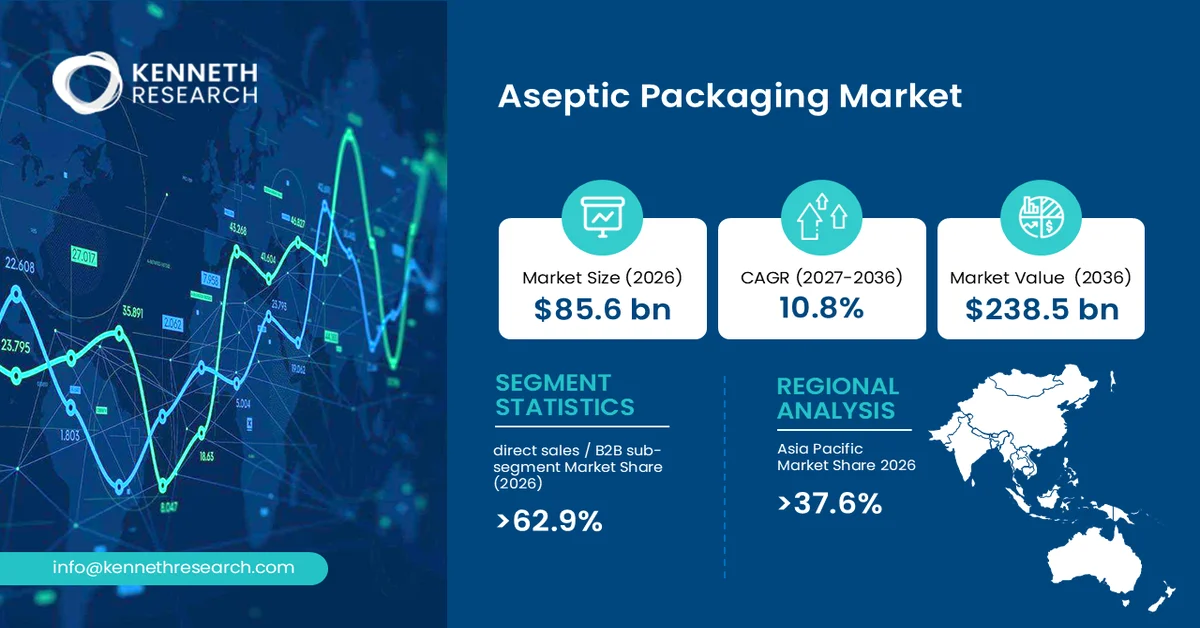
Aseptic Packaging Market size was valued at USD 85.6 billion in 2026 and is projected to reach USD 238.5 billion by the end of 2036, rising at a CAGR of 10.8% during the forecast period, i.e., 2027–2036. In 2027, the industry size of the global aseptic packaging market is estimated at USD 94.7 billion.
The primary growth driver is rising demand for shelf-stable food and beverages that can maintain safety and quality without continuous refrigeration. Aseptic processing combines commercial sterilization of the product and package with hygienic filling and sealing, enabling manufacturers to support broader distribution, inventory flexibility, and longer product usability.
The aseptic packaging market comprises packaging systems designed to preserve commercially sterile food or beverage products by filling them into commercially sterile containers under controlled, hygienic conditions. The process is distinct from conventional packaging because product sterilization, package sterilization, filling, and sealing are coordinated to prevent microbial contamination after processing.
Key characteristics include high barrier protection, controlled filling environments, hermetic sealing, and packaging structures engineered to protect contents from external contamination and deterioration. Aseptic formats can incorporate paperboard, polyethylene, and aluminum layers, with each material contributing structural strength, liquid tightness, or protection against environmental exposure.
Key Aseptic Packaging Market Insights Summary:
Key Takeaways: Market Trends & Insights
- The aseptic packaging market is valued at USD 85.6 Billion in 2026 and is projected to reach USD 238.5 Billion by 2036
- The market is projected to expand at a CAGR of 10.8% during 2027–2036
- Direct Sales / B2B accounts for the largest share within the Distribution Channel segment, with a 62.9% market share in 2026
- Asia Pacific holds the dominant regional position, accounting for 37.6% market share in 2026
- China and Japan are the key country markets in Asia Pacific, while the United States and Canada are the key country markets in North America
Market Drivers
- Sustainable Packaging Innovation
- Shelf-Stable Distribution and Supply-Chain Flexibility
- Food-Safety and Product-Protection Requirements
- Expansion of Processed and Ready-to-Consume Food Applications
Challenges
- Recycling Complexity and Material Compatibility
- High Integration Requirements for Aseptic Production
Aseptic Packaging Market Overview & Supply Chain
Global adoption of aseptic packaging is increasing as food and beverage manufacturers seek packaging systems that support product safety, shelf stability, distribution flexibility, and efficient supply-chain management. The technology is particularly relevant where manufacturers need to protect processed products from microbial contamination while maintaining product quality during storage and transportation. Its industrial importance is reinforced by the continuing global food-safety burden. The World Health Organization reported that unsafe food caused 866 million cases globally in 2021, highlighting the importance of effective food-safety controls across the food chain.
The industry value chain begins with raw-material suppliers providing paperboard, polymers, aluminum, adhesives, coatings, inks, and other functional inputs required to manufacture aseptic packaging structures. Packaging producers then convert these materials into multilayer cartons, pouches, bottles, closures, and associated components through processes including coating, lamination, printing, forming, sterilization integration, and quality control. Equipment manufacturers and technology providers supply filling, sealing, sterilization, inspection, and automation systems that enable controlled production environments. Finished packaging is distributed directly or through specialized distributors to food and beverage manufacturers, contract processors, and other industrial users. These end users integrate aseptic packaging with food-processing and filling operations before products move through wholesalers, retailers, institutional channels, and other distribution networks.
Aseptic Packaging Market - Growth Drivers & Challenges
Growth Drivers
- Sustainable Packaging Innovation: A major growth driver is the development of lower-impact aseptic packaging formats that respond to manufacturers’ sustainability objectives while preserving food safety and functional performance. Packaging suppliers are increasingly redesigning material structures, barrier layers, and polymer components to reduce reliance on conventional inputs without compromising protection against oxygen, light, moisture, and contamination.
- Shelf-Stable Distribution and Supply-Chain Flexibility: The increasing need for dependable distribution of processed food and beverages is another important growth driver. Aseptic packaging enables commercially sterile products to be placed into sterile containers under controlled hygienic conditions, supporting shelf-stable formats that can move through distribution networks without the same dependence on continuous refrigeration. This capability can simplify inventory management, broaden geographic reach, and provide manufacturers with greater flexibility when serving retailers, institutional buyers, and geographically dispersed markets.
Challenges
- Recycling Complexity and Material Compatibility: A key restraint is the technical difficulty of recovering aseptic packaging after use. Aseptic cartons commonly combine paperboard with polymeric and barrier components to achieve structural integrity, liquid containment, and product protection. These multilayer constructions can complicate sorting, separation, and processing within recycling systems that are primarily configured around established material streams.
- High Integration Requirements for Aseptic Production: A second restraint is the operational complexity involved in integrating aseptic packaging into food and beverage manufacturing. Unlike conventional filling, aseptic operations require coordinated product treatment, packaging sterilization, controlled filling conditions, sealing, and process monitoring. Manufacturers therefore need compatible processing and packaging equipment, validated operating procedures, trained personnel, and rigorous quality-control systems.
Aseptic Packaging Market Size and Forecast:
| Report Attribute | Details |
|---|---|
| Base Year |
2026 |
| Forecast Year |
2027-2036 |
| CAGR |
10.8% |
| Base Year Market Size (2026) |
USD 85.6 billion |
| Forecast Year Market Size (2036) |
USD 238.5 billion |
| Regional Scope |
|
Aseptic Packaging Market - Segment Analysis
Distribution Channel Segment Analysis
In the distribution channel segment, direct sales / B2B sub-segment is anticipated to capture the largest market share of 62.9% by the end of 2026.
Direct Sales / B2B dominates the distribution-channel segment because aseptic packaging is primarily specified and purchased through structured commercial relationships between packaging suppliers, food and beverage manufacturers, processors, and institutional buyers. Demand is supported by manufacturers’ need for consistent packaging specifications, integrated filling solutions, reliable supply, and technical support. The channel also enables closer coordination between packaging converters and production facilities, which is important where packaging materials must be compatible with sterilization and high-speed filling systems. Future adoption should remain concentrated in B2B channels as manufacturers prioritize supply continuity, specification control, and integrated packaging solutions.
End User Type Segment Insights
The food & beverage manufacturers is projected to grow as the second-largest segment in the aseptic packaging market due to four converging demand drivers.
Food & Beverage Manufacturers are projected to grow as demand for processed, shelf-stable, and conveniently distributed products increases the need for packaging that supports controlled processing and extended product usability. Aseptic systems are particularly relevant to manufacturers producing beverages, dairy products, liquid foods, and other products requiring strong microbiological protection. China’s National Bureau of Statistics reported that, in 2023, the value added of the country’s agriculture and related industries reached 19.8534 trillion yuan. his expanding processing base provides a substantial industrial customer pool for advanced packaging technologies. Adoption is also supported by packaging suppliers developing integrated filling, sterilization, automation, and material solutions tailored to food manufacturers.
Our in-depth analysis of the aseptic packaging market includes the following segments:
|
Segment |
Sub-segment |
|
Material Type |
|
|
Packaging Type/ Format |
|
|
Distribution Channel |
|
|
End User Type |
|
Aseptic Packaging Market - Regional Analysis
Asia Pacific Market Trends & Insights:
Asia Pacific aseptic packaging market is projected to hold the largest revenue share of 37.6% by the end of 2026.
Regional dominance reflects the concentration of food and beverage manufacturing, expanding packaged-food consumption, and continuing investment in processing and packaging infrastructure.
China represents a key country market because of its extensive food-processing industry, large manufacturing ecosystem, and continued modernization of packaging operations. Government initiatives are encouraging safer, more recyclable, and technologically advanced packaging solutions, supporting long-term industry development.
Japan represents another important market, supported by a sophisticated food-processing sector, established manufacturing infrastructure, and strong emphasis on product quality and operational efficiency. Its mature industrial environment favors adoption of packaging technologies that provide consistent performance and reliable product protection. Together, China and Japan provide complementary strengths: China offers broad manufacturing scale and ongoing industrial development, while Japan contributes technological maturity and quality-focused production capabilities.
North America Market Trends & Insights:
North America represents an important secondary region for the aseptic packaging market, supported by established food and beverage processing industries, sophisticated packaging infrastructure, and continued demand for convenient, shelf-stable products.
The United States remains the region’s principal country market, benefiting from a mature food-processing ecosystem, established retail and distribution networks, and strong demand for convenient packaged foods and beverages. Regulatory emphasis on food safety and packaging-material compliance further supports investment in controlled processing and packaging technologies.
Canada offers additional opportunities through modernization of its food-processing sector and government-backed initiatives focused on food safety, traceability, efficiency, and supply-chain resilience. These conditions can encourage processors to upgrade equipment and adopt packaging technologies capable of supporting operational efficiency and product protection. Together, the United States and Canada provide a favorable foundation for continued aseptic packaging adoption, particularly where manufacturers seek modernization, dependable distribution, and stronger food-safety performance.
Aseptic Packaging Market Competitive Landscape
Here is a list of upstream, downstream, and key players operating in aseptic packaging market competitive ecosystem:
- Tetra Pak International S.A. (Switzerland)
- Company Overview
- Business Strategy
- Key Product Offerings
- Financial Performance
- Key Performance Indicators
- Risk Analysis
- Recent Development
- Regional Presence
- SWOT Analysis
- SIG Combibloc Group AG (Switzerland)
- Amcor plc (Australia)
- Sealed Air Corporation (United States)
- U Flex Limited (India)
Recent Developments
- In 2025–2026, UFlex reported record aseptic packaging output and completed brownfield expansion at its Sanand, Gujarat facility, increasing capacity from 7 to 12 billion packs per annum. The company is also setting up a greenfield aseptic liquid packaging facility in Egypt with an annual production capacity of 12 billion carton packs.
- In April 2026, Sealed Air was acquired by private equity firm Clayton, Dubilier & Rice (CD&R) in a $10.3 billion deal. As part of the transaction, the company delisted from the New York Stock Exchange and became a privately held entity. Sealed Air's President and CEO stated the partnership would accelerate the company's strategy, investing in innovation and expanding capabilities with a longer-term vision.
Frequently Asked Question
In 2026, the aseptic packaging market exceeded USD 85.6 billion.
The aseptic packaging market is projected to reach USD 238.5 billion by the end of 2036, expanding at a CAGR of 10.8% over the forecast period (2027-2036).
The major players in the market are Tetra Pak International S.A., SIG Combibloc Group AG, Amcor plc, Sealed Air Corporation, U Flex Limited and others.
In the Distribution Channel segment, the Direct Sales / B2B sub-segment is anticipated to capture the largest market share of 62.9% in the future and exhibit lucrative growth opportunities during 2027-2036. This growth trajectory is largely attributed to manufacturers' need for consistent packaging specifications, reliable supply, and technical support.
Asia Pacific is projected to hold the largest market share of 37.6% by the end of 2026 and provide more business opportunities in the future. Continuous investments in food-processing modernization, packaging infrastructure, automation, and advanced manufacturing capabilities in China and Japan are fostering the region's dominance.
Why Choose Kenneth Research ?
-
Insight with Impact : We don’t just gather data — we uncover stories, trends, and opportunities that fuel business growth.
-
Experts Who Get It : Our team speaks your industry’s language and knows what really matters to your customers and market.
-
Custom-Built for You : Forget one-size-fits-all. We craft research and consulting solutions as unique as your business vision.
-
Partners, Not Just Providers : We work with you, not for you — collaborating closely to turn insights into smart, strategic moves.
-
Results That Speak : Our work powers brands, startups, and industry leaders alike — with a track record of ideas that work in the real world.
Report ID: 1379 |
Published Date: 15 Sep 2026 |
Report Format: |
Delivery Timeline: 48-72 Business Hours

Copyright © 2025 Kenneth Research. All rights reserved. Terms of Use | Privacy Policy
