Report ID: 1067 |
Published Date: 11 Aug 2026 |
Report Format: |
Delivery Timeline: 48-72 Business Hours
Allogeneic Stem Cell Therapy Market Outlook:
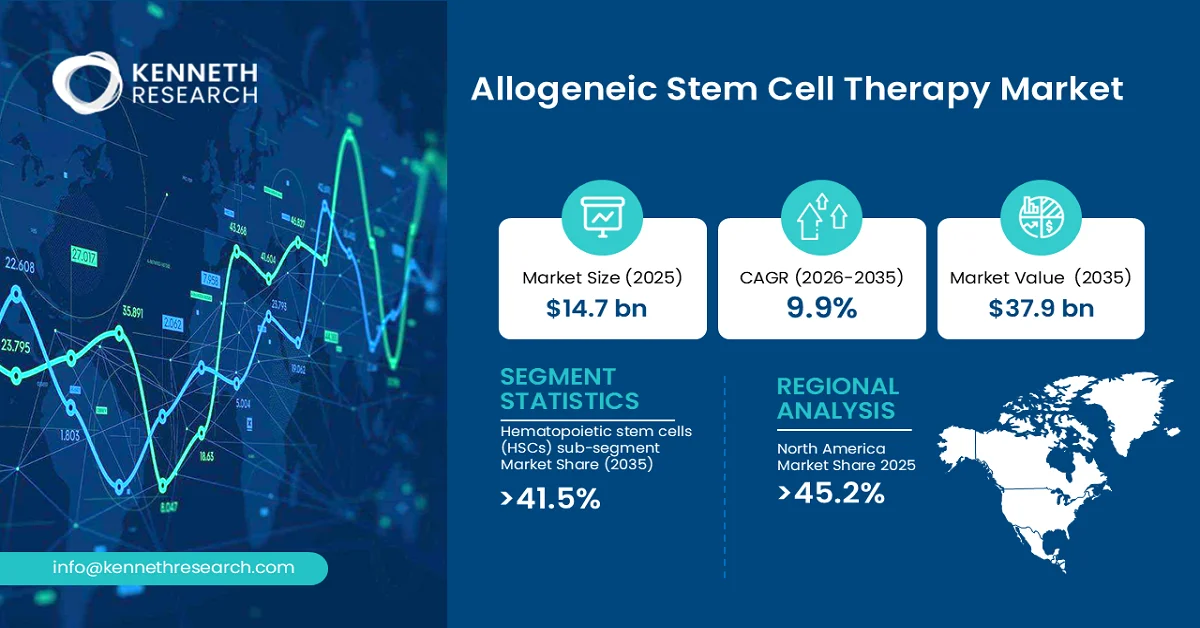
Allogeneic Stem Cell Therapy Market size was valued at USD 14.7 billion in 2025 and is projected to reach USD 37.9 billion by the end of 2035, rising at a CAGR of 9.9% during the forecast period, i.e., 2026-2035. In 2026, the industry size of the allogeneic stem cell therapy is estimated at USD 16.5 billion.
The allogeneic stem cell therapy market is primarily driven by expanding clinical adoption of donor-derived stem cell therapies supported by regulatory approvals and increasing transplant activity. Recent regulatory milestones for allogeneic cell therapies have strengthened confidence in standardized, scalable treatment approaches while broadening therapeutic applications in hematologic disorders and regenerative medicine.
The allogeneic stem cell therapy market comprises therapies developed from stem cells donated by a genetically different individual rather than the recipient. These therapies include hematopoietic stem cells, mesenchymal stem cells, and other donor-derived cellular products intended for transplantation or regenerative treatment across hematologic, immunologic, and selected degenerative diseases. Unlike autologous approaches, allogeneic therapies enable centralized manufacturing, standardized quality control, and the potential for ready-to-use ("off-the-shelf") treatment availability, supporting broader clinical accessibility.
The market is characterized by advanced cell processing technologies, stringent donor screening, cryopreservation capabilities, regulatory oversight, and specialized clinical administration within transplant centers and hospitals. It encompasses research, manufacturing, clinical development, commercialization, and post-transplant patient management, requiring compliance with rigorous safety and quality standards established by health authorities.
Industrial relevance is increasing as healthcare systems expand access to stem cell transplantation and regenerative medicine. The market supports biotechnology innovation, specialized manufacturing infrastructure, hospital-based cellular therapy programs, and precision medicine initiatives. Continued integration of donor-derived cellular therapies into clinical practice is reinforcing the sector's importance within advanced biologics and regenerative healthcare, while encouraging investment in scalable manufacturing platforms and next-generation therapeutic development.
Key Allogeneic Stem Cell Therapy Market Insights Summary:
Key Takeaways: Market Trends & Insights
- The allogeneic stem cell therapy market is expected to expand from USD 16.5 billion in 2026 to USD 37.9 billion by 2035, reflecting a 9.9% CAGR over the forecast period.
- Hematopoietic stem cells (HSCs) are projected to remain the leading stem cell type, accounting for 41.5% of the market share in 2035 due to their established clinical use in hematologic and immune-related disorders
- North America held the dominant regional position with a 45.2% market share in 2025, supported by advanced transplant infrastructure, strong biotechnology capabilities, and continued innovation across the United States and Canada
- Hospitals are anticipated to witness significant growth as the leading end-use segment, driven by increasing integration of allogeneic stem cell therapies into specialized transplant programs and multidisciplinary clinical care
- Growing regulatory support, expanding commercial manufacturing capabilities, and continuous advancements in donor-derived cell processing technologies are strengthening the long-term adoption of allogeneic stem cell therapies across global healthcare systems
Market Drivers
- Expanding regulatory validation for allogeneic cell therapies.
- Advances in scalable cell manufacturing and cryopreservation.
- Increasing clinical applications in hematologic malignancies, autoimmune disorders, and regenerative medicine.
- Growing investments in cell therapy manufacturing infrastructure and strategic
Challenges
- Complex manufacturing and quality control requirements.
- Limited donor availability and complex supply chain coordination.
Allogeneic Stem Cell Therapy Market Overview & Supply Chain
Global adoption of allogeneic stem cell therapies is accelerating as healthcare systems prioritize scalable regenerative medicine platforms that can be manufactured in advance and supplied as standardized, donor-derived treatments. Compared with patient-specific approaches, allogeneic therapies support centralized production, quality consistency, and broader clinical availability, making them attractive for hospitals and transplant centers. Advances in cell expansion, cryopreservation, and manufacturing automation are further improving commercial viability, while evolving regulatory pathways are enabling faster translation of innovative therapies into clinical practice. A notable milestone occurred in 2024, when the U.S. Food and Drug Administration approved the first mesenchymal stromal cell (MSC) therapy for steroid-refractory acute graft-versus-host disease, marking a significant advancement in regulatory recognition of allogeneic cell therapies and reinforcing confidence in donor-derived regenerative medicine.
The value chain for the allogeneic stem cell therapy market begins with donor recruitment and screening, followed by the procurement of qualified biological materials from bone marrow, umbilical cord blood, placental tissue, or other approved sources. These inputs undergo rigorous testing, isolation, cell expansion, characterization, and cryopreservation in Good Manufacturing Practice (GMP)-compliant facilities to ensure product quality, safety, and consistency. Specialized logistics providers maintain ultra-low-temperature cold chains during transportation to preserve cell viability from manufacturing sites to healthcare facilities. Distribution is coordinated through biotechnology companies, contract development and manufacturing organizations (CDMOs), cell banks, and specialty distributors. End users primarily include hospitals, transplant centers, academic medical institutions, and specialized regenerative medicine clinics. Key stakeholders across the ecosystem include donor registries, biotechnology developers, raw material suppliers, regulatory authorities, quality assurance organizations, healthcare providers, reimbursement agencies, and research institutions collaborating to support clinical adoption and long-term commercialization.
Allogeneic Stem Cell Therapy Market: Growth Drivers & Challenges
Growth Drivers:
- Expanding regulatory validation for allogeneic cell therapies: Regulatory progress is strengthening confidence in allogeneic stem cell therapies by establishing clearer approval pathways and demonstrating the clinical viability of donor-derived cellular products. Regulatory recognition reduces commercialization uncertainty, encourages investment in advanced manufacturing facilities, and accelerates the transition of therapies from clinical development to routine healthcare settings. This momentum also stimulates collaborations among biotechnology companies, hospitals, and research institutions seeking to expand treatment options for hematologic and immune-mediated disorders. A major milestone occurred in December 2024, when the U.S. Food and Drug Administration approved Ryoncil (remestemcel-L-rknd), the first FDA-approved mesenchymal stromal cell (MSC) therapy, providing an important regulatory precedent for future allogeneic cell therapies and reinforcing industry confidence in standardized donor-derived products. Future regulatory harmonization and growing clinical evidence are expected to support broader therapeutic indications and increased commercialization across global healthcare markets.
- Advances in scalable cell manufacturing and cryopreservation: Continuous improvements in cell processing, expansion technologies, automation, and cryopreservation are making allogeneic stem cell therapies increasingly suitable for large-scale commercial production. Standardized manufacturing processes enhance product consistency while reducing operational complexity compared with patient-specific therapies. Improved preservation techniques extend product shelf life and enable efficient transportation through specialized cold-chain networks, supporting wider geographic access. These developments also encourage healthcare providers to integrate donor-derived therapies into established treatment pathways by improving product availability and reducing logistical constraints. Over the long term, investments in automated manufacturing platforms, digital quality monitoring, and next-generation bioprocessing technologies are expected to improve production efficiency, strengthen supply reliability, and facilitate broader adoption of allogeneic stem cell therapies across hospitals, transplant centers, and regenerative medicine programs worldwide.
Challenges:
- Complex manufacturing and quality control requirements: Manufacturing allogeneic stem cell therapies requires highly controlled production environments, stringent donor screening, advanced cell processing technologies, and comprehensive quality assurance systems. Variability in donor-derived biological materials increases the complexity of maintaining consistent product quality across manufacturing batches. Companies must also comply with evolving regulatory requirements related to sterility, potency, traceability, and long-term product stability, resulting in extended production timelines and high operational costs. These factors increase commercialization risks for therapy developers and create barriers for new market entrants that lack specialized manufacturing capabilities. From a commercial perspective, elevated production costs can influence pricing strategies and reimbursement negotiations, potentially limiting broader accessibility. Looking ahead, continued investments in manufacturing automation, process standardization, and advanced analytical technologies are expected to improve operational efficiency, although maintaining regulatory compliance will remain a significant challenge for industry participants.
- Limited donor availability and complex supply chain coordination: The success of allogeneic stem cell therapies depends on the availability of qualified donors, efficient biological material collection, and uninterrupted cold-chain logistics throughout the product lifecycle. Identifying suitable donors while meeting stringent eligibility and safety requirements can delay production schedules and limit the availability of specific cell sources. In addition, transporting cryopreserved cellular products requires specialized storage infrastructure and precise temperature management, increasing logistical complexity across regional and international supply networks. Commercially, these operational challenges can extend delivery timelines, increase distribution costs, and affect treatment scheduling for healthcare providers. Companies must also coordinate closely with donor registries, manufacturing facilities, logistics partners, and clinical centers to maintain product integrity. Future advancements in donor management systems, supply chain digitization, and improved cryopreservation technologies are expected to enhance operational resilience, but logistical coordination will remain a critical consideration as commercialization expands.
Allogeneic Stem Cell Therapy Market Size and Forecast:
| Report Attribute | Details |
|---|---|
| Base Year |
2025 |
| Forecast Year |
2026-2035 |
| CAGR |
9.9% |
| Base Year Market Size (2025) |
USD 14.7 billion |
| Forecast Year Market Size (2035) |
USD 37.9 billion |
| Regional Scope |
|
Allogeneic Stem Cell Therapy Market Segmentation Analysis:
Type Segment Analysis
In the type of stem cells segment, the hematopoietic stem cells (HSCs) sub-segment is anticipated to capture the largest market share of 41.5% by the end of 2035.
The hematopoietic stem cells (HSCs) sub-segment dominates the allogeneic stem cell therapy market due to its established clinical utility in restoring blood and immune system function for patients with hematologic malignancies, bone marrow failure syndromes, inherited blood disorders, and immune deficiencies. Strong demand is supported by decades of clinical evidence, well-defined transplantation protocols, and broad physician familiarity with allogeneic hematopoietic stem cell transplantation. On the supply side, mature donor registry networks, standardized collection procedures for peripheral blood, bone marrow, and umbilical cord blood, and advanced cryopreservation capabilities enable reliable sourcing and distribution.
End Use Segment Analysis
The hospitals are projected to grow as the second-largest segment in the allogeneic stem cell therapy market due to four converging demand drivers.
The hospitals sub-segment is projected to experience robust growth because hospitals remain the primary settings equipped to administer allogeneic stem cell therapies that require multidisciplinary clinical expertise, specialized transplantation infrastructure, intensive patient monitoring, and advanced laboratory support. Increasing integration of cellular therapies into hospital-based oncology, hematology, and regenerative medicine programs is strengthening demand, while investments in dedicated transplant units and accredited cell therapy centers are expanding treatment capacity. On the supply side, collaboration between hospitals, biotechnology companies, donor registries, and specialized logistics providers is improving access to cryopreserved cellular products and streamlining treatment delivery. Regulatory support is also encouraging hospital adoption. In 2024, the U.S. Centers for Medicare & Medicaid Services (CMS) expanded Medicare coverage for allogeneic hematopoietic stem cell transplantation (HSCT) for eligible patients with myelodysplastic syndromes, improving reimbursement certainty and facilitating broader hospital-based utilization of these therapies. Looking ahead, continued expansion of transplant programs, improved reimbursement frameworks, and greater integration of advanced cellular therapies into routine clinical care are expected to reinforce hospital leadership in the market.
Our in-depth analysis of the global allogeneic stem cell therapy market includes the following segments:
|
Segment |
Sub-segment |
|
Type of Stem Cells |
|
|
Application |
|
|
End Use |
|
|
Source of Stem Cells |
|
Allogeneic Stem Cell Therapy Market Regional Insights:
North America Market Trends & Insights:
North America allogeneic stem cell therapy market is projected to hold the largest revenue share of 45.2% by the end of 2025.
The region benefits from a mature network of cell processing facilities, accredited transplant centers, and specialized cold-chain logistics that enable efficient manufacturing and distribution of allogeneic stem cell products. Continuous public and private investments in cell therapy innovation, coupled with favorable reimbursement mechanisms for eligible therapies, further strengthen commercial adoption. In addition, collaboration among biotechnology companies, academic institutions, healthcare providers, and regulatory agencies has accelerated clinical development and commercialization. Supporting this leadership, the U.S. health resources and services administration reports that the C.W. bill young cell transplantation program donor registry contained more than 9.4 million potential adult donors in Fiscal Year 2025, providing a substantial foundation for allogeneic transplantation and donor availability across the region.
The United States represents the largest contributor to regional growth due to its extensive transplant network, advanced manufacturing capabilities, strong biotechnology industry, and supportive regulatory environment for cell-based therapies. Continuous clinical research, expanding commercial manufacturing capacity, and increasing adoption of advanced biologics reinforce the country's leadership in allogeneic stem cell therapy development.
Canada complements regional growth through its publicly supported healthcare system, active participation in international stem cell research, and investments in regenerative medicine and translational research. Canadian academic institutions, hospitals, and biotechnology companies continue to strengthen cross-border collaborations, while ongoing expansion of transplant capabilities and cell therapy research infrastructure supports broader adoption of donor-derived stem cell therapies across the North American market.
Europe Market Trends & Insights:
Europe represents the secondary regional market for the allogeneic stem cell therapy market, supported by a mature regenerative medicine ecosystem, strong biomedical research capabilities, and widespread adoption of advanced cellular therapies across major healthcare systems. Demand continues to increase as healthcare providers expand access to stem cell transplantation for hematologic, immunologic, and regenerative medicine applications. The region benefits from extensive collaboration among biotechnology companies, academic research organizations, contract development and manufacturing organizations, and specialized clinical centers. Government initiatives promoting advanced therapy medicinal products (ATMPs), public funding for translational research, and harmonized regulatory oversight have encouraged innovation and commercialization. In addition, Europe is strengthening manufacturing capacity for cell-based therapies through investments in bioprocessing infrastructure and cross-border research partnerships. Future opportunities are expected to arise from continued expansion of clinical indications, greater adoption of standardized allogeneic cell products, advancements in automated manufacturing technologies, and increasing integration of precision medicine into routine clinical practice.
Germany serves as a major contributor to regional growth through its robust biotechnology sector, internationally recognized transplant centers, and strong investment in clinical research and advanced manufacturing capabilities. The country's emphasis on translational medicine and collaboration between research institutes and industry supports the development and commercialization of allogeneic stem cell therapies.
France is also an important market, benefiting from an established healthcare system, active regenerative medicine research programs, and government support for innovative therapeutic technologies. The presence of specialized hospitals, academic medical centers, and collaborative research networks is facilitating the evaluation and clinical adoption of donor-derived stem cell therapies. Ongoing investments in biotechnology innovation, manufacturing infrastructure, and clinical trial capacity are expected to further strengthen Europe's position in the global allogeneic stem cell therapy landscape.
Leading Companies Operating in the Global Allogeneic Stem Cell Therapy Market:
Here is a list of upstream, downstream, and key players operating in the global allogeneic stem cell therapy market competitive ecosystem:
- Mesoblast Limited (Australia)
- Company Overview
- Business Strategy
- Key Product Offerings
- Financial Performance
- Key Performance Indicators
- Risk Analysis
- Recent Development
- Regional Presence
- SWOT Analysis
- Gamida Cell Ltd. (Israel)
- Cynata Therapeutics Limited (Australia)
- Cellectis S.A. (France)
- Allogene Therapeutics, Inc. (United States)
- Fate Therapeutics, Inc. (United States)
Recent Developments
- In January 2025, Chengdu UCELLO Biotech achieved FDA IND approval for UC101, the first allogeneic universal CAR-T therapy worldwide to secure FDA IND status, representing a potential paradigm shift in cellular immunotherapy by utilizing donor T cells rather than patient-specific autologous cells.
Frequently Asked Question
In 2025, the allogeneic stem cell therapy market exceeded USD 14.7 billion.
The allogeneic stem cell therapy market is projected to reach USD 37.9 billion by the end of 2035, expanding at a CAGR of 9.9% over the forecast period (2026-2035).
The major players in the market are Mesoblast Limited (Australia), Gamida Cell Ltd. (Israel), Cynata Therapeutics Limited (Australia), Cellectis S.A. (France), Allogene Therapeutics, Inc. (United States), Fate Therapeutics, Inc. (United States), and others.
In the type of stem cells segment, the hematopoietic stem cells (HSCs) sub-segment is anticipated to capture the largest market share of 41.5% in the future and exhibit lucrative growth opportunities during 2026-2035. This growth trajectory is largely attributed to its established clinical use, strong physician adoption, and expanding application in hematologic and immune-related disorders.
North America is projected to hold the largest market share of 45.2% by the end of 2025 and provide more business opportunities in the future. Continuous investments in biotechnology innovation, advanced transplant infrastructure, and regenerative medicine across the United States and Canada are fostering the region's dominance.
Why Choose Kenneth Research ?
-
Insight with Impact : We don’t just gather data — we uncover stories, trends, and opportunities that fuel business growth.
-
Experts Who Get It : Our team speaks your industry’s language and knows what really matters to your customers and market.
-
Custom-Built for You : Forget one-size-fits-all. We craft research and consulting solutions as unique as your business vision.
-
Partners, Not Just Providers : We work with you, not for you — collaborating closely to turn insights into smart, strategic moves.
-
Results That Speak : Our work powers brands, startups, and industry leaders alike — with a track record of ideas that work in the real world.
Report ID: 1067 |
Published Date: 11 Aug 2026 |
Report Format: |
Delivery Timeline: 48-72 Business Hours

Copyright © 2025 Kenneth Research. All rights reserved. Terms of Use | Privacy Policy
