Report ID: 1312 |
Published Date: 11 Sep 2026 |
Report Format: |
Delivery Timeline: 48-72 Business Hours
Aircraft Battery Market Outlook:
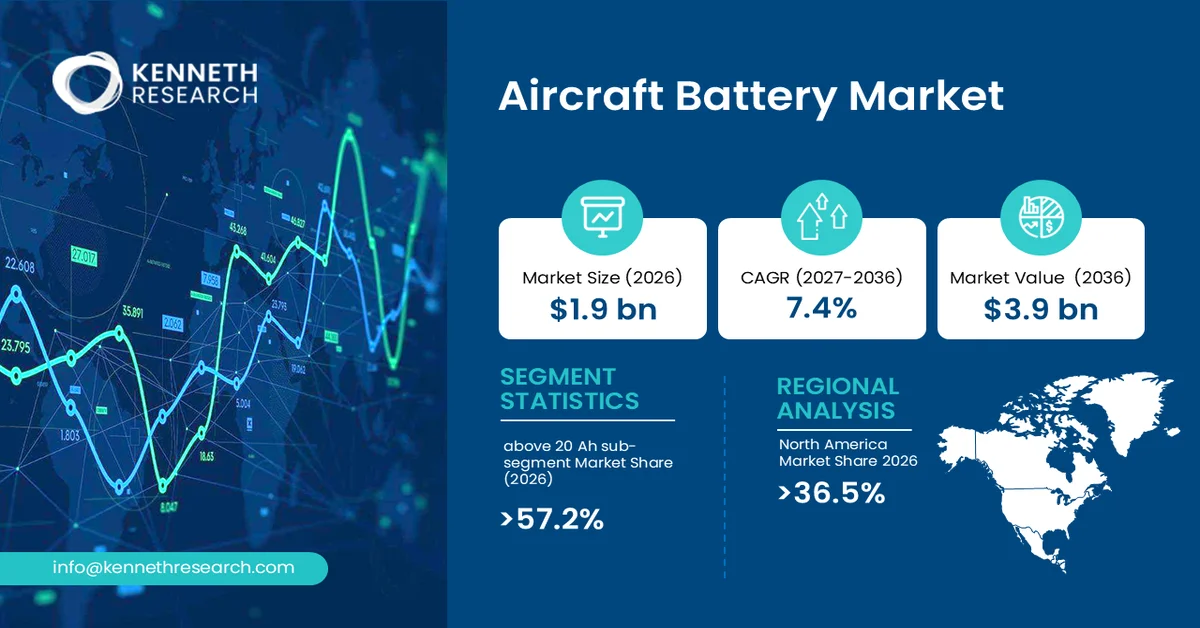
Aircraft Battery Market size was valued at USD 1.9 billion in 2026 and is projected to reach USD 3.9 billion by the end of 2036, rising at a CAGR of 7.4% during the forecast period, i.e., 2027–2036. In 2027, the industry size of the aircraft battery market is estimated at USD 2.0 billion.
The primary growth driver is the aviation industry’s transition toward hybrid-electric and electric flight, which is increasing demand for advanced onboard energy-storage systems. Government aviation authorities identify advances in electric power systems, battery technologies, and alternative aircraft-energy architectures as important developments, supporting continued investment in aircraft battery capabilities.
The aircraft battery market comprises batteries and associated battery systems designed, manufactured, integrated, and maintained for use in aircraft electrical and energy-storage applications. These systems supply stored electrical energy for functions ranging from emergency and standby power to aircraft starting, avionics, communications, safety equipment, and other onboard electrical systems. The market also encompasses technologies supporting the emerging electrification of aircraft propulsion and hybrid-electric architectures.
Key characteristics of aircraft batteries include high reliability, controlled energy delivery, thermal management, safety, monitoring, maintainability, and compatibility with aircraft electrical architectures. Battery chemistry and system design influence operational performance, lifecycle requirements, charging behavior, and safety considerations. The Federal Aviation Administration recognizes lithium-based systems as having distinct operational, maintenance, and failure characteristics compared with established rechargeable battery technologies, creating specific installation and certification considerations.
Key Aircraft Battery Market Insights Summary:
Key Takeaways: Market Trends & Insights
- Aircraft battery market was valued at USD 1.9 billion in 2026 and is projected to reach USD 3.9 billion by 2036 at a CAGR of 7.4% over 2027–2036
- Above 20 Ah capacity batteries held the leading segment position with a 57.2% market share in 2026, supported by demand for higher-capacity energy storage across aircraft applications
- Nickel-Cadmium (Ni-Cd) batteries represent the second and fastest-growing segment, benefiting from established aviation use, proven reliability, and compatibility with existing aircraft fleets
- North America led the regional landscape with a 36.5% market share in 2026, supported by strong aerospace capabilities and continued aircraft electrification activity across the United States and Canada
Market Drivers
- Electrification of aircraft propulsion
- Advancement in battery and electrical-system technologies
- Expansion of advanced air-mobility and electric-aircraft development
- Increasing integration of high-reliability electrical systems in aircraft
Challenges
- Stringent safety and certification requirements
- High technical and integration complexity
Aircraft Battery Market Overview & Supply Chain
adoption of aircraft batteries is increasing as aviation moves toward greater electrical-system integration, hybrid-electric propulsion, and lower-emission aircraft technologies. Batteries support onboard energy storage and are becoming increasingly relevant to emerging electric and hybrid-electric aircraft architectures. This transition is also creating requirements for improved energy density, thermal management, reliability, safety, certification, and battery lifecycle management. The industrial relevance is reinforced by the scale of aviation activity: the International Civil Aviation Organization (ICAO) reported 2.3 billion passengers carried on scheduled services in 2021, demonstrating the substantial operational ecosystem in which aircraft electrical and energy-storage technologies function.
The aircraft battery market value chain begins with raw-material and component suppliers providing metals, active electrode materials, electrolytes, separators, casings, connectors, monitoring components, and other specialized inputs. Battery manufacturers convert these inputs into cells, modules, packs, and integrated battery systems engineered for aircraft operating environments. System integrators and aircraft manufacturers then incorporate battery systems into electrical architectures, propulsion systems, emergency-power systems, and other aircraft applications while meeting applicable airworthiness and safety requirements. Distribution occurs through direct manufacturer relationships, authorized aerospace suppliers, maintenance organizations, and specialized aviation-part distribution channels.
Aircraft Battery Market - Growth Drivers & Challenges
Growth Drivers
- Electrification of Aircraft Propulsion: The increasing development of electric and hybrid-electric aircraft is creating a structural demand pathway for higher-performance aircraft batteries. As propulsion architectures shift from conventional engine-driven systems toward electrically powered motors, batteries become integral to energy storage and power delivery rather than being limited to auxiliary applications.
- Advancement in Battery and Electrical-System Technologies: Continuous advancement in battery chemistry, power electronics, battery-management systems, thermal management, and lightweight structural integration is improving the suitability of batteries for demanding aerospace applications. Modern aircraft require electrical systems capable of delivering reliable power while meeting stringent constraints on weight, temperature, vibration, electromagnetic compatibility, and operational safety.
Challenges
- Stringent Safety and Certification Requirements: The principal restraint arises from the safety-critical nature of aircraft battery systems. Battery failures can create thermal, electrical, mechanical, and fire hazards, requiring manufacturers to demonstrate robust protection, monitoring, containment, and failure-management capabilities before systems can be integrated into aircraft. The Federal Aviation Administration specifically highlights thermal runaway, manufacturing defects, overheating, overcharging, and physical damage as potential contributors to lithium-battery hazards.
- High Technical and Integration Complexity: Aircraft battery systems must operate reliably within tightly constrained aerospace environments, where weight, thermal conditions, electrical architecture, maintenance requirements, and system redundancy must be considered simultaneously. This creates a significant engineering challenge because improving one performance characteristic can introduce trade-offs elsewhere, particularly when higher energy storage is pursued without compromising safety, mass, durability, or thermal stability.
Aircraft Battery Market Size and Forecast:
| Report Attribute | Details |
|---|---|
| Base Year |
2026 |
| Forecast Year |
2027-2036 |
| CAGR |
7.4% |
| Base Year Market Size (2026) |
USD 1.9 Billion |
| Forecast Year Market Size (2036) |
USD 3.9 Billion |
| Regional Scope |
|
Aircraft Battery Market - Segment Analysis
Capacity Segment Analysis
In the capacity segment, above 20 Ah sub-segment is anticipated to capture the largest market share of 57.2% by the end of 2026.
The above 20 Ah capacity segment leads because aircraft applications increasingly require battery systems capable of delivering sustained electrical power across propulsion, emergency, standby, and other high-demand functions. The shift toward electrified and hybrid-electric aircraft is particularly supportive, as larger battery capacities provide greater usable energy for longer operating missions and more demanding electrical architectures. NASA’s electrified-aircraft research demonstrates the scale of this requirement: its X-57 Maxwell incorporated two 400-pound lithium-ion battery packs, highlighting the substantial energy-storage requirements associated with experimental electric aircraft.
Type Segment Insights
The Nickel-Cadmium (Ni-Cd) sector is projected to grow as the second-largest segment in the aircraft battery market due to four converging demand drivers.
The nickel-cadmium (Ni-Cd) segment is positioned for continued demand because of its established role in aircraft applications requiring dependable starting power, rapid recharge capability, stable voltage characteristics, and operational reliability. These attributes remain relevant for aircraft operators that prioritize proven technologies, established maintenance procedures, and predictable performance. The Federal Aviation Administration’s current safety guidance confirms that most commercial and military aircraft use NiCad batteries, demonstrating their continuing relevance within established aviation fleets.
Our in-depth analysis of the global aircraft battery market includes the following segments:
|
Segment |
Sub-segment |
|
Type |
|
|
Capacity |
|
|
Power Density |
|
|
Aircraft Type |
|
|
Application |
|
|
End-User |
|
Aircraft Battery Market - Regional Analysis
North America Market Trends & Insights:
North America aircraft battery market is projected to hold the largest revenue share of 36.5% by the end of 2026.
North America remains the dominant regional market, supported by its established aerospace manufacturing ecosystem, mature aircraft fleets, advanced battery-development capabilities, and strong investment in aircraft electrification.
The United States is the principal regional demand and production center, supported by a broad aerospace manufacturing base, sophisticated defense and commercial aviation industries, and substantial private investment in emerging electric-aircraft technologies. Its extensive supplier ecosystem also facilitates aircraft battery integration and aftermarket support.
Canada complements this position through a strong aerospace manufacturing cluster, particularly in aircraft production, components, and specialized engineering. Statistics Canada reported strong expansion in Canadian aerospace product and parts production in recent years, reflecting sustained aircraft and component demand. Together, the United States and Canada provide North America with a deep industrial base supporting aircraft battery development, manufacturing, integration, and lifecycle services.
Asia Pacific Market Trends & Insights:
Asia Pacific is emerging as an important development region for aircraft batteries, supported by expanding aerospace manufacturing, increasing aviation electrification activity, and government-backed programs for advanced air mobility and low-altitude aviation.
China represents the region’s principal growth opportunity, with government policy linking electric aviation to broader low-altitude-economy development and encouraging commercialization of electric vertical take-off and landing aircraft, new-energy general aviation aircraft, and associated high-energy-density aviation batteries.
Japan offers a complementary opportunity through its established aerospace engineering base and coordinated government-industry approach to aircraft decarbonization. The country’s framework emphasizes technology development alongside safety certification and international standardization, supporting long-term integration of advanced electrical and battery technologies into future aircraft platforms.
Aircraft Battery Market Competitive Landscape
Here is a list of upstream, downstream, and key players operating in global aircraft battery market competitive ecosystem:
- Saft (TotalEnergies SE) (France)
- Company Overview
- Business Strategy
- Key Product Offerings
- Financial Performance
- Key Performance Indicators
- Risk Analysis
- Recent Development
- Regional Presence
- SWOT Analysis
- EaglePicher Technologies (United States)
- EnerSys (United States)
- Concorde Battery Corporation (United States)
- Mid-Continent Instrument Co., Inc. (United States)
Recent Developments
- In October 2025, Saft successfully passed the rigorous DO-311A thermal runaway containment test for its AirLion™ lithium-ion aviation battery, a critical step toward certification by the FAA and EASA. The 28V smart battery offers over double the energy storage per weight compared to conventional lead-acid batteries, potentially reducing aircraft weight by 20-30 kilograms.
- In July 2026, EnerSys received a revised $150 million grant from the U.S. Department of Energy for its planned lithium cell manufacturing facility in Greenville, South Carolina, with the plant now focused on aerospace and defense applications and a total net investment of approximately $500 million. The facility is expected to have an initial production capacity of approximately 1 gigawatt hour, purpose-built to meet specialized defense requirements and strengthen the U.S. supply chain for FEOC-compliant lithium-ion cells.
Frequently Asked Question
In 2026, the aircraft battery market market exceeded USD 1.9 billion.
The aircraft battery market market is projected to reach USD 3.9 billion by the end of 2036, expanding at a CAGR of 7.4% over the forecast period (2027-2036).
The major players in the market are Saft (TotalEnergies SE), EaglePicher Technologies, EnerSys, Concorde Battery Corporation, Mid-Continent Instrument Co., Inc., and others.
In the Capacity segment, the Above 20 Ah sub-segment is anticipated to capture the largest market share of 57.2% in the future and exhibit lucrative growth opportunities during 2027-2036. This growth trajectory is largely attributed to increasing demand for higher-capacity battery systems for demanding aircraft electrical and energy-storage applications.
North America is projected to hold the largest market share of 36.5% by the end of 2026 and provide more business opportunities in the future. Continuous investments and technological development in the United States and Canada are fostering the region's dominance.
Why Choose Kenneth Research ?
-
Insight with Impact : We don’t just gather data — we uncover stories, trends, and opportunities that fuel business growth.
-
Experts Who Get It : Our team speaks your industry’s language and knows what really matters to your customers and market.
-
Custom-Built for You : Forget one-size-fits-all. We craft research and consulting solutions as unique as your business vision.
-
Partners, Not Just Providers : We work with you, not for you — collaborating closely to turn insights into smart, strategic moves.
-
Results That Speak : Our work powers brands, startups, and industry leaders alike — with a track record of ideas that work in the real world.
Report ID: 1312 |
Published Date: 11 Sep 2026 |
Report Format: |
Delivery Timeline: 48-72 Business Hours

Copyright © 2025 Kenneth Research. All rights reserved. Terms of Use | Privacy Policy
