Report ID: 1008 |
Published Date: 15 Jun 2026 |
Report Format: |
Delivery Timeline: 48-72 Business Hours
Air Fryer Market Outlook:
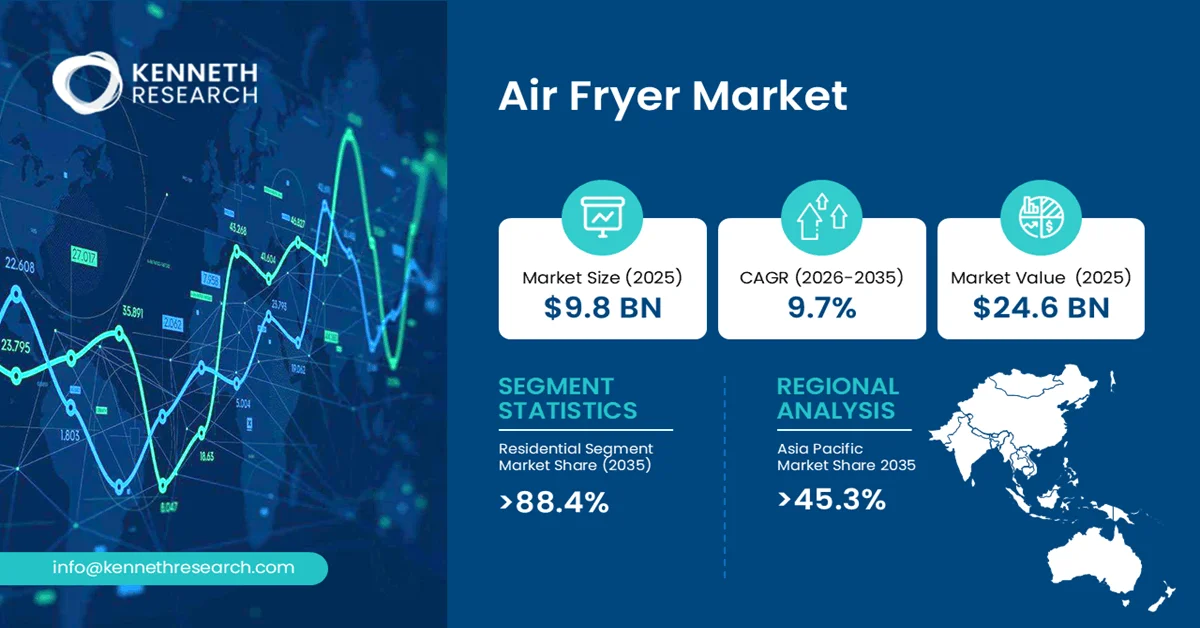
The global air fryer market size was valued at USD 9.8 billion in 2025 and is projected to reach USD 24.6 billion by the end of 2035, rising at a CAGR of 9.7% during the forecast period, i.e., 2026-2035. In 2026, the industry size of air fryer is assessed at USD 10.7 billion.
Rising health consciousness and regulatory pressure to reduce oil consumption drive air fryer adoption. Consumers and foodservice operators seek low-fat cooking alternatives without compromising taste, supported by government health initiatives advocating reduced dietary oil intake to combat obesity and lifestyle diseases.
An air fryer is a compact countertop kitchen appliance that cooks food by circulating high-velocity hot air around the cooking chamber, a process technically known as rapid air convection technology. Unlike traditional deep frying methods that require submerging food in heated oil, air fryers utilize a mechanical fan to distribute temperatures typically ranging between 140°C and 165°C (280-330°F), triggering browning reactions through caramelization and the Maillard reaction to produce a crispy exterior texture. This cooking mechanism enables the preparation of fried-style foods with significantly reduced oil content, positioning air fryers as a healthier alternative for consumers seeking to lower dietary fat intake without compromising on taste or texture characteristics.
Key Air Fryer Market Insights Summary:
Key Takeaways: Market Trends & Insights
- The residential segment constitutes the largest application segment in the global air fryer market, capturing approximately 88.4% of the market by the end of 2035
- Asia-Pacific stands as the dominant region in the global air fryer market, commanding approximately 45.3% of the market by the end of 2035
- Japan holds a 3.32% global share in 2026
- Japan holds a 7.14% Asia Pacific share in 2026
- The U.S. share in the in the global market is 20.49% in 2026 and 82.44% in the North America market
- The major players in the market are Koninklijke Philips N.V., SharkNinja Operating LLC, Groupe SEB (Tefal), Midea Group Co., Ltd., Instant Brands Inc., Cosori (Vesync Co., Ltd), and others
Market Drivers:
- Rising Disposable Incomes and Household Spending on Kitchen Appliances
- Rapid Urbanization and Smaller Living Spaces
- Expansion of Direct-To-Consumer Online Sales Channels
- Commercial Adoption by Cloud Kitchens and QSR Chains
Challenges:
- High Equipment Acquisition Costs and Price Sensitivity
- Performance Limitations and Consumer Expectation Gaps
Air Fryer Market Overview & Supply Chain
Global adoption of air fryers is accelerating due to mounting health awareness, urbanization, busy lifestyles, and government-backed nutritional policies. Technological advancements including Wi-Fi-enabled models compatible with voice assistants (Alexa, Google Assistant) enhance user convenience. Regulatory relevance is underscored by public health initiatives: during its 47th Central Advisory Committee meeting on May 27, 2025, India’s Food Safety and Standards Authority (FSSAI) urged states to reduce oil consumption by 10% to combat obesity through public awareness and lifestyle changes. Such government-led campaigns directly support air fryer adoption as a practical solution for healthier cooking, reinforcing industrial relevance across manufacturing, distribution, and foodservice supply chains.
The air fryer industry value chain begins with raw material inputs, comprising electrical components (heating elements, thermal sensors, control boards, wiring harnesses), metal sheets (stainless steel, cold-rolled steel, aluminum), plastic polymers (polycarbonate, ABS, polypropylene), non-stick coatings (ceramic-based or polytetrafluoroethylene), glass (viewing windows), and electronic connectors. Suppliers of rare earth metals and semiconductors form a critical upstream node.
Manufacturing involves multi-stage production: stamping and forming of metal casings, injection molding for plastic components, printed circuit board assembly for control systems, motor and fan integration, and final assembly line configuration. Quality assurance testing for thermal performance and electrical safety follows. Original equipment manufacturers (OEMs) produce for brand owners, while vertically integrated branded manufacturers maintain in-house production.
Air Fryer Market: Growth Drivers & Challenges
Growth Drivers:
- Rising Disposable Incomes and Household Spending on Kitchen Appliances: As household disposable incomes rise across emerging and developed economies, consumers allocate a larger share of expenditure to home improvement and kitchen modernization. Air fryers benefit directly from this trend because they represent a visible, accessible entry point into healthier cooking without requiring full kitchen renovations. The purchase decision is often discretionary and lifestyle-driven, making it highly sensitive to increases in discretionary household budgets. Younger demographics, particularly millennials and Gen Z consumers entering homeownership or independent living arrangements, prioritize countertop appliances that offer both functional utility and alignment with wellness values.
As real wages continue their gradual recovery trajectory in advanced economies, the addressable market for premium air fryers featuring smart connectivity and larger cooking capacities will expand. Manufacturers that successfully link their products to broader lifestyle aspirations—including meal prepping, entertaining, and dietary experimentation—will capture higher average selling prices and repeat purchase intent. - Rapid Urbanization and Smaller Living Spaces: Global urbanization trends are producing smaller household sizes and compact living spaces, particularly in metropolitan areas where kitchen square footage is increasingly constrained. Traditional full-sized ovens and multi-burner cooktops consume disproportionate space relative to the cooking needs of single-person or two-person households. Air fryers address this spatial constraint by offering multifunctionality—baking, roasting, reheating, and dehydrating capabilities—within a countertop footprint that typically occupies less than 0.1 square meters. Urban consumers living in studio apartments or shared accommodations view air fryers as space-efficient substitutes for conventional ovens rather than supplementary appliances. Furthermore, rental housing stock increasingly lacks full-sized ovens in entry-level segments, creating a captive market for portable cooking solutions
Challenges:
- High Equipment Acquisition Costs and Price Sensitivity: The manufacturing complexity of air fryers requires precision-engineered heating elements, high-velocity fan systems, temperature sensors, and non-stick ceramic or PTFE coatings that meet food-contact safety standards. These components drive base production costs substantially higher than those of conventional frying pans, deep fryers, or microwave ovens. Additionally, branded models incorporate proprietary digital controllers and mobile application integration, further elevating bill-of-materials expenses. Retail price points typically range from USD 60 for entry-level units to over USD 300 for premium smart-enabled models, placing air fryers in a discretionary purchase category rather than an essential household commodity.
- Performance Limitations and Consumer Expectation Gaps: Air fryer cooking fundamentally cannot replicate the exact sensory characteristics of deep-fat frying. The absence of submerging food in hot oil results in drier interior textures for certain food types, particularly battered items or foods with high moisture content. Limited cooking cavity capacity also restricts batch sizes; preparing meals for households exceeding four members typically requires multiple cooking cycles, extending total meal preparation time contrary to the convenience promise. Additionally, learning curve effects emerge because consumers must adjust oil quantities, cooking times, and temperature settings from traditional recipes, leading to inconsistent results during initial usage.
Air Fryer Market Size and Forecast:
| Report Attribute | Details |
|---|---|
| Base Year |
2025 |
| Forecast Year |
2026-2035 |
| CAGR |
9.7% |
| Base Year Market Size (2025) |
USD 9.8 billion |
| Forecast Year Market Size (2035) |
USD 24.6 billion |
| Regional Scope |
|
Air Fryer Market Segmentation Analysis:
Application Segment Analysis
The residential segment constitutes the largest application segment in the global air fryer market, capturing approximately 88.4% of the market by the end of 2035.
The primary catalyst for residential segment growth is unprecedented health awareness among household consumers. Escalating health consciousness among households is the primary catalyst for residential segment growth. The World Health Organization (WHO) reports that in 2022, 2.5 billion adults worldwide were overweight, with 890 million classified as obese—representing 43% of adults globally. This public health crisis has compelled households to seek cooking methods that reduce dietary fat intake without sacrificing food quality or taste.
Distribution Channel Segment Analysis
The online channel growth is driven by the sustained consumer preference for convenient, research-driven purchasing experiences.
Japanese households demonstrate increasing engagement with digital shopping platforms. According to the Statistics Bureau of Japan's Household Consumption Survey, the average monthly online shopping expenditure per household using internet purchases reached JPY 46,335 in May 2025, with over half of households utilizing online shopping channels. This widespread adoption creates a substantial addressable market for air fryer manufacturers seeking digital distribution. From a manufacturing and fulfillment perspective, the online channel benefits from centralized warehousing and lower per-unit fulfillment costs compared to brick-and-mortar retail distribution.
Our comprehensive analysis of the air fryer market covers the following key segments:
|
Segment |
Subsegments |
|
Type |
|
|
Basket Style |
|
|
Price Range |
|
|
Distribution Channel |
|
|
Application |
|
Air Fryer Market Regional Insights:
Asia-Pacific Market Trends & Insights:
Asia-Pacific stands as the dominant region in the global air fryer market, commanding approximately 45.3% of the market by the end of 2035, driven by a convergence of demographic shifts, manufacturing capacity expansion, and supportive regulatory frameworks. Urbanization across the region has fundamentally altered consumer kitchen preferences, with urban populations viewing air fryers as lifestyle-enhancing appliances that express personal identity rather than merely utilitarian tools. Rising disposable incomes across emerging economies have enabled higher household spending on premium kitchen appliances, while the expansion of the quick-service restaurant (QSR) and hospitality sectors has opened substantial commercial adoption channels.
India represents a high-growth market characterized by a dramatic manufacturing localization shift. According to Government of India data India is now the world's second-largest mobile phone manufacturer, a milestone supported by an electronics sector that has created 2.5 million jobs over the last decade. Production surged nearly six-fold, from approximately USD 19.9 billion in FY2014-15 to USD 118.3 billion in FY2024-25, while mobile phone exports alone saw a monumental 127-fold increase, during the same period. The Bureau of Indian Standards (BIS) has expanded compulsory quality control orders for electronic products, compelling brands to establish or contract domestic production facilities.
Japan demonstrates a mature but steadily growing market driven by technological sophistication and health-conscious consumer behavior. METI's E-Commerce Market Survey confirms that domestic electrical appliances maintain one of the highest e-commerce penetration rates across all product categories, with an EC ratio of 42.01%. This digital infrastructure enables manufacturers to reach Japanese consumers directly through online channels. Urban Japanese households prioritize space-saving, multifunctional appliances suitable for compact kitchens, with manufacturers developing quiet-operation models appropriate for apartment living and presets specifically for traditional fried foods like tempura and karaage with reduced oil content. The combination of high e-commerce penetration, technologically sophisticated consumer base, and emphasis on health-oriented cooking solutions continues to sustain steady market expansion.
North America Market Trends & Insights:
North America represents a mature and highly sophisticated secondary market for air fryers, characterized by strong consumer health awareness and rapid technology adoption cycles. Market demand is driven by sustained household interest in convenient, healthier cooking alternatives to traditional deep frying, with consumers increasingly viewing air fryers as essential countertop appliances rather than novelty purchases. Industrial activity benefits from established retail distribution networks, including mass merchants, specialty appliance stores, and e-commerce platforms that maintain substantial inventory turnover.
The United States leads the North American market, driven by a consumer base that prioritizes convenience, health benefits, and technological innovation. The proliferation of digital content creators and recipe developers on social media platforms has effectively educated consumers about air fryer versatility, accelerating adoption across all age demographics. Major retailers have dedicated substantial shelf space to air fryers across multiple price tiers, from entry-level manual units to premium smart-enabled models. The commercial food service sector, particularly fast-casual chains seeking to offer healthier fried food options, is increasingly specifying air fryers as standard cookline equipment.
Canda exhibits steady market growth, with consumer preferences closely tracking U.S. trends while demonstrating stronger emphasis on energy efficiency and product durability. Canadian households, particularly those in urban centers with compact kitchen layouts, favor multifunctional units that replace multiple appliances. The country's colder climate and extended indoor cooking seasons sustain year-round demand for air fryers as versatile meal preparation tools. Distribution channels include national appliance retailers and increasingly robust e-commerce fulfillment networks.
Leading Companies Operating in the Global Air Fryer Market:
The global air fryer market is highly competitive and moderately fragmented, featuring multinational conglomerates, specialized appliance brands, and low-cost OEM-led manufacturers from Asia. Philips leads with patented rapid air technology and health-centric positioning. SharkNinja competes through aggressive product innovation including dual-basket and vertical stack designs. Groupe SEB (Tefal) leverages extensive European and Asian distribution networks. Midea dominates white-label and contract manufacturing, enabling cost leadership. Cosori differentiates via smart app integration and digital-first consumer engagement. Intense rivalry has driven feature commoditization, forcing incumbents to defend share through innovation, regulatory certification advantages (e.g., BIS in India), and exclusive online channel strategies.
Here is a list of key players operating in the global air fryer market:
|
Company |
Specialty |
HQ |
Position |
|
Koninklijke Philips N.V. |
Patented rapid air technology; health-centric cooking |
Netherlands |
Leader |
|
SharkNinja Operating LLC |
Dual-basket and vertical stack innovation; direct-to-consumer |
USA |
Leader |
|
Groupe SEB (Tefal) |
Engineering excellence; wide European-Asian distribution |
France |
Leader |
|
Midea Group Co., Ltd. |
Vertically integrated manufacturing; private-label OEM |
China |
Major |
|
Instant Brands Inc. |
Multi-functionality; brand equity from pressure cookers |
USA |
Major |
|
Cosori (Vesync Co., Ltd) |
Smart app integration; digital-first consumer brand |
China / USA |
Major |
|
GoWISE USA |
Value segment; Amazon-optimized online sales |
USA |
Major |
|
Joyoung Co., Ltd. |
IoT-enabled smart appliances; dominant in China |
China |
Major |
|
Breville Pty Limited |
Premium design; high-performance engineering |
Australia |
Niche |
|
De'Longhi S.p.A. |
Premium small kitchen appliances |
Italy |
Niche |
|
Hamilton Beach Brands |
Mid-tier pricing; mass retail distribution |
USA |
Niche |
|
Cuisinart (Conair) |
Brand heritage; toaster oven-style air fryers |
USA |
Niche |
|
Xiaomi Corporation |
Smart minimalist design; Mi Home ecosystem |
China |
Niche |
Recent Developments
- In April 2026, India issued the Safety of Household, Commercial and Similar Electrical Appliances (Quality Control) Order, 2026, mandating BIS certification and ISI marking for over 90 categories of electrical appliances. Fryers—including air fryers—are explicitly listed under "Kitchen & food processing equipment" requiring compliance with IS 302 (Part 1): 2024 safety standards. Foreign manufacturers must obtain third-party certification, complete product testing, and affix the ISI mark on both product and packaging prior to import clearance or domestic sale. Non-compliance risks import restrictions, product seizures, and financial penalties under the BIS Act.
- In February 2024, at its inaugural EMEA Product Forum, SharkNinja unveiled an industry-first vertically designed two-basket air fryer, the Ninja DoubleStack XL. Unlike conventional side-by-side dual-basket models that occupy significant counter space, the DoubleStack XL employs a space-saving vertical configuration where two independent cooking baskets are stacked one above the other. The product retains separate temperature and time controls for each basket, enabling simultaneous cooking of different foods at different settings within the same footprint as a standard air fryer.
Frequently Asked Question
In 2025, the air fryer market was USD 9.8 billion.
The air fryer market is projected to reach USD 24.6 billion by the end of 2035, expanding at a CAGR of 9.7% over the forecast period (2026-2035).
The major players in the market are Koninklijke Philips N.V., SharkNinja Operating LLC, Groupe SEB (Tefal), Midea Group Co., Ltd., Instant Brands Inc., Cosori (Vesync Co., Ltd), and others.
In the Application segment category, the Residential sub-segment is anticipated to capture the largest market share of 88.4% in the future and exhibit lucrative growth opportunities during 2026-2035. This growth trajectory is largely attributed to government-led public health campaigns discouraging excessive oil consumption, which directly positions residential air fryers as a medically endorsed alternative for healthier home cooking.
Asia Pacific is projected to hold the largest market share of 45.3% by the end of 2035 and provide more business opportunities in the future. Continuous government-backed health initiatives and regulatory developments in Japan and India—including BIS certification mandates and national oil reduction directives—are fostering the region's dominance.
Why Choose Kenneth Research ?
-
Insight with Impact : We don’t just gather data — we uncover stories, trends, and opportunities that fuel business growth.
-
Experts Who Get It : Our team speaks your industry’s language and knows what really matters to your customers and market.
-
Custom-Built for You : Forget one-size-fits-all. We craft research and consulting solutions as unique as your business vision.
-
Partners, Not Just Providers : We work with you, not for you — collaborating closely to turn insights into smart, strategic moves.
-
Results That Speak : Our work powers brands, startups, and industry leaders alike — with a track record of ideas that work in the real world.
Report ID: 1008 |
Published Date: 15 Jun 2026 |
Report Format: |
Delivery Timeline: 48-72 Business Hours

Copyright © 2025 Kenneth Research. All rights reserved. Terms of Use | Privacy Policy
