Report ID: 1007 |
Published Date: 28 Jul 2026 |
Report Format: |
Delivery Timeline: 48-72 Business Hours
AIOps Market Outlook:
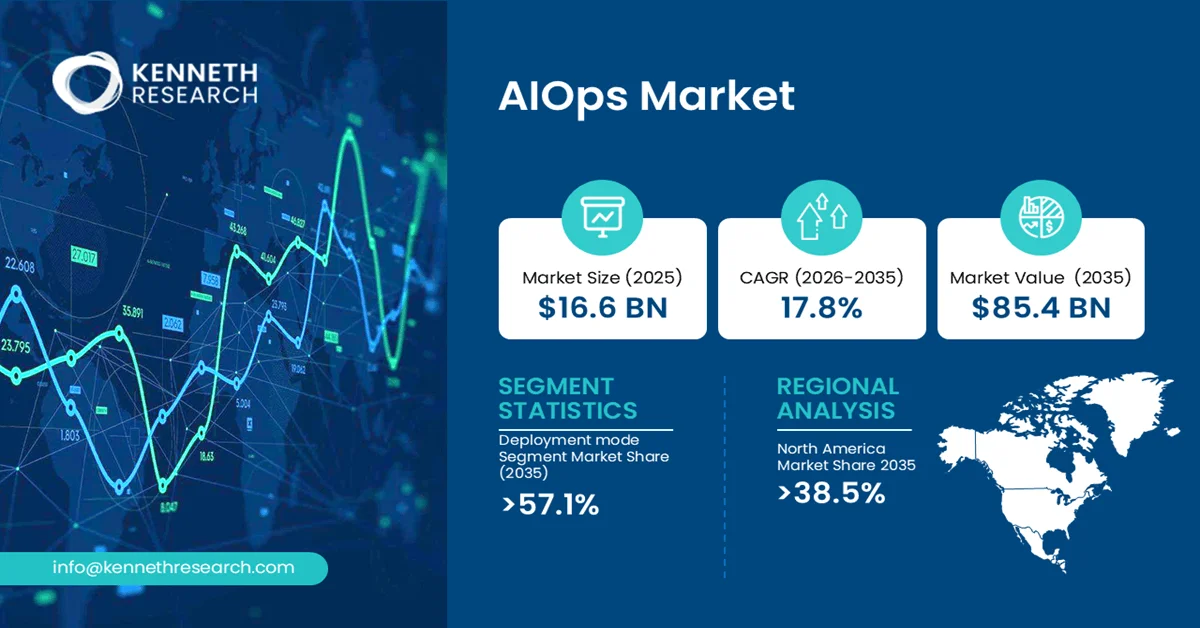
AIOps Market size was valued at USD 16.6 billion in 2025 and is projected to reach USD 85.4 billion by the end of 2035, rising at a CAGR of 17.8% during the forecast period, i.e., 2026-2035. In 2026, the industry size of AIOps is estimated at USD 19.5 billion.
The escalating complexity of hybrid and multi-cloud IT architectures overwhelms traditional monitoring tools, creating tool sprawl and alert fatigue. AIOps platforms ingest and correlate telemetry across disparate environments, cutting alert noise and enabling unified observability.
AIOps (Artificial Intelligence for IT Operations) refers to the application of machine learning, big data analytics, and automation to enhance and partially replace traditional IT operations management, including event correlation, anomaly detection, and root cause analysis. Key characteristics include real-time data ingestion from multiple monitoring tools, predictive alerting, and automated remediation workflows. Industrial relevance is most pronounced in sectors with complex, hybrid IT infrastructures—such as BFSI, telecommunications, healthcare, and cloud service providers—where downtime directly impacts revenue, compliance, and customer trust.
Key AIOps Market Insights Summary:
Key Takeaways: Market Trends & Insights
- In the deployment mode segment, the cloud-based sub-segment is anticipated to capture the revenue share of 57.1% during 2026-2035
- North America AIOps market is projected to hold the largest revenue share of 38.5% by the end of 2035
- The Asia Pacific market represented roughly 20% of the global market landscape in 2025
- Japan represented roughly 20.83% of the Asia Pacific AIOps market in 2025
- Japan held an estimated 4.48% share of the global AIOps market in 2025
- The U.S. alone accounts for over 24% of the global market in 2026
- The major players in the market are ServiceNow, Dynatrace, IBM, Splunk, Cisco, BMC Software, Datadog, Broadcom, Microsoft, Google, Oracle, HPE, Riverbed, and others.
Market Drivers:
- Regulatory Pressure for Real-Time IT Incident Reporting
- Exponential Growth of Observability Data Across Hybrid Infrastructure
- IT Skills Shortage and Engineer Burnout
- Shift-Left Observability in DevOps Pipelines
Challenges:
- Data Silos and Integration Complexity Across Legacy and Modern Stacks
- Algorithmic Opacity and Enterprise Risk Aversion in Automated Remediation
AIOps Market Overview & Supply Chain
Global adoption of AIOps is accelerating due to the exponential growth in IT observability data, the shift toward hybrid and multi-cloud environments, and the need for proactive rather than reactive incident management. The European Union Agency for Cybersecurity (ENISA) reported in its 2023 Threat Landscape for Supply Chain Attacks that over 58% of organizations across member states experienced at least one supply-chain-related IT operational disruption between 2021 and 2023, with manual monitoring cited as a primary contributor to delayed detection. This statistic underscores the regulatory and operational urgency for automated, AI-driven IT operations.
The AIOps supply chain comprises four sequential layers: data ingestion (logs, metrics, traces from APM/NPM tools), AI/ML analytics engine (anomaly detection, clustering, predictive modeling), automation/orchestration (remediation scripts, ticketing integration), and consumption layer (dashboards, alerts, chatbots). Together, these enable closed-loop IT operations intelligence.
AIOps Market: Growth Drivers & Challenges
Growth Drivers:
- Regulatory Pressure for Real-Time IT Incident Reporting: Financial and critical infrastructure regulators worldwide are mandating sub-hour incident notification and forensic traceability, a requirement unattainable with manual IT operations. The European Union's Digital Operational Resilience Act (DORA), effective January 2025, requires financial entities to detect, classify, and report major ICT-related incidents within strict timelines, directly fueling AIOps adoption for automated event correlation and root cause identification. Industry impact is most acute in BFSI (your designated segment category), where non-compliance can trigger fines up to 1% of average daily global turnover. Future implications include AIOps becoming a non-negotiable compliance layer across banking, energy, and healthcare sectors globally, with regulators potentially auditing AIOps deployment maturity.
- Exponential Growth of Observability Data Across Hybrid Infrastructure: As enterprises deploy microservices, serverless functions, and edge computing nodes, telemetry data volumes (logs, metrics, traces, events) are growing at significantly annually. Traditional threshold-based monitoring tools generate excessive false positives and cannot correlate signals across distributed systems. AIOps solves this through unsupervised machine learning that automatically establishes normal behavior baselines, detects statistical anomalies without pre-defined rules, and reduces alert noise by up to 95%. Industry impact is most visible in manufacturing (Industry 4.0 sensor fleets), telecommunications (5G network slicing with thousands of parameters), and retail (real-time inventory and payment systems). Future implications point toward fully autonomous IT operations (NoOps), where AIOps not only detects but also remediates incidents through closed-loop automation, freeing SRE teams for strategic innovation.
Challenges:
- Data Silos and Integration Complexity Across Legacy and Modern Stacks: Enterprise IT environments typically comprise decades-old mainframes, virtualized workloads, and Kubernetes clusters — each generating telemetry in incompatible formats, schemas, and protocols. AIOps platforms require unified, normalized data ingestion, but proprietary monitoring tools (e.g., legacy APM, mainframe loggers) deliberately restrict data egress or charge prohibitive fees for API access.
- Algorithmic Opacity and Enterprise Risk Aversion in Automated Remediation: AIOps machine learning models — particularly deep learning classifiers for anomaly detection — produce results without human-interpretable explanations. Enterprises in regulated industries (BFSI, healthcare) cannot justify automated actions (e.g., terminating a payment processing pod) when the AI's reasoning is opaque to auditors and compliance officers.
AIOps Market Size and Forecast:
| Report Attribute | Details |
|---|---|
| Base Year |
2025 |
| Forecast Year |
2026-2035 |
| CAGR |
17.8% |
| Base Year Market Size (2025) |
USD 16.6 billion |
| Forecast Year Market Size (2035) |
USD 85.4 billion |
| Regional Scope |
|
AIOps Market Segmentation Analysis:
Deployment Mode Segment Analysis
In the deployment mode segment, the cloud-based sub-segment is anticipated to capture the largest market share of 57.1% by the end of 2035.
The cloud-based deployment segment dominates the AIOps market due to three converging demand drivers. First, enterprises are migrating from pilot AIOps projects to production-scale implementations, and cloud-based software-as-a-service (SaaS) models offer the fastest time-to-value with zero infrastructure provisioning. Second, the proliferation of multi-cloud and hybrid IT environments—where applications span AWS, Azure, Google Cloud, and on-premise systems—requires AIOps platforms that are natively cloud-native to ingest telemetry from distributed sources without latency penalties. Third, the consumption-based pricing of cloud AIOps (pay-per-data-volume or pay-per-node) aligns with CFO demands for operational expenditure predictability.
The U.S. General Services Administration (GSA) reported that under its OneGov Strategy (launched April 2025), the federal government has executed 19 agreements with leading cloud and AI technology companies, including AWS, Microsoft, Google, and Oracle, to centralize procurement of cloud-based IT operations and AI services. These agreements deliver discounts ranging up to 90% on widely used commercial software and cloud services, explicitly prioritizing FedRAMP-authorized cloud solutions over on-premise alternatives for federal AIOps and observability requirements.
Industry Vertical Segment Analysis
The BFSI vertical is projected to grow as the second-largest segment in the AIOps market due to four converging demand drivers.
First, the rapid migration of financial institutions to hybrid and multi-cloud architectures has introduced unprecedented IT complexity, with 89% of Asia Pacific enterprises now running meaningful workloads across multiple public clouds. Second, digital transaction volumes have exploded—India's UPI in May 2026 recorded 23.2 billion UPI transactions, valuing INR 29.9 trillion—creating telemetry volumes that overwhelm legacy monitoring tools. Third, regulatory mandates such as DORA (EU) and the FFIEC IT Handbook (U.S.) require financial entities to maintain auditable, real-time incident detection and resolution capabilities. Fourth, the shift from AI experimentation to production deployment is accelerating, with BFSI firms deploying AI across fraud detection, KYC automation, collections, and audit review workflows.
Our in-depth analysis of the global AIOps market includes the following segments:
|
Segment |
Sub-segment |
|---|---|
|
Deployment Mode |
|
|
Offering |
|
|
Organization Size |
|
|
Application |
|
|
Industry Vertical |
|
AIOps Market Regional Insights:
North America Market Trends & Insights:
North America AIOps market is projected to hold the largest revenue share of 38.5% by the end of 2035. North America's dominance in the AIOps market is anchored by concentrated technology production, enterprise-scale consumption, sustained investment inflows, and proactive regulatory frameworks. The region hosts the global headquarters of nearly all major AIOps platform vendors—including IBM, Dynatrace, BMC Software, and Dell—which collectively drive product innovation and export capacity. On the consumption side, North American enterprises across BFSI, healthcare, and telecommunications have aggressively adopted AIOps to manage hybrid cloud complexity and meet stringent compliance requirements. Government investment reinforces this trajectory: the U.S. Department of Defense's FY 2026 budget introduces a USD 13.4 billion for AI and autonomy, signaling deliberate funding escalation for AI-enabled IT operations and cybersecurity.
The U.S. is the primary growth engine for North American AIOps adoption. The Department of Veterans Affairs exemplifies this trend, budgeting USD 147.7 million for its FY 2025 IT Operations Service Management investment—a 49% year-over-year increase—specifically to mature service governance and deploy AI-enabled platforms like ServiceNow for incident and problem management. This federal-level commitment cascades to commercial sectors, where the presence of AWS, Microsoft, and Google accelerates cloud-native AIOps deployment.
Canada demonstrates parallel momentum through targeted public sector digital modernization. In December 2025, ServiceNow announced a CA$110 million multi-year investment to enable AI adoption across Canada's public sector, including Canadian-hosted AI-ready infrastructure and a new Centre of Excellence creating approximately 100 high-skilled jobs. The Canadian government's Smart Cities Challenge and Digital Charter policies prioritize AI-driven operational efficiency, driving demand for AIOps platforms to modernize service delivery.
Asia Pacific Market Trends & Insights:
Asia Pacific represents the fastest-growing frontier for AIOps adoption, driven by accelerating digital transformation across hyper-connected economies. Market demand stems from the region's position as a global hub for cloud-native startups, megabanks, and telecommunications giants managing dense, high-throughput IT environments. Industrial activity is particularly pronounced in BFSI (digital payments infrastructure), manufacturing (smart factories), and logistics (supply chain visibility platforms). Government initiatives across the region are systematically embedding AI operations into national digital strategies. For instance, Japan's Society 5.0 framework prioritizes AI-driven infrastructure management, while India's IndiaAI Mission (2025) allocates dedicated funding for AI deployment in public digital services. Future opportunities include AIOps becoming a critical layer for managing edge-to-cloud workloads across ASEAN's rapidly digitizing economies, as well as cross-border data flow management under evolving digital trade agreements. The region's willingness to leapfrog legacy IT management paradigms positions it for compound growth beyond global averages through 2035.
Japan's AIOps demand is shaped by an aging IT workforce and a mature industrial base of telecommunications, automotive, and financial conglomerates. The government's Digital Agency has mandated AI-assisted monitoring for all critical public infrastructure by 2028, directly accelerating procurement. Japanese enterprises prioritize on-premise and hybrid AIOps deployments due to data sovereignty concerns, creating a distinct market sub-segment for vendors offering robust private cloud capabilities.
India: India's AIOps market is driven by the explosive growth of real-time digital payment systems (UPI: 23.2 billion transactions in May 2026 alone), massive BFSI digitization, and a thriving SaaS startup ecosystem. The Reserve Bank of India's push for 99.9% uptime on critical financial infrastructure forces banks to adopt predictive IT operations. Cost-conscious Indian enterprises favor cloud-based AIOps (SaaS) with consumption-based pricing, aligning with the global cloud segment dominance noted in your baseline inputs.
Leading Companies Operating in the Global AIOps Market:
Here is a list of key players operating in the global AIOps market:
- ServiceNow (United States)
- Company Overview
- Business Strategy
- Key Product Offerings
- Financial Performance
- Key Performance Indicators
- Risk Analysis
- Recent Development
- Dynatrace (United States)
- Salesforce (United States)
- IBM (United States)
- Splunk (United States)
- Cisco (United States)
- BMC Software (United States)
- Datadog (United States)
- Broadcom (United States)
- Microsoft (United States)
- Google (United States)
- Oracle (United States)
- Dell Technologies (United States)
- Hewlett Packard Enterprise (HPE) (United States)
- VMware (United States)
- BigPanda (United States)
- LogicMonitor (United States)
- PagerDuty (United States)
- ExtraHop (United States)
- Riverbed (United States)
- NetScout (United States)
- Zenoss (United States)
- Micro Focus (United Kingdom)
- Huawei (China)
- Alibaba (China)
- Tech Mahindra (India)
- HCL Technologies (India)
- Tata Consultancy Services (TCS) (India)
- Infraon/EverestIMS (India - Bangalore)
- Aims Innovation (India)
- Appnomic Systems (India)
- GAVS Technologies (India)
- ITRS (United Kingdom)
- Logz.io (Israel)
- Corvil (Ireland)
Recent Developments
- In July 2025, HPE completed its acquisition of Juniper Networks for USD 14 billion following approval from the U.S. Department of Justice (DoJ). To satisfy antitrust concerns, HPE agreed to divest its Instant On business unit and grant up to two licenses for the source code of Juniper's Mist AIOps platform via an auction process. This acquisition positions HPE as a formidable rival to Cisco in the AI-driven networking space. The Mist AI platform—a cloud-managed AI-driven networking solution—will be integrated with HPE's Aruba portfolio, creating a comprehensive AI-native networking offering.
- In April 2025, Riverbed unveiled a major expansion of its AIOps platform, introducing Riverbed IQ Assist™ (Generative AI for instant root cause analysis), Predictive AI (real-time anomaly forecasting), and Agentic AI (no-code customizable automation agents). This launch represents a shift from reactive to fully autonomous IT operations. The integration of three AI paradigms (generative, predictive, and agentic) into a single platform sets a new benchmark for AIOps capabilities. The drag-and-drop Agentic AI feature lowers automation barriers for non-coders, accelerating enterprise adoption. Riverbed's Smart OpenTelemetry approach also addresses data fragmentation challenges cited in market restraints.
Frequently Asked Question
In 2025, the AIOps market exceeded USD 16.6 billion.
The AIOps market is projected to reach USD 85.4 billion by the end of 2035, expanding at a CAGR of 17.8% over the forecast period (2026-2035).
The major players in the market are ServiceNow, Dynatrace, IBM, Splunk, Cisco, BMC Software, Datadog, Broadcom, Microsoft, Google, Oracle, HPE, Riverbed, and others.
In the Deployment Mode segment, the Cloud-based sub-segment is anticipated to capture the largest market share of 57.1% in the future and exhibit lucrative growth opportunities during 2026-2035. This growth trajectory is largely attributed to the exponential growth of observability data across hybrid and multi-cloud infrastructures, which forces enterprises to adopt cloud-native AIOps platforms for real-time anomaly detection.
North America is projected to hold the largest market share of 38.5% by the end of 2035 and provide more business opportunities in the future. Continuous investments by the U.S. Department of Defense and federal agencies like the Department of Veterans Affairs, alongside Canada's public sector digital modernization initiatives, are fostering the region's dominance.
Why Choose Kenneth Research ?
-
Insight with Impact : We don’t just gather data — we uncover stories, trends, and opportunities that fuel business growth.
-
Experts Who Get It : Our team speaks your industry’s language and knows what really matters to your customers and market.
-
Custom-Built for You : Forget one-size-fits-all. We craft research and consulting solutions as unique as your business vision.
-
Partners, Not Just Providers : We work with you, not for you — collaborating closely to turn insights into smart, strategic moves.
-
Results That Speak : Our work powers brands, startups, and industry leaders alike — with a track record of ideas that work in the real world.
Report ID: 1007 |
Published Date: 28 Jul 2026 |
Report Format: |
Delivery Timeline: 48-72 Business Hours

Copyright © 2025 Kenneth Research. All rights reserved. Terms of Use | Privacy Policy
