Report ID: 1368 |
Published Date: 15 Sep 2026 |
Report Format: |
Delivery Timeline: 48-72 Business Hours
Aerospace Parts Manufacturing Market Outlook:
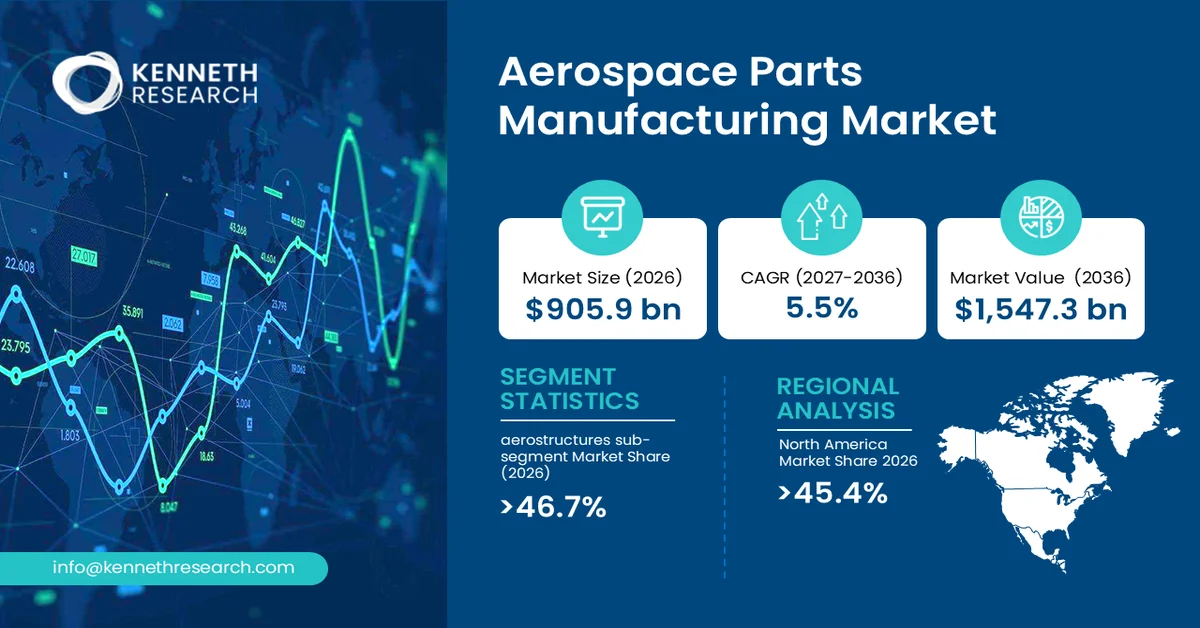
Aerospace Parts Manufacturing Market size was valued at USD 905.9 billion in 2026 and is projected to reach USD 1,547.3 billion by the end of 2036, rising at a CAGR of 5.5% during the forecast period, i.e., 2027–2036. In 2027, the industry size of the aerospace parts manufacturing market is estimated at USD 955.6 billion.
The primary growth driver for the aerospace parts manufacturing market is sustained expansion in global air transport, which increases requirements for new aircraft components and replacement parts. ICAO reported that scheduled passenger numbers reached 4.7 billion in 2024, demonstrating continued underlying demand for aircraft production, maintenance, and component supply.
The aerospace parts manufacturing market comprises the production of components and assemblies used in civil, commercial, military, and other aerospace aircraft and systems. It encompasses the manufacture of structural and functional parts, including aerostructures, engine-related components, flight-control elements, landing-system components, cabin and interior parts, and other specialized aerospace hardware.
A defining characteristic of the market is its stringent emphasis on dimensional accuracy, material performance, durability, traceability, and compliance with aviation safety and quality requirements. Manufacturers commonly work with advanced metals, composites, engineered alloys, and precision-manufacturing technologies to produce components capable of operating under demanding thermal, mechanical, aerodynamic, and environmental conditions.
Key Aerospace Parts Manufacturing Market Insights Summary:
Key Takeaways: Market Trends & Insights
- Aerostructures remained the leading part-type segment with a 46.7% market share in 2026
- North America held the dominant regional position with a 45.4% market share in 2026
- The aerospace parts manufacturing market is projected to increase from USD 905.9 Billion in 2026 to USD 1,547.3 Billion by 2036
- The market is expected to expand at a CAGR of 5.5% during 2027–2036
- Commercial aircraft is the second and fastest-growth analysis segment, supported by fleet expansion, aircraft production, modernization, and recurring maintenance requirements
Market Drivers
- Advanced manufacturing and composite technologies
- Rising aircraft fleet utilization and maintenance requirements
- Increasing adoption of lightweight aerospace materials
- Expansion of aircraft production and modernization programs
Challenges
- Skilled workforce and specialized manufacturing capability
- Material availability and complex supply-chain dependencies
Aerospace Parts Manufacturing Market Overview & Supply Chain
Global adoption of the aerospace parts manufacturing market is increasing as aviation activity recovers and aircraft manufacturers, maintenance providers, and operators require reliable access to certified components. The sector is increasingly influenced by advanced manufacturing, lightweight materials, precision engineering, automation, digital production controls, and stringent airworthiness requirements.
The aerospace parts manufacturing market value chain begins with specialized inputs, including aluminum and titanium alloys, nickel-based materials, composites, specialty steels, electronic components, and engineered polymers sourced from qualified material producers. These inputs move into machining, forming, casting, forging, composite fabrication, additive manufacturing, surface treatment, assembly, and inspection operations. Production is governed by stringent quality-management, traceability, certification, and airworthiness requirements. Finished components are distributed through direct relationships with aircraft manufacturers and tiered suppliers, authorized distributors, maintenance organizations, and specialized logistics providers.
Aerospace Parts Manufacturing Market - Growth Drivers & Challenges
Growth Drivers
- Advanced Manufacturing and Composite Technologies: Advanced manufacturing technologies are strengthening the aerospace parts manufacturing market by improving production precision, material utilization, component complexity, and manufacturing repeatability. Additive manufacturing, automated composite fabrication, advanced machining, and digital production systems enable manufacturers to produce intricate aerospace components while reducing dependence on conventional multi-stage manufacturing processes.
- Rising Aircraft Fleet Utilization and Maintenance Requirements: Growing aircraft utilization is supporting demand for aerospace parts across both original equipment manufacturing and aftermarket applications. Aircraft operators require continuous access to certified structural, mechanical, propulsion, cabin, and systems components to maintain fleet availability and operational reliability. At the same time, maintenance, repair, and overhaul activities generate recurring requirements for replacement, refurbishment, and upgraded parts throughout an aircraft's operating life.
Challenges
- Skilled Workforce and Specialized Manufacturing Capability: Aerospace parts manufacturing requires personnel with specialized capabilities in precision machining, composite fabrication, engineering, inspection, and quality assurance. The underlying restraint is the difficulty of replacing experienced workers while simultaneously developing new personnel with the technical knowledge required for tightly controlled aerospace production.
- Material Availability and Complex Supply-Chain Dependencies: Aerospace parts manufacturing depends on qualified materials and specialized inputs whose procurement can be constrained by concentrated supplier bases, long qualification processes, and limited alternative sources. Disruptions affecting metals, composites, semiconductors, engines, or other critical inputs can propagate across multiple manufacturing tiers because replacement suppliers cannot always be introduced immediately without qualification and technical validation.
Aerospace Parts Manufacturing Market Size and Forecast:
| Report Attribute | Details |
|---|---|
| Base Year |
2026 |
| Forecast Year |
2027-2036 |
| CAGR |
5.5% |
| Base Year Market Size (2026) |
USD 905.9 billion |
| Forecast Year Market Size (2036) |
USD 1,547.3 billion |
| Regional Scope |
|
Aerospace Parts Manufacturing Market - Segment Analysis
Part Type Segment Analysis
In the part type segment, aerostructures sub-segment is anticipated to capture the largest market share of 46.7% by the end of 2026.
Aerostructures dominate the part-type segment because they encompass essential aircraft structures such as fuselage sections, wings, empennage, frames, and structural panels, making them fundamental to aircraft production and fleet maintenance. Demand is supported by new aircraft manufacturing, fleet expansion, replacement of aging structural components, and increasing use of lightweight composite structures. NASA research continues to advance automated fiber placement, integrated stiffeners, and high-rate composite manufacturing, reflecting the industry's shift toward more efficient production of structural components. On the demand side, the FAA forecasts that the U.S. commercial aircraft fleet will increase from 6,852 aircraft in 2022 to 10,286 aircraft in 2043, indicating a sustained requirement for structural components throughout aircraft production and operational lifecycles.
Aircraft Type Segment Insights
The commercial aircraft is projected to grow as the second-largest segment in the aerospace parts manufacturing market due to four converging demand drivers.
Commercial aircraft is projected to be the fastest-growing aircraft-type sub-segment as expanding passenger and cargo activity encourages airlines to renew fleets, add capacity, and replace older aircraft with more efficient models. This directly increases requirements for aerostructures, propulsion components, landing systems, interiors, and other certified parts used in new-build aircraft and subsequent maintenance cycles. Industry adoption is also being shaped by fleet modernization, with manufacturers increasingly incorporating lightweight materials, advanced composites, digital manufacturing, and fuel-efficient aircraft designs. On the supply side, aerospace parts producers are expanding capabilities around high-volume programs while strengthening qualification, quality-control, and delivery systems to meet stringent requirements from aircraft manufacturers.
Our in-depth analysis of the aerospace parts manufacturing market includes the following segments:
|
Segment |
Sub-segment |
|
Part Type |
|
|
Aircraft Type |
|
Aerospace Parts Manufacturing Market - Regional Analysis
North America Market Trends & Insights:
North America aerospace parts manufacturing market is projected to hold the largest revenue share of 45.4% by the end of 2026.
Its leadership reflects a mature aerospace industrial base, extensive aircraft and component manufacturing capabilities, established maintenance infrastructure, and deep networks of specialized suppliers. The region also benefits from substantial commercial and defense aviation activity, advanced engineering capabilities, and regulatory frameworks that support certified aerospace production.
The United States represents the region's principal manufacturing and technology center, supported by major aircraft producers, extensive component suppliers, advanced production capabilities, and a large domestic aviation base. Government analysis also highlights continuing supply-chain investment and production challenges as aircraft demand rebounds.
Canada complements this ecosystem through established aircraft and aerospace-parts manufacturing capabilities, particularly around specialized production and integrated supplier networks. Its aerospace industry also benefits from close commercial integration with the U.S. market, supporting cross-border component flows and manufacturing relationships. Together, the two countries provide North America with a broad combination of production capacity, engineering expertise, supply-chain depth, and end-market demand, supporting its continued regional leadership.
Asia Pacific Market Trends & Insights:
Asia Pacific is emerging as an important aerospace manufacturing and component-production hub, supported by expanding commercial aviation activity, increasing aircraft utilization, industrial localization, and growing investment in advanced manufacturing capabilities.
China represents the region's principal growth opportunity, supported by the expansion of its domestic civil aviation ecosystem and government efforts to strengthen large-aircraft industrial capabilities. Policy initiatives specifically encourage development of major structural components, composite materials, engines, onboard systems, and manufacturing equipment.
Japan offers a complementary opportunity through its mature precision-manufacturing capabilities, engineering expertise, established aerospace supply relationships, and potential participation in next-generation aircraft programs. Together, China and Japan provide complementary advantages: China's expanding domestic aerospace ecosystem creates opportunities for capacity development and localization, while Japan's manufacturing sophistication supports high-value, technically demanding aerospace components.
Aerospace Parts Manufacturing Market Competitive Landscape
Here is a list of upstream, downstream, and key players operating in aerospace parts manufacturing market competitive ecosystem:
- Boeing (United States)
- Company Overview
- Business Strategy
- Key Product Offerings
- Financial Performance
- Key Performance Indicators
- Risk Analysis
- Recent Development
- Regional Presence
- SWOT Analysis
- Airbus (Netherlands)
- RTX Corporation (United States)
- Rolls-Royce (United Kingdom)
Recent Developments
- In August 2026, Airbus announced a multi-million-pound investment to expand its Belfast, Northern Ireland facility, strengthening A220 wing production capacity. The project includes a third composite autoclave and dedicated production tooling, supporting Airbus's goal of reaching 13 A220 deliveries per month by 2028. Airbus completed the acquisition of Spirit AeroSystems' Belfast operations in December 2025, integrating approximately 4,000 employees and reinforcing the UK's role in the company's manufacturing network.
- In February 2026, RTX Corporation announced a S$139 million (approximately $103 million) investment in Singapore through its Collins Aerospace and Pratt & Whitney divisions. Pratt & Whitney will add Geared Turbofan (GTF) Fan Drive Gear System maintenance capabilities at its Seletar facility, while Collins Aerospace will expand MRO capabilities for the Boeing 777X and 787 platforms. The investment is expected to be fully operational by 2030, strengthening Singapore's position as a strategic aerospace hub.
Frequently Asked Question
In 2026, the aerospace parts manufacturing market exceeded USD 905.9 Billion.
The aerospace parts manufacturing market is projected to reach USD 1,547.3 Billion by the end of 2036, expanding at a CAGR of 5.5% over the forecast period (2027–2036).
The major players in the market are Boeing (United States), Airbus (Netherlands), RTX Corporation (United States), Rolls-Royce (United Kingdom), and others.
In the Part Type segment, the Aerostructures sub-segment is anticipated to capture the largest market share of 46.7% in the future and exhibit lucrative growth opportunities during 2027–2036. This growth trajectory is largely attributed to increasing demand for structural components driven by aircraft production, fleet expansion, and maintenance requirements.
North America is projected to hold the largest market share of 45.4% by the end of 2026 and provide more business opportunities in the future. Continuous aerospace manufacturing activity, advanced production capabilities, and established supply-chain networks across the United States and Canada are fostering the region's dominance.
Why Choose Kenneth Research ?
-
Insight with Impact : We don’t just gather data — we uncover stories, trends, and opportunities that fuel business growth.
-
Experts Who Get It : Our team speaks your industry’s language and knows what really matters to your customers and market.
-
Custom-Built for You : Forget one-size-fits-all. We craft research and consulting solutions as unique as your business vision.
-
Partners, Not Just Providers : We work with you, not for you — collaborating closely to turn insights into smart, strategic moves.
-
Results That Speak : Our work powers brands, startups, and industry leaders alike — with a track record of ideas that work in the real world.
Report ID: 1368 |
Published Date: 15 Sep 2026 |
Report Format: |
Delivery Timeline: 48-72 Business Hours

Copyright © 2025 Kenneth Research. All rights reserved. Terms of Use | Privacy Policy
