Report ID: 1297 |
Published Date: 14 Sep 2026 |
Report Format: |
Delivery Timeline: 48-72 Business Hours
Aeroderivative Sensor Market Outlook:
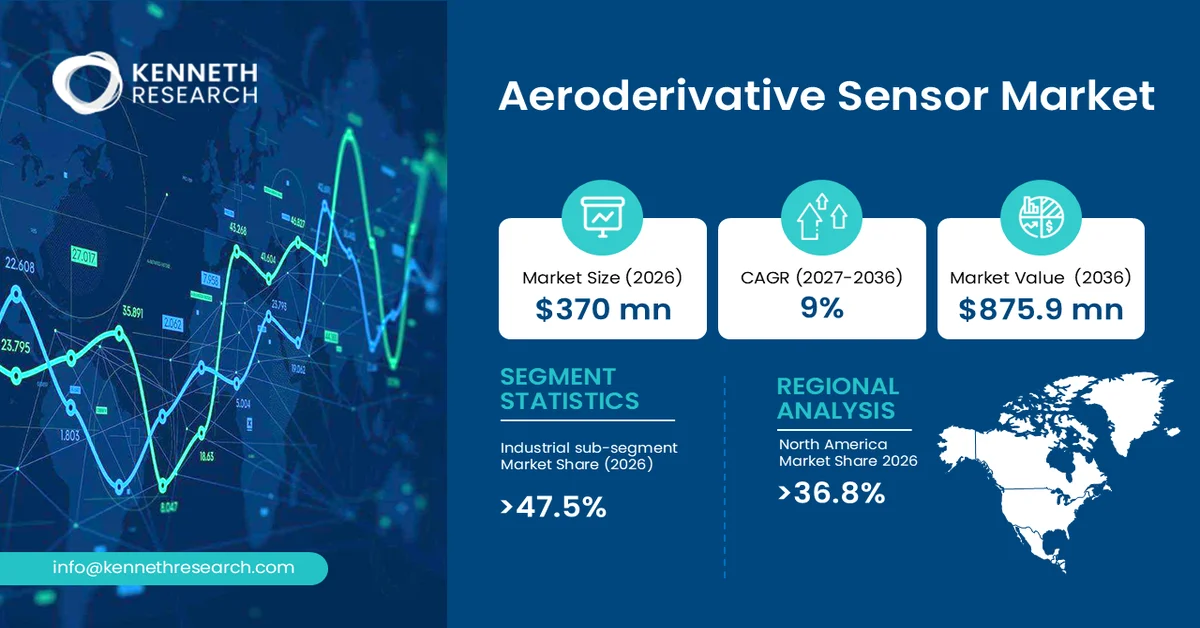
Aeroderivative Sensor Market size was valued at USD 370 million in 2026 and is projected to reach USD 875.9 million by the end of 2036, rising at a CAGR of 9% during the forecast period, i.e., 2027–2036. In 2027, the industry size of the aeroderivative sensor is estimated at USD 403.3 million.
The growing deployment of aeroderivative gas turbines across power generation and industrial operations is driving demand for advanced sensing technologies.
The aeroderivative sensor market comprises sensing technologies used to monitor and control aeroderivative gas turbines and their associated systems. These sensors measure critical operating parameters such as temperature, pressure, flame presence, vibration, speed, flow, and combustion conditions, converting physical operating characteristics into signals used for monitoring, control, diagnostics, and protection. Aeroderivative turbines are derived from aircraft or turboshaft engine technology and are valued for their compact architecture and suitability for applications requiring flexible power generation.
Key characteristics of aeroderivative sensors include high-temperature tolerance, rapid response, measurement accuracy, durability, and compatibility with turbine control and condition-monitoring systems.
Key Aeroderivative Sensor Market Insights Summary:
Key Takeaways: Market Trends & Insights
- Aeroderivative sensor market is projected to grow from USD 370 million in 2026 to USD 875.9 million by 2036, registering a CAGR of 9% during the forecast period.
- North America is projected to remain the leading regional market, accounting for 36.8% in 2026, supported by established aerospace and industrial infrastructure and increasing adoption of advanced turbine monitoring technologies across the U.S. and Canada.
- Industrial is expected to remain the leading Application segment with a 47.5% share in 2026, driven by widespread aeroderivative turbine use for power generation, oil and gas, and other energy-intensive industrial operations.
- Flame Sensors are expected to witness continued demand as turbine operators prioritize combustion safety, rapid flame-loss detection, and reliable monitoring across conventional and alternative-fuel turbine systems.
Market Drivers
- Increasing adoption of predictive maintenance and digital turbine health-monitoring systems.
- Growing development of hydrogen-capable aeroderivative turbines and combustion systems.
- Rising demand for real-time temperature, pressure, flame, vibration, and emissions monitoring.
- Integration of AI, machine learning, and digital-twin technologies with turbine sensing architectures.
Challenges
- Harsh Operating Conditions and Sensor Durability
- Complex Installation, Calibration, and Maintenance Requirements
Aeroderivative Sensor Market: Market Overview & Supply Chain
Adoption of aeroderivative sensors is increasing as gas-turbine operators prioritize efficiency, reliability, emissions management, and continuous equipment monitoring. Sensors provide critical operating information for turbine control, combustion monitoring, fault detection, and predictive maintenance. The underlying industrial base remains substantial: the U.S. Energy Information Administration reported that natural gas accounted for 43% of U.S. electricity generation in 2023, while operators added 9,274 MW of new natural-gas turbine generating capacity during the same year.
The aeroderivative sensor value chain begins with sensing elements, semiconductors, ceramics, metals, optical components, wiring, housings, and other specialized materials. Sensor manufacturers convert these inputs into temperature, pressure, flame, vibration, speed, and flow-sensing devices through precision manufacturing, calibration, testing, and packaging. System suppliers integrate sensors with turbine control, monitoring, and protection systems. Distribution is primarily conducted through direct OEM relationships, specialized industrial suppliers, maintenance providers, and long-term service agreements.
Aeroderivative Sensor Market: Growth Drivers & Challenges
Growth Drivers
- Increasing Focus on Turbine Health Monitoring and Predictive Maintenance: The growing emphasis on turbine reliability and condition-based maintenance is accelerating demand for advanced aeroderivative sensors. Temperature, pressure, vibration, flame, and other sensors provide continuous operating data that can identify abnormal conditions before they develop into costly equipment failures. This supports predictive maintenance, improves asset availability, and enables operators to optimize turbine performance. Government-backed technology development is reinforcing this trend.
- Transition Toward Lower-Carbon and Alternative-Fuel Turbine Operation: The transition toward lower-carbon power generation is creating new requirements for sensors capable of monitoring combustion under changing fuel conditions. Aeroderivative turbines are increasingly being evaluated for operation with hydrogen and other alternative fuels, requiring accurate monitoring of flame stability, ignition, temperature, pressure, and emissions. These parameters are critical because alternative fuels can alter combustion characteristics and operating conditions. The U.S. Department of Energy is supporting development of a retrofittable hydrogen burner for the FT4000 aeroderivative engine, demonstrating industry and government interest in adapting aeroderivative turbines for hydrogen operation.
Challenges
- Harsh Operating Conditions and Sensor Durability: Aeroderivative sensors operate in demanding environments characterized by high temperatures, vibration, pressure, and corrosive conditions. These conditions can accelerate sensor degradation, reduce measurement reliability, and increase maintenance requirements. The challenge becomes more pronounced as turbine manufacturers pursue higher efficiency and performance, requiring sensors to function closer to demanding hot-section conditions. The U.S. National Academies identifies high temperatures, corrosive environments, rotating components, and limited installation space as important challenges for gas-turbine sensor deployment.
- Complex Installation, Calibration, and Maintenance Requirements: Aeroderivative sensor deployment can involve significant installation and calibration complexity because sensors must be positioned accurately within compact turbine architectures while maintaining reliable measurement performance. Access to internal components can be difficult, and incorrect positioning, wiring, or calibration can compromise the quality of condition-monitoring data. Research on aeroderivative gas turbines highlights that internal sensor installation is difficult because of machine complexity, while sensor placement closer to bearings can provide more valuable diagnostic information.
Aeroderivative Sensor Market Size and Forecast:
| Report Attribute | Details |
|---|---|
| Base Year |
2026 |
| Forecast Year |
2027-2036 |
| CAGR |
9% |
| Base Year Market Size (2026) |
USD 370 million |
| Forecast Year Market Size (2036) |
USD 875.9 million |
| Regional Scope |
|
Aeroderivative Sensor Market: Segment Analysis
Application Segment Analysis
In the Application segment, the Industrial sub-segment is anticipated to capture the largest market share of 47.5% in 2026.
Its dominance is supported by the extensive use of aeroderivative gas turbines in power generation, mechanical-drive applications, and other energy-intensive industrial operations where continuous monitoring is essential. Sensors enable operators to track temperature, pressure, vibration, combustion conditions, and other parameters to improve equipment reliability and operational efficiency. The U.S. Department of Energy has demonstrated advanced sensor technologies for combustion turbines, including rugged temperature sensors operating at temperatures above 1,100°C, highlighting the need for specialized sensing solutions in harsh turbine environments.
Sensor Type Segment Analysis
In the Sensor Type segment, the Flame Sensor sub-segment is projected to witness strong growth as turbine operators prioritize combustion safety, reliable flame detection, and prevention of unplanned shutdowns. Flame sensors continuously identify flame presence and transmit signals to turbine control systems, enabling rapid fuel shutoff when flame loss occurs. This function is particularly important in aeroderivative turbines operating under demanding temperature, pressure, and vibration conditions. Baker Hughes’ Reuter-Stokes Flame Tracker portfolio includes a model specifically designed for aeroderivative gas turbines, demonstrating direct applicability of advanced flame-sensing technology to this market. On the supply side, manufacturers are developing sensors with higher sensitivity, rapid response, improved cooling, and compatibility with multiple fuels, including hydrogen.
Our in-depth analysis of the global aeroderivative sensor market includes the following segments:
|
Segment |
Sub-segment |
|
Sensor Type |
|
|
Service Provider |
|
|
End-Use |
|
Aeroderivative Sensor Market – Regional Analysis
North America Market Trends & Insights:
North America is projected to remain the dominant region in the aeroderivative sensor market, accounting for 36.8% in 2026.
Regional leadership is supported by established aerospace and power-generation industries, a large installed base of gas turbines, advanced condition-monitoring capabilities, and strong investment in turbine efficiency and reliability. The U.S. represents the principal market, supported by extensive deployment of aeroderivative turbines across power generation, oil and gas, and industrial applications. Government requirements for continuous monitoring of emissions from thermal power facilities also reinforce demand for sophisticated sensing and monitoring systems.
In the U.S., sensor demand benefits from advanced turbine modernization, predictive-maintenance adoption, and continued investment in gas-turbine monitoring technologies. A 2024 U.S. Department of Defense SBIR award also supported development of multi-parameter sensing for turbine-engine health monitoring, combining temperature, pressure, vibration, and blade measurements to improve rotor-health assessment.
Canada provides additional opportunities through its power-generation and energy infrastructure, where continuous monitoring and turbine diagnostics support operational reliability. The region's combination of turbine OEM capabilities, specialized sensor suppliers, engineering expertise, and regulatory requirements should sustain its leadership in advanced aeroderivative sensing technologies.
Asia-Pacific Market Trends & Insights:
Asia-Pacific is an important growth region for aeroderivative sensors, supported by expanding power-generation infrastructure, industrial energy demand, and modernization of gas-turbine systems. Japan is pursuing energy-security and decarbonization initiatives while maintaining thermal generation as an important part of its electricity system. Japan’s latest energy statistics indicate that thermal generation continued to represent a substantial portion of electricity production, creating opportunities for turbine monitoring, combustion sensing, and condition-monitoring technologies.
Japan is also advancing next-generation gas-turbine technologies using alternative fuels. NEDO reported successful long-duration testing of an ammonia-fired gas turbine and plans for commercial deployment, creating future.
China offers significant opportunities because of its large industrial base, expanding electricity infrastructure, and continued investment in gas-fired and distributed power systems. The country's industrial modernization and increasing emphasis on energy efficiency are supporting demand for advanced turbine monitoring technologies.
Aeroderivative Sensor Market – Competitive Landscape
Here is a list of upstream, downstream, and key players operating in the global aeroderivative sensor competitive ecosystem:
- AMETEK, Inc. (United States)
- Company Overview
- Business Strategy
- Key Product Offerings
- Financial Performance
- Key Performance Indicators
- Risk Analysis
- Recent Development
- Regional Presence
- SWOT Analysis
- Baker Hughes Company (United States)
- Safran Electronics & Defense (France)
Recent Developments
- May 2026: AMETEK completed its acquisition of First Aviation Services, expanding its aerospace and defense capabilities through additional MRO expertise and proprietary aerospace components.
- May 2025: Baker Hughes launched the Flame Tracker Increased Low Gain (ILG), an advanced flame-detection technology for gas turbines.
Frequently Asked Question
In 2026, the aeroderivative sensor market exceeded USD 370 million.
The aeroderivative sensor market is projected to reach USD 875.9 million by the end of 2036, expanding at a CAGR of 9% over the forecast period (2027–2036).
The major players in the market are AMETEK, Inc., Baker Hughes Company, Safran Electronics & Defense, Collins Aerospace, Meggitt PLC, and others.
In the Application segment, the Industrial sub-segment is anticipated to capture the largest market share of 47.5% in the future and exhibit lucrative growth opportunities during 2027–2036.
North America is projected to hold the largest market share of 36.8% by the end of 2026 and provide more business opportunities in the future.
Why Choose Kenneth Research ?
-
Insight with Impact : We don’t just gather data — we uncover stories, trends, and opportunities that fuel business growth.
-
Experts Who Get It : Our team speaks your industry’s language and knows what really matters to your customers and market.
-
Custom-Built for You : Forget one-size-fits-all. We craft research and consulting solutions as unique as your business vision.
-
Partners, Not Just Providers : We work with you, not for you — collaborating closely to turn insights into smart, strategic moves.
-
Results That Speak : Our work powers brands, startups, and industry leaders alike — with a track record of ideas that work in the real world.
Report ID: 1297 |
Published Date: 14 Sep 2026 |
Report Format: |
Delivery Timeline: 48-72 Business Hours

Copyright © 2025 Kenneth Research. All rights reserved. Terms of Use | Privacy Policy
