Report ID: 1131 |
Published Date: 21 Aug 2026 |
Report Format: |
Delivery Timeline: 48-72 Business Hours
Adhesive Foam Tape Market Outlook:
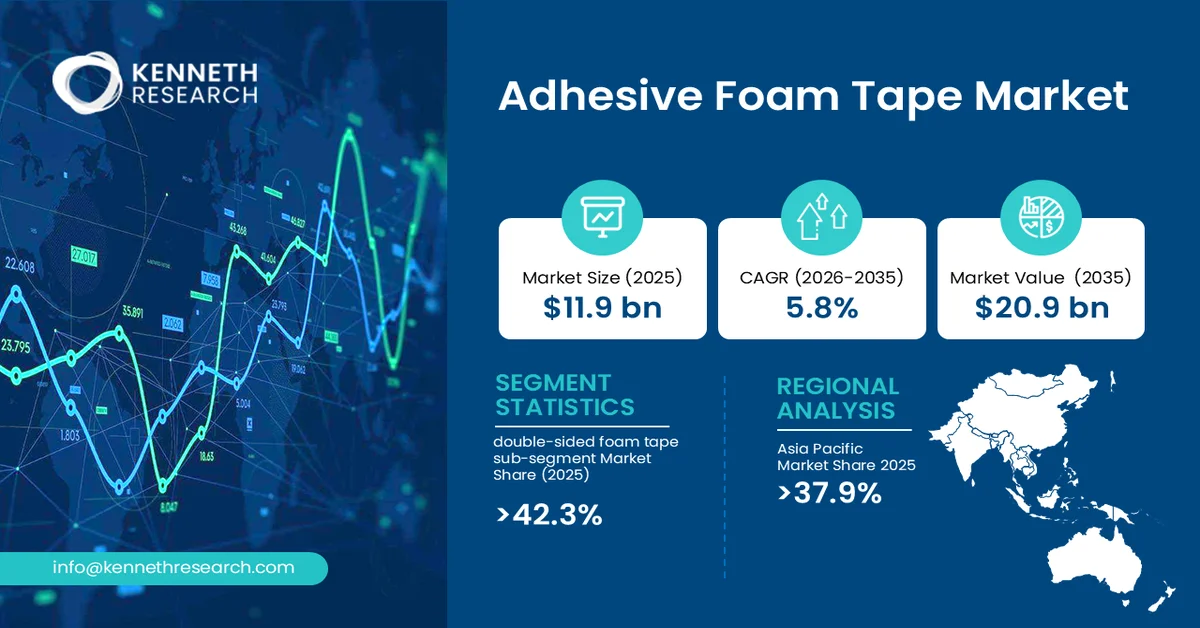
Adhesive Foam Tape Market size was valued at USD 11.9 billion in 2025 and is projected to reach USD 20.9 billion by the end of 2035, rising at a CAGR of 5.8% during the forecast period, i.e., 2026-2035. In 2026, the industry size of the adhesive foam tape is estimated at USD 12.6 billion.
Growing global vehicle manufacturing is accelerating demand for adhesive foam tapes that enable lightweight bonding, vibration damping, sealing, and component assembly. As automotive manufacturers increasingly replace mechanical fasteners with high-performance adhesive solutions to improve design flexibility and production efficiency, adhesive foam tape adoption continues to expand across modern vehicle manufacturing. Supported by recent motor vehicle production trends reported by the International Organization of Motor Vehicle Manufacturers (OICA).
The adhesive foam tape market comprises pressure-sensitive bonding products manufactured by combining foam substrates—such as polyethylene (PE), polyurethane (PU), polyvinyl chloride (PVC), acrylic, or other engineered foams—with adhesive coatings on one or both sides. These tapes are designed to deliver durable bonding, cushioning, sealing, vibration damping, thermal insulation, gap filling, and acoustic attenuation while conforming to irregular surfaces. Depending on application requirements, adhesive foam tapes are available in single-sided and double-sided configurations with varying thicknesses, densities, adhesive chemistries, and performance characteristics.
The market serves a broad industrial base where reliable bonding solutions are required to replace or supplement conventional mechanical fastening methods. Adhesive foam tapes are extensively utilized in automotive assembly, building and construction, electrical and electronics manufacturing, appliances, transportation, signage, packaging, and general industrial fabrication. Their ability to reduce assembly complexity, improve aesthetics through concealed bonding, absorb mechanical stress, and provide long-term environmental resistance makes them integral to modern manufacturing processes. Continuous advances in adhesive formulations and foam materials further support their adoption in applications requiring enhanced durability, lightweight construction, and improved production efficiency.
Key Adhesive Foam Tape Market Insights Summary:
Key Takeaways: Market Trends & Insights
- The Adhesive Foam Tape Market is expected to grow from USD 12.6 billion in 2026 to USD 20.9 billion by 2035, registering a CAGR of 5.8% during the forecast period (2026-2035)
- Double-Sided Foam Tape remained the leading product type, accounting for 42.3% of the market share in 2025, driven by its widespread use in lightweight bonding, sealing, cushioning, and vibration damping applications
- The Automotive end-user industry is projected to witness the fastest growth, supported by increasing adoption of adhesive foam tapes in electric vehicles, lightweight vehicle assembly, and advanced manufacturing processes
- Asia Pacific dominated the global market with a 37.9% market share in 2025, led by strong manufacturing capabilities and expanding industrial activity across China and India
- The market is estimated at USD 11.9 billion in 2025, reflecting strong demand from automotive, electronics, construction, and industrial manufacturing sectors that continue to accelerate global adoption of adhesive foam tape solutions
Market Drivers
- Increasing adoption of advanced electronics and consumer devices
- Expansion of sustainable and energy-efficient building construction
- Rising demand for high-performance industrial sealing and insulation solutions
- Continuous innovation in acrylic foam materials and pressure-sensitive adhesive technologies
Challenges
- Raw material price volatility and supply chain disruptions
- Increasing technical performance and application-specific compliance requirements
Adhesive Foam Tape Market Overview & Supply Chain
Global adoption of adhesive foam tapes is increasing as manufacturers prioritize lightweight assembly, noise and vibration reduction, durable sealing, and automated production across automotive, electronics, construction, and industrial sectors. These tapes enable efficient bonding of dissimilar materials while reducing reliance on mechanical fasteners, supporting improved product performance and manufacturing productivity. Sustainability initiatives and vehicle electrification are further accelerating demand for advanced bonding solutions that withstand thermal cycling and harsh operating environments. The automotive industry remains a particularly important demand center, with the International Energy Agency (IEA) reporting that global electric car sales exceeded 17 million in 2024, reflecting continued expansion of vehicle production requiring high-performance bonding and sealing materials throughout battery systems, interiors, and exterior assemblies.
The adhesive foam tape value chain begins with the procurement of petrochemical-derived polymers, including polyethylene, polyurethane, acrylic, PVC, and specialty elastomers, alongside pressure-sensitive adhesive chemistries, release liners, and protective films sourced from global chemical and materials suppliers. Manufacturers convert these raw materials into engineered foam substrates through foaming, lamination, coating, slitting, die-cutting, and quality testing processes to achieve application-specific thickness, adhesion, compressibility, and environmental resistance. Finished products are distributed through direct sales channels, industrial distributors, converters, and specialized value-added partners that customize tape formats for customer requirements. End users span automotive manufacturers, electronics producers, construction companies, appliance manufacturers, aerospace suppliers, packaging firms, and industrial equipment manufacturers. Major stakeholders across the ecosystem include raw material producers, adhesive formulators, foam converters, tape manufacturers, machinery suppliers, logistics providers, OEMs, contract manufacturers, distributors, and aftermarket service organizations that collectively support product innovation and commercial adoption.
Adhesive Foam Tape Market: Growth Drivers & Challenges
Growth Drivers:
- Expanding electric vehicle manufacturing accelerating high-performance bonding demand: The rapid expansion of electric vehicle manufacturing is creating sustained demand for adhesive foam tapes that support lightweight construction, battery assembly, thermal management, sealing, and vibration control. Compared with conventional fastening methods, engineered foam tapes simplify assembly, enable bonding of dissimilar materials, and improve durability in demanding operating environments. As vehicle platforms become increasingly electrified and digitally integrated, manufacturers are adopting advanced bonding solutions that enhance production efficiency while maintaining structural integrity and aesthetic quality. This trend is encouraging adhesive manufacturers to develop products with improved temperature resistance, long-term adhesion, and compatibility with automated production lines.
- Growing preference for lightweight and automated manufacturing processes: Manufacturers across automotive, electronics, construction, and industrial equipment sectors are increasingly replacing mechanical fasteners with adhesive foam tapes to improve operational efficiency and product performance. These tapes enable faster assembly, reduce component weight, minimize drilling and welding operations, and provide multifunctional benefits such as sealing, cushioning, and vibration damping within a single solution. Their compatibility with automated manufacturing systems supports higher production throughput while maintaining consistent bond quality across complex assemblies. As industries pursue lean manufacturing, improved product aesthetics, and enhanced sustainability through material optimization, demand for advanced adhesive foam tapes continues to strengthen. Future product development is expected to focus on higher-performance acrylic foam technologies, improved adhesion to advanced composites and engineered plastics, and solutions compatible with next-generation manufacturing environments, reinforcing the market's long-term growth trajectory.
Challenges:
- Volatility in petrochemical-based raw material supply and pricing: Adhesive foam tape manufacturers remain highly dependent on petrochemical-derived inputs such as polyethylene, polyurethane, acrylic polymers, specialty adhesives, release liners, and performance additives. Fluctuations in feedstock availability, energy costs, geopolitical disruptions, and transportation constraints create unpredictable procurement conditions that directly affect production planning and manufacturing costs. Frequent changes in raw material prices reduce pricing stability for long-term customer contracts and compress profit margins, particularly for suppliers serving cost-sensitive industries such as automotive and consumer electronics. Manufacturers often face difficult commercial decisions between absorbing higher input costs or passing them through to customers, potentially affecting competitiveness. Looking ahead, companies are expected to diversify supplier networks, strengthen strategic sourcing practices, and increase investment in alternative materials and localized procurement to improve supply resilience and reduce exposure to future market disruptions.
- Increasing technical performance requirements across end-use applications: End-use industries are demanding adhesive foam tapes capable of delivering consistent performance under increasingly demanding operating conditions, including extreme temperatures, moisture exposure, chemical contact, ultraviolet radiation, vibration, and long service lifecycles. Meeting these evolving specifications requires continuous investment in material science, adhesive formulation, testing, certification, and product customization. The need to support diverse substrates, automated manufacturing processes, and application-specific compliance standards increases product development complexity and extends commercialization timelines. Smaller manufacturers may encounter barriers in maintaining competitive innovation capabilities while controlling research and qualification costs. Over the long term, market participants that successfully develop high-performance, application-engineered solutions and maintain rigorous quality assurance systems are expected to strengthen customer relationships, whereas suppliers with limited technical differentiation may face increasing competitive pressure.
Adhesive Foam Tape Market Size and Forecast:
| Report Attribute | Details |
|---|---|
| Base Year |
2025 |
| Forecast Year |
2026-2035 |
| CAGR |
5.8% |
| Base Year Market Size (2025) |
USD 11.9 billion |
| Forecast Year Market Size (2035) |
USD 20.9 billion |
| Regional Scope |
|
Adhesive Foam Tape Market Segmentation Analysis:
Product Type Segment Analysis
In the product type segment, the double-sided foam tape sub-segment is anticipated to capture the largest market share of 42.3% by the end of 2025.
Double-sided foam tape dominates the adhesive foam tape market because it provides a combination of structural bonding, sealing, cushioning, vibration damping, and gap-filling within a single product, making it suitable for a wide range of industrial applications. Demand is particularly strong in automotive, electronics, construction, appliances, and signage, where manufacturers seek lightweight alternatives to screws, rivets, and welds while improving assembly efficiency and product aesthetics. The segment also benefits from increasing automation, as double-sided foam tapes are compatible with high-speed production lines and enable consistent bonding across diverse substrates, including metals, plastics, composites, and glass. On the supply side, manufacturers continue to expand advanced acrylic and polyethylene foam tape portfolios with enhanced temperature resistance, weatherability, and long-term durability to meet evolving customer specifications.
End-User Industry Segment Analysis
The automotive is projected to grow as the second-largest segment in the adhesive foam tape market due to four converging demand drivers.
The automotive end-user segment is projected to register strong growth as vehicle manufacturers continue replacing conventional mechanical fastening methods with adhesive foam tapes to improve lightweight design, vibration damping, sealing performance, and assembly efficiency. Modern passenger and commercial vehicles increasingly incorporate mixed-material structures, advanced electronics, battery systems, and sophisticated interior components that require durable bonding solutions capable of accommodating thermal expansion and dynamic loading. This trend is driving broader adoption of high-performance foam tapes across both conventional and electrified vehicle platforms. On the supply side, manufacturers are expanding portfolios with acrylic and specialty foam tapes offering enhanced durability, chemical resistance, and compatibility with automated assembly processes.
Our in-depth analysis of the global adhesive foam tape market includes the following segments:
|
Segment |
Sub-segment |
|
Product Type |
|
|
Material |
|
|
Application |
|
|
End-User Industry |
|
Adhesive Foam Tape Market Regional Insights:
Asia Pacific Market Trends & Insights:
Asia Pacific adhesive foam tape market is projected to hold the largest revenue share of 37.9% by the end of 2025.
The region benefits from integrated supply chains for polymers, pressure-sensitive adhesives, and engineered foam materials, enabling cost-efficient production and rapid commercialization of advanced adhesive solutions. Strong industrialization, increasing automation, and supportive manufacturing policies have encouraged investments in automotive, consumer electronics, electrical equipment, and construction sectors, all of which are major consumers of adhesive foam tapes. Regional demand is further reinforced by export-oriented manufacturing hubs and continuous expansion of high-value industrial production. Supporting this leadership, China's Ministry of Industry and Information Technology (MIIT) reported that China produced 31.282 million vehicles in 2024, underscoring the scale of one of the region's largest end-use industries for adhesive foam tapes.
China serves as the region's principal manufacturing hub, supported by its well-established automotive, electronics, appliance, and industrial equipment sectors. Its vertically integrated supply chain, strong raw material availability, and advanced converting capabilities enable large-scale production of high-performance adhesive foam tapes for both domestic consumption and exports. Continuous investment in electric vehicles, industrial automation, and advanced manufacturing technologies further strengthens long-term demand.
India is emerging as a significant growth market owing to expanding domestic manufacturing, infrastructure development, and government initiatives that encourage local production across automotive, electronics, and industrial sectors. Rising investments in modern manufacturing facilities, coupled with increasing adoption of advanced bonding technologies by domestic and multinational manufacturers, are expected to enhance India's contribution to regional demand while reinforcing Asia Pacific's leadership in the global adhesive foam tape market.
North America Market Trends & Insights:
North America represents a strategically important region for the adhesive foam tape market, supported by mature manufacturing industries, advanced material engineering capabilities, and strong demand for high-performance bonding solutions across automotive, electronics, aerospace, construction, healthcare, and industrial equipment sectors. Manufacturers in the region increasingly adopt adhesive foam tapes to improve assembly efficiency, reduce product weight, minimize vibration, and replace conventional fastening methods with more versatile bonding technologies. Government initiatives promoting domestic manufacturing, electric vehicle production, infrastructure modernization, and advanced industrial innovation continue to strengthen the operating environment for adhesive material suppliers. The region also benefits from significant investments in research and development, enabling the commercialization of next-generation adhesive systems with improved durability, thermal resistance, and sustainability characteristics. Looking ahead, increasing automation, expanding electrification of transportation, and greater use of engineered lightweight materials are expected to create additional opportunities for premium adhesive foam tape manufacturers and specialized converting companies.
The United States remains the primary contributor to regional demand, supported by its extensive automotive, aerospace, electronics, and construction industries, along with a well-developed ecosystem of adhesive manufacturers, raw material suppliers, and advanced manufacturing facilities. Continuous investment in electric mobility, industrial automation, and high-value manufacturing is driving broader adoption of engineered bonding solutions across diverse applications.
Canada complements regional growth through its expanding automotive supply chain, building and infrastructure projects, and industrial manufacturing base. The country's focus on advanced manufacturing, sustainable construction practices, and innovation in engineered materials is encouraging greater utilization of adhesive foam tapes in transportation, commercial construction, and industrial applications, reinforcing North America's position as a key regional market.
Leading Companies Operating in the Global Adhesive Foam Tape Market:
Here is a list of upstream, downstream, and key players operating in the global adhesive foam tape market competitive ecosystem:
- Srivasavi Adhesive Tapes Ltd. (India)
- Company Overview
- Business Strategy
- Key Product Offerings
- Financial Performance
- Key Performance Indicators
- Risk Analysis
- Recent Development
- Regional Presence
- SWOT Analysis
- Tape-Rite Co., Inc. (United States)
- LAMATEK, Inc. (United States)
- Ajit Industries Pvt. Ltd. (India)
- CCT Tapes (United States)
- Lohmann GmbH & Co. KG (Germany)
Recent Developments
- In November 2025, tesa introduced tesa® 60218, a 2,000µm single-sided grey electrically conductive foam tape designed for EMI shielding and grounding applications as well as electrostatic discharge (ESD) applications. The tape features a highly compressible conductive foam backing with excellent conformability to surface variations, low closure force, reliable recovery properties, and high electrical conductivity over a wide working range in XYZ-direction even at high temperatures and humidity. The product demonstrates an initial contact resistance of 0.03 Ohm per square inch in the z-direction.
- In June 2026, tesa UK launched a new suite of high-performance double-sided foam tapes designed for exterior applications, extending the company's foam tape assortment . The new products include two groups—one for the most challenging outdoor installations and another for less demanding exterior applications—each differing in foam type and adhesive system. The top-tier grades (tesa 62852, 62854, and 62855) feature closed-cell PE foam backing and pure acrylic adhesive systems originally developed for automotive applications such as fastening rubbing strips, badges, and decorative trims. These tapes offer bonding strength peaking at 23 N/cm on steel after 14 days, along with UV resistance, water resistance, and ageing performance superior to standard adhesive tapes.
Frequently Asked Question
In 2025, the adhesive foam tape market exceeded USD 11.9 billion.
The adhesive foam tape market is projected to reach USD 20.9 billion by the end of 2035, expanding at a CAGR of 5.8% over the forecast period (2026-2035).
The major players in the market are Srivasavi Adhesive Tapes Ltd. (India), Tape-Rite Co., Inc. (United States), LAMATEK, Inc. (United States), Ajit Industries Pvt. Ltd. (India), CCT Tapes (United States), Lohmann GmbH & Co. KG (Germany), and others.
In the product type segment, the double-sided foam tape sub-segment is anticipated to capture the largest market share of 42.3% in the future and exhibit lucrative growth opportunities during 2026-2035. This growth trajectory is largely attributed to increasing adoption as a lightweight alternative to mechanical fasteners across automotive, electronics, construction, and industrial manufacturing applications.
Asia Pacific is projected to hold the largest market share of 37.9% by the end of 2025 and provide more business opportunities in the future. Continuous investments in manufacturing, automotive production, and industrial expansion across China and India are fostering the region's dominance.
Why Choose Kenneth Research ?
-
Insight with Impact : We don’t just gather data — we uncover stories, trends, and opportunities that fuel business growth.
-
Experts Who Get It : Our team speaks your industry’s language and knows what really matters to your customers and market.
-
Custom-Built for You : Forget one-size-fits-all. We craft research and consulting solutions as unique as your business vision.
-
Partners, Not Just Providers : We work with you, not for you — collaborating closely to turn insights into smart, strategic moves.
-
Results That Speak : Our work powers brands, startups, and industry leaders alike — with a track record of ideas that work in the real world.
Report ID: 1131 |
Published Date: 21 Aug 2026 |
Report Format: |
Delivery Timeline: 48-72 Business Hours

Copyright © 2025 Kenneth Research. All rights reserved. Terms of Use | Privacy Policy
