Report ID: 1286 |
Published Date: 01 Sep 2026 |
Report Format: |
Delivery Timeline: 48-72 Business Hours
Active Phased Array Radar Market Outlook:
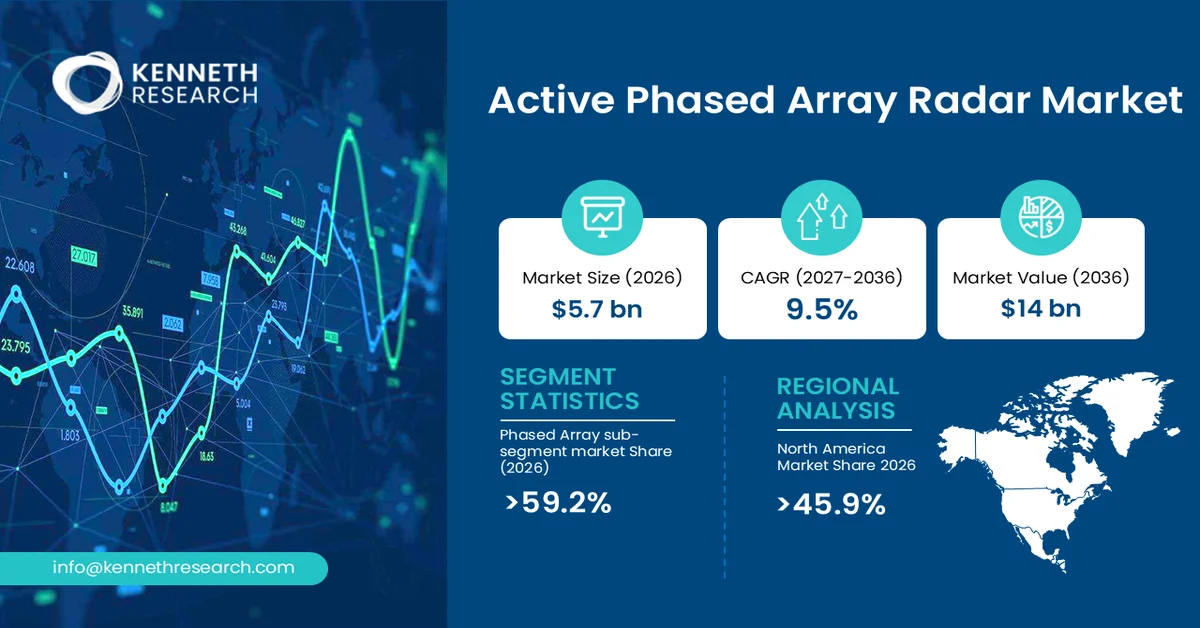
Active Phased Array Radar Market size was valued at USD 5.7 billion in 2026 and is projected to reach USD 14 billion by the end of 2036, rising at a CAGR of 9.5% during the forecast period, i.e., 2027–2036. In 2027, the industry size of the active phased array radar is estimated at USD 6.2 billion.
The growing demand for high-speed, multi-function radar systems is accelerating adoption of active phased array technology across defense and surveillance platforms. Electronic beam steering enables rapid directional changes without mechanical antenna movement, supporting faster target detection, tracking, and situational awareness.
The active phased array radar market encompasses radar systems that use electronically controlled arrays of antenna elements, typically incorporating individual transmit/receive modules, to steer and shape radio-frequency beams without mechanically moving the antenna. Active electronically scanned arrays (AESAs) represent an advanced form of phased array technology, enabling rapid beam steering, flexible radar modes, and simultaneous management of multiple sensing functions.
Key characteristics include distributed transmit and receive architecture, electronic beam steering, solid-state operation, high operational flexibility, and scalable antenna configurations. These systems can support functions such as target detection, tracking, surveillance, fire control, and electronic warfare. Their ability to rapidly redirect beams makes them particularly relevant for platforms requiring responsive and persistent sensing.
Key Active Phased Array Radar Market Insights Summary:
Key Takeaways: Market Trends & Insights
- Active Phased Array Radar Market is projected to grow from USD 5.7 billion in 2026 to USD 14 billion by 2036, registering a CAGR of 9.5% during the forecast period.
- North America is projected to remain the leading regional market, accounting for 45.9% in 2026, supported by defense modernization, advanced aerospace capabilities, and investments in air and missile defense across the U.S. and Canada.
- Phased Array is expected to remain the leading Antenna Type segment with a 59.2% share in 2026, supported by rapid electronic beam steering, multifunction operation, and flexible radar deployment.
- Medium power systems are expected to witness continued adoption as defense platforms seek a balance between radar performance, platform size, energy consumption, and thermal-management requirements.
Market Drivers
- Modernization of legacy radar fleets with active electronically scanned array architectures.
- Increasing demand for multifunction surveillance and fire-control radar systems.
- Growing adoption of digital beamforming and solid-state RF technologies.
- Rising focus on integrated air and missile defense and persistent aerial surveillance.
Challenges
- Thermal Management in High-Power Radar Architectures
- Complex Calibration and System Integration
Active Phased Array Radar Market Overview & Supply Chain
Adoption of active phased array radar is increasing as defense forces modernize air-defense, missile-warning, surveillance, and maritime sensing capabilities. Electronic beam steering enables rapid scanning, flexible beam management, and multifunction operation, making the technology valuable for increasingly complex threat environments. Government modernization programs are reinforcing this demand. The U.S. Government Accountability Office identifies the Navy’s Air and Missile Defense Radar (AMDR) as a next-generation radar program supporting surface warfare and integrated air and missile defense, with the AN/SPY-6 family designed to improve long-range detection and ballistic-missile defense capabilities.
The active phased array radar value chain begins with semiconductor devices, RF components, antenna elements, transmit/receive modules, processors, power-management components, and specialized materials. Radar manufacturers integrate these inputs into antenna arrays, electronic beam-steering architectures, signal-processing systems, and complete radar units. System integrators then conduct calibration, software integration, environmental testing, and platform-level qualification. Distribution is primarily driven by direct procurement, defense contracts, system integrators, and long-term government programs.
Active Phased Array Radar Market: Growth Drivers & Challenges
Growth Drivers
- Intensifying radar modernization for air and missile defense: Defense modernization programs are accelerating demand for active phased array radar as military forces replace mechanically scanned systems with electronically steered, multifunction architectures. AESA technology enables rapid beam steering, faster target revisits, simultaneous surveillance and tracking, and stronger performance against complex aerial threats. Government procurement programs demonstrate this transition. In 2023, the U.S. Air Force began installing an Active Electronically Scanned Array (AESA) system on B-52 aircraft under its Radar Modernization Program, replacing legacy radar technology and enhancing navigation and targeting capabilities.
- Increasing need for multifunction and digitally steered radar systems: Modern defense platforms increasingly require radar systems capable of performing multiple missions through a single adaptable architecture. Active phased arrays can electronically redirect beams, dynamically allocate sensing resources, and support surveillance, tracking, fire control, and other functions without relying on mechanical antenna movement. This flexibility is particularly valuable for air-defense networks facing diverse and rapidly evolving threats. Government defense technology planning also emphasizes the shift toward solid-state phased arrays and increasingly digital beamforming architectures.
Challenges
- Thermal management in high-power radar architectures: Active phased array radars contain densely integrated transmit/receive modules that generate substantial heat during operation. As radar systems become more powerful and compact, controlling temperature across the antenna array becomes increasingly difficult. Excessive heat can affect RF performance, component reliability, and operational stability, making thermal design an important constraint in airborne, naval, and ground-based applications. Research on AESA radar cooling has shown that increasing the number of transmit/receive modules raises peak temperature, while cooling-system design must account for module arrangement and coolant flow.
- Complex calibration and system integration: The sophisticated architecture of active phased array radar creates substantial calibration, testing, and integration requirements. Individual transmit/receive modules must operate coherently so that the complete array maintains accurate beam steering, gain, phase alignment, and signal quality. Integrating RF hardware with digital beamforming, signal processing, electronic protection, and command-and-control systems further increases development complexity. Calibration can also become time-consuming as array architectures grow more sophisticated, potentially increasing engineering costs and extending qualification cycles.
Active Phased Array Radar Market Size and Forecast:
| Report Attribute | Details |
|---|---|
| Base Year |
2026 |
| Forecast Period |
2027-2036 |
| CAGR |
9.5% |
| Base Year Market Size (2026) |
USD 5.7 billion |
| Forecast Year Market Size (2036) |
USD 14 billion |
| Regional Scope |
|
Active Phased Array Radar Market Segmentation Analysis:
Antenna Type Segment Analysis
In the Antenna Type segment, the Phased Array sub-segment is anticipated to capture the largest market share of 59.2% in 2026.
Its dominance is supported by the ability to electronically steer radar beams without mechanical antenna movement, enabling rapid scanning, flexible beam control, and multifunction operation. These capabilities are valuable for defense surveillance, air and missile defense, weather monitoring, and other applications requiring rapid environmental assessment. The U.S. Department of Energy's 2024 assessment of next-generation phased array radar highlights faster directional sampling, reduced mechanical complexity, and software-enabled adaptation as important advantages of the technology. Government agencies are also evaluating multifunction phased-array architectures for future radar applications, supporting continued technology development. On the supply side, advances in solid-state transmit/receive modules, digital signal processing, and electronic beamforming are improving system flexibility. Future adoption is expected to remain strong as radar users prioritize faster scanning, greater reliability, and multifunction sensing capabilities.
Power Output Segment Analysis
In the Power Output segment, the Medium power systems sub-segment is projected to grow as defense organizations seek radar architectures that balance detection performance, platform constraints, energy consumption, and operational flexibility. Medium-power configurations are suitable for platforms where radar capability must be integrated within practical limits on size, weight, power, and cooling. Their application across naval, airborne, and ground-based systems creates opportunities for scalable phased-array architectures and modular transmit/receive technologies. Government radar programs demonstrate continued emphasis on scalable and adaptable architectures. The U.S. Navy's AN/SPY-6 family uses modular radar building blocks and active phased-array technology, enabling configurations to be adapted across different platforms and missions.
Our in-depth analysis of the global active phased array radar market includes the following segments:
|
Segment |
Sub-segment |
|
Platform |
|
|
Frequency Band |
|
|
Function |
|
|
Power Output |
|
|
Antenna Type |
|
Active Phased Array Radar Market Regional Insights:
North America Market Trends & Insights:
North America is projected to remain the dominant region in the active phased array radar market, accounting for 45.9% in 2026. Regional leadership is supported by sustained defense modernization, advanced aerospace capabilities, established radar-development expertise, and government investment in surveillance and missile-defense infrastructure.
In the U.S., demand is supported by defense procurement programs involving advanced electronically scanned radar for aircraft, naval platforms, missile defense, and integrated air-defense networks. The country also benefits from a deep ecosystem of defense contractors, RF semiconductor developers, radar specialists, and research institutions.
Canada is expanding its role through Arctic and continental surveillance modernization. Its Arctic Over-the-Horizon Radar program is intended to strengthen early warning and threat tracking across northern approaches, creating opportunities for advanced antenna, RF, signal-processing, and radar-system suppliers.
Asia-Pacific Market Trends & Insights:
Asia-Pacific represents an important growth region for active phased array radar, supported by defense modernization, expanding surveillance requirements, and increasing investment in integrated air and missile defense. Japan is strengthening radar-based situation awareness and next-generation air-defense capabilities, while China continues to advance military modernization and information-based operational capabilities. Japan's defense planning specifically calls for improving detection and tracking capabilities against increasingly sophisticated aerial threats, including through upgrades to fixed warning and control radars.
Japan benefits from a mature aerospace and electronics ecosystem and increasing emphasis on persistent surveillance and advanced radar technologies. Its defense strategy also supports greater information sharing and regional monitoring capabilities.
China offers significant opportunities because of its expanding military modernization and focus on information superiority, electromagnetic capabilities, and integrated sensing. Continued investment in air-defense networks, surveillance platforms, and electronically steered radar architectures should create opportunities for active phased array radar suppliers across the region.
Leading Companies Operating in the Global Active Phased Array Radar Market:
Here is a list of upstream, downstream, and key players operating in the global active phased array radar market competitive ecosystem:
- Northrop Grumman Corporation (United States)
- Company Overview
- Business Strategy
- Key Product Offerings
- Financial Performance
- Key Performance Indicators
- Risk Analysis
- Recent Development
- Regional Presence
- SWOT Analysis
- Lockheed Martin Corporation (United States)
- RTX Corporation (United States)
Recent Developments
- May 2026: Northrop Grumman delivered its 1,000th SABR (AN/APG-83) AESA radar, supporting ongoing F-16 modernization programs. The radar provides enhanced sensing and targeting capabilities for upgraded aircraft.
- April 2025: Lockheed Martin announced advancements in its next-generation integrated air and missile defense radar systems, emphasizing improved long-range threat detection and multi-domain battlefield awareness.
Frequently Asked Question
In 2026, the active phased array radar market exceeded USD 5.7 billion.
The active phased array radar market is projected to reach USD 14 billion by the end of 2036, expanding at a CAGR of 9.5% over the forecast period (2027–2036).
The major players in the market are Northrop Grumman Corporation, Lockheed Martin Corporation, RTX Corporation, Thales Group, BAE Systems plc, Mitsubishi Electric Corporation, and others.
In the Antenna Type segment, the Phased Array sub-segment is anticipated to capture the largest market share of 59.2% in the future and exhibit lucrative growth opportunities during 2027–2036.
North America is projected to hold the largest market share of 45.9% by the end of 2036 and provide more business opportunities in the future.
Why Choose Kenneth Research ?
-
Insight with Impact : We don’t just gather data — we uncover stories, trends, and opportunities that fuel business growth.
-
Experts Who Get It : Our team speaks your industry’s language and knows what really matters to your customers and market.
-
Custom-Built for You : Forget one-size-fits-all. We craft research and consulting solutions as unique as your business vision.
-
Partners, Not Just Providers : We work with you, not for you — collaborating closely to turn insights into smart, strategic moves.
-
Results That Speak : Our work powers brands, startups, and industry leaders alike — with a track record of ideas that work in the real world.
Report ID: 1286 |
Published Date: 01 Sep 2026 |
Report Format: |
Delivery Timeline: 48-72 Business Hours

Copyright © 2025 Kenneth Research. All rights reserved. Terms of Use | Privacy Policy
